Gun Racks to Book Shelves


My computer indicated it needed to be restarted this morning and then it wouldn’t stop. I would have panicked and forced a shutdown had not James, the patient man from the repair shop, assured me these things take time. “Chill,” he said. “Have some breakfast.”

James did not realize that I’d already eaten two breakfasts and downed my morning half-beer. I did not share this with James. Instead, I made myself putter, peeking at the screen every five minutes for two hours.

And voilà! The computer finally stopped restarting and seems docile and responsive enough to risk writing some words.

During that down time, I distracted myself with housekeeping which led to some rearranging ideas. The Coauthor appeared as I emptied a shelf unit and started to push it to the door.

“Don’t try to move that alone,” she scolded. “It’s too heavy for you.”

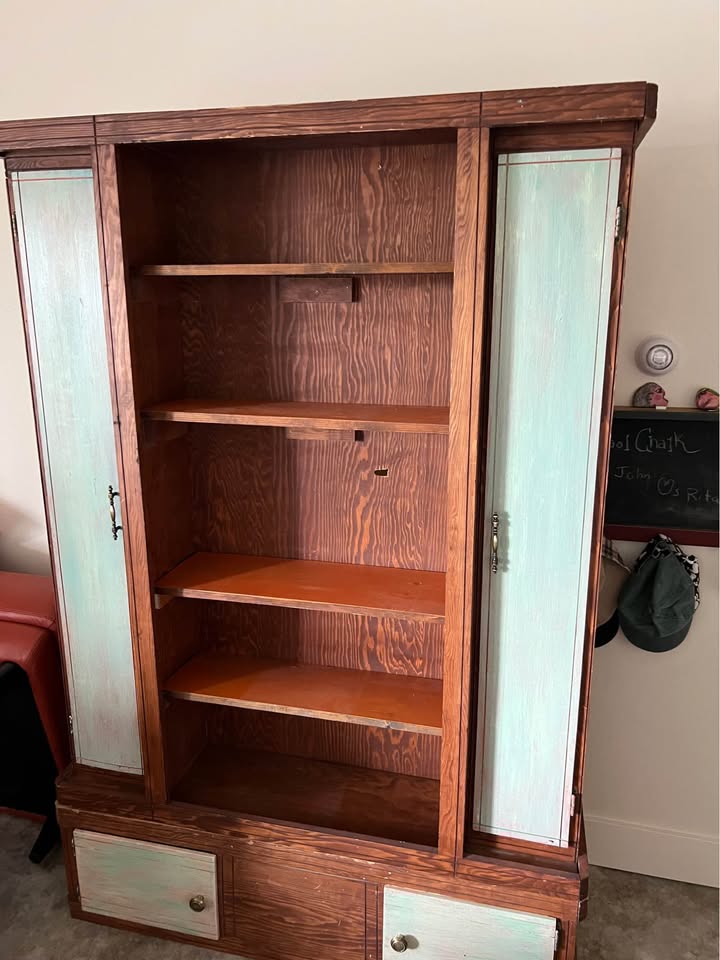
The shelf in question was an old gun rack I’d converted to a bookshelf in my efforts to bring about world peace 35 years ago. It has grown uglier, and the world has grown more vicious. I want to donate both the shelf and the world to an unwitting charity and start over.

“It doesn’t work that way, sweetheart,” the Coauthor said sympathetically.

I cried a little. My increasing incapacities are deeply disturbing.

“You move it then,” I said, defiant. “Or else I’ll keep trying, and it will fall on me, and I’ll die a slow death pinned under my own stupidity.”

“That’s how most of you will die anyway,” she laughed.

“Not funny,” I said and threw a paisley orange pillow at her. She caught it, and we sat down on the worn and disconnected sectional (my latest attempt at the perfect couch).

“Let’s go,” she said.
“Let’s not,” I said.

But I was outvoted, and the cosmic train pulled into the station.

We dissolved into waves of symphonic sound. Timpani drums made from the skins of scapegoats boomed like bombs bursting in air. The bass moaned low and mournful, the cellos and violins sobbed as they were deported. But somehow, life itself was beautiful beyond words.

“How can this be?” I asked the Coauthor. But I knew. The celestial choir had dismembered me, and my atoms were dancing shamelessly inebriated in the variegated light.

Eternity receded. I resisted reassembling, but here I am, alone with my keyboard, an empty bookshelf, a list, and a plan. Somewhere, in another time, another place, I am an oboe.

A leopard.
A mollusk.

I am puffed cheeks blowing out fifteen candles and the first gasp of a new planet.

And at some incomprehensible level, I trust that all will be well.


Runoff


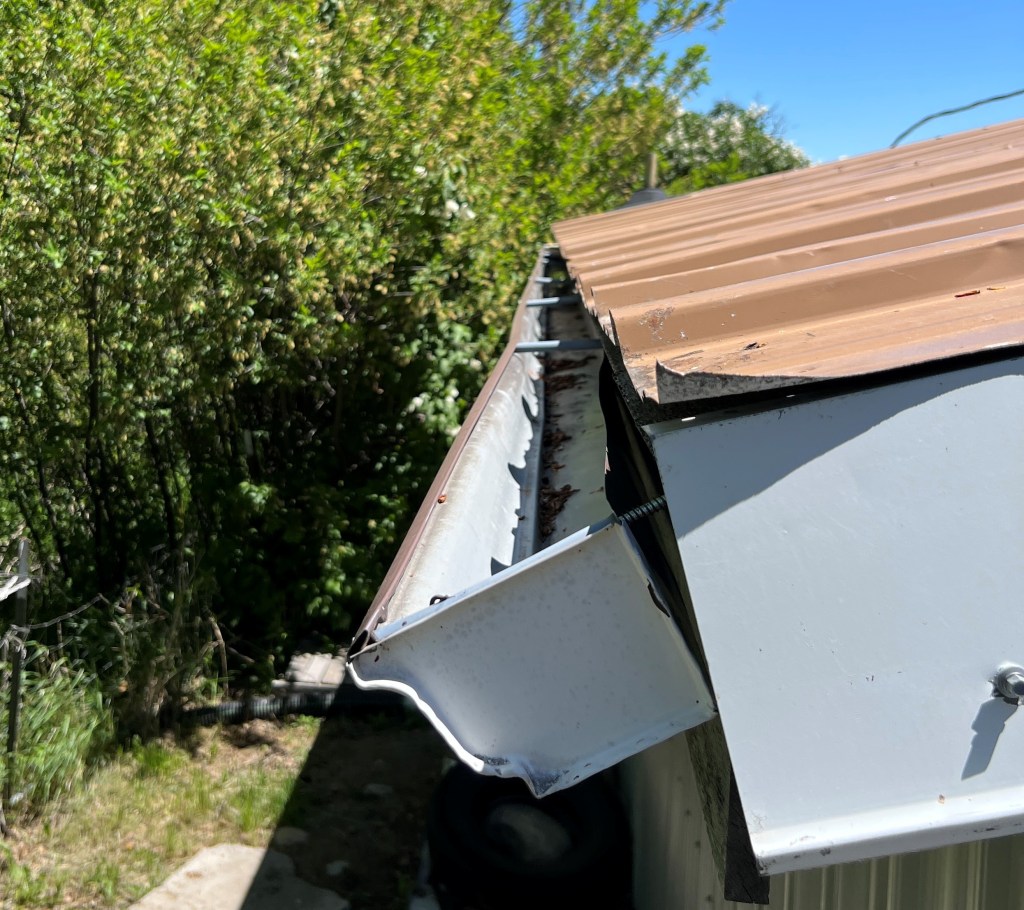
Lately, I’ve been fixated on guttering. We have a lot of unguttered or badly guttered buildings. When rain falls on impervious surfaces and is not guttered or sloped away, it pools up and erodes old foundations.

Water may seem innocuous. Innocent. But it is the (almost) universal solvent. According to the Khan Academy, “Water is key to the vast majority of cellular chemical reactions essential to life. Water molecules are polar, with partial positive charges on the hydrogens, a partial negative charge on the oxygen, and a bent overall structure.”

A bent structure may sound unattractive or dangerous, but in fact, it’s the magic that allows the embodiment of both the negative and the positive to coexist and dissolve nearly anything.

But even with the threat of dissolution, rain is not the essential problem. Too many impenetrable surfaces are.

Thus: guttering. The precious rainwater is renamed runoff and routed to centralized locations such as sewers or storage tanks. This creates the potential for stagnation or downstream flooding.

As humans, we long for shelter from the storm. Impenetrability is tempting. It’s hard to be vulnerable, receptive, and thankful; harder still to lovingly accept rejection and scorn.

But we live in a world where the Coauthors and the Dancers cause the rain to fall on the just and unjust. The sun shines on the kindly folk as well as the cruel, selfish fools.

Many of us feel quite indignant about this. We seek justice but often end up plotting revenge. This storyline has no happy ending. In fact, it has no ending at all. Revenge is self-perpetuating.

Bullies, tyrants, and other impervious souls have developed gutters that shunt kindness and forgiveness off as if they were wastewater. The resulting pools putrefy due to the contaminants they’ve picked up, testifying to the toxicity of fear.

Watching sacrifices go down the drain or get routed to a holding tank where good intentions become sludge is painful.

Even so, the stubbornly resilient make plans (that will no doubt go awry) and dig deep into linty pockets to offer the widow’s mite.

The Holy Role-Models of Resilience are chaotic, redundant, and flighty. They live in the gutters and fix broken toys. And while wildfires rage, they shelter frightened families under scorched wings.

It sometimes seems that Creation has grown weary of us, and the exhausted Dancers have lost the beat. I honestly don’t know.

But in this briefest of moments, some of us have the great good fortune of being lilies of the field, hoping no one sprays us with a broad leaf herbicide as we turn our open faces to the cleansing rain and rejoice when sunlight breaks through.

Remember Your Lines

Sing a song of sixpence, a pocket full of rye.
Four and twenty blackbirds baked in a pie.

When the pie was opened, the birds began to sing.
Wasn't that a dainty dish to set before the king?

The king was in the Whitehouse counting out his money.
The queens, in Mar-a-Lago, eating bread and honey.

The maid worked for the government hanging out fake clothes,
But down came a blackbird and pecked off her nose.

There was DEI commotion, but Little Jenny Wren
Flew down into the garden and put it back again.

Outside my window, four and twenty blackbirds form an undulating carpet of wings. From them, I take hope. From me, they take grain. We do not begrudge each other these small takings. Is that enough?

“That’s a fair exchange,” the Unimagined whispers. “It is enough.”

As far as I can tell, I’ve lived in this one body my entire life. I’ve not thrown it on a grenade, but if needed, I think I would. I’ve not run it into burning buildings to save those unconscious from smoke inhalation, but if needed, I think I would. But would I?

These are my fantasies and aspirations. When I grow extra beans or beets, I share. Once, I was walking with a friend in the city late at night, and a mugger knocked her down. I chased him, but he got away. How are we to know if we are bit players or heroes?

“It’s your story,” the Writer says. “Remember your lines.”

My heart breaks for the runner who stumbles or the farmer whose tractor runs out of fuel while plowing the muddy field. The glancing back. The long walk home. The crowd dispersing. The rich preparing to eat themselves alive, knives sharpened, bones strewn everywhere. “Wait!” I shout, aware that I, myself, have stumbled and looked back. “Are those my bones?”

The Living Companion laughs. “Those are the ancestor’s bones. You still have flesh.”

I still have flesh. I still have carrots and dried kale. Oh, Force of Life, give me the audacity of blackbirds singing from the center of the pie. The king cannot partake of singing birds. And may I borrow the tenacity of little Jenny Wren, putting the faces together again?

The Bane of My Existence chucks me on the chin. “Sure, but keep in mind, some things broken cannot be fixed. And don’t sing alone if you can help it, honey. The harmonies will help you remember your lines.”

Humpty Dumpty sat on the wall.
Humpty Dumpty had a great fall.
All the king’s horses and all the king’s men
Couldn’t put Humpty together again.


Delusions to Die By

Though historians may beg to differ, it seems that humans have never been this close to self-annihilation. While wars rage and the earth gets trashed, the most pressing moral inquiry of the masses is this: “How can I get a better deal?”

A derisive snort and mocking applause announces The Presence in the corner.

“Hello, Holy Contradictions,” I mumble.

What I tease into words in the murky dawn might be the wind or a mouse scratching in the wall, but I feel certain something beyond is lurking in the cosmos. I offer greetings most mornings.

“Good day,” HC says, emerging from chimera to full status as a citizen unto itself. It has wings. It has legs. It has a beating, bleeding heart. “You aren’t wrong,” it adds from a perfectly formed mouth.

“You mean my sarcastic comment about the morality of acquisition? The Art of the Deal? Or the nearness of extinction?”

“It’s all rooted in selfish genes and the wrong-headed notion of survival of the fittest,” HC says with scorn. “You think you want fat lives, herd immunity, and evidence of superiority as indicated by possessions and an address on Easy Street.”

“True,” I admit. “That does sound good. Makes me want to be the fittest.”

HC snorts again. “Have you thought that through? C’mon. You’ve got the brain power to get beyond your genes. In the end, the Fittest will stand armed, paranoid, and alone. The winner of the rat race is a rat.”

“Nice platitudes,” I say. “Got a better way?”

HC shrugs. “Stop deluding yourself. No one survives. It’s Now that counts.”

“Thanks,” I snap. “I feel so much better.”

“The ultimate measure of fitness is how you love and protect the unfit. It’s time to break the light into itself, hold the Face of Anger in your hands, and let her bite you.”

My hands are fisted. “You are certifiably nuts,” I say in a low, edgy voice.

“And you are certifiably angry,” HC says with authority.

“Yeah. So, I’m supposed to bite myself?”

HC nods. “And hold the Faces of Joy and Justice but be careful. They’re elusive and explosive.”

“You’re seriously insane,” I say. “I can’t do any of this.”

“Oh, but you can,” HC insists, not at all sympathetic. “Hold all the Faces of Insanity in your hands and let them bite the hell out of you.”

I stare at my weathered hands. The biting has begun.

“I’d rather hold your face,” I plead, frightened.

“Oh, my little mosquito!” HC says gently. “What do you think you’re doing?”

A grim hilarity takes hold. I slap myself silly, and for now, we get on with it.
The Big Bang

The Big Bang slammed me awake last night. I leapt up, disoriented by the interplay of light and dark.

“Where’s that damn cloaking device?” The Voices of God bellowed as they rushed around the cosmos, causing huge dust storms and limited visibility. “There are incoming attributions and false narratives. Cheap bombs, shrapnel, black holes, and clusterfucks. Get under the bed and dig, baby, dig.”

In times like these, God never makes literal sense, but the urgency was palpable. I grabbed a robe and raced for the hills. Everything was coming apart. Suffering shimmered in the frigid air, obscuring the path, garbling the few words that meant anything.

The ark capsized. Creatures great and small swam to shore and thundered uphill behind me, trying to escape inbound tsunamis of ignorance and the cruel waves of degeneration. God’s hair was on fire, flames licking the heavens dry.

I tossed the cloaking device to the Creators and shouted, “Get out while you can.”

God disappeared into a flock of starlings that lifted from tree to sky, rejoicing. Their seamless undulations blocked the sun, blinding everyone below. Soldiers on both sides dropped their guns, and we wrapped ourselves in white. There was nothing left to do but lie flat and let the earth cradle our slim and innocent hopes.

To God, we are an exotic species, endangered and angular. We bend light and draw fire in unpredictable ways. As singularities, we’ve been extinct from the beginning, but in limited multiplicities, we eke out tenuous lives in tents pitched on the banks of an ever-rising river.

“Who are you?” a curly-haired child tugged on my sleeve; brown eyes luminescent. Green eyes, piercing. Blue eyes glinting black. The child was hungry but did not ask for food.

“What are you doing?” an old man demanded, his beard blazing red, his legs blown off. It seemed clear that I did not meet with his approval.

“Are you my father?” I whispered, frightened by the familiarity of it all. “Are you my child?”

The cloaking device deactivated. The scales fell from my eyes. The child ate. The old man laughed and slapped my back. The starlings landed and began nesting in the warm cleavages of Abraham’s lovers: Hagar; Sarah; Keturah. Other Mothers appeared: Adishakti; Mary; Kali; Maya; and of course, and always, Grandmother Eve.

“So many Mothers in one place,” I said. “You’re in big trouble.”

“I can handle it,” the Idea of God waved dismissively. “Go back to sleep.”

I grabbed the weathered hands and shook my head. “You’re going to need some help. I’m staying.”

Grandmother patted the bench beside her. “It won’t be long either way,” she smiled. “Suit yourself.”

Pilgrimage

Our final pilgrimage to my favorite Goodwill was a resounding success, but it was twinged with the usual autumn sadness. My father died in the fall when I was nineteen. For whatever reasons, I began shopping at thrift stores shortly after. Maybe I needed to prove I could take care of myself. Or maybe I wanted to give discarded items one last chance at usefulness. A selective resurrection.

Whatever the origins, it’s a spiritual practice now.

Time ceases to exist as Original Source and I sort through bins of castoffs and misfits, keeping in mind the needs and tastes of everyone we love. The possibilities are endless. Our cups and our carts runneth over.

Unpacking is less rewarding. Original Source abdicates as I face the flood of questions:

How did this get in my cart? What, dry-clean only? Why didn’t I check this zipper? Where’s the other boot? Will this really fit her? Oh, dear, are scarves out of style? Aren’t they still worn by Germans and movie stars?

Then, the recriminations:

You have too much stuff. Red is not your color. You’re a hoarder, a second-hand capitalist. You idiot, here’s the other boot, and they’re both for the left foot. Five aprons will not make you a better cook. There’s no room for more coats. And this candle stinks!

Next, the defenses:

You can’t have too much hand sanitizer, and red looks better with a little blue. That stain might come out. It’s hard to find a gold lamé shawl when you need one or Halloween pajamas, for that matter. Single boots make quirky, boho vases, and if the electricity goes out at night, you can locate that candle by smell alone.

Finally, action:

It’s all sorted. Little futures line the halls like wallflowers. I sidle up, dressed for any occasion, hoping Someone will ask me to dance. My imagination has a touch of arthritis, but I can still feign elegance and squeeze my feet into glass slippers.

Here’s the truth: Glass slippers offer no support whatsoever and shatter easily.

The sound of breaking glass attracts Cinderella’s attention. She glares from her repurposed throne, fanning herself.

“No worries,” I tell her. “I’ll glue the shards into a collage and call it Happily Ever After.”

Prince Charming and I bring in the last load of laundry.

“Warm for this time of year,” he says, mopping his brow with a silk bandana.

Cinderella sashays over in a chiffon gown, and Prince Charming tenderly takes her hand. Original Source takes mine, and the orchestra begins playing my grandmother’s favorite waltz. I have no idea how close we are to midnight, but I don’t care.

Forewords

Some books have forewords by famous or knowledgeable persons who offer praise and guidance about the author and the content of the book. You can often alleviate confusion if you read the foreword before diving into the story.

Wouldn’t it be great if we were all born with forewords? Most of us would welcome a little prophetic commentary about our potential coherence and skillsets, and of course, hints about who’s who, what to expect, the plot, subplots, and dead ends.

God clears her throat, leans one elbow on the counter for balance, and kicks off her crocs to rub the soles of her malodorous feet. I startle and stare at the unshapely, overweight, gray-haired specter in my kitchen.

“I’m beat,” she groans. “Cashiered all night. We were so slammed I hardly had time to pee.”

“Nice costume!” I sneer. “You look great in polyester and frump. Makes me want to fall down and worship you right now.”

“Go ahead, Ms. Sarcasm. But you might confuse people. It’s not in your storyline.”

“Maybe. But remember the grieving summer when we danced naked in that abandoned house? Or the night I laid flat in the hayfield, digging my fingers into October dirt, dedicating every ounce of my being to whatever good we could do?”

God lifts a skeptical eyebrow, limps to the living room, plops down on the reclining couch, and raises the footrest.

“Ah, that’s better,” she says. “How’s your supply of Budweiser?”

Somehow, I knew this would be the next request. Does God have a predictable plotline? My own narrative favors dark beer, but I have leftovers from recent guests.

“How about a dusty IPA?”

She shrugs. “Fine. And maybe a bite to eat?”.

I rustle up what I’ve got. She chugs the beer, gobbles a few cheesy crackers, and falls asleep, mouth slack, crumbs on her chin.

The snoring of the exhausted poor permeates the dawn. I stare at the fallen arches and callouses of every worker, every waitstaff, at faces twisted into smiles, hoping for generous tips. Hoping for a raise.

The rich are gathered in the dining room, eating from the hands of domesticated children. They help themselves to precious metals, surcharge fuel, food, and basic necessities, and savor the best of the milk and honey.

My humble guest rouses herself and pats the cushion beside her. I collapse into our shared weariness and contemplate my chances (or anyone’s chances) of writing a happy ending.

“It seems like the last chapters almost write themselves,” I mumble, my heart heavy.

“True. Though judicious editors can make a world of difference.”

“Yeah,” I say. “But most people hate being edited.”  

“That’s true,” she sighs. “So true.”

Texture

Nine years ago, when the walls I’m staring at right now were taped, mudded, and painted, I was in the midst of chemo; my attention was limited, and my judgment fractured. I chose the texture of least resistance: orange peel. We ended up with a boring, slightly bumpy, ivory creaminess as far as the eye could see. I’ve since blued and purpled some rooms to break the grip of ivory, but undoing texture is a whole different matter.

Humans are a thin-skinned, acne-prone, melanoma-inclined, busted-nose species. We’re born smooth, but life has a way of texturizing and shaming, so we add layers. Leather and tatts. Silks and fine linen. We use fat wallets and fancy cars to distract.

“What about sanding?” asks the Creator of Walnut, the Weaver of Wool. “And there’s always acid, epoxy, varnish, and grinders.”

Even allegorically, this sounds painful. In the looking glass, I see that I’ve grown more textured than the last time I looked and not in ways I’d describe as appealing.

“Don’t be so judgy.” says the Big Eye in the Sky. “I’d go face to face with you any day.”

“Of course, you would,” I say. “And I’d be toast.”

“Toast is soft bread with a roughened exterior,” the Eternal Jokester counters. “Quick exposure to intense heat.”

My friend Scott rails about the energy required to make toast, but I like toast. I resist feeling guilty because I turn off lights like a religious zealot, hang my clothes to dry, and heat water on the wood stove. Shall I thus be held blameless for the fractured ozone? Mudslides? Fires? For a carbon footprint larger than my feet? Shall I be exonerated?

“Of course not,” the Balancing Beam assures me. “Exoneration is out of the question. But when your fault lines widen into fatal apertures, and your body rejoins the teaming earth, your consciousness will be windswept and shiny. Smooth as glass.”

“Gee, thanks,” I say. “That sounds just peachy. But in the meantime, I think I’ll get some Botox and touch up my hair.”

 “Oh, yes! And amass more riches and fame,” Pock-Face Crooked Arm grins.

“Easy peasy,” I say. “It’s all about appearances. And lying. The bigger, the smoother, the lie, the better.”

“I’m not sure where I went wrong,” The Truth admits. “But there’s hell to pay. The course corrections are going to be rugged.”

“But it will come out okay in the end, right?” I ask in a weak voice.

“You may have to define what you mean by the end, honey,” the Lover says, stroking my sagging cheek. “That word isn’t in my lexicon.”

DNA

IMG_6748 (2)

In many ways God and I have very little in common. The narrow gateway of our commonality is not the DNA I share with other humans, fruit flies, bananas, trees, or goats; not my uncertainties or my short journey in this limited body. And absolutely not my tendency to bite my thumb when I sense God is close. God doesn’t have thumbs. But sometimes, she borrows one and bites it while I write, just to demonstrate her solidarity. It’s a transparent solidarity. I slip my hand through and watch the world turn to fire. I am intrigued by the godness of fire as mass gives way to energy.

Often the godness around me is so dense I can hardly breathe. Billions of people seething and searching for the right ways to live their lives, afraid of all the wrong things. Even the stars are born and die, so what do we have to fear? One form godness takes is joy, a flower with roots that run deep in dark places. Another form of godness is suffering, and it will be with us until the end.

“Yes,” God says, affirming my pondering. “Maybe not DNA, but joy and suffering. Yes, these we have in common.”

“God,” I say. “I don’t always love it when you show up and agree with me.” I turn my gaze inward, where of course, I find God smiling between the strands that define who I think I am. I slide my consciousness back out, trying to think of other things. Deadlines. Vitamins. Bad travel conditions. Entropy. Anything but You-Know-Who.

“Okay,” God says. “Let’s play hide-and-seek. Shall I find you, or do you want to find me?”

“What does it matter?” I say. “It’s one and the same.”

God pretends to ring a bell. “Ding, ding, ding,” she says. “Folks, we have a winner.”

I can’t help but laugh. What a chump. I shrug. “Fine. So you’re here. What’ll it be today? Compassion? Sacrifice? Slippage? The mundane grip of reality? Painting sticks? Rearranging my rock collection? Maybe a small skirmish with the dark forces of hell and selfishness?”

God mimics my shrug. Then she leans over, examines my thumb, and kisses the bite marks away.

“All better,” she says, her voice tender and soothing. I stare at my thumb.

“Maybe,” I say, tears welling up. “But I don’t see the point. You know I’ll bite it again.”

“Exactly,” God says. “Exactly. Maybe that’s why I love you so much.”

Envisioned but Unexpressed

IMG_2843 (2)

I have a lot of sway-backed shelves sagging under the weight of my various anxieties and accumulated supplies–tins of sardines, bags of rice, quinoa, pasta, and popcorn. My internal ambiance closely resembles my outer surroundings—disorganized abundance within and without. For instance, you would not believe my hoard of art supplies. Found objects. Brushes. Half-used, mostly dried paint and ink. Reclamations and creations at the ready; envisioned, but unexpressed.

“Nice,” God says as she surveys the scene. “Envisioned but unexpressed. I like that.”

“I don’t,” I say. “How many recycled canvases, wooden boxes, odd-shaped bottles, and smooth rocks do I need? What I need is time. Inspiration. Discipline. Not more words, and definitely not more clutter.”

“You sound like your own mother,” God says. “I’m a little jealous. Isn’t that my job?”

“Maybe,” I say, in breezy tone. “But I don’t mind. I’m highly skilled at self-denigration and shallow despair.”

“Oh good grief,” God says. “Some days I don’t think you’ve even made my acquaintance. Shut up already.”

I’m a little startled. Who wouldn’t be? But after I get over my surprise, I feel honored. How many people does God tell to shut up? Maybe I’m special. I wait, respectfully silent. Expectant. Ready to hang on every word.

And…you guessed it. Silence. Utter silence. The kind of silence that waits on the other side of the mirror. If you’re brave enough to hold your own stare, you’ll learn a great deal from the pigment in your irises and your soulful black pupils steadily pulling the outer light in. We’re momentary shades of inherited longing, hoping for an impossible permanence.

Oh so gently, God takes away the mirrors and windows. The shelves and drawers are bare. No canned milk, no lentils, no cereal, no chocolate. My closet echoes in its emptiness. My art supplies are gone. I have nothing left. Even the walls are gone. I stand stark naked, unable to move or see.

“God,” I whisper. “What color am I now?”

“Baby blue,” God whispers back. I can see it in my mind; the delicate color of untouched sky.

“And God,” I add. “Are there any words left?”

“One,” God says. “There’s one. There’s only ever been one.”

“It’s my name, isn’t it?” I ask, stricken. Terrified. It’s the name I can’t remember. God shakes her head.

“Not now, sweet thing,” she says, handing me my T-shirt and jeans. “But someday. And when the time is right, you’ll remember.”