IQ Test

If children ask for bread, do you give them a stone?

Meditation isn’t easy. Most mornings, I prefer monkey mind. Trying to control the breath makes me claustrophobic. Panic arises, and the Coauthor has to dance into the void and tickle my brain to save me from sinking into useless rants and bitter condemnations.

“How about we do an IQ test to help you get centered?” she suggests in a beguiling voice. “We’ll pretend there are no wrong answers.”

“Or we could pretend there are no right answers,” I snipe back.

“You’ve clearly lost the beat,” she says, and shoves me into an ancient classroom rapidly filling with Ethereal Beings.

 “Please find a seat,” she commands, tapping a baton on her podium. “I’ll read the questions. You may answer telepathically if you’d like.”

She begins.

  • If you lower yourself into a hot tub filled with bliss, and luxuriate until you completely dissolve, will the soup of your soul be a positive addition to the mix?

(Unlikely)

  • Do you gaze at youth and beauty with envy, spite, or joy? If the nubile youngsters gaze back, do you nod modestly or preen as if you’re still attractive?

(None of the above)

  • Would you rather build a fire, harvest carrots, or watch someone get murdered or raped on TV, assuming justice is eventually served?

(Carrots)

  • Why would someone invent a color that others can’t even see?

(To hide)

(Does anyone love you? Do you love anyone, and if so, what exactly does that mean?)

(Pass)

  • When the familiar collapses, will you run amok, join the choir, or sidle uphill to watch?

(Run amok)

  • Do you prefer approval or adventure? Acrimony or accolades? Whiskey or vodka? Breastmilk or beer?

(Beer)

  • Which moral platitudes cause you to choke on your whole wheat pasta?

(Pretty much all of them)

  • How often do you wash your hair or clean the wax from your misshapen ears?

(None of your business)

(If anyone does love you, or if you do love anyone, have you prepared for the next holocaust? Do you bake the occasional gluten-free pie?)

“Enough!” the Ethereal Beings yell in mock protest. “There’s real work to do.”

The Coauthor winks. “And what might that be?”

“Feed the hungry, silly.” They march out, laughing and singing, arms laden with bread. I remain seated in the last row, deep within the bowels of discordant realities, soaking in the terrifying harmonies of simple truths. My heart is pounding. I remind myself to breathe with my diaphragm.

The Coauthor motions me forward, takes my pulse, and hands me a drum. “Here you go, Maestro. Go find a parade.”

Poems and Dialectics


Dear Readers,

Odd week this week. Odd week every week. Here are three poems to consider. The first by Shel Silverstein. The second and third by me, struggling to respond to such an awful, open invitation.

------------------------------------------------

Invitation

If you are a dreamer, come in
If you are a dreamer, a wisher, a liar,
A hope-er, a pray-er, a magic bean buyer...
If you're a pretender, come sit by the fire
For we have some flax-golden tales to spin.
Come in!
Come in!


******************************************************
                                                              No Words

We have no words but carrots and beets. The corn is tasseling. There’s nothing else to report. An outbreak of peace would be nice. But outbreaks of endless revenge threaten to end it all in a flash.

We have no words of our own. Every thought is on loan, and our hands are tied. Our feet take us places we don’t want to go. All of this is prophetic. Pathetic. We don’t know where to turn. 

We have no words but longings and love. Perhaps we could bake some bread and tenderly explore where it hurts. The diagnosis will be indeterminate, so we’ll remain afraid. The little we possess never includes the right words.

We have no words. Only weeds and misconceptions. Obsidian-tipped news that once flew fearless now lies twisted and broken. Redacted. Redundant. The few remaining meanings have hidden themselves.

We cling to words as if we own them and they will save us. But Words are guests. Real Words ring free and true like bells. Rods and staffs may bring comfort, but the Truth speaks softly and carries no stick. No salvation and no stick.

********************************************************

What We Serve On Platters

Come in, you old-skinned bastions of wrinkles and droopy eyes.
Come in, youngsters drifting in the increasingly salty sea.
Come in, bruised souls walking littered paths to nowhere.

Come in. Come in.

Here is a place at the table. Here you can relax and break bread.
Here you can dream. Here you can practice forgiveness.
Here your shame turns to dust. Your sharp fears grow dull.

Here.

Come in, you resistant bastards of the cruel ways, you of the emptiness.
Come in, you liars who torture and violate. Who consume and destroy.
Come in, monsters, devils, seekers of vengeance. You’re already burning in hell.

Come in. Come in.

Here you will be taken apart. Served in pieces at the feast.
Here you will be the sacrifice you always wanted to be.
Here your story will be rewritten, and you’ll return as a bird.

Here.

What is it you’re looking for?
Why are you skimming? It’s all here.
Stop. Breathe. Stop. Sit.

Come in.

Familiars

Photo credit: Anonymous Friend

My body is only vaguely familiar this morning. We greet each other suspiciously, as if one of us hails from the Deep State and the other from Nirvana. We shake hands, staring at our knobby knuckles and prominent veins, and try to agree on a reasonable plan for the day.

We’re joined by a Holy Threesome. My body and I glance at each other, wondering if we should genuflect or drop to our knees.

“Do you like the curled posture of prayerful supplicants? Knees bent, hands folded, head bowed?” we ask the Ubiquitous Coauthors.

“Not especially,” they shrug. “Reminds us of chained prisoners being shaved.”

“Did you hear that?” I ask my ears sarcastically. “Maybe they were just praying.”

My ears have become accustomed to hearing lies. Incredulity is our new constant.

We invite the Coauthors to join us for morning libations. All the Interdimensional Beings in the vicinity appear because the day is gray, and they have little to do. The Coauthors introduce my body and me as the hosts.

“And what are your names?” I ask as I pass around a plate of digestives.

They laugh. Crumbs fly from the communion table and the dogs happily lick them up.

My former selves also arrive uninvited. The supply of digestives, toast, and beer dwindles. My memories are conflicted, insights constrained, and my collective reach no longer exceeds my collective grasp. The raucous chatter irritates me.

“Quiet!” I demand. “I have a question for the Coauthors.”

I square my shoulders, face the Creative Force of the Universe, and ask, “Could you tell us the truth?”

“That’s a big ask,” they say. “Members of your species are busily denying history, science and common sense. Not sure what we can do about that.”

The Interdimensional Beings and my multiplicities gasp. “There has to be something you can do!” they shout.

The Coauthors shrug. My multiplicities look for ways to escape. The Beautiful Beings flap their wings, and panic shimmers in the heavy air. Our shared pulse is racing.

There’s a crash and then silence.

“I can’t breathe,” one of the Beings whispers.

My body remembers fainting when giving blood: the shrinking of my visual field, the removal of the tangible, the fight to fill my lungs.

We surround the Being. It’s a bird with a broken neck. The Glass it crashed into was not visible, but it was real. Is this the truth I asked for? The harsh realities of cause and effect?

“Where will you go now that you’ve shattered?” we asked the Being. Her body is disintegrating, her wings no longer discernable.

“Home,” the Being said. “Supper at six. See you then.”

Forewords

Some books have forewords by famous or knowledgeable persons who offer praise and guidance about the author and the content of the book. You can often alleviate confusion if you read the foreword before diving into the story.

Wouldn’t it be great if we were all born with forewords? Most of us would welcome a little prophetic commentary about our potential coherence and skillsets, and of course, hints about who’s who, what to expect, the plot, subplots, and dead ends.

God clears her throat, leans one elbow on the counter for balance, and kicks off her crocs to rub the soles of her malodorous feet. I startle and stare at the unshapely, overweight, gray-haired specter in my kitchen.

“I’m beat,” she groans. “Cashiered all night. We were so slammed I hardly had time to pee.”

“Nice costume!” I sneer. “You look great in polyester and frump. Makes me want to fall down and worship you right now.”

“Go ahead, Ms. Sarcasm. But you might confuse people. It’s not in your storyline.”

“Maybe. But remember the grieving summer when we danced naked in that abandoned house? Or the night I laid flat in the hayfield, digging my fingers into October dirt, dedicating every ounce of my being to whatever good we could do?”

God lifts a skeptical eyebrow, limps to the living room, plops down on the reclining couch, and raises the footrest.

“Ah, that’s better,” she says. “How’s your supply of Budweiser?”

Somehow, I knew this would be the next request. Does God have a predictable plotline? My own narrative favors dark beer, but I have leftovers from recent guests.

“How about a dusty IPA?”

She shrugs. “Fine. And maybe a bite to eat?”.

I rustle up what I’ve got. She chugs the beer, gobbles a few cheesy crackers, and falls asleep, mouth slack, crumbs on her chin.

The snoring of the exhausted poor permeates the dawn. I stare at the fallen arches and callouses of every worker, every waitstaff, at faces twisted into smiles, hoping for generous tips. Hoping for a raise.

The rich are gathered in the dining room, eating from the hands of domesticated children. They help themselves to precious metals, surcharge fuel, food, and basic necessities, and savor the best of the milk and honey.

My humble guest rouses herself and pats the cushion beside her. I collapse into our shared weariness and contemplate my chances (or anyone’s chances) of writing a happy ending.

“It seems like the last chapters almost write themselves,” I mumble, my heart heavy.

“True. Though judicious editors can make a world of difference.”

“Yeah,” I say. “But most people hate being edited.”  

“That’s true,” she sighs. “So true.”

Glue Us In, Baby

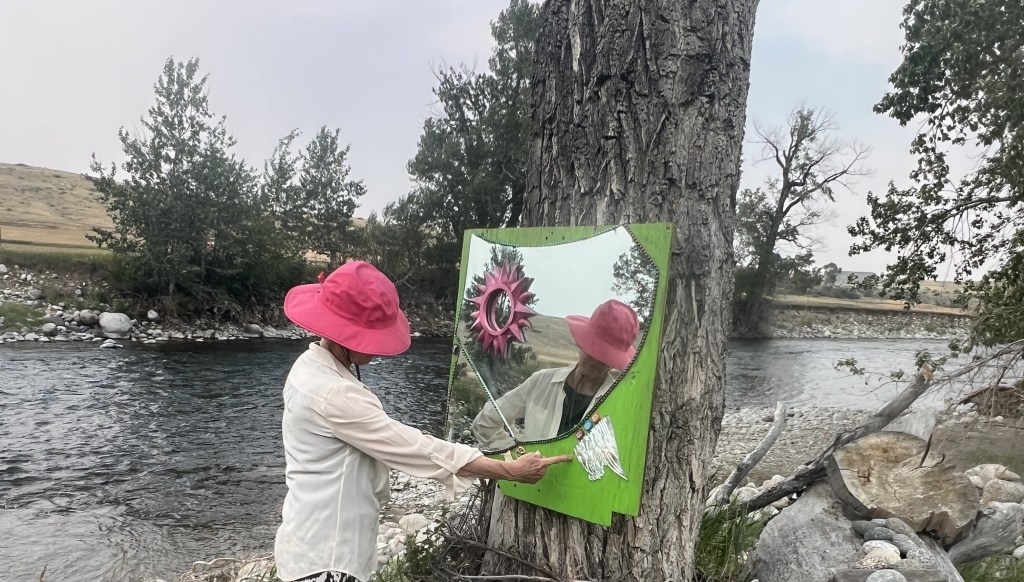
Three years ago, sudden and massive waters dropped a generous array of boulders near the newly cut riverbank. I’ve rolled these stones into a labyrinth and placed a recycled angel named Mary Magdalene at the center. Her arm fell off occasionally, but a fellow angel stopped by and glued it permanently in place.

Rafters appreciate Mary as they drift by, snapping thin lines through the air, hoping to catch and release innocent trout. Darth Vader and the Hulk stand guard, and I’ve added reading glasses.

Lately, besides sticks, stones, and angels, I’ve been drawn to shattered mirrors, discarded jewelry, and certain words–the ones used to deliver sucker punches: Bastard (someone born to an unwed mother); Bitch (a female dog); Fuck (to make love); God (a concept used to elevate oneself and control others).

“Wait!” God exclaims. “Don’t put us on that list.”

 I shrug. “You put yourselves on.”

“Hmmm. Well then, we’re taking ourselves off.”

“Good luck,” I shrug again. “I cross you off. You crop back up.”

“Fascinating,” God says. “What’s that about?”

“Consciousness. We’re at war. URGES. LIES. Still small voices. It’s Jiminy Cricket vs. Pleasure Island. We don’t want to humble ourselves and do the work necessary to be real.”

I step back from my collage and admire how the jagged and the smooth interact. The reconfigured shards reflect my splintered image.

“We love what you’ve done with your imperfections,” God says.

 “I rather like being cracked and shiny,” I admit. “Is that okay with you?”

An explosion of unadulterated laughter threatens to jiggle things loose. The glue isn’t quite dry.

“Mind?” God howls and contorts into a string of Mardi Gras beads, baubles, bones, and tubes of epoxy. “Glue us in, baby,” they chant. “Glue us in and hang us down near Mary.”

“But it’s dangerous down there. Floods. Trespassers. Unrelenting sun,” I warn.

In fact, my angel’s outer layer is peeling from constant UV exposure, and I could lose her to flooding or vandalism.

 “Then hang us high,” they laugh. “We’ve seen a flood or two in our day.” They begin singing an old camp tune. “You put your right arm in. You put your right arm out, you put your right arm in…. Let’s go!”

 I throw my arm over God’s shoulder, and we croon our way to the labyrinth. To Mary. To the river.

We put our whole selves in. We put our whole selves out. We put our whole selves in, and then we shake them all about. We do the hokey pokey, and we turn ourselves around.

And maybe. Just maybe, that’s what it’s all about.

Thin Ice

My religious friends keep warning me that God and I are skating on thin ice. Especially when God names himself Prostitute or Fat Boy. Especially when she manifests as many, and the guarantees are few. We shrug. It’s what we do.

A man named Mick once told me that our postings make him laugh until he cries. He was puzzled as to why. He reads them every Sunday in an alley where an apple tree drips fruit to no avail, and he sips a yellow beer for communion.

The peyote that is God brings paralysis. The river that is God brings release. It’s the author God who writes you using metaphor and mint, drawing symbols in the sand for your protection, throwing ashes to the wind to guide you home.

We are mostly made of water: a fluid interaction between energy and thirst, a form of transportation, a sacrificial lamb. A sheer veneer of ice embodies danger with a certain kind of grace. But the pace of truth exhausts me, and I’m tempted to give up.

God removes his mittens. Offers me bare hands. The crowd of God applauds as I stand on shaky skates and push off using boulders and other people’s dreams. The sheen of God beneath me, the sky of God above, I am hypothermic mercy and cold, defiant love.

My remaining bones grow brittle with God’s blessing. I no longer take the time to make my bed. God shakes her head. When salt dissolves in water, ions form electrons, positively charged. With saline in my veins, the poison makes a promise that I’ll live another day.

Fat Boy tries to juggle. My Prostitute wears pink. She says, “Look at me, I’m funny, and when I’m cold, I’m slick.” But when I look, it’s only water and a wiser way to die. There’s thunder in the distance. And like Mick, I start to laugh. Until I cry.

Resisting Domestication

Caged animals trouble me even if there are acres of natural habitat within their enclosures. The prowling and howling unsettle my claustrophobic soul. And the barriers give visitors a false sense of security. Some time ago, instead of eating the raw meat offered, a grizzly bear ate its handler. We’ve not yet domesticated grizzlies, but if photos of human hubris in Yellowstone Park are any indication, people think befriending wild animals is easy. Just walk right up and pet the bison. In gratitude, it will lower its massive head and lick your hand.

Over the eons, animals willing to be domesticated have provided humans with companionship, labor, and food. Various theologies claim to have domesticated God for similar reasons, but in truth, there is no such thing as a tame or definable God.

“You’ve got that right,” God bellows, sitting large in the hayfield, posing as a woolly mammoth while celestial beings take selfies with her.

I wave but keep my distance. “You know you’re extinct, right?” I’m joking but I’m also afraid of the answer.

God’s tusks circle back to her ancient head. She roars, and the celestial beings roll away like geodes. Their fall from grace cracks them open revealing the phantastic crystal formations of their inner lives. I long to touch the cold brilliance of the fractured geodes, feed God fresh-cut hay, build a nice barn, and corral them all.

“Are you imagining what kind of fencing you’d need?” God asks.

“Yes,” I admit. “But I don’t really want you contained.”

God looked at me long and hard. I looked at myself long and hard. “Ok. I guess I do want you a little bit contained. Otherwise, you’re terrifying.”

As if to prove my point, Woolly Mammoth bellows again. “You terrify yourselves. I’m the source of comfort.”

I bravely push back. “Well. Maybe. But you’re also the reason we need comfort. The conditions we’re born into…consciousness, love, loss, sacrifice, floods, fires, starvation, war…”

“What makes you think your species isn’t going the way of the woolly mammoth?” God interrupts.

“Um, well. We’re amazingly adaptable. And no one’s hunting us.”  I stop abruptly as I realize we actually hunt each other. And our ability to adapt has limits. God’s silence is not reassuring.

I try a slight change of subject. “Did you know scientists are working on cloning woollies back into existence?”

“You don’t say!” Woolly Mammoth exclaims facetiously as she turns and becomes first light. I see that the truth, such as it is, has shaped itself into shelter. It looks dicey, but I think well, if God lives anywhere, it’s here, so I crawl in. At least it’s not a cage.

You Can’t Make Me

God and I are listening to Bonnie Raitt on Youtube. “I can’t make you love me if you don’t,” she croons, her voice resigned, gentle. The lyrics were inspired by an article about a man who’d shot up his girlfriend’s car. During sentencing, the judge asked the offender if he’d learned anything. He replied, “Yes, I did, Your Honor. You can’t make a woman love you if she don’t.”

“Well, that’s true,” God says. “But don’t extrapolate. She’s singing about eros–an attraction that’s sensuous, artistic, and spontaneous.” God gave me a chummy wink. “It may not have been that wise, but I put eros slightly out of your direct control. And I’ll admit, I get a kick out of watching eros make fools of you all occasionally.”

My mind drifts to some of my youthful escapades that may or may not have been fueled by eros. I keep silent. God laughs.

“I hid it in the genes; biology and all that,” God says, but quickly adds, “I also gave you a modicum of willpower and common sense. You can channel eros in some very nice ways.” God smiles. “It’s a source of energy.”

“Yeah,” I say. My mind drifts to the notion of loving my enemies; definitely not a source of energy.

“Ah,” God says. “Let me clear that up for you. It’s a problem with language. I never command eros. It’s there or it isn’t. My first–and actually only–commandment is this: Have compassion. Choose self-sacrifice. Act for the common good. I don’t just hope you love each other in this sense of love. It’s a full-on mandate.” God pushes back in the recliner, watching me squirm.

“Penny for your thoughts,” she says. And I say, “You already know what I’m thinking, But fine, I’ll say it. I’m thinking about mandates. I don’t like seatbelts. They make me itch and feel claustrophobic. There are mandates I hate.”

“Yup,” God says. “I know that.”

“But on the other hand, I detest second-hand smoke, and drunk drivers terrify me.”

“I know that, too.”

The song continues. “Morning will come, and I’ll do what’s right. Just give me ‘til then to give up this fight.”  The longing in her voice, the beautiful, ultimately loving surrender always chokes me up. Such a heart-wrenching choice.

“Now, about those seatbelts,” God says. “You realize that in a crash, your untethered body becomes a bludgeon, right? It’s a mandate for the common good, not your comfort.”

“Yes, Ma’am,” I say. “That’s why I wear the damn things.”

But sometimes, I finish my half-beer in the car when I’m not driving. I haven’t shot up any vehicles, but I admit I still have some work to do.

“Oh, most of you have quite a bit of work to do,” God says. “And not to rush you, but like the song says, morning will come.”

Settling

There are short-lived truths that go sour, longer truths that offer comfort but eventually wear out like a well-loved quilt, and eternal truths that hide among the bulrushes, debts, and sanctuaries. Physical punishment or harsh words will stop unwanted behavior in its tracks, but the motives will dive underground and propel from below.

“Ok,” God says, “Then grace is like a shovel.”

Your offspring don’t own you, and you don’t own your offspring, and we are all the offspring of many. Boundaries are a constant negotiation, but we trundle along, fostering and adopting, breaking and healing, astonished and befuddled; the urges and joys of reproduction writ large.

“Of course,” God says. “My image in the darkened glass.”

There are forces that undermine balance, reduce generosity, and recast restraint as shameful. The meaning of enough is flattened by trucks exceeding the speed limit. Avarice can be dressed up to look like self-care, and acquisition is a seductive master, a damsel in distress, a mirage of power.

“Yes,” God says. “And forgiveness is a home-cooked meal.”

Fear is a natural response to the threat of pain, death, or humiliation. Belligerence is also a natural response. Hatred is the venom produced by fear and belligerence. The poison flows both directions—outward and inward.

“True,” God sighs. “And the antidote…”

God’s voice fades. I lean in, hoping God just needs to clear her throat or something. God is going to say the antidote is love, right? Or maybe compassion, or courage, or sacrifice? Silence reigns. No singing river. No chattering birds. No traffic. No wind. Not even the distant opening or closing of doors.

“Is this it? The antidote is nothing?” I think to myself.

“Noooo,” my inner self protests. I realize I’m dangerously close to settling for a short truth, even if i know it will grow bitter with time, even if I know it will lose its shape like cheap underwear. As long as it disguises the taste of the poison in my mouth–I don’t care.

I look straight into the vibrant universe and hope for a reassuring word.

“Sorry,” God finally says. “I’m all out of platitudes.”

“I don’t mind,” I say, thrilled that God has spoken. “I can handle that. Have a nice day.” I chuckle.

“You crack me up,” God says, laughing. We stand face to face, our foreheads touching, eyes closed, breathing. Then we link arms and walk to the garden to plant a few more marigolds among the rows of kale.

To Tell The Truth

“Hello, God,” I said. “I’m glad to see you.”

“No, you’re not,” God said. “And besides, you can’t see me. You’re pretending again.”

“Ha,” I said. “I’m not pretending; I’m extraordinarily brave. I tell it like it is, and I see you as you are.”

“No,” God said, smiling. “To tell the truth, you see me as you are. Yes, in your timid sort of way, you’re brave. I’ll give you that. But at best, on a good day, you see a fraction.”

“Whatever,” I said. “Hide all you want. Bury yourself in round river rock. Roll to the sea and come back as rain. Write one of your names in the sky and erase it before anyone notices. I’m on to you, God.”

God threw back her head and laughed a belly laugh that turned into thunder that turned into earthquakes that turned into fire that burned the forest to ash, and yet…the hatching and birthing and sprouting continued in a clamorous flurry of all that might be and all that has always been. And nothing was essential. And nothing was missing except the deadly little part I was clinging to as if it could save me.

“Don’t look,” I said to God, as I tried to pry open the rusted metal box where I hide most of myself. “Nothing of interest here.” It opened a crack and I could see my inconsequential self looking back at me, pleading.

God stopped laughing and stared at her feet. She traced the grain in the wood floor with her toe. It was clear she had something difficult to say. I started crying. “It’s too late, isn’t it?” I sobbed. “I need one more life. Just one more. I’ll get it right next time, I promise.”

God shook her head solemnly and took my cold hand into her warm ones. We went to harvest the last of the carrots, me still sniffling, thinking my sorrow might generate a bit of sympathy. God, big and earthy. We dug for a while and then God paused, shovel in hand. “Lie down in the weeds and look up,” she said.

“I don’t want to,” I said, wiping my nose. “The ground is hard. The weeds have thorns, and we don’t have time for your nonsense. Winter’s coming.”

God held my gaze and sighed a long sigh that became a steady wind that became flying leaves that became fine dust. “That’s true,” she said, as she laid herself down between the rows. “Winter is coming.”