Senses

Smell is our oldest sense. Collectively, humans can detect billions of different odors. This has played a central role in our evolution, leading to such literary declarations as Fe Fi Fo Fum, I smell the blood of an Englishman. The sense of smell has made headlines recently because a microscopic organism has been infecting human brains, disabling the senses of smell and taste: a virus not to be trifled with. But then, evil is rarely to be trifled with, right God?

No answer. The silence isn’t holy. But some days, I just keep talking.

And about this notion of evil, God. Who’s evil? What is it? As you know, I don’t like dust settling on things again and again or ashes as a final destination. I like fresh sheets, crisp salad, and good news. Call me shallow, but that’s the way it is, God. I would prefer to be comfortable, adored, young, well-fed, and smart. And whatever deprives me of what I want, well, let’s call that evil, shall we?

My one-way chat takes a nasty turn as the sun intensifies through the window and I see myself reflected on my computer screen in all my dismal glory. “No wonder God is busy elsewhere,” I say to my image in a mean voice. “You’re all the things you dread.” I consider the procedures and surgeries available to make me seem younger, more adorable, smarter. This breaks my fall. My distended ego deflates, and I give myself a smile that naturally lifts the wrinkles.

See, God? Here I am, smiling. All done judging. C’mon by.

I sit. I force myself to say prayers of lovingkindness for the twisted senator, the mouth-breathing fools on the airplanes, lazy neighbors, unkind people, even those who torture, deprive, and dehumanize. I give thanks for my senses, even though I can smell the blood of the disgusting humans who are destroying the planet. Oh, I wish I were the giant.

This last thought finally rouses The Presence. Holy Words, like sleek black animals, invade my brain. “You can’t eat your way to heaven,” they say in a low growl. “You can’t smell your way to salvation. You can’t see the face of God, and you can’t force your way in.” The Words collect around The Presence, and The Presence turns to me, taking the shape of a very old friend.

“The thing that shines in the broken moment, the shelter of translucent skin, these are lessons. Very little of who you are or what you do is to your credit or entirely your fault. Regardless, you will never be the giant. For this, be grateful. Go listen to holiday music. Inhale cinnamon and vanilla.”

“But that seems so…” I pause.

“Shallow?” asks my Very Old Friend. “Simple?”

“Yeah,” I nod. “It’s like giving up. Surrendering.”

“Yes,” my Very Old Friend says. “Much harder than it seems. But you can do it.  I’ll help.”

Sphincters and Other Lesser Parts of the World

In the process of letting go (a euphemism for aging) I’ve grown more conversant with my inner workings. Organs, nerves, limbs, skin, circulatory systems, hairline–we’ve all befriended each other. For instance, on a recent road trip miles from anywhere, my bladder urged me to pull over. I squatted (a humble pose if there ever was one) and waved cheerfully at the driver of the pick-up that happened by. She waved back. A warm calm spread throughout my body as my bladder and I drove on home.

Some of us think of creation as parts of The Body. Others are more exclusive about who’s in and who’s out; what’s to be honored, who’s to be enslaved. These are ego-based pretendings, wrong-headed derivations. In the Oneness, every molecule has a voice. For instance, when stubbed, the oft-overlooked third toe suddenly takes center stage.

This is the kind of pondering that almost always guarantees a visit from God. Sure enough. She’s arrived on the west wind with a flood-inducing chinook on her tail.

“Why, hello there, God,” I say. “What a nice surprise. C’mon in.” My automatic hospitality reminds me of a poem my grandmother had on her kitchen wall:

            Guest, you are welcome here. Be at your ease.

            Get up when you’re ready. Go to bed when you please.

            We’re happy to share with you, such as we’ve got,

            The leaks in the roof and the soup in the pot.

            You don’t have to thank us or laugh at our jokes.

            Sit deep and come often. You’re one of the folks.

I memorized the rhyme, but I didn’t know what it meant to sit deep, and I didn’t like people partaking of my grandmother’s kindness. I wanted her all to myself. Now, I want God all to myself. I want singular adoration, endless comfort, and permission to be at my ease forever without the hassles of caring for others.

“Sorry,” God says. “Doesn’t work that way.” We gaze at the fire. She strokes her chin. “If you had a choice, which part of The Body would you be?”

I chew my thumb and think. Brain, eyes, ears all come to mind, but they’re too obvious. “Bladder,” I say. “I’d be the mop bucket.”

God laughs. “You know you’d have to cooperate with the sphincter, right?”

“Yeah,” I say. “I’ve known that for a very long time.” I raise my right hand. “I do hereby solemnly swear to love and honor the sphincters of the world. My own and others.”

I expect God to chuckle, but instead, I realize we are sitting deep; God and me. And I see that nothing functions without cooperation and mutual respect, internally or out there in the nasty, brutal, fractured Oneness we live within. I know I’m not alone, but sometimes I wish I were.

Holiday Lights

Recently, my friend brushed so close to death that her skin became luminescent, and the fingers on her left hand grew longer and more graceful. I noticed this when she lifted that hand to show me how she’d surrendered. I suspect she was either bidding the others in the room farewell or she was offering her hand and the rest of herself to the Larger. She doesn’t know. But at that moment, a Boundless Tangibility of Peace overcame the reluctance in her lungs, and she lived. It was that close. I like looking at her. She’s always had an easy laugh and a generous ear, but now she glows.

Three years ago, I decorated random pieces of yard art with solar-powered holiday lights, and they’ve flickered ever since, faithfully announcing the arrival of a thousand nightfalls. Of course, I know that eventually the lights will go out and my friend will stop glowing, but the pressing question is this: What are we supposed to do in the meantime? How should we greet each sunrise when we find ourselves alive? How do we handle the twinkling blue as daylight fades? My friend isn’t sure. Neither am I. We think it has something to do with acceptance. Authenticity. Doing our best.

But who knows? My Co-author does, but it’s tough to get a straight answer.

“Now honey-pie, y’know that ain’t true.” God has shown up. He protests in an awful imitation of a Southern drawl. “Y’all make this a bigger puzzle than it needs to be. I’ve been damn straight on this since forever. Love, give, and rejoice until you cannot do it anymore. Then fold.”

“You make it sound easy, but it’s not,” I say, feeling both insolent and amused.

“Want me to spell it out, darlin’?” God asks, long arms crossed over galactic chest, looking impish.

“Yeah,” I say. “Spell it out.”

“Love.” God says as if he’s in a spelling bee. “L. O. V. E.”

“Very funny,” I say.

“Then laugh,” God says. “Laugh your greedy, frightened, malignant, time-limited ass off.”

“I don’t mean funny like that,” I counter. “I mean you aren’t much help. I can spell ‘love’ all by myself.”

“Oh, really?” God asks and waits.

“Really,” I say firmly. But I’m lying. I’ll be asking for help within minutes. With apologies to Robert Frost, I’m often a lost child in the confusing woods when it comes to love.

“Now, ain’t that the Truth?” The Boundless Tangibility of Peace says to the Larger.

“For certain,” The Larger says. “Them woods is lovely, dark, and deep. But they ain’t no place for a chubby-cheeked babe.”

This cracks us up and we laugh our fool heads off. Yes, God is Love, the Big Breast in the Sky, the Larger, the Smaller, the Woods, the Clay, the Life, the Death. And yes, God is the Way Home. But until then, there’s work to do, and we all know how it’s spelled.

Thanksgiving

            “Sometimes, your species is hard for me,” God said, looking a little haggard.

            “I know,” I nodded. “I don’t like people that well either. But it’s hard to write them off entirely.”

            “Yeah,” God agreed. “I often wonder what makes me hang in there.” She paused. I waited. “It might be the gratitude,” she said finally. “Humans are capable of saying thanks in a way that warms my heart. Nothing quite like it.”

            “Gratitude?” I asked. “You like that better than when they apologize?”

            God chuckled. Her corporealness was starting to fray. “Are you a worthy representative of all humanity?” she asked in an impish voice, a luminescent grin taking over what was left of her face.

            “No.” I shook my head emphatically. This was a trick question.

            The grin expanded. “Oh, no worries. You’ll do. Tell me how you feel when you’ve messed up and need to say you’re sorry.”

            I grimace. Confession of sins? Facing faults and shortcomings? Asking forgiveness? Not easy. Not fun.  

            “You already know this,” I said, giving God a look. “I hate failing and being wrong. I do not like needing to apologize.” I looked down at my hands and stopped talking, but in my mind, I went further. It’s complicated. I have my pride. Once in a while, I get stubborn and lie to myself or other people. And I blame others and feel sorry for myself…but I didn’t want to mention that to God.

            The eyes of God looked upon my soul. “My point, exactly,” she said. “People often make the same mistakes and sometimes, show up again, woeful and defeated. Or they get defensive and act like they’re not wrong after all. I accept apologies all day long, but I don’t enjoy the process, and I don’t think people do either.”

            God looked at her own hands, cracked a thousand arthritic knuckles, and stood into the stratosphere of herself. She wrapped the cloak of unknowability around her shoulders and set the sky on fire. “So, that’s why I like gratitude better than penance,” she concluded.

            “But how do you know it’s sincere?” I asked, but there would be no answer. The room, the land, the cities, the earth—everything had become one big party.

            God was center stage, doing an Irish jig. Darlings and demons cavorted across galactic dance floors, and all creation clapped and stomped, keeping the intricate beat alive. “Gratitude’s an attitude. Fake it ‘til you make it,” they sang. I couldn’t see who was playing the frenetic fiddle, but I did not want to join this ridiculous reverie. I needed some space, and God knew it. The scene receded and God’s merciful arms surrounded me. Only me.

            “Go in peace,” she said, dismissing me to my quiet place.

            “Thank you,” I whispered.

            “You’re welcome,” God said. We both meant it.

It’s What’s for Dinner

Yesterday, I borrowed my sister’s horse trailer to salvage some old lumber, but things did not go smoothly, and the trailer arrived home well after dark. Ordinarily, this wouldn’t be a problem, but it’s shipping season; she needed to haul calves bright and early today. We unloaded recycled boards with flashlights, and at dawn, I went back to use a magnet to search for rusty nails in the crusted manure. I didn’t want a distressed calf to end up with a nail in a hoof.

When I sit down with my co-author to await the alchemy that produces words, I’m often pulled toward thousands of unnecessary things to do, but picking up loose nails was necessary—an effort to avoid small suffering in the face of huge suffering. Even though it meant facing a cold morning, I’m glad I found and removed those nails.

But that was that. Now it’s time to write, and the familiar battle is on. Mind and body at war: Mind wants to settle and focus, but body gets up, stares at the baked goods, waters the spider plant, paws through the fridge for a corked half-beer, and meanders back outside to check the temperature and admire the sunrise. The bawling of distraught cattle is thick in the air.

I come back in and sit. A housefly buzzes the coffee table, executing dives and turns that I admire, even as I hate and detest the fly. I start to chew my thumb for inspiration, but the odor of cow poop stops me cold. I’d forgotten to wash my hands. At the kitchen sink, I find last night’s dishes, so I scrub a few of the pans. I grab a fly swatter on my way back. Of course, the fly disappears.

I sit again. My mind is calm. I am not moving. I accept the lowing of bereft cows and the frantic calls of their disoriented calves, destined to be fattened, slaughtered, and eaten. I live in this particular world. I accept my role in the brokenness.

When the followers of Chuang Tzu asked him how he’d like his body disposed of, he replied it mattered not: Eaten by the birds of the air or by worms in the soil. Such is the journey of the body. In the grand scheme, we eat and are eaten.

“True,” God agrees, joining my thoughts, hands folded in his lap, large and calloused. “But I must say, some of your fellow beings get a lot fatter and sassier than others. And unlike the endings brought about by hunter or slaughterhouse, many deaths are neither swift nor humane.”

I nod. One of the most haunting images on the nightly news is the emaciated woman, nursing a stick-thin infant. She sits listless, her eyes and the baby’s eyes dull, unregistered. Neither will ever be fat.

With clean hands, I offer God a croissant. He declines.

Rock Saw

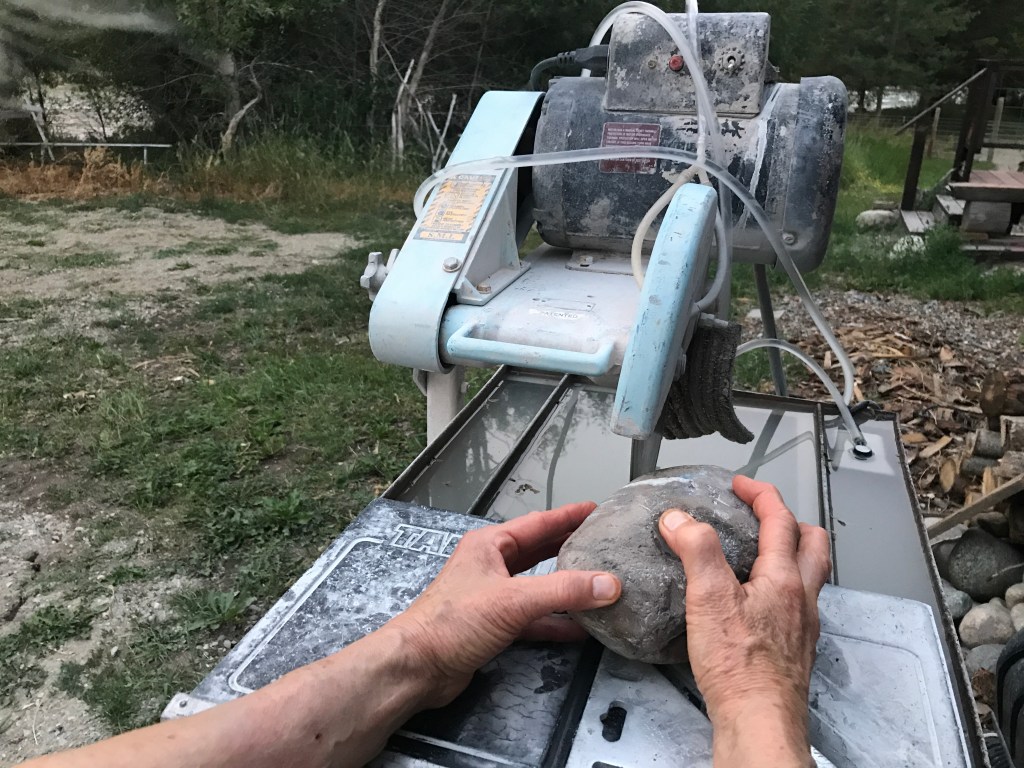
I have a functional rock saw. It’s dusty, rusty, and ugly, but it has one fancy feature: the blade–which has diamond chips on the edge. It can slice a rock in two but if I accidentally touch it, it won’t even scratch my skin. I know this in my head, but my neck muscles tighten to the point of popping when I flip the switch and begin guiding the chosen rock through the process of coming apart.

It is with reverence and holy anticipation that I open and explore the inner workings of stone. Some have nothing hidden and remain a steady brown or gray, but others have intricate interiors—patterns of color and luminosity, suggestions of scenery, stories of minerals and the workings of water. When the slabs first separate and emerge from the murky waters, they shine like newborns. The one has become two. A beautiful but sudden breakage has taken place—much different than the geologic forces that diminish stones slowly into smoother, more humble surfaces.

As it turns out, God doesn’t like my rock saw all that well. The Three-in-One stand alongside, frowning. They don’t approve of the primitive deconstruction of density and coherence. They don’t fully understand my all-too-human sequence of raw apprehension followed by awe. Maybe I don’t either. But as always, they are patient and kind.

“Having an audience doesn’t help,” I told them last evening, as I worked on a particularly hard specimen. Something deep inside that amalgamation of jasper and flint was so dense it repeatedly grabbed the blade and stalled out. I kept trying, but the motor reached the shut-down temperature, so there we sat, waiting for things to cool.

“Want something to drink?” I asked, hoping they’d say no and go somewhere they’d be more appreciated. They glanced among themselves, mentally conferring about the status of their hydration and the needs of the universe.

“Don’t let me keep you,” I added. “This could take a while.”

Again, they conferred. And laughed. A flock of sparrows landed on their outstretched arms which had blackened to coal. Then diamond. Then jasper, blood red and mustard yellow. The sparrows lifted the inextricable threesome, dropped them in the river and updrafted into numinous air I could only hope to breathe someday. A very high place. Heaven, if you will.

As time came back into focus, the motor had cooled enough to let me start again, working slowly through the recalcitrant hunk of greatly compressed life. “It has to be beautiful in there if it is this hard to cut,” I thought to myself. I often think things that turn out to be mostly wrong . This is an insight that often brings a surprising amount of peace.

Auto-Correct

My Co-author had to disrupt the internet to get my attention and even now, crashed and subdued, I’m trying to find ways to curl up around some happy little thought and protect myself from the simplicities and complexities of that damn self-reflective loop that causes me such trouble. It’s worse than my morning cough. Worse than my lists of things to do. Is this banquet of options meant to prove something? Should I learn to weld?

My Co-author offers no edits. The exuberant birds keep singing, even though I’m sure they’ve already mated for the season. We have water. Enough water for baths and baptisms, for chard, onions, and corn. But the way forward, the way back–always under construction. This is hard for most lifeforms and algorithms to grasp. I am among them.

With a cool breeze and sustenance, it’s easier to make space for my longings and give them a name. I will call them Holy. With a severely curtailed agenda, it is easier to befriend all those familiar demons and fears. I will call them Holy as well. I recognize my hands and consider the things they will do today. If I stare long enough, the delicate bones of God disintegrate, and to be consistent, I know I should call the disintegration Holy and make this morning into a trinity. Land, sea, and sky. Mind, body, and soul. Life, death, and passage.

God slides into distant view as an inane prompt, wondering if I want to save this document. It’s not been saved in the allotted time, nor have I, nor have the people washing up on various shores, seeking to make a better life.

“I don’t like your magnitude this morning,” I tell my Co-author.

“I know,” she says. “And I don’t blame you one bit.”

“Oh, but you do,” I say. “I feel the sun on my damaged skin. I taste the salt. The joy in the river is at an all-time low.”

“And yet, here we are,” my Co-author says, complacent.

“Would you mind editing?” I ask.

“No need,” my Co-author says. “Everything stolen shall be returned. Everything broken shall be repaired. All words misspoken shall be transformed.”

“Sounds as reliable as auto-correct.” I say in a snarky voice. “So, thanks for nothing.”

“You’re welcome,” my Co-author says, and she means it. Nothing is one of her favorite gifts.

A misguided bird has flown through the open door into our porch. I move to help it rejoin the wilder world, glad to have something obvious to do, but before I get there, it has realized its mistake and flown away.

Jerusalem

There is joy in an empty morning, especially if it is tinted slightly turquoise or gentile orange. Wait. I meant genteel. Not gentile. Where did that come from? Oh well. Too late. My mind has gone down the rabbit hole of the middle east and the histories of whole cultures and artificial delineations that have led to pathetic claims of superiority and audacious acts of murder or full-on genocide. Out of suffering has come suffering.

Oh, Jerusalem. You were meant to point us to wholeness but instead, you are irreparably cracked. You have a planet-full of earthborn children pretending to cry out for peace, but peace is boring. What we want is unfettered growth, unmitigated accumulation, endless storage space, and the assurance of a self-styled salvation. Gentile, Jew, Palestinian, Greek, African, White, Latino, Asian, Native, Alien, Influxers, Outgoers, Believers, and those bloated with greed. We’re all a blur in the eye of the passing God who named us Jerusalem and flew away. Named us Eve, Fig Leaf, and Pig’s Eye.

“Are there clues in our DNA?” I ask God as he makes another pass, and I continue to free associate, stimulated by the random events of typos and auto-correct.

“For what?” God says, slowing to a flickering presence, picking at a hangnail, disdainful and uninterested in being embodied.

“For how we’ve gone so wrong,” I say.

“Who’s to say you’ve gone wrong?” God says. “Maybe I planned it this way. And what do you mean by ‘wrong’ and am I included in your sweeping judgements?”

I lean in close to this flippant caricature with onion breath, ragged nails, and bruised feet. God leans away. I lean closer. God gets up and puts himself in the corner, a place of shameful contemplation. I wiggle past the hulking body and become as angular as any corner has ever been.

“Face me,” I demand. Then add in a pleading voice, “I have something you might like.”

God’s hair is greasy. His teeth are mostly gone. His longings are choking the life out of him. He can’t have what he most wants. He’s so lonely he’s willing to settle for fleeting liaisons, lies, and invitations to banquets where only poison is served. Why would anyone host a banquet and then serve poison?

In my angularity, I’ve chosen to serve ramen. It takes the shape of its container, but the long strands remain true to themselves unless they’re cooked too long, and that’s what matters. I try to make sure nothing tastes like soap, whitewash, or condemnation, but there’s a slight aftertaste anyway. I don’t blame myself. If I’ve learned anything from God, it is this: nothing in life will be completely free of aftertaste.

Trees Walking

“God,” I said, after a hot, dry afternoon of good and bad happenings. “How are you different than coincidences or things we can’t explain?”

“I’m not,” God said. “In other dimensions, they don’t even call me God.”

I’ve always known that had to be the case, but knowing hasn’t reduced my longing for a provable formula, a reliably vengeful God, a certain ally, or an intelligent designer with some degree of accountability.

I sighed and asked politely, “What do they call you, then?”

God smiled. “Ah, let’s see. If I put the terms in English for you, I’m sometimes called Attribution, Allah, Beelzebub and Baby’s Breath, Creator, Calamity, Dalliance, Dendroid, Emmanuel, Ego…” She paused and smiled. “Shall I go on?”

“Well, the ABCs are a little boring,” I said. “How about a different alphabet? Or the language of a neighboring planetary system?”

This was perhaps an unwise request from an older soul like myself. God grabbed the brittle corners of my imagination and shook the filmy cataracts loose. My eyes beheld a night sky so dense with possibilities that it almost instantly blinded me. The names of God were a thousand suns, unleashed. God waved her baton; the symphony of all her names was deafening. I intended for my tongue to move, but it would not. With great effort, I raised my finger to signal for help.

“Enough?” God asked.

“Too much,” I said, as I tried to gather what was left of my sensibilities.

“Hand them over,” God said.

“No,” I said. “They’re mine.”

God shook her mane, waved her appendages, leathered up, and roared around in circles on a ruby red Harley. Followers stampeded behind, raising clouds of luminescence. A cacophony of unearthly mirth blew through the trees and with help from a gifted artist, they were transformed into maniacal silver laughter. I couldn’t hold on.

“Uncle,” I shouted.

“Good one,” God shouted back.

“No, I mean I give up,” I said.

“I know what Uncle means,” God said as she put me back together, muttering to herself in languages from beyond and beneath. “There.” She patted my head which felt slightly askew. “That’ll do for now.” She started to walk away but then gave me a second glance. “You’re getting a little tired of the circularity, aren’t you, honey?”

“No!” I lied. “No, not at all.” With the few shreds of pride still at my disposal, I stood erect. “You have a nice day, God” I said. Then I turned my back, rolled under the nearest pile of dead branches, and held very still. As my eyes adjusted, I could see that I was not alone. So many sentient beings, so many innocent souls hiding from the birds of prey.

Maybe God was right. Maybe I am a little tired. This will be an excellent place to rest.

NYT2009
(One of Roxy Paine’s amazing creations)

Volcanic

God slept rough last night alongside the cooling embers of volcanic rock from the eruption of Mt. Nyiragongo in Africa. She awoke exposed, porous and pure as the lava itself, but this did not make her happy. She shook me awake to ask if I would bury her under the acres of rich loam currently planted in alfalfa so she could begin reclaiming her complexity. To be simplified to lava is painful.

“Oh no!” I exclaimed as I opened my eyes in the dim light of dawn and ran my hands over a face so jagged and pitted it made terrible acne seem easy. “Oh sweet God. You’ve become stone.”

“Yes,” God said, woeful, but with a shred of hope. “Lava stone. I’ve heard it has healing properties, but I’d rather move along. Bury me in the topsoil, please. There’s still time. I’ll take care of the rest.”

I reluctantly agreed. We held hands as we walked through the verdant fields made fertile by thousands of years of runoff from the surrounding and willing hills. I was glad I’d remembered my cowhide gloves, both because the hand of God was razor sharp and because the shovel I was dragging along was old. The handle was splintered, and I knew I would be digging for a long time, possibly the rest of my life.

The squawking of the wild and noisy geese nesting across the river helped me find my center as God chose the perfect place to be interned. I wished for another way, but life consists of trying to solve things that are not solvable. This is something gradually revealed over the years allotted to those defined as alive. They say that suicide is a permanent solution to a temporary problem. This is true, but then the same can be said for all deaths; ultimately all problems are subjective and temporary, and all deaths seem permanent.

The bounce of sound across water is predictable but not guaranteed.

“God,” I said. “Are you sure?” I was wondering why God insisted on being buried on such a beautiful day. I wondered why I had to be the one digging. I wondered where this weathered old shovel came from.

“Yes,” God said, the nod of her head causing tremors under my feet. Her voice is not measured in decibels but rather revealed in the marrow of reverberating bone. I broke ground, putting body and soul into the sink of the shovel, giving thanks for the leather protecting my thin, unlovely skin from slivers and blisters. I have callouses, but they are often an insufficient defense for these long hot days and the softening effect of sweat.