New Shoes

Old shoes IMG-3339

This morning, on the Stillwater, smoke from both the fires of Canada and the fires of hell invade my body and soul with every shallow in-breath, and I endure the artist at work–yesterday’s ashes glazing the face of granite into something too terrible to touch, too beautiful to behold.

Not long ago, I began to pack for yet another autumn transition. I picked the last of the purslane-choked green beans, pulled the onions, undid the hoses, and with sickening ambivalence, bought poison to deal with mice. Traps or poison? I’m not a rodent, but I’d rather be poisoned than trapped. If we had a decent God, we wouldn’t have to use our crude, projected empathy to make these wrenching decisions. Maybe we’d even feed the mice and marvel at the prodigious quantities of seashell pink offspring. Or maybe in the spirit of the grand circle of life, we’d learn to eat said offspring. A delicacy. Except for their tiny spasmodic appendages, curled baby mice do bear a remarkable resemblance to shrimp. Wait. That wouldn’t solve the problem.

Eat or be eaten. Poison or be poisoned. By and large, the weeds won this year. And now, forests are being blazed out of existence, flood waters gorge on land, and lives are lost. I sit in unearned comfort, grimly examining the karmic consequences of nonaction, trying to goad my flesh into movement, my mind into comprehension. It feels useless. Why bother? Such is my mood today.

Yesterday was a different story. I had new running shoes, and there’d been rain. And God, I know you don’t like it when I imply you’ve engaged in miracles for my sake, but it seemed you’d reduced the gravity along the highway where my stride was effortless and I bounded along like a deer, legs spring-loaded, heart lifted and extraordinarily light.

“It was the shoes,” God says.

“I don’t believe you,” I say.

And God laughs. I can barely see the big, sharp teeth through the haze, but I can hear the riotous sound of a happy God.

“No, really,” I say in my loudest voice. “I don’t believe you.”

“I know,” God says. “Next time, run in old shoes with rocks in your pocket.”

“Fine,” I say. “That’s just what I’ll do.”

“And what will you prove, darling?” God asks, suddenly all innocent and interested.

“Nothing,” I shout. “I’ll prove nothing. There’s nothing mortals can prove. You shift the odds, change the playing field, turn down the volume, distort the light. We’re mice in an endless maze. Where are you, God? That’s what I want to know. Where are you?”

“Sheesh, oh ye of little vision. Calm down. You cannot look anywhere I’m not. I’m the maze and the fire, the weeds and the water, the new shoes and the rocks. And by the way, you got a good deal on those Sauconys, but I liked the yellow Asics pretty well too.”

 

Red Box

Red box

God and I are meandering down the alley. I’m on foot. God’s doing a high-wire act to make me laugh. There are crows, evidence of squirrels, and things discarded littering our way. Among the riffraff I find the redeemable. I offer thanks for the empty gift box flashing fancy red from a garbage can, and driftwood, smooth as skin, and seven or eight green apples, all bruised from the fall. I commune with the broken, hoping to catch a direct glimpse of my constant, often invisible, sometimes putrid companion who hides among the worst of it. The ways of God aren’t always pretty, safe, or easy. But I’ve learned to never, ever sanitize God. It causes a crippling loss of the sensations that make us human.

Today, it appears God wants to be silly, but shoes hanging by their laces from electrical lines don’t do much for me. Everything seems stupid. “Hey Goofball,” I venture. “Could you stop clowning around? I don’t want to laugh right now.” Honesty usually works well with the Holy Goofball. She can make her hide thicker than a crocodile’s. But this time, her skin is thin and she’s reactive.

“What makes you think this is for you?” she asks, voice sharp and petulant. “It isn’t always about you.” I look around. Lilac bushes are wilting. Alley weeds transgress, ugly and aggressive. Dust and smoke swirl. And then I notice that a muttering woman with a Safeway shopping cart has turned toward us. Why’d she turn? It isn’t even a paved alley. But here she comes. Snarling. Incoherent. A small, vicious world pulled tight around her—she’s walled herself off from gentleness, reason, or even meaningful contact. She’s a one-winged bird, flapping low. The gravel impedes her progress, but even so, she’s steadily getting closer.

Unhinged people frighten me.

Of course, I know, you know, God is permanently, proudly, unhinged. An ever-present danger to my complacency. Ultimately, it’s always God pushing the shopping cart, arriving as requested. I often wonder why I ask. But this is irrelevant. The street lady comes for us all, requested or not.

She waits, scowling, while I meekly climb in. There’s room for my red box, the driftwood, and a few of the apples. I am adding to her burden, but I see no other option. This unflinching, castoff God shows me the way, holding a fractured mirror.

My real home is a borrowed wire cage, my shelter permeable, mostly imagined. I am wilting lilacs, aggressive weeds, swirling smoke and fine gray dust. I am the favored child of an unhinged God, waiting to see what will happen next.

Coping With the Bad Days

IMG_3460 (2)

As I pulled up on my bike to check on repairs underway on our van, God came out the back door in his underwear, bent over from the pain in his belly. He claimed it was the doughnut he’d eaten last night. He seemed confused–frightened about his prostate symptoms. “Got cancer down there. I think it’s spread to my nuts.” He motioned towards his testicles which I could have glimpsed if I tried, given the sparse and baggy nature of his attire. “This is my girlfriend’s house,” he explained. “I didn’t mean to stay here, but the police, and the people evaluating me…I’m not a hoarder. I’m autistic. I bought you some parts, but I can’t deal with it. Maybe next time.”

I could see the mottled top of his bald head where a nasty boil had crusted over. With one hand, he clawed at the air near me, seeking solace, coherence, connection. He wanted a kind of reassurance I could not possibly give. It’s the kind of reassurance I usually beg from him. And he’s stuck with the same dilemma. Such reassurances are hollow. Inane. In the short run, everything will not be okay.

I offered what I could. “God,” I said. “Some days will be better than this.”

He moaned and held his stomach. I gave him a teddy bear I’d found in a dumpster. It was clean and soft, tan, with a pink bow. He examined my gift. “This looks familiar,” he said. “I think I’ve met this bear somewhere before. Can’t recall for certain.” He held it against his pain.

Ordinarily, I might have been ashamed of a dumpster gift, but not with God. Our eyes met. Beyond his prostate and roiling intestines, far from his festering boils, half-truths, and tattered underwear, a firefly flitted across the back of our retinas and exposed the dark for what it is—nothingness waiting for light. A blanket. A good place to hide and lick your wounds. Easily done in.

“Sometimes, the dark should be left alone,” God said.

I knew this. I nodded and turned my bike toward home. God faded. I felt certain he was going to the river where there are always people who need to get across. It’s especially dangerous this time of year.

Slow Awakenings

IMG_0989 (2)

“You awake?” I ask God. We got home very late. Time zone hopping is hard for me. I assume God doesn’t love it either, but I want to talk through my disorientation. Maybe with a cup of strong coffee, I can rouse the sleeping giant.

Our travels took us to cities cluttered with Homo sapiens arrayed in colors and shapes one sees less frequently in Montana. Beautiful, disturbing fractals–repeating patterns of hope, defiance, and despair. God on stage. God embodied. God black. God white. God with a face no one could love. I was reminded that God is, by definition, homeless. Such exposures can be unsettling. My usual world is small. My town, smaller.

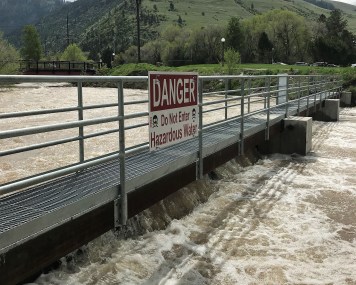
Here on the rising river, God groans and pulls the alfalfa field over his shoulders, a shimmering quilt, greening as I watch. A red-winged blackbird lands on the garden fence. Then a robin. The boulders of winter have been rolled away, leaving the tomb empty again. The eyes of God are bleary, the breath of God questionable. The garments of night are crumpled at the edge of the riverbed–riffraff to contain spring runoffs and preserve riparian areas essential to survival.

In the natural order of things named God, I catch my breath and await further instructions. God yawns and rolls over. The hills pillow his sleepy head, and he gives me a nonchalant wave before snuggling back in. Generally, I don’t like being ignored, but this morning, I can tolerate the slow awakenings. I am growing more patient as my years dwindle and my soul thins out. Reality has become more translucent. When I really concentrate, I catch glimpses of the beyond where my thin bones and thick arteries won’t matter anymore.

Closer in, everything seems to matter. There are hills to die on, but I don’t know which ones. This is why I wish God would wake up. The fight to survive winter is over, but the wrong-headed weeds of early spring romp through my dreams—nasty little gargoyles grinning and drinking while I stand in the rain, chilled and uncertain. Exactly which battles should I wage, God? And how will I know if I win?

God snorts in his sleep. Likely, he’s dreaming gargoyles too. In the underworld, they’re everywhere.


Crumbs

golden_labrador_retriever (2)

Lately,  my life has been disrupted by a lot of travel. I barely have time to clean things out and cram them full again. I over-pack. It’s good to have a lot of baggage–it gives me choices. I can distract myself, especially if the journey is troubling.

“Ha! You crack me up sometimes,” God says from the bottom of my backpack. “Baggage blinds you, and distraction is the main ingredient in denial. You know damn well these things aren’t good for you. What’s going on?”

“Ha yourself,” I say. “Like you don’t already know what’s going on. I’m tired. I have this little life to live, and no matter where I go, I find meaninglessness, finality, circularity, and suffering. Nothing is going right. Our window shades keep malfunctioning, the dirt in our garden has gotten contaminated, and the kitchen floor is littered with crumbs.”

“Funny you mention crumbs,” God says. “Not long ago, a wise woman taught me the importance of crumbs. If I remember right, she was a Gentile.”

“A what?” I say. God snaps her glorious fingers, and a hundred dogs appear–barking, jumping, fetching, tumbling–licking up those crumbs as if our floor was a five-star doggy restaurant. It’s a party. A festival of abundance. I lay down among the dogs, and they lick my cheeks, salty with self-pity. I think to myself, “In my next life, I want to be a dog.” I throw a heavy cloak of doubt over myself, and I wait.

God watches, arm’s crossed, enjoying the energy. She loves the dogs. The dogs love her. God reaches into the silverware drawer, finds more crumbs, and flings them in the air. The dogs leap up, eating them before they even reach the floor.

“Do you see, child?” God asks me. I don’t see. My ignorance is embarrassing. The doubt has crept up around my neck. It’s hard to breathe.

“Even the crumbs are sacred,” God explains in a patient voice. “And so is your doubt.”

Most of the dogs have romped away, but a golden lab lays down beside me, and we consider this mystery together. The dog pulls the cloak away, puts a paw on my belly and licks my neck. I’ve done nothing to warrant this comfort, this unconditional companionship. I don’t even deserve the crumbs, but I see now they are lovely.


Coffee

P1040836 (3)

This is hard to admit, but it appears my attitude toward life is dependent on a good cup of coffee and whole wheat toast. These are bedrock to my salvation from the tedium of the known world. Sure, I enhance my attitude by conscious efforts and limiting my exposure to the news, but a morning bereft of sustenance takes me down the rabbit hole of despair.

God arrives on the frozen wings of this morning’s wind. I’m ready to confess. “God, I wish I were more resilient, but without coffee and food, I don’t think I believe in you.”

God laughs. “No worries, darling. I still believe in you, and so far today, I haven’t eaten a thing.”

“Fasting?” I said, trying to move the subject away from belief.

“Not exactly,” God said. “When you’re God, eating is complicated. Basically, I wait until I’m invited.”

At first glance, this didn’t seem like much of a problem. If you had a chance to have God over for dinner, why wouldn’t you? There had to be a trick. Invite God for dinner? Why not?

The reasons started rolling in. What would I serve? Would God want salad and dessert? The right silverware? In what form would God arrive? There it was. The central problem. God would come parading in as a stinky homeless guy with a dog. The dog would snarl. The guy might steal things. Or God could show up as a whole camp of refugees, big-eyed, big-bellied, unable to speak in a civilized tongue.

And it wouldn’t be a temporary visitation. That invitation could lead to discomfort and displacement. My bank account would dwindle, my security would be shaken. Even fortified with coffee, and a dark beer waiting, this was too hard for me. I have plans for Pad Thai take-out tonight. I don’t want to ruin this cozy vision by inviting God along.

“I can’t finish this toast,” I said. “I always make about half a piece too much. Would you like it?” Even this was hard to admit. Hard to offer.

God nodded and rocked quietly in our gliding rocker by the stone fireplace. Sure enough, the ugly, hungry, hopeless people began crowding in. God took the crusts and broke them, and broke them, and broke them. There was laughter. God and the children playing tag. God and the old women sharing my beer. God and the young men, admiring the weapons they no longer needed.

“Such abundance,” God said. “Such ingenuity. And with time, you’ll do even better.”

Even full of toast and coffee, I have trouble believing this. But I’m willing to try.


Charitable Giving

IMG_2809 (2)

I positioned my cold feet in the warm sunlight, determined to sit until the embers in the stove or the chickadees outside the window convinced me that anything matters. So far, it hasn’t worked. I’m in a wicked post-holiday mood. I just threw out three beautifully-rising loaves of bread after discovering that flax can indeed go rancid, and this is not good for you. I’d taken a little taste of the dough. It was unusually bitter, which led to the research, which led to the painful placement of the loaves in the compost bucket. I hate that things go rancid.

I want everything to stay whole and healthy, even in large quantities. I often cloak my hoarding tendencies under colorful claims of creativity and eventuality. But I know the truth about me. I’m a mixture of pioneer ancestors and an excessive culture. Like God, I see potential redemption in even the worst of the worst, and try to make use of everything. I hate letting go.

The chickadees are gone. Wild turkeys are pacing the perimeter of the garden, calculating whether flying over the tall fence will result in enough nourishment to justify the energy expenditure. They don’t know about the rancid flax-laden dough about to appear. This may sway their decision. I trust their digestive systems can make use of rancid flax, or they’ll know enough to turn up their pointy beaks and strut away.

“And you?” God says gently, speaking from deep within the pile of nearly-rotten wood I’m trying to burn up.

I pause to think of myself as a calculating turkey, pacing the outer edge of Eden. “No idea,” I answer. That kind of wisdom is a distant memory in the oldest part of my aging brain. But what I do know is that a great, rancid toxicity is blanketing the earth from massive accumulations of wealth. And I don’t know how to shake it off. Even as I scorn the greed of those who have too much, I wonder how I can get a little more. I hate this about myself.

I try my usual cure. “Give until it hurts, you selfish hypocrite,” I say in a nearby mirror.

God rushes toward me like a grandmother saving a child from a coiled rattlesnake.

“No!” she shouts, waving her arms. “No. Stop it. That kind of talk doesn’t help anyone.”

I jump back, startled. She throws a blanket over the mirror.

“Take a beer and sit among your possessions,” she says sternly. “Be in your body. Be in my body. Open your soul. And notice where it hurts, darling. Then, gently, give. But give until it heals. That’s all. Give until it heals.”

This is a complete impossibility. But that’s one of the things I like about God. She often pairs the impossible with dark beer.


Brittle

OLYMPUS DIGITAL CAMERA

“God,” I said. “Blogging with you is like trying to shovel water out of a fast moving river.” God said nothing. This is one of God’s favorite responses. Even though I’m used to it, I don’t like it.

My motivation wanes and I assess the strength of my arms, the shape of the morning, the level of courage left after the terrors of the night. It isn’t easy to let go and make contact with something that vibrates like God. My brittle convictions are always in danger of breaking. My perch is precarious and I don’t look down for very long.

“Down is the wrong direction,” God says, the voice rising from the frost on the windows.

This time, I give God a taste of her own medicine. I say nothing.

“Down is the wrong direction, and anyway, the only real escape is breakage. Don’t be afraid. I work best with colorful fragments, contrite hearts, and brave, belligerent foolishness. I’m more of an abstract artist. I like mixed media. Exotic combinations.”

Even though I intended to stay silent, I couldn’t stop myself. “You are one twisted dude, God,” I said. I thought I was angry, but when God started laughing and dancing and throwing small stones in the air, I melted. I let go. I fell, and broke.

“Look what you did,” I screamed, terrified of all the jagged edges, the false starts, the weakened beliefs. Utter incoherence where once there’d been an idea. An explainable self, shattered.

“Yes,” God said. “Look what I did.”

Mexico (in two stanzas)

IMG_1682 (2)

I

COFFEE

In Mexico, watching a purple bus drift by, I am expansive. I could break into a million pieces of particularity. My coffee is covered against the sparrow droppings, tiny feathers driven down by the trickster wind swirling around me. Moments ago, it grabbed my pesos and I had to kneel in the street to retrieve them.

With these words, I issue a summons to you, God of bent umbrellas, of fuscia bougainvillea, God of soft round buttocks wobbling along the narrow streets. People, larger and smaller than you intended, unaware of their great beauty. I summon you because I do not speak this language. I want to tell them I love them. And they frighten me.

The cobblestone streets have pools of muddy water where the image of God is repeatedly distorted.

God slides into a chair beside me. “Bend,” he says with a heavy Spanish accent.

I am bent.

“Look within.”

I look. There it is. The belly, the underbelly, the future and the past. I’m not among the young, nor the fragile. I’m pale and bewildered. I wonder if something, somewhere, might nourish my roots or clarify the shadows lurking on the horizon. The pathetic little cactus in the door is dead.

God holds the sky. With as much dignity as I can muster, I pay the check and step into the downpour.

II

MASSAGE

It was a nice massage until God showed up. She changed the music to random cosmic sounds and began slinging my head around like a bowling ball, doing long probing strokes down both sides of my neck. Sometimes, God doesn’t know her own strength.

I groaned involuntarily. God said something in Spanish.

“No habla Espanol,” I said, my voice mingled with indignation and shame. This was not news to God, but I wasn’t sure what else to say.

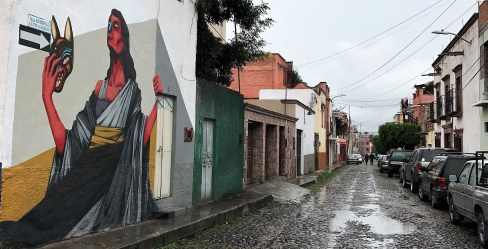
I’ve seen God lurking in the streets here in San Miguel de Allende since that first morning, but until the massage, we’d not had much contact. The colors are distractingly vibrant here; the traffic, the people constant and close. And bells. So many bells calling everyone to Mass. In India, the calls to prayer were just as insistent. I wonder if God attends now and then. Usually, I think she just sits on the side of the road, hand extended, eyes shaded. This is where the devil sits too. No wonder they ring so many bells.

God’s elbow dug into my trapezius muscle on the right. It’s always sore there. I winced. What could I possibly say to defend myself? God was energized, almost giddy. The musical tones and rhythms were accelerating. God’s talons circled my middle, I softened to feathers, and we soared skyward until earth blurred to a massive indistinction, like the abstract art at the Institute, suggesting–but not insisting–on life.

Mirrors

IMG_1549

The mirror this morning was blurry. Dim light showing only the essential outline of myself. I wanted no further clarity. “Does anyone want to see clearly?” I ask myself. “We’ve all fallen in love with this hazy image of ourselves. Aren’t we pretty? Aren’t we smart? Aren’t we worth saving?”

“Well, yes and no,” God says, startling me. I don’t know why God has to be so stealthy sometimes. In certain contexts, it could be devastating, but I’ve grown grudgingly accustomed to these sudden visits.

“Hello, God,” I say, not in a friendly tone.

“Hello, my dear,” God says. Is there mockery in that tone? Is that a smirk on God’s face? Why are the clouds gathering? Why are the birds so jittery? Is this it? Was it a mistake to paint the old bicycles bright colors and pretend they could fly? Was it sinful to spray the weeds with poison? Trap the mice? Carve out a selfish sanctuary, filled with food, and sustenance for my soul? Am I violating the stone when I slice it open to see what’s inside? Am I a fool to drink dark beer at dawn? Tell me, God. What is it?

“Good lord, what’s wrong with you?” God says. “Calm down.”

“I can’t,” I say. “Your plans frighten me. Your ways enrage me. There are too many stars. I don’t know who I am.”

“That’s totally understandable,” God says in a calming voice. “Perhaps it would be better if you suspended your faith for a while. I don’t need you to believe in me, you know. You can cut me loose. I’ll be fine.”

I swallow and keep my stinging eyes closed. “What good would that do?” I ask. “The sparrows will still eat the strawberries before they’re ripe. I’ll grow more feeble and gray. The children will blossom and fade. I won’t finish half of what I wish I could, and I doubt it would make me, um, whatever it is that I think I want.”

“Exactly,” God says. “Exactly. And I’ll love you, either way. I actually don’t need anyone to believe in me. The belief that matters flows the other way.”

The blurred mirror begins to splinter, cracks threading their way through the once-solid glass. My image is webbed with tributaries. Then it disappears as shards rain down, sharp and dangerous. I sweep them up and set out for the landfill, where it’s free to get rid of almost anything. Shattered lives, broken glass, carcasses of little yellow birds.

Sometimes, the guy at the dump saves something back for one more round of usefulness. Maybe, today, there’ll be a treasure to redeem. Or maybe not. I’ll be fine, either way.