There Will Come a Day

When I got out my vitamin organizer to take my supplements this morning, today’s cubby was empty. I must have dipped in twice yesterday. No wonder I feel overwrought; too much B-complex and an overdose of magnesium may account for my anxious dream last night wherein Barack Obama helped me bandage the finger I cut making his family a salad. I don’t like forgetting, and I don’t like anxious dreams.

But dream we must. Forget we must.  Decline we must. Die we must. There will come a day when the puppy digging in the compost right now is an old, grey-faced mutt, and there will come a morning when no matter how watchful I am, I won’t glimpse my sister, half-crazed on her 4-wheeler, chasing down a skunk with her shotgun.

“Sorry I’m late,” God says as she rushes in. “You’ve rearranged your writing space. I like it.”

“Oh, hi God,” I say. “Coffee?”

God holds up her hand. “No, thanks. I had a cup with your neighbor, and I’m going to treat myself to a latte later. Still catching up on the fiascos of Easter/Passover/Ramadan. And Ukraine…” Her voice cracks.

“Hmmm,” I say. “Want some vitamins or something?”

God smiles and leans forward. “You know I’m not vengeful, right?” I nod and wait. “And you know I don’t play favorites, right?” I nod again, wishing I could be an exception. “And you know branches will always grow toward the sun and move gracefully in the wind, and things you drop will fall toward the center, right?”

I nod a third time suddenly feeling quite sad. “And where do the things you drop go?” I ask in a quiet voice, turning my face away. But God sees my eyes welling up anyway. She makes a fist of her giant hand and thumps herself hard in the chest. “Right here,” she says, and hits herself again. “Right here.”

When I sleep, I shroud the windows in purple velvet drapes. It occurs to me that I’d like my body wrapped in these before it is laid to rest in the garden. “Sounds like a good plan,” God says, voice fading. “I like purple.”

I have the intention of wiping my eyes and nodding again, but neither are possible because I have dissipated into the moment. The drapes are sun-streaked, dusty, and elegant. Granted, it may be an idiosyncratic or imagined elegance, but it doesn’t matter. What matters is the gravity-defying blackbird perched on the top branch of the wind-whipped cottonwood.
Bruised

God and I were sitting in our pajamas near a nice fire, watching the sky, hoping the storm wouldn’t bring the cold temperatures predicted. Hoping the planet would somehow survive the ravages of greed. I was examining an ugly bruise on my forearm. Essentially, bruises occur when capillaries near the surface break and spill blood. Thin skin increases the risk.

Thousands of years ago, a prophet wrote that God wouldn’t take advantage of a bruised reed. There was no mention of bruised arms, egos, or disintegrating hips, but why would this assertion be necessary? What kind of God would go around beating up injured, weakened people, or break an already bruised reed?

“Um, God,” I say, “What’s your point with that whole bruised reed thing?”

God’s full attention swings toward me, a lumbering presence, a set of boots. I pull my sleeve down to cover the purple blotch. A tiny fraction of God’s focus is enough to end life as we know it, but I risk such things because in the end, it doesn’t matter. We’re sitting on a second-hand couch. I don’t care if it gets scorched.

“Why do you ask?” God says, warm breath laced with lavender and the allure of summer.

“Nice move,” I mumble and shift my gaze to the sparrows landing on the icy fence. As most four-year-olds know, Why? has no final answer. Asking why is a way to prolong the conversation, to shift the burden back.

I turn again to the God on my couch. “I ask because…” I am inundated with unwelcome insights. I hate bruised reeds. If I were God, I’d make a bonfire out of those damned reeds. How is it possible to walk alongside the bruising and the bruised? I don’t like wounded healers, and I don’t want to be one.

We sit. The wind is picking up, the chill becoming dangerous.

The ancient gaze of God is kind. “You love what you think is whole and beautiful because your vision is shallow.”

I close my eyes.

The primordial voice of God is gentle. “You love stories with endings because the untold threatens your sense of control.”

I cover my ears.

The wounded hand of God is warm as it hovers over mine. “You love stones because the bruises don’t show.”

I open one eye.

It’s not a single hand but a thousand; mottled, thick veined, and open. I choose one, entwine our fingers, and wait. God willing, the frozen ground will eventually soften toward spring when both planting and burying will be easier.  “Oh, we’re willing,” God says as the sky dumps snow. “But are you?”

Bucket Lists

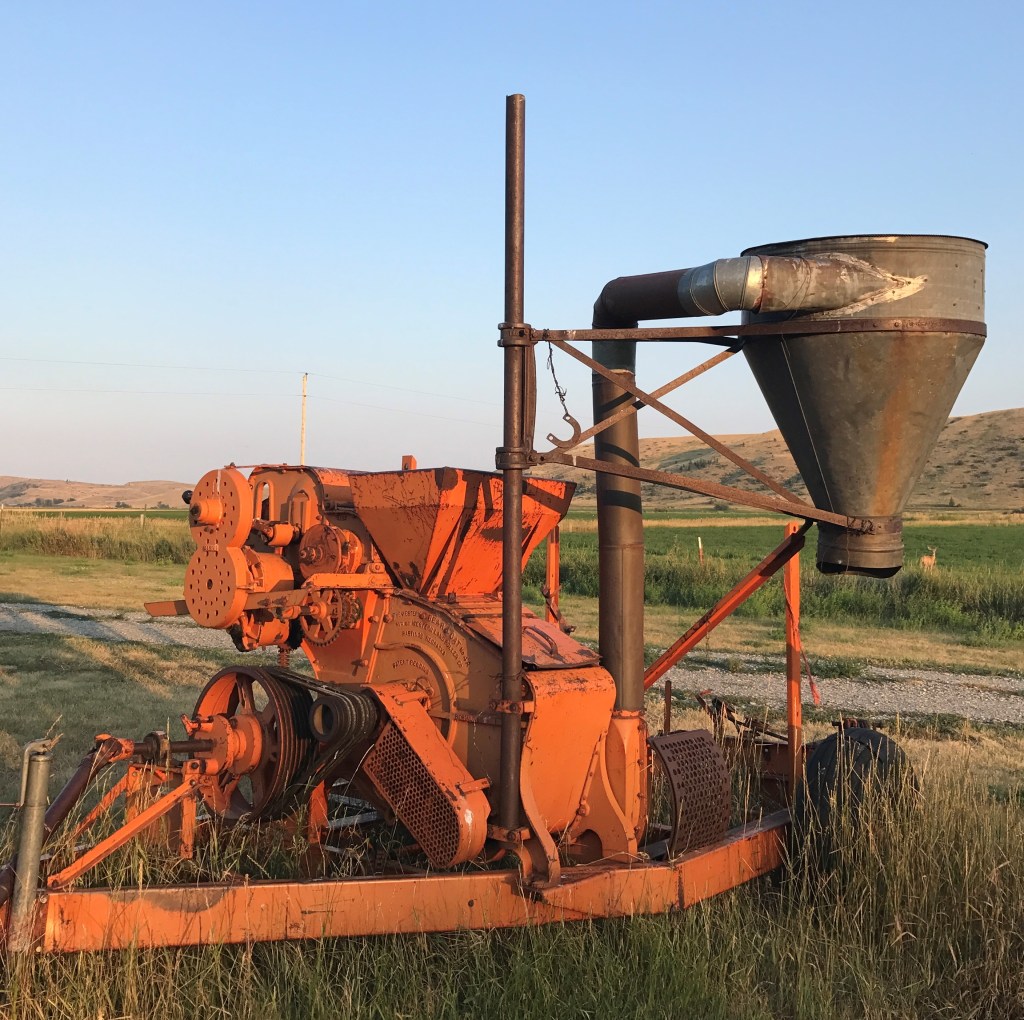
Nearly all the windows in our house are oriented south for solar gain, but the view to the north is exceptionally nice. Our inner space reflects a set of values, givens, and limits. We’ve filled most rooms with books and rocks to hide lapses in judgment. Outside, the garden has gradually improved—I love repurposing metal coated with rust and twisted stumps that are not yet dust. It takes a practiced eye to see the beauty.

“Yes,” God says, disrupting my existential mulling. “I love repurposing, too. Especially the fragile and distorted.”

“Hi there, God,” I say in a falsely chipper voice. “How about you be nice and take care of me today? Let’s exercise, write, do some art, drink green smoothies, and then after I’ve fallen fast asleep, how about you carry me gently into the next realm?”

“What?” God says in mock surprise. “You want to cash it in?”

“Well, yeah. Or, maybe,” I say. “I don’t like aging. I want an easy way out.”

“An easy way out,” God echoes, nodding. “Thank you for being honest with me.” This is a standard phrase therapists use when clients drop a verbal bomb about their homicidal, suicidal, malicious, vindictive, hopeless, violent urges and fantasies. It buys a little time.

But God doesn’t need to buy time. I’m suspicious. God already knows I’m as afraid of dying as the next person, but I’m deeply ambivalent about staying alive. Fighting for every last breath soaks up resources, drains loved ones, involves a fair amount of suffering, and has the same outcome. What’s a few more days or even years if they are filled with pain, struggle, and hardship? It may look heroic, but there are many ways to define heroic. Leaving willingly, gracefully, at the right time might be another definition. I glance sideways at God.

God glances back. “How’s that bucket list coming?” she asks, with a mischievous smile. “I know you’re inclined toward rescuing and saving, but don’t put the world, or yourself, on the list. You can save neither.”

“God, darling,” I say. “I don’t even know what ‘save’ means. And how’s your bucket list coming along?”

“Thanks for asking, sweetie,” God says. “But let’s talk about why you want to know.” This is another classic therapy maneuver; turn the question back on the client. But then God reaches over, takes a drink of my coffee, and salutes herself in one of my many mirrors. This is not a classic therapy move. Too invasive. Too intimate. Impulsively, I look straight at God, grab her cup, and take a swig. The coffee is hot, dark, and bitter. I want to spit it out, but God bows her head, palms together, touching her lips. I have the distinct impression she’s cheering me on, so I swallow and raise the cup. We look in the mirror together. It takes a practiced eye to see the beauty.

Lies

Sometimes, like right now, mocking, sarcastic words get in my head, and I write them down and imagine going viral. But then I hit delete hoping to be left wordless and alone. Words are the vehicle of vanity, triviality, and lies. There has to be something true beyond words.

In daydreams, I stare steadily into the eyes of the current Russian dictator, our own recent dictator-in-waiting, Brazil’s and Britain’s buffoons; I imagine having the depth of soul to crack their stony defenses and open some tiny pocket of humanity and compassion inside them. Their grotesque, malignant egos melt away and flocks of bluebirds and goldfinches are freed from within, winging their way to freedom. Cue: Julie Andrews singing “The Hills are Alive…”

O.K., I’ll admit it. What I actually imagine is vultures pecking their eyes out while I hold them frozen in place with a magic spell. Then I smash their skulls on rocks. I… There’s a disturbance to my left. I hold up my hand. “Not now,” I say, turning to God, who always stops by midsentence. “I’m on a confessional roll.”

“You certainly are,” God says, as she multiplies and divides. She’s heavy with child. With children. She’s heavy with hope and courage. She’s heavy with bombs. She’s swallowed the detonators; the bombs will explode, and today, like every single day on this blessed earth, she will die a hundred thousand deaths. And in this fragmented, impossible way, God, too, will go viral.

“Come with me,” God says. I back up, shaking my head.

“Where?” I ask. “Nirvana? The life I deserve next? The cross? The front lines? The back alleys?  The grave?”

“Yes,” God says. “Come.”

I take a reluctant step. Then another. It’s rocky terrain. I stumble. I get up and examine my scrapes and bruises. I hurry toward the fleeting purple robe in my pointy shoes. The bridge across the icy stream has been destroyed. I try to leap across, but I slip and fall in. I think I’ve sprained my ankle. I’m wet, cold, hungry, disabled, lost, afraid, and angry. I’m a refugee, hunted prey, weakened by age and a soft life. “Stop!” I shout at God. “You’ve made your point.”

“I did?” God asks, in disbelief. “I wasn’t aware I had a point.”

“Not funny,” I say, rubbing my frozen hands together.

“Agreed,” God says. “Not funny.”

Outsourcing

People who insist on naming God after themselves irritate me. Same goes for people who display religious icons, symbols, carvings, or statues. Wise writers far before my time called these “graven images” (not a compliment) and indicated Yahweh (not their real name) isn’t thrilled with the idea of being portrayed in such limited, distorted ways. We invent names we can pronounce and create images we can use for signaling, comfort, or torture. The names and images come with suggested donations and membership guarantees. The in-crowd will be safe. The out-crowd will go to hell.

For convenience, I call this massive, creative, omnipotent bundle of compassion, wisdom, and potentiality “God.” Short, crisp, easy to spell. But wildly inaccurate, right God?

God slides into view, a pile of sticks, a taste of tea, an imagined joke, a yoga stretch, safety. An act of kindness, vivid forest green washing through a dream that would otherwise be drab. God isn’t shy or without preferences, but neither is God insistent. I wait.

“Ocean,” God says. “Egg of magpie. Eye of newt. Opposable thumbs. Lace. Elephants. Lilies. Those who are heavy-laden. Microscope, telescope, telltale stains on a well-worn soul. Yellow. Something gleaming on the far horizon. Mercy. Hallucinations, hallelujahs, hallways leading nowhere. Everywhere.”

“Stop!” I yell. “What in the world do you mean?

God laughs. “Not sure what you mean by “world.” Remember that just beyond your definitions, a little part of me is waiting for you. But no hurry. We have forever.”

“Blue,” I said. “Warm quilts, icy beer. Old friends. Leg of lamb, bark of dog, things that frighten me. Death. Justice. Slow arrivals. Snow falling innocent and pure. The brave song of a single child. A cracked bell ringing.” I stop and wink. “Am I getting the hang of it?”

God loves to play, but sometimes the rules of the game are hazy. The fire crackles and converts the dead apple tree to gas and soot. The temperature rises. A tiny fraction of feather escapes from a small tear in my down vest and floats on currents invisible to my naked eye. It appears to defy gravity in favor of other forces as it floats here and there. Or maybe it isn’t defiance. Maybe it’s a complex expression of faith: gravity, warm air, cool air, breath, the earth circling a star we’ve named the sun.

The wisp of feather finally settles, God fades, and I know that someday I will be free and undefined. But for now, I make up rules that suit me and name things that actually have no name.

The Harder Truths

“God,” I lamented. “It’s seriously cold and I’m sad.”  My old friend had died in the night, brave and private in his decline. I rubbed my hands together, trying to warm them. God watched me, face impassive. I continued. “You know I hate being cold.” I was feeling sorry for myself. Too many losses. Too much grief. Deep freeze cold makes me insecure, achy, and painfully aware of mortality.

God didn’t seem inclined to do anything useful, so I got a blanket. She watched as I draped it over my chest and wrapped my feet. Then she said, “Most of you secretly want your mommies when you’re cold, hungry, frightened, or sad, don’t you?”

This seemed less than kind. I glared. Said nothing. God went on. “But not your real mommy. You want an imaginary celestial being who understands how hard things are. Someone to fawn over you, feed you, assure you of your incredible worth, make false promises, and tuck you in, safe and sound, every night.”

I wasn’t enjoying these revelations, and the blanket wasn’t helping much. I shivered and looked away. God continued. “Oh, I know you sometimes arrange to be tucked in by surrogates, but even if they give you warm milk, dim the lights, or stay and snuggle, they aren’t what you long for. They can’t save you from yourself.”

Why on earth was God saying such things? I’m not all that demanding. I don’t think I long to be taken care of—at least not all the time. Is a blanket too much to ask? Overall, I’m relatively independent, nearly a prepper, minus the guns. I have two outhouses, a pantry, solar panels, wood stove, tons of rice, and an attitude.

God sat big in the middle of my brain. I sat uneasy in the presence of this God, apparently determined to say things I didn’t want to hear.

“Being grown-up means you put yourself to bed at night.” God said, as if ending a sermon or an inspirational talk.

I was not inspired. “No,” I wailed. “You’re wrong. You’re there. I know you are. And there are others. The ancestors. The nymphs and gnomes, the weak and strong. My beloved. My children and the children in such despair. Such need. They all go to bed with me. And we sleep. And we wake up. And we hope. And we believe as best we can.” I made these shaky declarations between ragged breaths, my hands fisted, ready to slug it out.

God took the fists and blew warm breath on them as they unclenched. I looked up and saw that God was crying, too. We flung our arms around each other and let the tears drip into the vast and rising darkness where the souls of the dearly departed wait to tuck us in with a strange and certain warmth.

Senses

Smell is our oldest sense. Collectively, humans can detect billions of different odors. This has played a central role in our evolution, leading to such literary declarations as Fe Fi Fo Fum, I smell the blood of an Englishman. The sense of smell has made headlines recently because a microscopic organism has been infecting human brains, disabling the senses of smell and taste: a virus not to be trifled with. But then, evil is rarely to be trifled with, right God?

No answer. The silence isn’t holy. But some days, I just keep talking.

And about this notion of evil, God. Who’s evil? What is it? As you know, I don’t like dust settling on things again and again or ashes as a final destination. I like fresh sheets, crisp salad, and good news. Call me shallow, but that’s the way it is, God. I would prefer to be comfortable, adored, young, well-fed, and smart. And whatever deprives me of what I want, well, let’s call that evil, shall we?

My one-way chat takes a nasty turn as the sun intensifies through the window and I see myself reflected on my computer screen in all my dismal glory. “No wonder God is busy elsewhere,” I say to my image in a mean voice. “You’re all the things you dread.” I consider the procedures and surgeries available to make me seem younger, more adorable, smarter. This breaks my fall. My distended ego deflates, and I give myself a smile that naturally lifts the wrinkles.

See, God? Here I am, smiling. All done judging. C’mon by.

I sit. I force myself to say prayers of lovingkindness for the twisted senator, the mouth-breathing fools on the airplanes, lazy neighbors, unkind people, even those who torture, deprive, and dehumanize. I give thanks for my senses, even though I can smell the blood of the disgusting humans who are destroying the planet. Oh, I wish I were the giant.

This last thought finally rouses The Presence. Holy Words, like sleek black animals, invade my brain. “You can’t eat your way to heaven,” they say in a low growl. “You can’t smell your way to salvation. You can’t see the face of God, and you can’t force your way in.” The Words collect around The Presence, and The Presence turns to me, taking the shape of a very old friend.

“The thing that shines in the broken moment, the shelter of translucent skin, these are lessons. Very little of who you are or what you do is to your credit or entirely your fault. Regardless, you will never be the giant. For this, be grateful. Go listen to holiday music. Inhale cinnamon and vanilla.”

“But that seems so…” I pause.

“Shallow?” asks my Very Old Friend. “Simple?”

“Yeah,” I nod. “It’s like giving up. Surrendering.”

“Yes,” my Very Old Friend says. “Much harder than it seems. But you can do it.  I’ll help.”

Sphincters and Other Lesser Parts of the World

In the process of letting go (a euphemism for aging) I’ve grown more conversant with my inner workings. Organs, nerves, limbs, skin, circulatory systems, hairline–we’ve all befriended each other. For instance, on a recent road trip miles from anywhere, my bladder urged me to pull over. I squatted (a humble pose if there ever was one) and waved cheerfully at the driver of the pick-up that happened by. She waved back. A warm calm spread throughout my body as my bladder and I drove on home.

Some of us think of creation as parts of The Body. Others are more exclusive about who’s in and who’s out; what’s to be honored, who’s to be enslaved. These are ego-based pretendings, wrong-headed derivations. In the Oneness, every molecule has a voice. For instance, when stubbed, the oft-overlooked third toe suddenly takes center stage.

This is the kind of pondering that almost always guarantees a visit from God. Sure enough. She’s arrived on the west wind with a flood-inducing chinook on her tail.

“Why, hello there, God,” I say. “What a nice surprise. C’mon in.” My automatic hospitality reminds me of a poem my grandmother had on her kitchen wall:

            Guest, you are welcome here. Be at your ease.

            Get up when you’re ready. Go to bed when you please.

            We’re happy to share with you, such as we’ve got,

            The leaks in the roof and the soup in the pot.

            You don’t have to thank us or laugh at our jokes.

            Sit deep and come often. You’re one of the folks.

I memorized the rhyme, but I didn’t know what it meant to sit deep, and I didn’t like people partaking of my grandmother’s kindness. I wanted her all to myself. Now, I want God all to myself. I want singular adoration, endless comfort, and permission to be at my ease forever without the hassles of caring for others.

“Sorry,” God says. “Doesn’t work that way.” We gaze at the fire. She strokes her chin. “If you had a choice, which part of The Body would you be?”

I chew my thumb and think. Brain, eyes, ears all come to mind, but they’re too obvious. “Bladder,” I say. “I’d be the mop bucket.”

God laughs. “You know you’d have to cooperate with the sphincter, right?”

“Yeah,” I say. “I’ve known that for a very long time.” I raise my right hand. “I do hereby solemnly swear to love and honor the sphincters of the world. My own and others.”

I expect God to chuckle, but instead, I realize we are sitting deep; God and me. And I see that nothing functions without cooperation and mutual respect, internally or out there in the nasty, brutal, fractured Oneness we live within. I know I’m not alone, but sometimes I wish I were.

Holiday Lights

Recently, my friend brushed so close to death that her skin became luminescent, and the fingers on her left hand grew longer and more graceful. I noticed this when she lifted that hand to show me how she’d surrendered. I suspect she was either bidding the others in the room farewell or she was offering her hand and the rest of herself to the Larger. She doesn’t know. But at that moment, a Boundless Tangibility of Peace overcame the reluctance in her lungs, and she lived. It was that close. I like looking at her. She’s always had an easy laugh and a generous ear, but now she glows.

Three years ago, I decorated random pieces of yard art with solar-powered holiday lights, and they’ve flickered ever since, faithfully announcing the arrival of a thousand nightfalls. Of course, I know that eventually the lights will go out and my friend will stop glowing, but the pressing question is this: What are we supposed to do in the meantime? How should we greet each sunrise when we find ourselves alive? How do we handle the twinkling blue as daylight fades? My friend isn’t sure. Neither am I. We think it has something to do with acceptance. Authenticity. Doing our best.

But who knows? My Co-author does, but it’s tough to get a straight answer.

“Now honey-pie, y’know that ain’t true.” God has shown up. He protests in an awful imitation of a Southern drawl. “Y’all make this a bigger puzzle than it needs to be. I’ve been damn straight on this since forever. Love, give, and rejoice until you cannot do it anymore. Then fold.”

“You make it sound easy, but it’s not,” I say, feeling both insolent and amused.

“Want me to spell it out, darlin’?” God asks, long arms crossed over galactic chest, looking impish.

“Yeah,” I say. “Spell it out.”

“Love.” God says as if he’s in a spelling bee. “L. O. V. E.”

“Very funny,” I say.

“Then laugh,” God says. “Laugh your greedy, frightened, malignant, time-limited ass off.”

“I don’t mean funny like that,” I counter. “I mean you aren’t much help. I can spell ‘love’ all by myself.”

“Oh, really?” God asks and waits.

“Really,” I say firmly. But I’m lying. I’ll be asking for help within minutes. With apologies to Robert Frost, I’m often a lost child in the confusing woods when it comes to love.

“Now, ain’t that the Truth?” The Boundless Tangibility of Peace says to the Larger.

“For certain,” The Larger says. “Them woods is lovely, dark, and deep. But they ain’t no place for a chubby-cheeked babe.”

This cracks us up and we laugh our fool heads off. Yes, God is Love, the Big Breast in the Sky, the Larger, the Smaller, the Woods, the Clay, the Life, the Death. And yes, God is the Way Home. But until then, there’s work to do, and we all know how it’s spelled.

High Wind Warning

As dawn arrived, the wind picked up and all manner of things wired or weighted down began banging and clanging in protest, especially the artistic frying pan hanging next to the rusty tire chains. Everything not secured took flight. It was the last I saw of the brown tarp, the ordinary clothes I’d hung to dry, and the light pink clouds that make mornings easier. I ran outside and grabbed at vague shapes flying by, but it was futile. I looked up. The tempest had peeled the sky raw, and the gaping blue of infinity was in sharp relief. I wasn’t ready for the existential vertigo that washed over me. My lack of innocence was frightening.

“God!” I yelled from the middle of nowhere. “I could use some help here!” The voracious wind emptied my lungs and flung my words down the valley. I took cover in the low-slung fort I’d built as a child, amazed it was still there. On hands and knees, I inched deep into the soft, undisturbed darkness and found a place to hide.

This is where a Godness discovered me, hours later. I was thirsty and ready to surrender. The Godness began to sing against the merciless gusts in a tone lower than sound. Gradually, the wind died down, and we emerged to survey the damage. Fallen trees, stripped branches, shed antlers, lost feathers, disturbed water, dashed dreams—a landscape bereft of permanence. Neither God nor the earth engage in murderous self-defense. I could see why the promise of heaven makes so little sense. It’s only the promise of hell that matters.

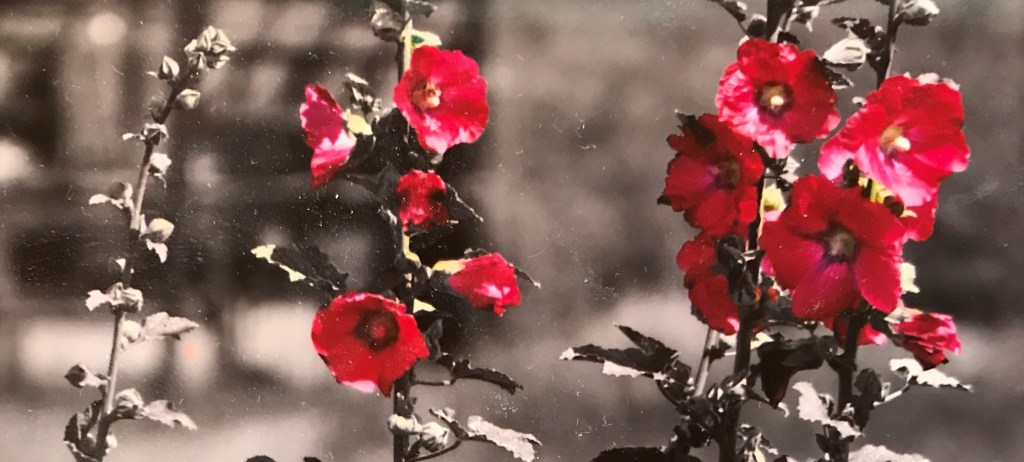
I tried to whisper the names of God etched in the grounded patterns of dust and ash, but my lips were gone. Holy breath, warm and moist on my neck, made me long for my mother, or a simpler God, or something easier than gale-force wind. Gently, the Godness wrapped me in fragmented light and told me I would always be beautiful. I shook my head and blushed the blood red color of my favorite hollyhock.

Hollyhocks are biennials. The seeds from the parent plants sprout and gather force the first year and bloom madly the next. They can last for generations without any human assistance. The hope they inspire seems delicate. But it’s not.