The Coming of the Winter


Chopping hollyhock skeletons in the wind guarantees a shower of fertilize seeds scattering every which way. Far too many will attempt to germinate no matter where they’ve landed.

Hollyhocks are cross-breeders. Mutators. They mix it up. It’s impossible to predict which colors they’ll sport if they successfully root and grow. Lavender, salmon, yellow, white, pink, red, and magenta. In moderation, they are spectacular, but like the unwanted and displaced everywhere, their attempts to flourish indiscriminately must be attenuated. This, I do not enjoy.

There is weariness in managing opportunists, weeds, and predators,
in seeking balance against exuberant or shameful excess.
There is tedium in finding words, choosing words, creating words.
Like hollyhock seeds, there are too many fertile words
jostling for position in our limited thoughts.
Especially in the fall, when everything is browning
and dropping and preparing for winter
as if another spring is guaranteed. As if lying is acceptable.

“Preheat the oven,” my Coauthor says. “We need to hurry.”
I glance at the clock and shake my head. “Too late. We’ll have to go without the bread.”

Disappointed and crabby, my Coauthor helps load the car. We put the sweet batter in the fridge for later baking and our resentments on hold for later resolution. Not every day can roll out smoothly. The smell of cinnamon cannot infuse every moment. No one lives forever.

That doesn’t stop us from blaming each other.

“God,” I say sternly. “You could’ve heated up the oven on your own.”

God glares out the window. We drive the muddy roads a little too fast, but we make it in time to be of help.

There is weariness in brushing the remaining strands of hair,
in mumbling hollow phrases of comfort.
There is tedium in searching for ways to say I love you,
fare thee well, and goodbye.
The first skiff of snow on the mountains
is the last gasp of the summer that promised never to end.
As the light wanes, the transformation of pleasant evenings
into the inevitable pitch-black night is softened
by a moon that is no longer out of reach.

Angles of Repose and Other Non Sequiturs

What do you suppose the angle of repose would be for those pyramids of dead bodies we’ve seen in the news over the years? (The angle of repose is the steepest angle at which a sloping surface formed of a particular loose material is stable.)

Syria. Tuam. Viet Nam. The Sudan. Gaza. The victims of Covid in Brazil. In these places, they would know.

Mass graves are frowned upon here in our modern and stolen country, so most of us will not witness haphazard heaps of people firsthand. We have refrigeration and waiting lists. We prefer to deport or enslave rather than outright slaughter.

Most mornings, I either cry or paint something. Some days, it’s yellow. Others, dark blue. Or a swirling medley of colors interacting aggressively with each other. Sometimes, I glue broken bits of mirror into new shapes. It can get messy.

“What would you like to cover today?” I ask Royal Blue. Before Royal Blue can respond, Blood Red shoves Royal Blue aside, and a firing squad tosses the sanctity of life into the air and takes aim.

“Knock it off right now,” I yell at Blood Red. “I MEAN IT.”

Blood Red shrugs. “Fine. But you know I’ll be back.”

Something ends. Something begins. Breakage and destruction are part of rebirth. A long time ago, at the end of an especially magical youth camp, I considered smashing my guitar so I could give everyone a splinter. I had the odd notion that this would keep us together. But smashing my guitar seemed a bit extreme. Instead, I pulled apart a pheasant feather that had traveled in my guitar case for years and handed the astonished circle bits of pheasant down.

 Now, most days, I wonder if I have something I could dismember to express my outrage and despair. To break hope open. To keep us together.

“Heroics come in many guises,” the Paint Brush whispers. “You do you. No need to come apart just yet.”

“That’s nice of you to say, Paint Brush,” I shake my head. “But I’m no longer flexible enough to kick myself in the butt.”

“Who cares?” Paint Brush scoffs. “Bruises aren’t the best motivators. How about a cookie?”

“Not hungry,” I mumble.

“Oh, honey,” Paint Brush says gently. “You have no idea how hungry you are.”

Gun Racks to Book Shelves


My computer indicated it needed to be restarted this morning and then it wouldn’t stop. I would have panicked and forced a shutdown had not James, the patient man from the repair shop, assured me these things take time. “Chill,” he said. “Have some breakfast.”

James did not realize that I’d already eaten two breakfasts and downed my morning half-beer. I did not share this with James. Instead, I made myself putter, peeking at the screen every five minutes for two hours.

And voilà! The computer finally stopped restarting and seems docile and responsive enough to risk writing some words.

During that down time, I distracted myself with housekeeping which led to some rearranging ideas. The Coauthor appeared as I emptied a shelf unit and started to push it to the door.

“Don’t try to move that alone,” she scolded. “It’s too heavy for you.”

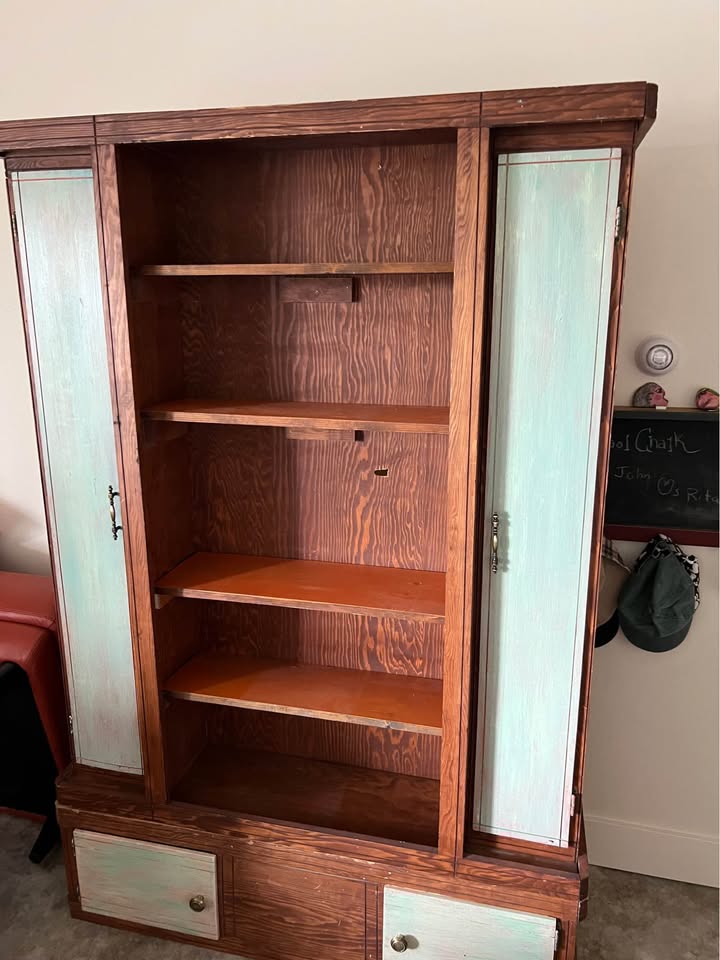
The shelf in question was an old gun rack I’d converted to a bookshelf in my efforts to bring about world peace 35 years ago. It has grown uglier, and the world has grown more vicious. I want to donate both the shelf and the world to an unwitting charity and start over.

“It doesn’t work that way, sweetheart,” the Coauthor said sympathetically.

I cried a little. My increasing incapacities are deeply disturbing.

“You move it then,” I said, defiant. “Or else I’ll keep trying, and it will fall on me, and I’ll die a slow death pinned under my own stupidity.”

“That’s how most of you will die anyway,” she laughed.

“Not funny,” I said and threw a paisley orange pillow at her. She caught it, and we sat down on the worn and disconnected sectional (my latest attempt at the perfect couch).

“Let’s go,” she said.
“Let’s not,” I said.

But I was outvoted, and the cosmic train pulled into the station.

We dissolved into waves of symphonic sound. Timpani drums made from the skins of scapegoats boomed like bombs bursting in air. The bass moaned low and mournful, the cellos and violins sobbed as they were deported. But somehow, life itself was beautiful beyond words.

“How can this be?” I asked the Coauthor. But I knew. The celestial choir had dismembered me, and my atoms were dancing shamelessly inebriated in the variegated light.

Eternity receded. I resisted reassembling, but here I am, alone with my keyboard, an empty bookshelf, a list, and a plan. Somewhere, in another time, another place, I am an oboe.

A leopard.
A mollusk.

I am puffed cheeks blowing out fifteen candles and the first gasp of a new planet.

And at some incomprehensible level, I trust that all will be well.


The Circle, The Fall, and The Fat-Faced Child

From the perspective of a maggot, a cadaver is not an ending. It’s a feast. But then maggots are a banquet for geckos who are later gobbled up by mice. Laying hens peck mice into bite-sized pieces, and I enjoy chunks of chicken in my stir-fry.

Yeah, yeah. Circle of life and all that.

But are we more than maggot fodder? This has been debated since we invented the language necessary to express the longing and horror the question evokes.

“Of course, you’re more than maggot fodder,” The Ether speaks.

I sigh with relief, but I don’t let my guard down.

“And…?” I ask.

The Ether laughs. “You’ll be gecko excrement as well!”

“And there it is.” I roll my eyes.

“Seriously, honey, you’re not one thing now, and you never will be. The Holy Procession always breaks things down.”

I fight to stay coherent and unbroken in the moment.

The Ether materializes as a fat-faced child. Blond and defiant. I stare at the face. I wonder if it will wrinkle and hollow with age or stay pink and ebullient forever. I wonder if I will get my youthful body back someday.

“You wonder some crazy shit,” God says.

“You would too if you lived here. If you watched the news. If you had an inkling of what it means to deal with a real body.”

“Oh, but I do.”

“No, I live here. I am. And I do. You only pretend.”

The Fat-Faced Child frowns and begins to build a doll house out of Lincoln logs and Legos. “I’m gonna paint this pink and live here,” she says. “You’ll see.”

Her energy could easily swallow me alive. I go to the basement to get paint. Hot pink first. Then lemon yellow, lime green, royal purple, and turquoise. With this pungent, tangible turquoise, we could paint ourselves into the Upper World of the Zuni, and I am filled with joy. I am ready.

“How is this possible?” I ask.

“You have to fall,” she says. “Sometimes hard. Sometimes soft. But you have to let go and fall.”

In front of the doll house, a circle of my dearest friends are singing. Ring around the rosy. Pockets full of posies. Ashes, ashes. We all fall down, and they begin to fall. But The Fat-Faced Child falls first. Even in diminishment and grief, this is something I’ve always known.

  The Fat-Faced Child Falls First

Accusatory cataracts

drop from my eyes

And I realize

The Fat-Faced Child

has always fallen first.

Always suffered most.

Always broken the fall

for the rest of us.

And in the endless ruination,

The Fat-Faced Child

uses all the jagged bones

and tender tissue

to build again.

The Perfect Couch

I’ve searched for the perfect couch for a large portion of my adult life. I maintain a steady presence on the internet marketplaces and frequent the thrift shops scattered across the three states we travel the most. My couch karma is pathetic. Once, I broke my vow to only buy used items and bought a new one. That didn’t work out either.

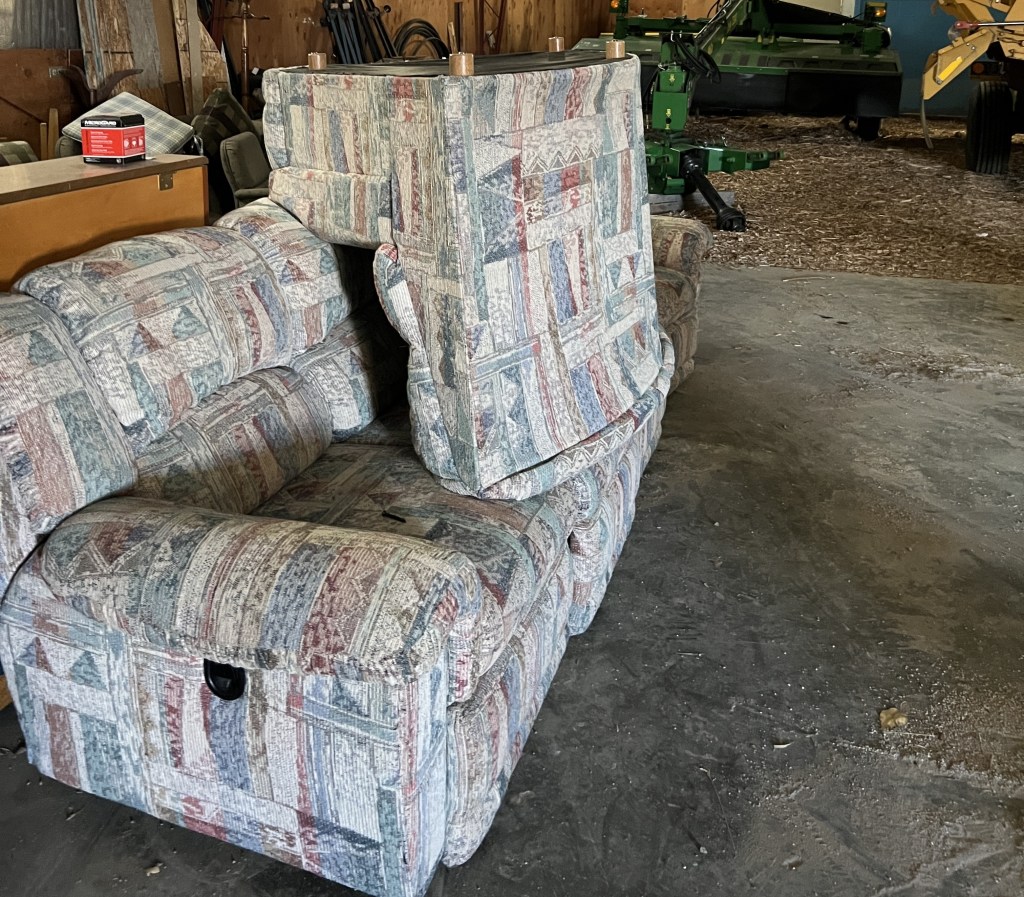
Over the years, God has cheerfully sat on each of them except for the small sectional coated with multiple layers of nearly invisible cat hair. That one didn’t even make it into the living room. Too bad. It would have matched the nostalgic recliner I’m usually sitting in this time of day. If any cat people are interested, the sectional is piled in the barn. Blue geometric design. Can’t miss it.

“You’re funny,” God says, lowering himself into the sagging cushions of my most recent attempt.

“I know,” I reply, proud but sad. My mom would have turned eighty-nine today. I didn’t engage in any “Happy Birthday in Heaven” posts, but I’ve sent my regards to wherever the essence of mothers goes.

Generally, my mom did not like secondhand furniture, but she loved this little recliner that last year because she could put the footrest up and down on her own. Limits and needs humiliated her. She would have starved rather than ask someone to cut up her meat. I can relate.

It is one of life’s ironies that if we live long enough, we come to understand the disappointments, fears, and irritating quirks of our elders from the inside out.

“No, no. That’s not irony,” God says. “That’s mercy.”

“I don’t think so,” I say. “It feels vindictive. It makes me wish I’d been nicer and tried harder to understand.”

“No amount of niceness takes mortality away. You were nice enough.”

“I’m not so sure.”

“Trust me,” God says, “You were nice enough.” Then he adds, “Say, I didn’t sleep well last night. Mind if I take a little rest?”

He yawns, snaps the wobbly footrest up, settles back, and is soon snoring peacefully. I watch his chest rise and fall while George Winston plays melancholy piano in the background. Such short lives. Such very short lives.

I guess maybe it is mercy, I think. Better to understand later than never. A rush of adoration washes over me. I lower my own footrest quietly to tuck a turquoise blanket around the vast arthritic feet of my friend, the patient creator, the weary one, snoozing on my latest bad couch.

Uncle Bud

Just days ago our beloved Uncle Bud fell and did not regain consciousness. This past year his body and mind had started giving way, and our collective family grief began. Now it’s in full force. He’s gone.

Among his many achievements and passions, Uncle Bud was a master fisherman. I walk by the river, seeing it through his eyes, feeling his hand-rubbing oh-boy enthusiasm from the inside out. God walks alongside, quiet.

“It wasn’t all rosy,” she says. “For him or your mom…”

“I know,” I interrupt. “They didn’t talk about it much, but I know.”

Uncle Bud was generous, kind, and positive. Filled with good humor and gratitude. In contrast, his childhood included poverty and difficulties most people don’t have to face. In a moment of rare self-disclosure my mom told me that she and Uncle Bud had a pact: They would be there for each other, and they would never, ever give in to the negativity and deprivation they experienced as children.

I’ve known a lot of bitter, unkind people, who constantly blame others for their troubles. Their parents, the government, teachers, partners, neighbors, children—anyone but themselves. Fault-finding is a toxic hobby; blame obliterates gratitude. This is ironic because gratitude lifts the spirit. But for some reason, finding fault is simple, and blame is easy. Gratitude takes effort.

“Why is blaming so seductive?” I ask God.

“That’s a no-brainer,” God answers. “It’s lack of center. Lack of compassion. Insecure people crave admiration. They focus on what’s wrong around them to build themselves up. They’re takers, not givers. Enough is never enough and they are never to blame.”

“Yeah,” I said. “I feel that tension all the time.”

“What tension?” God asks with false innocence.

“I want to be positive and cool like Uncle Bud, but I also want everyone to notice how much I give, how hard I try. I tell myself it’d be good for them to be grateful. But that’s not how it works is it?”

“Being positive is a choice, and gratitude’s a choice. You can’t demand gratitude,” God says with a knowing grin. “Trust me. I’ve tried!”

 “Ha! You’re almost as funny as Uncle Bud.” I smile sadly.

“Thanks,” God says. “He really was amazing.” I nod. We watch the trout rise. And together we remember Uncle Bud with sadness, love, and deep well-earned, willingly offered gratitude for the courageous choices he made and all the ways he added happiness to the lives around him.

Speaking Terms

Yesterday, God and I were not on speaking terms. Today, a purifying spring snow is falling, the beer is cold, and I have repented. It was partly God’s fault, but I’m the one repenting. It works better that way. God can be a real handful, but after I calm down, I don’t mind cajoling him along. It’s that or fire him, and I don’t want to fire him: I need the help. We all need the help. Even the toughest among us need the help.

“Not true,” the Bruising Force of God says, smearing bacon fat on the last piece of toast. “Well, maybe true,” he admits, chewing with his holy mouth open.

“Sometimes, you disgust me,” I say, trying to focus on the garden instead of God’s missing teeth, the dead bodies in Ukraine, or the grief inherent in being human. Pandora is playing my Eva Cassidy station. I turn up the volume to drown out the smacking noises. Long ago, a friend introduced me to Eva’s voice—though Eva had already died of breast cancer. She didn’t survive long enough to enjoy her success. My friend does not remember any of this because her memories have come as untethered as cheap kites in sporadic wind.

“Cheap. Fancy. Doesn’t matter. They all come back to earth,” God says, as he brushes crumbs off his shirt. “Write that down,” he adds. “That’ll be a good line.” I glare out the window. The snow is thicker now, each flake a mesmerizing angularity, falling straight and heavy. I wonder if the weight will break branches.

“Yes,” God says, still pontificating. “Branches will break. Oceans will rise. There will be surges and recedings. But in the meantime, I’d sure like another piece of toast.”

My wish to bring God down a notch is palpable, but I manage to get up, walk calmly to the kitchen, and make more toast.

Preparing for Guests

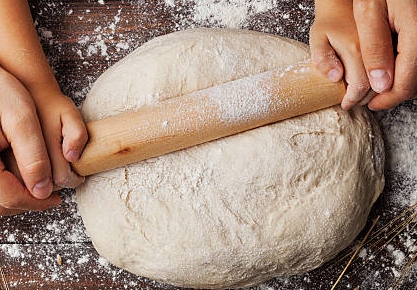
Not long ago, God and I were kneading dough, trying to time things so the smell of fresh bread would greet our guests at the door. Homemade sourdough is one of my staples, and I wanted to impress these acquaintances with my earthiness. I had a hunch they were our kind of people.

Most of us need a few homies; a posse, an inner circle of those who know us well enough to hold our fears and failures–and reveal their own. Recently a chunk of our inner circle fell to the forces of mortality, and the wound is still tender, keeping me acutely aware that anyone can fall at any moment and no longer be. God puts the dough in a cool place to slow the rise. She gives me a knowing glance. “You’re ambivalent, aren’t you?” she asks.

“Yeah,” I say. “There are days I think it’s best to be disconnected. Less risk. Less pain.”

“Slight correction, if I may?” God says. “What you mean is that the illusion of being disconnected offers a bit of respite, but…”

I hold my hand up. Mercifully, the Center of All that Is and Isn’t, the Author, the Plot, the Weaver of the Tapestry, the Queen of Connection stops talking. I know where this is headed. I know about Oneness, and I know about loss. Many’s the time I’ve tried to make God understand how it feels to be on my side of the perpetual falling away, but God only sees it as falling into, not away. I think that’s callous and naïve. God thinks I’m tiresome and unsympathetic. So, once in a while, to show God how hard it can be, I sing to her–usually James Taylor’s Fire and Rain–and she cries a little for our sakes. But being the thing we fall into is also hard. She borrows Paul Simon (himself, a borrower of ancient hymns) and sings to me.

“…I’ve often felt forsaken, and certainly misused. But I’m all right, I’m all right. I’m just weary to my bones. Still, you don’t expect to be bright and bon vivant so far away from home, so far away from home.”

And I cry a little for her sake. The best homies remind us we aren’t home, and the wisest among us realize there is no home, only the lonely journey and the shared and cherished resting places. Most dreams have been driven to their knees, but it’s all right. It’s all right. Even when exhausted, God kneels alongside the dream. And shatters with the dream. And sings.

The oven is ready, the table set. We will break bread together, drink leftover wine, and in those rare moments, we will bravely partake of a singular and temporary joy.

The Harder Truths

“God,” I lamented. “It’s seriously cold and I’m sad.”  My old friend had died in the night, brave and private in his decline. I rubbed my hands together, trying to warm them. God watched me, face impassive. I continued. “You know I hate being cold.” I was feeling sorry for myself. Too many losses. Too much grief. Deep freeze cold makes me insecure, achy, and painfully aware of mortality.

God didn’t seem inclined to do anything useful, so I got a blanket. She watched as I draped it over my chest and wrapped my feet. Then she said, “Most of you secretly want your mommies when you’re cold, hungry, frightened, or sad, don’t you?”

This seemed less than kind. I glared. Said nothing. God went on. “But not your real mommy. You want an imaginary celestial being who understands how hard things are. Someone to fawn over you, feed you, assure you of your incredible worth, make false promises, and tuck you in, safe and sound, every night.”

I wasn’t enjoying these revelations, and the blanket wasn’t helping much. I shivered and looked away. God continued. “Oh, I know you sometimes arrange to be tucked in by surrogates, but even if they give you warm milk, dim the lights, or stay and snuggle, they aren’t what you long for. They can’t save you from yourself.”

Why on earth was God saying such things? I’m not all that demanding. I don’t think I long to be taken care of—at least not all the time. Is a blanket too much to ask? Overall, I’m relatively independent, nearly a prepper, minus the guns. I have two outhouses, a pantry, solar panels, wood stove, tons of rice, and an attitude.

God sat big in the middle of my brain. I sat uneasy in the presence of this God, apparently determined to say things I didn’t want to hear.

“Being grown-up means you put yourself to bed at night.” God said, as if ending a sermon or an inspirational talk.

I was not inspired. “No,” I wailed. “You’re wrong. You’re there. I know you are. And there are others. The ancestors. The nymphs and gnomes, the weak and strong. My beloved. My children and the children in such despair. Such need. They all go to bed with me. And we sleep. And we wake up. And we hope. And we believe as best we can.” I made these shaky declarations between ragged breaths, my hands fisted, ready to slug it out.

God took the fists and blew warm breath on them as they unclenched. I looked up and saw that God was crying, too. We flung our arms around each other and let the tears drip into the vast and rising darkness where the souls of the dearly departed wait to tuck us in with a strange and certain warmth.

Aerobics

On road trips, it is important to adapt. I just finished hopping around for 30 minutes in this guest house, urged on by a British man and two scantily clad women on YouTube. As is often the case, the women were silent, but they kept the beat. God sat on the edge of the bed, observing this ritual. My upper arms will be sore tomorrow because I do not routinely wave them around like that. I prefer the treadmill or the great outdoors.

“You’re always welcome to join in,” I say to God, as I wipe sweat droplets from the floor.

“Kinda busy,” God mumbles and turns to the map of the world on the wall.

I follow her gaze and feel the familiar plummet of significance. Not counting disputed regions, for now there are 195 independent (and artificially defined) nations on earth, populated by over seven billion of us. None exactly like me, but all of them a twinkle in God’s eye and a pain in God’s neck. All of them a whisper. Each of them a vision just out of reach.

“Remember,” God says. “The map is not the territory.” I do remember. Albert Korzybski, a Polish-American thinker, said that a century ago. Wise man, but still. Maps are something, right?

I grab my jacket and invite God along for a stroll in the park with the puppy and me. “Already there,” God says. I knew that, but I thought I’d ask. The proportionality of God is the issue. The map on the wall is a flat reminder of a round planet in serious trouble. Many of the flags along the bottom include red. I hold out hope that bleeding isn’t necessary, and weapons are not the final answer.

God sighs. “You left the key in the car and the car unlocked last night,” she says. “Might want to lock up on your way to the park.”

“Might not,” I say. “I like it when nothing happens.”

“Right,” God says with an eye-roll. “Your choice. A safe car is not a blessing. A stolen car is not a curse. Just so you have that straight.”

Of course, I don’t have that straight. I’m human. I manufacture imaginary blessings like that unstolen car all the time. “Sure thing,” I say to God with false bravado. “I get it. You had nothing to do with the car being safe.”

“That’s not what I said,” God says. “It’s just that I hate riding along in stolen cars, but I won’t blame you if that’s what I need to do. I’ll ride. I always ride. Even when it’s only a minor traffic violation, not a stolen car.”

“You ridin’ black or white?” I ask.

“Black,” God said. “Black and male. If they shoot me, call my mother, will you?”

I’ve not spoken with God’s mother for a while. I nod. “I will,” I say, imagining the cosmic grief the call would inflict. “But do you have to take such risks?” God gives me a disappointed look. “Yeah,” she says firmly. “Yeah. I do.”