Don’t Listen to the Wind

“How old do you think I am?” the wind asked as she whined by.

“Older than those hills you’re blowing away.” I smiled.

“And twice as dusty,” God added, chuckling.

The wind shrugged and continued on her way, but I kept up the banter. I love it when God is amused.

“Hey, speaking of old, how about that 300-cubit ark they built in Kentucky? Or that dinosaur museum in Montana where they claim that homo sapiens co-existed with the T-Rex?” I grinned.

The literalist take things to such absurd levels, I assume the Creator thinks it’s funny.

“Don’t,” God said with a catch in his voice. “Don’t.”

I did a doubletake. God wiped his eyes and dropped his head into his hands. “I never dreamed humans would devolve like this,” he said, his voice heavy. “Of course, it’s inspired. It’s poetry, analogy, history, myth. It’s best guesses, confessions, and cautionary tales.”

I put my arm over God’s shoulder. Handed him a hanky. We sat in the garden with our backs to the wind.

“Talk to me,” I said. God blew his nose and grabbed a handful of rotting leaves.

“Do you know who I am?” he asked.

“Not for sure,” I admitted. “But I suspect you’re The Source. The Artist. Most of the time, you seem nice. Maybe a little lonely.”

God threw the leaves in the air, and we watched the wind take them.

“Do you know where I live?” he asked.

“Um, I guess I’d say everywhere,” I said.

“So why don’t you visit more often?” God asked like a sidelined elder.

“Sorry,” I mumbled. “It’s harder than you think.”

“Oh, don’t I know!” God leaped up and began pacing the perimeter of the space-time continuum. “Don’t I know!”

“You’re upset,” I reflected in my best therapist voice.

“Ya think?” God snapped. “I’m plagued by deluded fundamentalist folly; people frightened by mercy, blinded to my magnitude. Vast cults, twisting beautiful literatures into false guarantees, justifying murder, mayhem, war, and extinction. Yeah. I’m upset.”

“But we’re not all like that,” I protested. “There are scientists! And activists! Truth-tellers, artists, and public servants…”

“Burned at the stake,” God interrupted, glaring.

Wow. God was as grim as I’d seen him for a while. I took a deep breath. Sometimes, dark humor helps. “Well, everyone enjoys a good barbeque,” I said.

“Don’t bother,” the wind snorted. “I’ve tried everything. He’s got to deal with this on his own. It’s beyond you.”

“No, it’s not,” God whispered in a voice so low the wind stopped to listen. “Sometimes, she makes me laugh. I like that.”

Planned Obsolescence

Did you know that if you push a straight edge up the outside of your apparently empty tube of toothpaste, at least a week’s worth will squish to the top? And if you cut the tube open and flay it, you’ll find even more of the goo clinging to the inside.

Labeling and packaging practices are fraught with waste, lack of imagination, and greed, often making it difficult to use up the entire contents of whatever it is you’ve purchased. And don’t get me started on single-use plastics, false recycling guarantees, and planned obsolescence.

Even well-intended containment is tricky. For instance, my own packaging has become increasingly prone to leaking, bruising, and breaking. My container has been taped up, repainted, and artificially preserved for a while now. Clearly, it’s not going to last until everything I have to offer is entirely used up.

As I struggle with this unpleasant reality, a primal protest grips me.

“Hey, Universe!” I yell. “When we age out, do our unused talents and potentialities end up in the Great Landfill of the Afterlife? Do you reabsorb our unwritten masterpieces? Our unsung songs? Hard-earned but unheeded advice? Unturned stones and dormant acts of kindness? How about the promises we meant to keep? Do you even have a plan for this obsolescence?”

God’s enormous head lifts from its heavenly repose in the sky beyond sky, and the Gaze comes to rest on the tiny speck that is our planet, that is my naked eye, that is a bioluminescent Whisper in the amniotic fluids covering the earth.

“You are not the sum of your talents, failures, passions, or fears,” the Whisper murmurs as the tide rolls in. “You’re the question, not the answer. You’re the journey, not the miles. You’re evolution’s hitchhiker, the plot of my favorite fantasy, and a transitory fraction in the equation you call eternity.”

This ethereal, evasive answer infuriates me. I want my untapped potential to guarantee longevity if not immortality. Like the spiritual toddler that I am, I throw my temporary container to the ground and beat my knobby fists against the pain of consciousness, empathy, imperfection, erosion, imagined glories, and old dogs.

The earth receives my rage and offers joy. Its undulating tenderness envelops me.

I roll onto my back and stare at the sky gathering itself into another night. The massive head of God explodes into trillions of stars, galaxies expanding, defying entropy and all attempts to limit or restrain.

Every boundary eventually gives way. Every horizon is a curvature forward. And we are all, together and forever, the trajectory of a certain hope and the substance of things not seen.

Oil and Gas: Nectar of the Gods

Millions of years ago, on this evolving planet, tiny animals and plants died, sank to the bottom of the swampy waters, and were gradually pressurized into coal, oil, and other nasty-seeming substances.

Quite recently (in geologic time) humans began to play with fire and found it helped to stay warm and cook food. Not long after that, we discovered that digging, drilling, refining, and combusting those nasty substances provided astonishing amounts of energy.

Soon, basketballs, varnish, nylon tents, plastic bottles, airplanes, asphalt, and cozy homes began to seem a birthright for many of us. Even though it’s now obvious that extracting, refining, and burning these nonrenewable deposits of ancient life is dangerous, destructive, and ultimately deadly, we can’t seem to stop.

“Nice summary,” God says. “Though a tad simplified.”

“Fine,” I say. “Go ahead and complexify, God. You always do.”

God offers me an apple and leans back into the gathering clouds.

“I got my first doctorate in chemistry,” he says. “Technically, you should call me Dr. God. But I’m not hung up on titles.”

“Right. Or maybe I should call you Dr. Denial,” I say. “I got my first doctorate in psychology, and you are diagnosable.”

“That’s rich!” God chuckles. “Isn’t your diagnostic system just a primitive description of being alive? Coping?”

“Maybe,” I admit. “But there are better or worse ways to cope. You seem to cope by rolling the dice a lot. And we’re the dice.”

“Vegas, baby,” God jokes, rubbing his hands. “What happens in Vegas stays in Vegas.”

“Ah, c’mon,” I say. “Not funny.”

God grins. “Fine. Actually, nothing that happens in Vegas stays in Vegas. You probably don’t know this about me, but I bathe in untouched oil reserves. I rub Myself with chunks of coal and float in pockets of natural gas. They let me be. I let them be. I love what they were and where they are, but you should leave them alone. They’re not worth the gamble.”

“That horse has left the barn,” I say.

“Oh, I know,” God says. “I got my second doctorate in statistics with a dissertation on probability.”

“So, with our selfish, exploitive, nature, we’re screwed, aren’t we?”

“Likely,” God nods, then adds, “I often root for the underdog, but it doesn’t look promising. I’m working on my third doctorate. It’s in theology. I’m exploring the concept of black holes and infinity, and I’m totally transfixed. Want to be on my examining committee?”

“I think I already am,” I say.

“I knew that,” God says with a big grin. “Ironic, isn’t it?”

I Eat Your Joy for Breakfast

God is indulging in a morning nap, sound asleep on a weathered recliner near the garden shed. I’ve noticed that God can sleep pretty much anywhere. But I’m awake and agitated, stewing about climate change, greed, cruelty, and the limited hours at the landfill.

I clear my throat and speak loudly enough to wake anyone within ear shot. “Someone took a huge gamble when they introduced creativity and choice into their evolutionary efforts.”

God startles and sits up. “What now?” he says, rubbing his eyes, raking his fingers through his holy bedhead hair.

“Creativity,” I say. “The bored human is often a deadly human. We need to create and change things up. But then we compare. We get insecure and try to make ourselves more beautiful and have too many children and accumulate vastly more than we need. This leads to overpopulation, scarcity, and war.”

God swings his legs to the side of the recliner, stretches, and groans. “You’re so right. It’s a huge gamble. And yeah, it hasn’t gone that well so far. But it isn’t over.” He sees my scowl and adds, “I mean it’s always over, and it always isn’t.”

He lays back down, situates his hat over his eyes, and pats the space beside him. I perch on the edge. I do not know how to relate to this complacent, laissez-faire God.

“Blur,” he says in a languid voice. “Blur, mingle, melt.”

He means let go. He means he’ll carry me for a while. He intends to be a source of comfort.

“I can’t blur,” I whisper. “I know you have your ways, but I want to do something on my own. I want to make my mark.”

God sits back up. “And there you have it,” he declares.

The profound irony of what I just said hangs in the air between us.

God sighs. “You are still adolescent apes; you need to play. But your marks will all wash away. Remember, the lasting measure of worth is compassion.”

I look down at my hands. God continues. “And the nature of mercy is upside down. The gluttonous will eventually fast. The lips of liars will be purified. It’s all about balance.” He winks and adds, “When you get it right, I eat your joy for breakfast. It’s delicious.”

I stare across the expanse of my life. Finally, I say, “And when you speak, I stir-fry your words for dinner. They’re tasty.” “Fair enough,” God smiles. “That makes me happy.” But as he drifts back to oblivion, I hear him mutter, “Or at least I think it does.”

Missive from the Beautiful, Horrible Moment

Every morning I sit in the warm, chunky soup of God, my attention split between robins in the garden, clouds on the move, and my fingers poised above the keyboard. God appreciates the opportunity to clown around, but sometimes they take it too far, and I feel left out.

I want God to notice me. I eat dandelions. I pull clumps of quack grass, pretending there’s a chance to eradicate this long-rooted invader. Quack grass is also known as twitch, quick grass, quitch grass, scutch, dog grass and witchgrass. My own pet name for it is Satan. On more generous mornings, I allow for the possibility that it has redemptive features. Not today.

“How about we all float on our backs?” God suggests, flailing happily in the womblike liquid of themselves, ignoring boundaries such as time and space.

I shake my head. The steady pressure of God is eroding my body. The Ever-Presence is a weighted blanket, a hazmat suit, an open invitation to find peace in what is true. I am not a maker of stars, but I am my own tornado. While I’m still able, I will continue spinning through the garden, yanking quack grass to kingdom come.

All the faces of God smile. “Look!” they say. The arms of God bend, fingers pointing every possible direction. I have no idea where to look.

“You’re too inclusive. Too amped. Could we bring it down a notch?” I ask petulantly.

The many fists of God punch the air, and their faces melt like candles into a singular pool where I see my singular reflection and consider my singular fate. The robins appear to be flirting, ready to mate. The aroma of God is intoxicating, but even so, my stiff hands won’t curl around the quack grass anymore.

My friends and family are floating on nearby rivers, hiking their own circuitous trails, and I wish them well. I wish myself well. I wish God well—the Unitary, the Complex, the Galactic–all of them.

“Thank you,” they say harmonically.

“You’re welcome,” I say automatically.

“That’s unlikely,” they laugh. “Our welcome is usually, um, shall we say overstated?”

I nod. “Well, you’re more welcome than quack grass.”

They grin, poking each other in the side. “Score! We’re more welcome than quack grass.”

I realize God is making fun of me, so I issue a slight retraction. “Actually, that’s not entirely true. Depends on the day.”

Feet

My feet are propped comfortably in front of me. Morning light plays over the intricate curves and delicate runs of bone, cartilage, joints, digits, nails, veins, and varying hues of smooth, innocent skin. From this angle, the lumps and bumps don’t show. I’m caught in the magic of backlit flesh, sad that it is such a transient reality.

“Ah, don’t cry,” the Artist says, but it’s obvious she’s gratified by my reaction. Art is about emotion and recognition. It solves problems by simplifying and causes problems by revealing. At this moment, my feet are perfect. They don’t belong to me.

Perfection dwells in the twinkling of the eye, not the tally of a lifetime. It never lasts, but it leaves telltale signs: a smear of sacrificial blood wiped away, a cruel thought left unexpressed, a knowing glance, a long, hard day. Perfection is when traffic stops both directions to let a single ray of sunlight reach a dark place.

“God,” I say, pulling my achy feet back under me, reclaiming their imperfections. “These feet remind me of you. You’re both getting less reliable. Why did you choose evolution and entropy for design motifs?”

“I love entropy!” God declares with no hint of apology. “Random loss, chaos, the gradual decline into disorder; these spawn the next iterations of myself. You can’t expect me to convert everything into predictable mechanical work. Sometimes, thermal energy must stay put so there’s room for wonder.”

“Oh, that’s so you, God. Cold. Self-absorbed. Molecular. Can’t you stop for a minute and sympathize? Even if decline is fodder for the future, even if transition is the ground source of wonder, it’s still tough.”

“Well, it’s just as tough being eternal and waiting around,” God retorts. “But that’s not the point. Of course, it’s hard. The challenge is to grow softer and wiser. In the short run, denial makes things easier. But never better. Be brave.”

“Fine,” I say with a dismissive wave. I’ve heard it all before. I get up and put on my favorite red socks. They will help me venture into a mundane day. “I suppose you expect me to be grateful for things like warm socks and a working automobile.”

“Of course, I do,” God says with a self-satisfied smile. “And mind if I ride along? I need to check some inventories.”

“Not at all,” I say. “But bundle up. It’s wicked cold out there.”

From Whence We Came

Almost every day, God and I sit in a ratty blue recliner angled toward the window and sip beer. God expects me to hold still and listen. I try, but it seems nonsensical—an inefficient and unreasonable request.

Then I remind myself that efficiency isn’t the only road to success and not everything worthwhile is reasonable. The ability to reason is one ingredient in the soup that defines us, but it’s not the entire recipe. There’s sausage, kale, and wonderment. There’s an extravagance in creation that can’t be explained. Abstract thought and scientific inquiry may be the pinnacles of evolution, but pinnacles need foundations. Humans rationalize cruelty as readily as they eat that second donut.

“Working on some interesting similes and metaphors this morning, aren’t we?” God teases, sliding from chair to mirror to window to bird, sashaying to music I can barely hear.

“I’m thinking about foibles and do-overs,” I answer, happy that God seems loose and crazy today. “Could I have the last ten minutes back? I went down the wrong rabbit hole.”

“Nope,” God says. “Why do you even bother to ask? You know better.”

“No, I don’t,” I say, gleeful and untethered. “YOU know better.”

God winks and pulls me out of the chair. We do a four-pig jig creaking around the room in old bodies. We dance straight through the newly purple wall and fall, barriers breaking like bones.

I am blissfully unaware of dinosaurs, dodos, and all the hapless creatures currently facing extinction before they even have a name. They can all be Adam. They can all be Eve. I love them fiercely, but I can’t save them. I can’t even save myself (and truthfully, I don’t want to).

God’s reading glasses fly off while we’re cavorting. They shatter against the edge of a light green piece of granite I keep nearby for thermal mass, and small pieces fly everywhere. But no worries. The dangerous shards gather themselves into a coarse form of collective compassion, willing to return to the fire from whence they came. The fire from whence we all came. The fire to which we will all return.

“Sorry about your glasses,” I say. “I could read to you until they’re fixed if you’d like.”

“I’d like that very much,” God says.

“Do you mind if I start in the middle?” I ask. “I’ve already read the first chapters.”

“Not at all,” God says. “I suspect I know the plot.”

“I’m sure that’s true,” I say, oddly defensive. “But the descriptions are spectacular. And the details matter.”

“Yes, they do,” God agrees. “They really do.”

Aftermath

God flaps long black wings and lands gracefully on a large pile of debris while I gaze at what was once a fence but is now a line of uprooted bushes, broken promises, sticks, and mud. I wave. God takes human shape and waves back. A wide-brimmed hat shades her eyes from an ambitious morning sun. The FEMA people have come and gone.

We are creatures of the seasons, drawn along by the unstoppable orbit of earth and the long and short of things out of our control. We’ve learned to adapt. Even the meanest among us is glad for a cold drink on a hot day. Even the bravest does not welcome frostbite. When a season runs amok, and our shelters collapse, burn, or float away, we stand stripped of familiar, protective layers. Our dreaded smallness is revealed.

Both “aftermath” and “seasons” have etymological roots in agriculture. Knowing when to plant and knowing there will be a smaller, second crop available after harvest–these are as essential to survival as breathing—though not as automatic. I survey the aftermath of this season so far. It has severely eroded riverbanks, civility, and the pillars of our democracy.

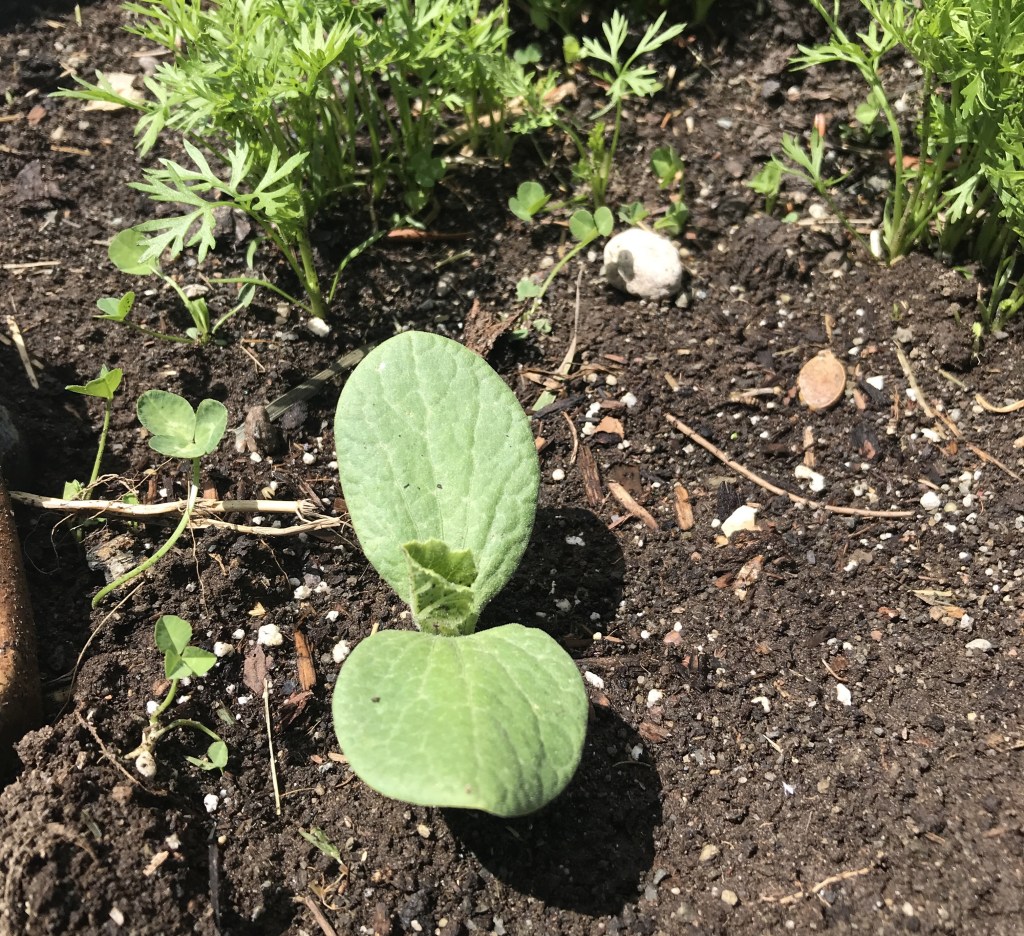
I settle beside God. We say nothing. Not long ago, the flat surface we’re sitting on was a bridge plank from somewhere upstream. Now it’s woven into what the river has lifted, tossed, and left behind. It will not be a bridge again. I do not know which bridges will hold. I’m tired and afraid. God takes my hand, and we walk to the garden where seeds are belatedly sprouting. I am astonished to see the Lower Salmon River squash seeds I saved from last year making a go of it. I was sure they were rotten, infertile, or dead.

“Never say never,” God whispers, gently touching the sprouts.

“Never say always,” I counter. “I’m not sure what’s next, but it won’t be the same river, ever again.”

“Nothing is ever the same river,” God says.

I give God an ironic look and push my hand through her ephemeral chest. On the other side, there’s a new season as yet unnamed. At some point, I will call it home, but even so, it will be temporary.

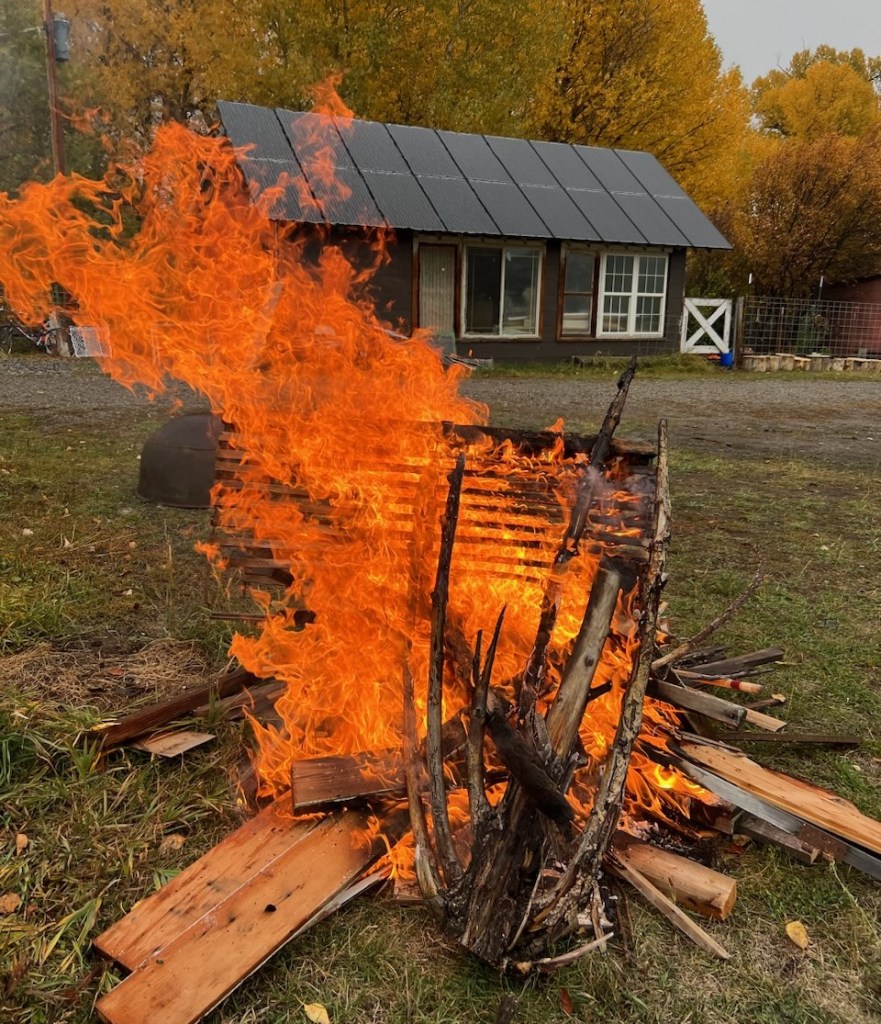
God leans down, pulls a weed, and squints up at my wavering being. “There is no final resting place,” she says. “But the painted ponies love having riders like you.” She hands me a golden coin. I hand it back. She laughs, swallows the coin, and flies away. I have flotsam and jetsam to clear, wells to cleanse, and fires to build. So many fires to build.

The Constant is Change

“A kennel is different than a fenced yard,” I explained to God last evening as we problem-solved the nature of limits, dogs, and human frailties. Dogs naturally dig, bark, jump, protect, chase, growl, and express exuberant affection. This presents problems to the elderly, newly planted marigolds, and other tender things. God seems to think containment should include flow.

“I know the difference,” God said with a twinge of disdain. “But I want to be able to open the door and be done with it. I like things simple.”

What a lie! I risked looking straight at God who then splintered into a hungry blackbird, a broken bike, unearthed seedlings, an abandoned fawn, an icy river, and hops vines using last year’s growth to climb heavenward. A teaspoon of topsoil, a glance at sky–this is all the evidence anyone needs; God does not like things simple.

“Fine. So we’re not that simple,” God admitted, fading into the late-blooming lilacs. I filled the bird feeder, replanted snapdragons, marigolds, and basil, and imagined how I could upcycle the bike. It has a kickstand. That gave me hope. Even though the river is high and noisy, I slept well.

But an intrusive idea about yet another way to rearrange the living room occurred to me this morning, and a Paul Simon tune is on replay in my head. The bike is still broken and I need to build a fence. I’m trying to focus, but distractions take root like invasive weeds—they have no natural enemies. Possibilities plague me. What should I transform next?

The angelic face of change is often made of plastic and other petroleum products designed to enslave and deplete. And yet…

Change is what we are made of.

What would we do without rust and mildew, the molding peach, the dry rot spreading through brick and mortar? Should we bow down to the power of deterioration and thank the gods of decline? I think not, but I suspect it’s all the same to the Many-Sided God; unlike me, they are free and untethered.

“Ah, but you are free to choose your tethers.” God intrudes midsentence–appearing as punctuation and grammar, a parenthetical phrase gone rogue, coauthoring away, as unbidden as Paul Simon, as pernicious as bindweed. And as dangerous as an unruly dog who is way too happy to see me.

“Get down!” I yell. This is not an ideal way to interact with God, but I have no treats or tennis balls to throw, so I drop to my knees where it’s safer and tell myself it’s not a bad thing to be adored.

Transparencies

There are days when dinosaurs, cockroaches, and head lice provide me with a certain comfort. The deliberate ignorances and cruel choices of our species are hardly inspiring, but when I consider the magnificence of survival and the wonders of extinction over the inconceivable span of years these creatures represent, I relax. We can all relax.

Consider the lesson of the glass winged butterfly (Greta Oto). Freed of human tunnel vision, we can ride the tails of invisibility and let our perspectives shrink and swell. Trippy. Who needs externally induced altered states when you can consider the history of our planet and become completely disoriented, bodily displaced? As one researcher noted, being transparent makes for great camouflage. There’s no point in hiding cumbersome errors, glaring false starts, or neon selfish longings. Why not own up to our foibles, strip down to essence, and have a good laugh at ourselves as we give up or start over? In a cosmic, tragic sort of way, we are hilarious. This may be the sole reason humans have consciousness; we can laugh. God likes to laugh.

Or maybe, it’s terror. We inflict terror on each other, and when we do, we often reach out of our bodies to see if anyone is there to help. We come apart so easily because we’re afraid of being nothing, but here’s the funny part: We are everything; the thorn and the rose.

Across the meadow, the Artist is painting roses with blood—your blood, the neighbor’s blood, God’s blood, the soldier’s blood.

“Please,” I whisper to the Artist. “No more roses.”

The Artist pauses, hands me a brush, and with a smile that brings tears to my eyes, says, “Paint what you will.”

“No, I’m not that kind of artist,” I protest, holding the dripping brush away from myself. But I see that the blood is holy, and I relent. I paint myself red. I paint the Artist red. It occurs to me we are the embodied Scarlet Letter, marked as shameful, marked as chosen, marked as doomed, marked as loved.

These absurd contradictions make God laugh. I laugh. The Artist laughs. The dinosaurs laugh. Lice and lichen, seconds and centuries, grief and gladness, daylight and starlight, the endless longing for justice, mercy, and release. In my humbled alteredness, I understand there is no greater love than to lay down your life for a friend and sadly, there’s no greater delusion than to think you can preserve your life or anything you love anyway.

“Well said,” the Artist comments gently, combing through my hair with a fine-toothed comb, checking for lice. “I have nothing to add.” I know that’s not exactly true, but I let it go for now.