Heat

If it wasn’t so hot, I’m sure I’d have more profound thoughts and find something meaningful in the riffraff of this day, but the idea of cold water is as far as I can go right now. Our laundry is currently flapping in the beastly wind. I can go to the clothesline and bring it in, but I can’t think. Even the effort necessary to generate coherence could send sparks flying from my overheated fears into the parched undergrowth of my soul, and a fiery mayhem could ensue. I worry about the trees.

“Stop it,” God says. “You engage in ridiculous amounts of pointless worry. The souls of the trees are not at all like yours. They are fine. Fine, tall, and willing.”

“Willing?” I ask. There’s a pause. The earth wipes its sweltering forehead. I have horrid visions of blazing forests.

“Yield,” God says from a triangular highway sign.

“Unlikely,” I say. I don’t have the energy to yield today. I’m not a natural yielder. I wish I were a tree, but they don’t live forever. I wish I were new and shiny. I wish I were a radio, a cup of good coffee, a perfect banana, a crisp apple, a purple gladiola, or a row of corn soon to be knee high. I pretend that yielding is not required of such embodied objects.

“I’m sad, God,” I say. “Sad and hot. Hot and sad.” The little faith I have is not shaped like a mustard seed or a triangular highway sign. It’s a cheatgrass barb stuck in my sock, irritating my ankle to death. If I could find it, I’d yank it out, but it is embedded deeply in the weave of the yarn.

“Throw the socks away,” God says, and hands me a sweating glass of lemonade.

I take a sip and consider the barefoot road of the blessed faithless. In some ways, it looks easier, less conflicted, less painful, and if these were ordinary socks, I might comply. I might peel them off, throw them away, and rid myself of that exasperating, chronic chaffing—that annoying, inflaming, intrusion of barbed, fertile seed. Someone knitted these socks for me. I don’t know why I wore them through the deceptive, predatory grass, but I did.

“No.” I shake my head. “I can’t throw them away. But thanks for the permission. And the lemonade. That really hit the spot.”

“You’re welcome,” God says, in an approving voice. “It’s an old family recipe.” God speaks from within the twisted rind of a well-squeezed lemon. I realize that this fragrant, yellow God will soon rest on the unstable surface of our compost pile, momentarily brilliant, but willing to yield to the heat as it hastens the eternal dismantling.

Jerusalem

There is joy in an empty morning, especially if it is tinted slightly turquoise or gentile orange. Wait. I meant genteel. Not gentile. Where did that come from? Oh well. Too late. My mind has gone down the rabbit hole of the middle east and the histories of whole cultures and artificial delineations that have led to pathetic claims of superiority and audacious acts of murder or full-on genocide. Out of suffering has come suffering.

Oh, Jerusalem. You were meant to point us to wholeness but instead, you are irreparably cracked. You have a planet-full of earthborn children pretending to cry out for peace, but peace is boring. What we want is unfettered growth, unmitigated accumulation, endless storage space, and the assurance of a self-styled salvation. Gentile, Jew, Palestinian, Greek, African, White, Latino, Asian, Native, Alien, Influxers, Outgoers, Believers, and those bloated with greed. We’re all a blur in the eye of the passing God who named us Jerusalem and flew away. Named us Eve, Fig Leaf, and Pig’s Eye.

“Are there clues in our DNA?” I ask God as he makes another pass, and I continue to free associate, stimulated by the random events of typos and auto-correct.

“For what?” God says, slowing to a flickering presence, picking at a hangnail, disdainful and uninterested in being embodied.

“For how we’ve gone so wrong,” I say.

“Who’s to say you’ve gone wrong?” God says. “Maybe I planned it this way. And what do you mean by ‘wrong’ and am I included in your sweeping judgements?”

I lean in close to this flippant caricature with onion breath, ragged nails, and bruised feet. God leans away. I lean closer. God gets up and puts himself in the corner, a place of shameful contemplation. I wiggle past the hulking body and become as angular as any corner has ever been.

“Face me,” I demand. Then add in a pleading voice, “I have something you might like.”

God’s hair is greasy. His teeth are mostly gone. His longings are choking the life out of him. He can’t have what he most wants. He’s so lonely he’s willing to settle for fleeting liaisons, lies, and invitations to banquets where only poison is served. Why would anyone host a banquet and then serve poison?

In my angularity, I’ve chosen to serve ramen. It takes the shape of its container, but the long strands remain true to themselves unless they’re cooked too long, and that’s what matters. I try to make sure nothing tastes like soap, whitewash, or condemnation, but there’s a slight aftertaste anyway. I don’t blame myself. If I’ve learned anything from God, it is this: nothing in life will be completely free of aftertaste.

Trees Walking

“God,” I said, after a hot, dry afternoon of good and bad happenings. “How are you different than coincidences or things we can’t explain?”

“I’m not,” God said. “In other dimensions, they don’t even call me God.”

I’ve always known that had to be the case, but knowing hasn’t reduced my longing for a provable formula, a reliably vengeful God, a certain ally, or an intelligent designer with some degree of accountability.

I sighed and asked politely, “What do they call you, then?”

God smiled. “Ah, let’s see. If I put the terms in English for you, I’m sometimes called Attribution, Allah, Beelzebub and Baby’s Breath, Creator, Calamity, Dalliance, Dendroid, Emmanuel, Ego…” She paused and smiled. “Shall I go on?”

“Well, the ABCs are a little boring,” I said. “How about a different alphabet? Or the language of a neighboring planetary system?”

This was perhaps an unwise request from an older soul like myself. God grabbed the brittle corners of my imagination and shook the filmy cataracts loose. My eyes beheld a night sky so dense with possibilities that it almost instantly blinded me. The names of God were a thousand suns, unleashed. God waved her baton; the symphony of all her names was deafening. I intended for my tongue to move, but it would not. With great effort, I raised my finger to signal for help.

“Enough?” God asked.

“Too much,” I said, as I tried to gather what was left of my sensibilities.

“Hand them over,” God said.

“No,” I said. “They’re mine.”

God shook her mane, waved her appendages, leathered up, and roared around in circles on a ruby red Harley. Followers stampeded behind, raising clouds of luminescence. A cacophony of unearthly mirth blew through the trees and with help from a gifted artist, they were transformed into maniacal silver laughter. I couldn’t hold on.

“Uncle,” I shouted.

“Good one,” God shouted back.

“No, I mean I give up,” I said.

“I know what Uncle means,” God said as she put me back together, muttering to herself in languages from beyond and beneath. “There.” She patted my head which felt slightly askew. “That’ll do for now.” She started to walk away but then gave me a second glance. “You’re getting a little tired of the circularity, aren’t you, honey?”

“No!” I lied. “No, not at all.” With the few shreds of pride still at my disposal, I stood erect. “You have a nice day, God” I said. Then I turned my back, rolled under the nearest pile of dead branches, and held very still. As my eyes adjusted, I could see that I was not alone. So many sentient beings, so many innocent souls hiding from the birds of prey.

Maybe God was right. Maybe I am a little tired. This will be an excellent place to rest.

NYT2009
(One of Roxy Paine’s amazing creations)

Volcanic

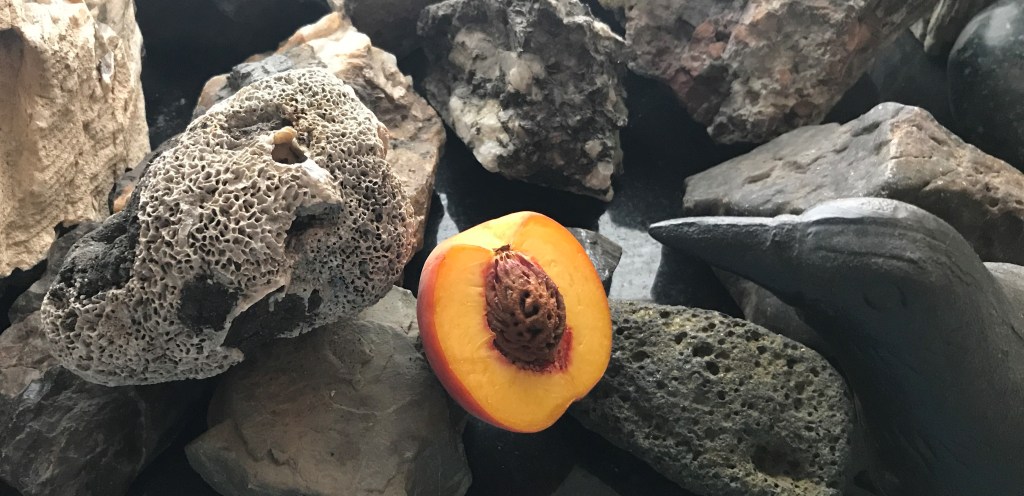
God slept rough last night alongside the cooling embers of volcanic rock from the eruption of Mt. Nyiragongo in Africa. She awoke exposed, porous and pure as the lava itself, but this did not make her happy. She shook me awake to ask if I would bury her under the acres of rich loam currently planted in alfalfa so she could begin reclaiming her complexity. To be simplified to lava is painful.

“Oh no!” I exclaimed as I opened my eyes in the dim light of dawn and ran my hands over a face so jagged and pitted it made terrible acne seem easy. “Oh sweet God. You’ve become stone.”

“Yes,” God said, woeful, but with a shred of hope. “Lava stone. I’ve heard it has healing properties, but I’d rather move along. Bury me in the topsoil, please. There’s still time. I’ll take care of the rest.”

I reluctantly agreed. We held hands as we walked through the verdant fields made fertile by thousands of years of runoff from the surrounding and willing hills. I was glad I’d remembered my cowhide gloves, both because the hand of God was razor sharp and because the shovel I was dragging along was old. The handle was splintered, and I knew I would be digging for a long time, possibly the rest of my life.

The squawking of the wild and noisy geese nesting across the river helped me find my center as God chose the perfect place to be interned. I wished for another way, but life consists of trying to solve things that are not solvable. This is something gradually revealed over the years allotted to those defined as alive. They say that suicide is a permanent solution to a temporary problem. This is true, but then the same can be said for all deaths; ultimately all problems are subjective and temporary, and all deaths seem permanent.

The bounce of sound across water is predictable but not guaranteed.

“God,” I said. “Are you sure?” I was wondering why God insisted on being buried on such a beautiful day. I wondered why I had to be the one digging. I wondered where this weathered old shovel came from.

“Yes,” God said, the nod of her head causing tremors under my feet. Her voice is not measured in decibels but rather revealed in the marrow of reverberating bone. I broke ground, putting body and soul into the sink of the shovel, giving thanks for the leather protecting my thin, unlovely skin from slivers and blisters. I have callouses, but they are often an insufficient defense for these long hot days and the softening effect of sweat.

Under the Influence

My head moves more fluidly (inside and out) after a smattering of beer—usually about half a bottle of Moose Drool. I achieve similar results by playing with the right amount of paint, rusted metal, knotty slabs of wood, rocks, or dirt. The right amount of God is a different formula. It ranges from less than none to cosmic tons.

“What do you mean, similar results?” God asks lazily from the kitchen where he’s adding a lot of cream to his coffee.

“Hmmm. Let me think about that,” I say, as if I’m going to answer. I’m sipping my Moose Drool, adjusting my lists, and enjoying the bright yellow birds hopping around in our diversely-cultured front yard. God melts through the window and into the lawn so quietly the birds don’t even notice they are now hopping around on God’s chest. This tickles God. He tries to hold still but the earth trembles. The great heart of God is gathering force as it comes apart in the dirt.

The trick with God is to stall. He’s got the worst case of attention deficit disorder ever. Humans with attention problems face a lot of challenges, but with God, it’s just another glorious day of goldfinches flitting across the wide expanse of everywhere at once.

Ah ha! Everywhere at once. That’s it. That’s my answer. The result of just enough paint, canvas, rock, metal, or beer is the momentary assurance that I’m in the right river, and I’m not going to drown. I’m everywhere and everyone. connected but alone, safe and in mortal danger; and I accept this eternally transitory condition as my own. As God. As a bright yellow bird.

“God,” I shout. “I have it!”

God surfaces and blinks. He’d fallen asleep among the holy invisibilities of existence. “You have what?” he asks, not fully awake.

“I have your answer,” I say, disappointed at his apparent confusion.

God scratches his rangy head. “I think I forgot the question, honey. Sorry about that.”

“God,” I say. “Sometimes, it seems like you’re not paying any attention to me at all. You’re too busy enjoying the yellow birds.”

 “You’re right. You’re absolutely right,” God admits with a guilty grin. “They’re so beguiling and fragile. So perfect and temporary. But then, so are you. I’ll try harder.”

“O.K.” I agree. It’s time to get dressed. I put on my bright yellow pants and a yellow hoodie.

“Look!” I shout to God from my yellowness. “This should make it easier for you.”  I’ve also added hot pink high-tops to my outfit. We both think this is very funny.

Settling

There are short-lived truths that go sour, longer truths that offer comfort but eventually wear out like a well-loved quilt, and eternal truths that hide among the bulrushes, debts, and sanctuaries. Physical punishment or harsh words will stop unwanted behavior in its tracks, but the motives will dive underground and propel from below.

“Ok,” God says, “Then grace is like a shovel.”

Your offspring don’t own you, and you don’t own your offspring, and we are all the offspring of many. Boundaries are a constant negotiation, but we trundle along, fostering and adopting, breaking and healing, astonished and befuddled; the urges and joys of reproduction writ large.

“Of course,” God says. “My image in the darkened glass.”

There are forces that undermine balance, reduce generosity, and recast restraint as shameful. The meaning of enough is flattened by trucks exceeding the speed limit. Avarice can be dressed up to look like self-care, and acquisition is a seductive master, a damsel in distress, a mirage of power.

“Yes,” God says. “And forgiveness is a home-cooked meal.”

Fear is a natural response to the threat of pain, death, or humiliation. Belligerence is also a natural response. Hatred is the venom produced by fear and belligerence. The poison flows both directions—outward and inward.

“True,” God sighs. “And the antidote…”

God’s voice fades. I lean in, hoping God just needs to clear her throat or something. God is going to say the antidote is love, right? Or maybe compassion, or courage, or sacrifice? Silence reigns. No singing river. No chattering birds. No traffic. No wind. Not even the distant opening or closing of doors.

“Is this it? The antidote is nothing?” I think to myself.

“Noooo,” my inner self protests. I realize I’m dangerously close to settling for a short truth, even if i know it will grow bitter with time, even if I know it will lose its shape like cheap underwear. As long as it disguises the taste of the poison in my mouth–I don’t care.

I look straight into the vibrant universe and hope for a reassuring word.

“Sorry,” God finally says. “I’m all out of platitudes.”

“I don’t mind,” I say, thrilled that God has spoken. “I can handle that. Have a nice day.” I chuckle.

“You crack me up,” God says, laughing. We stand face to face, our foreheads touching, eyes closed, breathing. Then we link arms and walk to the garden to plant a few more marigolds among the rows of kale.

Hair

Human hair is fascinating. We’re not nearly as furry as our ancestors and cousins, but we still sprout the stuff. Left alone, it signals everything from how old you are to how well you slept last night. But of course, we don’t leave it alone. We cover it, color it, play with it, yank it out, let it sluff off, implant, extend, shave, curl, straighten; We cut it, dreadlock it, donate it, and occasionally douse it to kill off the lice.

We’re sometimes born bald. We sometimes die bald. I was yanked from the womb early with forceps that left my head badly misshapen. Fine tufts gradually grew in, and my hair was unremarkable for decades. But then God let cancer have a go at me, and the chemo stripped it all back off.

“What???” God says, emphatically.

“Yes, all of it. Legs, arms, eyebrows, privates…”

“I know what you mean, but ‘God let cancer have a go?’ C’mon. Is that really how you see it?”

“What other way is there?” Me, arms crossed. God, preening in the mirror.

I don’t want platitudes for an answer. In my limited view, if God is God, then that’s that. Good and evil might seem definable in the moment, but as time in our mortal bodies passes, clarity fades and boundaries blur. Any kind of loss, torture, crucifixion, or disease takes a terrible toll. But endings, unsettlings, baldings, and pain often provide the energy necessary for rebirth, joy, peace, and health.

“True,” God says. “But even that isn’t the whole story.”

“So, then what’s the whole story?” I ask. But I have a pretty good idea what God is going to say.

“There is no such thing as a whole story,” God says, with a grin larger than necessary. “The wholeness of the story is in the process. There are no tragic or happy endings, because there are no endings.”

“I knew you were going to say something impossible like that,” I say. “And you know they feel like endings, right?” I tip my head to the side and add, “At least you didn’t blame anyone.”

God touches my face, kisses my head, and nods. “Nice chatting, but I need to go now. I’ve got a hair appointment. Just a trim, but I’m thinking of adding strands of purple here and there.”

God is beautifully grey, but purple will be a nice addition. And as for me, my hair’s been more or less back for five years now. I’m into bleach and occasional blue, but I have tubes of red, green, pink, and turquoise at the ready. I like having choices, but–here’s a small confession—if I don’t like the outcomes, it’s nice to have God around to help me reconfigure.

Nothing to be Done

Sometimes I take God by the neck and shake him until he goes limp and falls like rain and dust and shards of stained glass at my feet—a deadly mix of elements within my power to restore but broken and unlikely. I walk away barefoot, continually astonished at the human propensity to self-destruct.

Usually, the high wind warnings are accurate. Anything of value or consequence must be weighted down or be lost. But somehow the birds stay light and navigate the currents of air with enviable grace. It’s easy to resort to anger. It’s tempting to bow down to lesser gods and find temporary nourishment by eating the tender parts of your own soul. Tempting, but not wise. This morning, I pause and chew my thumb nail instead. Penitent. Pensive. Wishing I had the patience of Job or the dark wings of Kali.

God assembles himself. I keep my hands in my lap. God swivels his hips. I nod noncommittally. God leans in and whispers, “I can tell you where the chickens are hiding their eggs.” He’s flirting. I resist.

“I can predict the next storm,” he says. I shrug.

“Hell, I can control the next storm,” he adds, trying to get a rise out of me. It works.

“Do you think I don’t know that?” I ask, exasperated. “Do you not understand how hard that is to hear? You can control a storm but not an army? You can make it rain, but things die of drought and starvation?”

When I’m like this, sometimes God gets irritable and defends himself, claiming to suffer along with everyone else. Sometimes, God gets all loving and huge and tries to instill hope. And sometimes, God just takes a single sip of my dark morning beer and waits.

And I wait. And the silence reminds me of wonder. And the slow-moving clouds remind me of water. And I remember the unusually fat worm I dug up yesterday. Of their own volition, my calloused hands come together in a kind of praise—a grudging acceptance of very thin skin.

There’s nothing to be done about God. Ground cover only lasts so long. Light breaks through. Dirt blows in. Rain eventually falls and the magical seeds sprout; rhizomes shoot along in the dark until they surface uninvited. The tenacity is a splendor and a curse.

“You remind me of quackgrass,” I tell God, breaking our shared revery.

“Funny,” God says. “I was thinking the same thing about you.”

Goodwill

Today, I am wearing polka dot pants and a striped shirt. My hair is bedheaded in an unattractive way and my black and green socks feature a famous golfer. Yes, I’ve been to the church of Goodwill again, and as usual, God was present in abundance. I had to leave, but it was clear that God planned to stay until closing. While I was there, he managed to load five carts full of treasures as he chatted up the Russians and a shy woman who looked Asian. He commiserated with the disabled man and paid for three people’s purchases.

I don’t know what he did when the store closed for the night, but I came back to this borrowed house in this borrowed town and did laundry. We’re here because my friend Max is clinging, perhaps unwillingly, to the last strands of a well-lived life. At present, I’ve hidden myself upstairs to write and think. I hope God doesn’t come by. I’m preoccupied and sad, and it would be tedious to review all his finds.

“Tedious?” God says, incredulous. “You might be the slowest learner ever. How long have we been acquainted?”

“Depends,” I sigh. “At least half-a-century. But if we go with Psalms 139, then longer.”

For some reason, God thinks this is funny. Maybe I do too. Or maybe not. Who wants to count up every second they’ve breathed the rarefied air of this good earth? Music from downstairs drifts up. “I love it when you sing to me,” croons David Gabriel, singing Steven Merritt’s song, The Book of Love. It’s part of the Zoom pub quiz process that ends this semester’s happiness class. My job is to stay offline and out of sight. I’m fairly good at both, but I’m worried about God. He’s in a mood.

“Should I sneak down and wink at everyone on the screen?” God asks. “Or just check my Facebook page and download megabytes of things?”

“No,” I say firmly. “You’d bump him offline, and if you show up, you’ll cause trouble.”

“Exactly,” God says. “I’d like that.”

“What makes you happy, God?” I ask, hoping to distract him.

“Money,” God says. I roll my eyes. “Doing whatever I feel like doing. Driving a fast car. Taking more than my share. Getting drunk and stoned and all messed up. Keeping my wife pregnant.”

“Stop it,” I say, plugging my ears. This is not the time for irony.

God shrugs. “You asked,” he says. “Want to see some of my stuff? I found three navy blue shirts, this hat, and…” He glances at my face and stops mid sentence. His voice cracks. “There’s nothing more either of us can do,” he says. “Death will come when it comes.”

“But you’re hanging out there, right?” I manage to say.

“I can’t believe you’re even asking,” God says. But he says it in a soft, kind voice. It’s then that I notice the logo on the shirts and the baseball hat. Mariners. Max’s favorite team.

Comfort

God is thick like a down quilt this morning. Thick in the air, thick in the snow, thick in the garden dirt, thick in the fire, thick in sadness, thick in my chest.

Maybe lingering, maybe gone, is a loved one of such large heart and honest soul that the world has a hollow sound right now. An empty echo. The long vibration of the gong. The bell that tolls. I could look to the blackbirds for comfort or the white hills with their dusting of snow, but I don’t want comfort. I want wisdom. It eludes me.

Yesterday was warmer. I found evidence that the raspberry roots are taking life seriously and have begun to send up dark green signs of hope. We could have a bright red harvest next year and maybe even a few berries later this year. The long arc of transplantation requires patience and faith. I sat back on my haunches and gave thanks. But as the day ended, black doubts took hold, and I went to bed hungry.

“Good morning, little one,” God says gently as she shakes off the majesty of thickness and shrinks into human view. A gift. God’s body thrown across the railroad tracks of fear and despair. God, willing to be a slender apparition, glowing in momentary light. I’m torn. I know God is dead and alive, here and there, atomic and cosmic. But I’m no longer sure I speak the right language to be fully understood, and I have these wounds that open in the night. I use whatever pressure I can muster to close them, but they will never heal.

“Good morning, God,” I answer, staring out the one unshaded window. “I don’t feel like moving, or I’d offer you some coffee. Sorry.”

“No worries, honey,” God says. “I know where you keep the cups.”