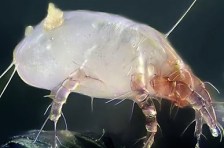
Dust Mite

5 reasons dust mite facts (2)

Sometimes, my co-author pushes things a little further than seems appropriate and leaves me dangling. For instance, this morning I’ve had to gulp back my aversion and hide my incredulity while  I try to model polite acceptance. “Hello, God,” I said. “I see you’ve become a dust mite.”

No discernible answer. I try a little ingratiation. “Wow. You’re so tiny and translucent.” But I’m thinking UGLY! Of course, I realize beauty’s in the biased eye of the beholder. I continue on. “And bugs like you are impossible to eradicate.”

Without a word, God infiltrates my psyche and I drop a little deeper. Humans can dip very low. God can dip lower.

“God, you freak me out. You’ve taken up residence in the detritus of humankind, yet you remain essential and good. You’re living where we’ve been, transforming what’s fallen from our bodies into sustenance. You restore meaning to things that have been cast off and forgotten. You complete the circle. You’re like a mother clasping the old sweaty shirt of her child to her heart, weeping for all that has been, all that could have been. Taking courage from the scent remaining in the shredded cloth. You fearlessly find the way forward. Onward.” Still no answer, but I think God is in agreement.

“I’m like that today too, God,” I say, longing for some kind of affiliation.

I’m sitting beside my expanding rock collection–stones that were once fallen trees, transformed by minerals in the ancient putrid waters that sucked them down. I can’t fathom the pressure necessary to create these stones. And how is it they’ve come to be here, on my bench, in my house, absorbing the warmth of the morning sun?

Judging from the way things break down and are reconfigured, my place in this cacophony of life and death is a whimsical bit of happenstance. This upsets me a little bit.

“Sometimes, I wish you took me a little more seriously, Dust mite God,” I said. Of course, no answer.  “Okay, sometimes I wish you didn’t pay any attention to me at all. You’re a frightening, infinitesimal speck of persistence, patiently digesting, creating and re-creating this ragged world and all that is within it.” No comment. No reaction. I stumble on.

“Diminutive God, you’re nearly invisible to the naked eye.  I don’t know what to make of you. Why have you chosen to inhabit such a tiny space.?”

Finally, I realize there will be no reasonable answers. In fact, there will be no answers at all today. Only compassion. Only resurrection. Only the icy hope of rising water, the magical appearance of red-winged blackbirds, the ambivalent green of an ordinary day.

In this version of myself, I am the friend of dust mites, the builder who will not reject these temporary stones. I am a transitory being of ashes and dust, improvising the best I can with the materials at hand. I won’t get it entirely right. No one ever does. And it doesn’t matter in the least.

 

In Praise of Sky

sunset august (3)

I sing the praises of blue, blue sky, diving magpies, hawks, and ravens. Perfectly still air, and a calm soul. I shout thanks for the excellent sleep and the waking, consciousness and sustenance, and the rusty metal relics I’ve made into toys and works of art. Pumpkin pie and beer for breakfast. Lotion for my itchy legs. A plan that will help me sequence as I meander. A charger for my phone. I am among the blessed. My good fortune extends so far beyond what I deserve that the comparison is spurious. What I deserve and what I have are unrelated. To prove otherwise would involve such massive statistical analyses, only God could give it a go.

My mind wanders. Imagine God with 7 billion independent undeserving variables lining up with their blessings and curses, their riches and hunger, their longings and fears. What connects to what? What would the dependent variables be? Clean air? Laughter? Breast milk? Weapons? Money? Love? A full belly? A fantastic sexual partner? Healthcare?

Correlation is NOT causation. This is the single spiritual truth I learned in Advanced Statistics. But, my or my, aren’t we tempted to draw the easy conclusions? Isn’t it hard to let go of those judgements about who deserves what? Some graceless days, I deserve nothing. Some malevolent days, I’d willingly get rid of half the world’s population, convinced I’d be doing the Universe a favor.

Tune in here, God. Don’t you realize how maddening it is to be us? Well-fed, fulfilled human beings who’ve invented politics, the nightly news and the Internet? I didn’t ask to be born who I am, where I am. Why am I not a dead Syrian child? Why am I not a billionaire? God, you’re inconsistent and nearly inscrutable. What am I? What am I supposed to do?

“Enough,” God said. “You’re enough. You’re a stitch in the quilt I’ve been working on, a glimmer of light through water, you add to the harmonics, and help with the boredom I face occasionally. I set you free before you knew what that meant, and I’ve been trying to teach you ever since. Most humans are frightfully slow learners, but luckily, I invented education, and if you’re willing, I’ll keep teaching you.”

“Ok,” I said meekly.

“Good to hear,” God said. “You can back off the statistics. I was enjoying your revelry before you drifted. Do what’s in your heart to do. Let your joy make you brave, compassion make you strong. That’s how I do it, and remember, we’re a lot alike.”

“Yeah. I hate when you point that out,” I said, loosening up a little.

God laughed and blew me flirtatious kisses, like fireworks on the horizon. I blew some back and began again to praise the blue, blue sky. But frankly, it didn’t seem like enough. I crossed my arms, ill at ease with my comparative wealth. God laughed again. “Keep trying,” God whispered. “Keep trying.”

Longevity

20160524_203048-2

Out the southern window, eleven Canadian Geese sliced silently through the sky in a straight dark line. But it only looks straight. It’s curved like the earth, curved like all who dwell herein. An orange school bus glides along the distant road, carrying tired values and outdated ideas back and forth while unruly children bounce on the cracked leather seats. I’ve ridden that bus all my life. The back window rattles loose and I occasionally escape, but I don’t get far.

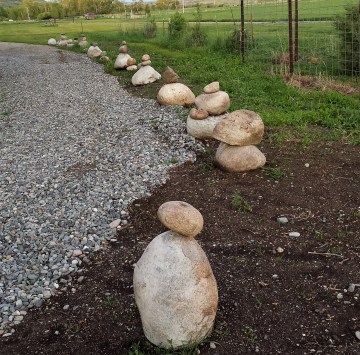
To mark the path home, I’ve rolled large stones into a curved line, and stacked smaller ones on the rounded tops, held in place by gravity, spit, and Zen. When the wind howls through the valley, some of them tumble off. These are local river rocks, but I drag stones home from wherever I go. Alleys, beaches, roadways, mountains, even other continents.

Decades ago, I rescued a collection of agates that had been buried by debris in the back yard of an old Forest Service office. I imagined the collector, likely now dead, watching from beyond. I wash them occasionally, and put them in new buckets, but at some point, I’ll do something more fitting, more spectacular with them. They seem content to wait. If anything can grasp the term geologic time, it would be rocks. When I was a child, I thought trees lived forever. Now I know they don’t, and I’m glad. I’m warmed by their cast-off bodies, sheltered by their harvested limbs.

And rocks don’t last forever either. But their comparative longevity is comforting.

And what’s forever, anyway? The little God on my shoulder—the one that ordained this moment–whispers something in my ear. “It’s music. Or another name for winter.”

Ah. I see. Listen to me all you fireflies and buffalo, nymphs and gnomes, wind and sun, seeds and stones. This is the gospel for today: Trees don’t live forever. Rocks don’t last forever. Bus rides eventually end. The earth is a circle moving in circles, creating the cradle, smoothing the grave. And that is how it should be. Amen.

The Value of Hate

dog-2

I stayed in the city last night. Slept in my favorite closet at my daughter’s little place. This morning, as anticipated, the woman who purports to hate her dog was up early, screaming obscenities through the thin walls. The dog is a little Corgi with the requisite liquid brown eyes, short fat legs, and wagging tail. It has no apparent way to defend itself.

According to other neighbors, the verbal assaults have been steady for the past five years, and include constant haranguing about the dog’s inadequacies and sins: stupidity, hair shedding, eating, drinking, looking, lying down, getting up, needing to go outside, and, well, being a dog. Strangely, I’ve rare even heard it bark.

The few times I’ve seen them outside, the woman walks close to the dog, yelling in an ugly voice. She openly declares her hatred for the dog, as if this will garner sympathy, connection, or even affection from her neighbors or passers-by. The dog looks innocent, but her ranting suggests such horrid behavior that even the most sincere dog lover might wonder about the incorrigible nature of this awful little dog.

So my daughter has orchestrated a rescue. She found someone willing to adopt the dog, and I helped her negotiate all the strange requirements necessary for the dog to move to a happy place. She chats up the neighbor most days now, tries to set a date, listens with patience and empathy, and waits for the dog to be handed over. She waits, and chats. And waits.

My daughter is too young to realize the enormous value of having something to hate.

Fire

OLYMPUS DIGITAL CAMERA

Before the snow came, I burned rotten, misshapen wood. Dirty wood, not even worth cutting up for the woodstove. Wood filled with unremovable, wayward screws. Such fires are my last resort.

Enduring the scorn of my carpenters, I save every scrap of wood—wood that was once a seed that grew into a tree that was felled, milled, planed, dried, sawn, hammered, and then, in this case, tossed aside as remnant. I am a gatherer of remnants. I restore things. But there’s a limit, and sometimes, fire is the answer. It burned ferocious and unfettered.

Evening came, the fire died down. I went in to watch gratuitous violence on TV and eat fish wrapped in freezer-burned tortillas. Long after dark, I looked out the upstairs window. Of course, the flames were gone, but to my consternation, the embers were visible. The air was still, but I know well the nature of wind—it can blow up sudden and savage. Not long ago, our neighbor’s smoldering garbage nearly burned our house down. My fire wasn’t dead enough.

Boots, flashlight, rake, shovel, I trudged across the uneven ground to assess the cinders. Things were hotter than I’d thought they’d be. I found a long hose and hooked it up to the hydrant. Water hit and hissed. I put the hose down and stirred the steaming mound. Embers, given a last gasp of air, burst into flame. I let them burn themselves down, down, down, littering the night with airborne sparks. Hose at hand, I admired the blaze for a while. Then I broke the fire apart. Flame fell back to glowing embers. I raked a perfect circle of pulsating orange heat and stared into the hypnotic beauty.

The circle glowed vibrant and seductive. I imagined screams of agony, should I walk across these coals, or sink down through the intense heat to the inverse world below. The vision was potent enough that I turned the hose on full force. Fire, water, earth, and air. Ashes to ashes, dust to dust. It took a while, but finally, I could put my hands anywhere in the gray soup. It was over.

I walked slowly back to the house, a somber carbon-based lifeform, caught in the trappings of a long-dead Deity. I glanced up. Dark sky came to life. My eyes adjusted to billions of stars, mirroring my true, living image back to me. Minuscule. Vulnerable and magnificent. Stardust, spit, and ash. Ragged, weary, incomplete.

I knew I would be what was left after the fire. And I wasn’t afraid. I tucked myself into the womb of the ever-birthing, ever-blazing God.

Facing into the Wind

four_horseman(Image From SleepyHollow Wiki)

I’m in Chicago, visiting. Bad things have happened in the world. Very bad. A young father, wrapped in his black widow hoodie, hovers over a brand-named stroller. He’s at Starbucks. He is white. His child is rose petal pink. He will order the same drink his entire life, which will be neither as long nor as easy as one might guess. This much I know on my own.

Then, the heavens open, and four horsemen descend. Even before they hit their stride, most of the world bows down. A few try to hide. I casually throw my coat over the child, looking down and away. She’s remained quiet, playing with her hands, which are turning to long green vines. Beautiful strands of ivy. So tender they make me cry. I wish she were turning to stone instead. I wish I were turning to stone, but I’m not. I’m seething, disoriented, weak to the point of water.

God is glaring from every corner, fretting at the customers, darkening the sky. Hurrying the line along. The horsemen dismount, elbow forward, and place their orders. It’s clear they’re not going to pay. They slug each other’s shoulders and point lewdly at younger women. They’re eyeing the baby, making repulsive gestures. As they stroke their filthy beards and move closer, I gag in fear, and vomit. They back up, disgusted, and leave, whipping their horses and shouting joyful obscenities as they disappear over the horizon.

God brings a mop and bucket, and without a word, cleans up my mess. I touch my face. The child. The window. I take her outside and she puts down roots.

Even with the sky black and foreboding, I realize I’ve been saved.

But to what end? I feel an urgent need to know.

I go back inside the Starbucks and summons the courage to tug on the frayed sleeve of God’s flannel shirt. “Why did you save me?” I ask.

“What can I get for you?” God answers. “Wait, let me guess. Split-shot latte with two percent.”

I nod, and accept the foamy drink. “Why did you save me?” I ask again, this time a little louder.

God sighs and gently takes my face in those warm, strong coffee-scented hands. I want to look away, but it’s too late. The eyes have me completely in their spell. “Why did you come back inside?”