Strong Nuclear Force

Earlier this week, God and I were deep into a discussion about the aptly named Strong Nuclear Force which is the force that holds subatomic quarks together and is thus responsible for the stability of matter. Because people often anthropomorphize God, I suggested that maybe she should change her name to Strong Nuclear Force. She pretended to consider this before concluding that she preferred other names, such as Lambkins, Alpha, Omega, or The Beloved.

The discussion ended, and the week steamrolled over me the way some weeks do. That brief exchange was unsettling, but I didn’t have time to revisit it. I barely had time to drink beer or exercise or contemplate how to save our tottering democracy. And the weeds took advantage of my frantic pace and went to seed as rapidly as they could.

I accept these harsh realities and the finite linearity of time. With what I consider to be enormous self-discipline, I’ve now seated myself in the old blue recliner, ready to center on the Center. The gardening and vacuuming will have to wait.

“So, you don’t have to go around calling yourself Strong Nuclear Force if you don’t want to,” I say, as my opening volley. “But I don’t like calling you those other names. Especially The Beloved. It sounds obsequious and weak.”

“No worries,” God smiles. “It’s just that I don’t like limiting myself. The nuclear scientists were quaking in their boots when they realized they could break the hold of the Strong Nuclear Force and set protons free. They wondered if once unleashed, the chain reactions would convert all matter to a kind of selfish, toxic energy that would end existence as you all define it.”

“And they detonated anyway,” I sigh. “We’re in so much trouble.”

“Yes, you are. You can see why the basics are so central, right?” God asks.

“Yeah,” I say, wondering which basics she means.

“Love,” she says.

“Too simple,” I say. “Undefined. Mushy. I don’t like that idea anymore. I want to roar and maim and shake people until their heads fall off.”

Strong Nuclear Force lifts her skirts and leaves.

The protons are free to crash.

The rich tell lies and steal from the poor.

The frightened arm themselves with weapons and hatred.

The young flounce. The old stiffen.

“Come back,” I yell. “You win. The Beloved is a fine name.”

“I always win,” she smiles.

“Maybe,” I say. “But that’s not readily apparent. Love is a tall order.”

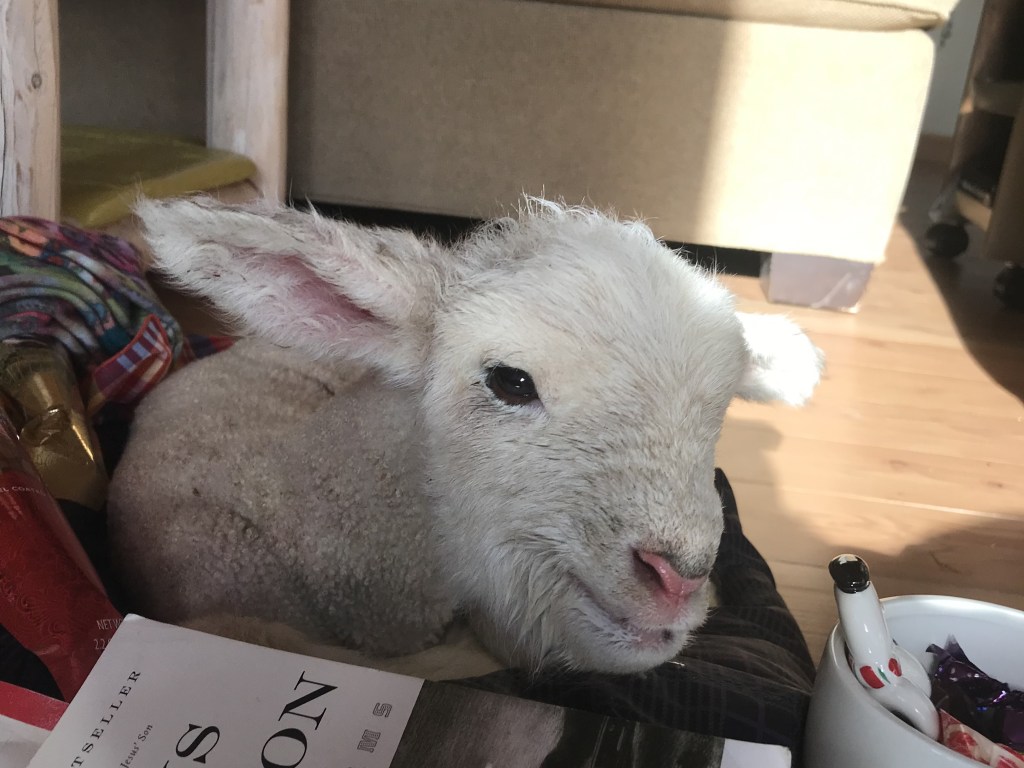
“I know,” Lambkins says. “I’m often in disguise, but I’m taller than you think.”

Pecking Order

There are fourteen tiny chicks in a box at my feet, hopping around, testing their wings, eating, drinking, pooping, napping, and then starting the sequence over again. They are utterly defenseless, so small they’d not even make a good hors d’oeuvre for a predator, but they don’t seem to know this. When I reach down to get one, they chirp in vociferous protest and scramble away as if escape were possible. Think of the energy they’d save if they just laid down and accepted whatever came their way–warmth, light, food, clean water, a snuggle with a human–or a quick end to a short life. Instead, they react to perceived threat with every fiber of their fuzzy little beings. It’s both comical and profound.

Chickens do not seem to engage in self-reflection. Among their favorite treats are chicken eggs and chicken meat. Their opportunistic cannibalism doesn’t appear to trigger any crises of conscience, and it doesn’t bother me either. They’re cute, and I’m pretty sure they like me. After capture, they relax in my warm hands, and some drift off to sleep. I can’t be sure, but it looks like blissful surrender.

“Well, it’s not,” God says, as she joins me, latte in hand.

“Where’d you get that?” I ask. I have my beer, but the latte looks good.

She flashes the telltale Starbucks logo and nods at the chicks. “They’re playing dead. It’s a last resort.”

“They are not,” I say.

God leans back. “Chickens are one of my prototypes,” she says. “But there are some design flaws. They have pecking orders and will literally kill and eat the hen at the bottom, especially if she’s an outsider. I’m not proud of how this has turned out so far.”

When God says things like that, it triggers my reactivity. “Yeah. And what’s the plan exactly? If the lion lies down with the lamb, what will the lion eat? Grass?”

God scoops up one of the black chicks and makes cooing sounds. Exasperated, I continue. “And if chickens kill the weakest member, doesn’t that make the flock stronger? And why would people born with a penis want a vagina? And if you have the chance to enslave someone for free labor, why not? Isn’t this why you gave us women, guns, and germs?”

God puts the chick back among the others, sips the last of her latte, and folds her hands. I slither to the floor. My plan is to play dead when God picks me up. But God just sits there, smiling and waiting. I look with longing at her soft, giant hands.

“Won’t work,” she says. “You’re too old to play dead.” She helps me change the water while the chicks chirp frenetically. “They’re so darn adorable,” she says.

“And versatile,” I say sarcastically, still wishing for an easier way, a less disturbing set of truths.

“And versatile,” God says, in a calm, dark voice. “Versatile.”