Where Things Break Down

“Do you mind if I call you Allah for a while?” I asked my old friend often referred to as God.

“Of course not,” she said. “I’ve been called worse.”

I was hoping Allah might ask me why so I could explain my longing for humans to be more forgiving and inclusive, but she just sat at the edge of my peripheral vision grooming and preening, completely self-absorbed. This irritated me, but then I thought, why not be self-absorbed if the Self you are absorbed in is the energy behind DNA, the Big Bang, dark matter, the molecular miracles of sperm, egg, tastebuds, vision, synapses, light, friendship, sacrifice, and transformation. Why not?

“I’ll tell you why not,” Allah interjected. “Absorbed is the wrong verb. I’m self-expulsive. I have self beyond self. I wear more hats, circle more stars, shape myself into more curvilinear spaces than you can possibly imagine. But I like it when you open your mind and try. Keep up the imagining. Climb high.

“When I was younger, I had no fear of heights,” I said. “But now I get vertigo.”

“I know,” Allah said. “And it’s wise to be cautious. I can’t promise to catch you when you fall.”

“I’m already falling,” I said.

“Me, too,” Allah said.

“Why?” I asked. “You’re falling voluntarily, aren’t you?

“Of course. But I’m lonely. Misunderstood. And…”

I held up my hand, signaling Allah to stop talking. I was feeling sick. Vertigo does that to me.

“Do you mind if I call you duckling for a while?” Allah asked, kindly changing the subject. “Or maybe cuddle-buddy?

“Do you mind if I call you Absurd instead of Allah?” I responded, smiling a little through the haze of my human frailties and foibles. The vertigo settled.

Then without warning, Absurd grabbed my arm and pulled me into a headfirst dive. The speed of our descent peeled back the skin on our faces.

“See?” she shouted.

“See what?” I shouted back.

“Falling together isn’t that bad,” she answered with a thin-lipped grin.

“Stop this nonsense,” I pleaded.

“Can’t,” Absurd said. “It is what it is.”

She pulled the cord, the chute opened, and the moments of the coming day rolled out beneath us. We landed on a spongy, rotting heap of bad intentions, false hopes and broken promises.

“What’s this?” I asked, trying to scrape the sticky substance off my shoes.

“Compost,” she said. “Where things break down and get another chance.”

Oil and Gas: Nectar of the Gods

Millions of years ago, on this evolving planet, tiny animals and plants died, sank to the bottom of the swampy waters, and were gradually pressurized into coal, oil, and other nasty-seeming substances.

Quite recently (in geologic time) humans began to play with fire and found it helped to stay warm and cook food. Not long after that, we discovered that digging, drilling, refining, and combusting those nasty substances provided astonishing amounts of energy.

Soon, basketballs, varnish, nylon tents, plastic bottles, airplanes, asphalt, and cozy homes began to seem a birthright for many of us. Even though it’s now obvious that extracting, refining, and burning these nonrenewable deposits of ancient life is dangerous, destructive, and ultimately deadly, we can’t seem to stop.

“Nice summary,” God says. “Though a tad simplified.”

“Fine,” I say. “Go ahead and complexify, God. You always do.”

God offers me an apple and leans back into the gathering clouds.

“I got my first doctorate in chemistry,” he says. “Technically, you should call me Dr. God. But I’m not hung up on titles.”

“Right. Or maybe I should call you Dr. Denial,” I say. “I got my first doctorate in psychology, and you are diagnosable.”

“That’s rich!” God chuckles. “Isn’t your diagnostic system just a primitive description of being alive? Coping?”

“Maybe,” I admit. “But there are better or worse ways to cope. You seem to cope by rolling the dice a lot. And we’re the dice.”

“Vegas, baby,” God jokes, rubbing his hands. “What happens in Vegas stays in Vegas.”

“Ah, c’mon,” I say. “Not funny.”

God grins. “Fine. Actually, nothing that happens in Vegas stays in Vegas. You probably don’t know this about me, but I bathe in untouched oil reserves. I rub Myself with chunks of coal and float in pockets of natural gas. They let me be. I let them be. I love what they were and where they are, but you should leave them alone. They’re not worth the gamble.”

“That horse has left the barn,” I say.

“Oh, I know,” God says. “I got my second doctorate in statistics with a dissertation on probability.”

“So, with our selfish, exploitive, nature, we’re screwed, aren’t we?”

“Likely,” God nods, then adds, “I often root for the underdog, but it doesn’t look promising. I’m working on my third doctorate. It’s in theology. I’m exploring the concept of black holes and infinity, and I’m totally transfixed. Want to be on my examining committee?”

“I think I already am,” I say.

“I knew that,” God says with a big grin. “Ironic, isn’t it?”

Missive from the Beautiful, Horrible Moment

Every morning I sit in the warm, chunky soup of God, my attention split between robins in the garden, clouds on the move, and my fingers poised above the keyboard. God appreciates the opportunity to clown around, but sometimes they take it too far, and I feel left out.

I want God to notice me. I eat dandelions. I pull clumps of quack grass, pretending there’s a chance to eradicate this long-rooted invader. Quack grass is also known as twitch, quick grass, quitch grass, scutch, dog grass and witchgrass. My own pet name for it is Satan. On more generous mornings, I allow for the possibility that it has redemptive features. Not today.

“How about we all float on our backs?” God suggests, flailing happily in the womblike liquid of themselves, ignoring boundaries such as time and space.

I shake my head. The steady pressure of God is eroding my body. The Ever-Presence is a weighted blanket, a hazmat suit, an open invitation to find peace in what is true. I am not a maker of stars, but I am my own tornado. While I’m still able, I will continue spinning through the garden, yanking quack grass to kingdom come.

All the faces of God smile. “Look!” they say. The arms of God bend, fingers pointing every possible direction. I have no idea where to look.

“You’re too inclusive. Too amped. Could we bring it down a notch?” I ask petulantly.

The many fists of God punch the air, and their faces melt like candles into a singular pool where I see my singular reflection and consider my singular fate. The robins appear to be flirting, ready to mate. The aroma of God is intoxicating, but even so, my stiff hands won’t curl around the quack grass anymore.

My friends and family are floating on nearby rivers, hiking their own circuitous trails, and I wish them well. I wish myself well. I wish God well—the Unitary, the Complex, the Galactic–all of them.

“Thank you,” they say harmonically.

“You’re welcome,” I say automatically.

“That’s unlikely,” they laugh. “Our welcome is usually, um, shall we say overstated?”

I nod. “Well, you’re more welcome than quack grass.”

They grin, poking each other in the side. “Score! We’re more welcome than quack grass.”

I realize God is making fun of me, so I issue a slight retraction. “Actually, that’s not entirely true. Depends on the day.”

Hog Heaven

From my bank of unblinking windows I watch the ways of old trees dying. None are a direct threat, so I keep a respectful distance and consider rootedness and wind, drought and disease, and the sustenance dead trees leave for future generations.

Like trees, we exist fleetingly between flood and fire, partaking of a generous past, discovering our relevance even as we decay. I have been reborn many times, birth canals shaping the way things look when I reemerge. This morning’s reemergence is solemn. I am grateful for the stillness.

But my revery is interrupted by two pigs noisily reminding me it’s breakfast time. Obviously, their pen is too close to the window. These exuberant uprooters are stinkers in every sense of the word. I try to limit my fondness, but the way they make eye contact is most endearing. I see interest. Recognition. Maybe even primitive affection. I also see the truth. They are omnivores. If I were down and broken, they would eat me. And I’m sure somewhere in their active little brains, they are aware that I am a predator, and they are worthy prey.

“And thus you could break and eat them,” God says, finishing my thought.

“Eat or be eaten, eh?” I say, scattering soaked corn for the dramatically ravenous pair.

“Almost. But actually, it’s eat and be eaten,” God says. “That’s the plan. A good one, if I do say so myself.”

This is not a new conversation. I wrinkle my nose as images of mold, fungi, maggots, and other faithful workers of creation come to mind. I am an integral part of an inclusive, circular, cleansing, evolving, expanding universe. Pigs, chickens, cattle, yaks, grasses, trees, seeds, whales, mules, plankton, cabbage, caviar. Apples, melons, hybrids, bones, stones, erosion, uprisings, down-fallings. I sigh and look at my hands.

“So, God, what do you eat?”

God laughs. “Oh, I nibble on almost anything. I’m not picky. And before you ask, let me add that I am also eaten.”

I resist this idea, but then I realize I’ve always known the divine and sacrificial taste of God.

“You’re welcome.” God says, dissipating into the blue tangibilities of a day that has arrived unscathed.

There are orange chunks of squash in the trough—the final remains of last year’s garden. I sweeten the deal with an outdated protein drink we bought for a friend with cancer. The pigs are in hog heaven. I’m jealous of their uncomplicated joy.

Thinning

When I finally realized that people are just pieces of newly broken stone tumbling downstream in the flow of time, I began to hope that I could be smoothed into something shiny and beautiful and then roll onto an exotic beach to glitter forever. But I see now that being shiny doesn’t last and I’m well on my way to dust.

God laughs and then sneezes. “See how powerful you’ll be?” She blows her nose and wipes her eyes. “Dust allergies are the worst.”

 I ignore her, grab the ash bucket and a few of the dirtier rugs, and step into the wind.

“Don’t be afraid,” she says, following me.

The wind dies down, and river nymphs skim lightly across the surface of clear mountain water, moving without resistance toward the salty sea.

“That’s not quite true,” God says. “Nothing on earth moves without resistance. But it’s less at higher elevations if you can handle the thinner air.”

I consider the lungs of the sherpas, the gills of the shark. I remember watching the eye of the lamb I held in my lap grow dull as life lifted itself away. And I remember flying.

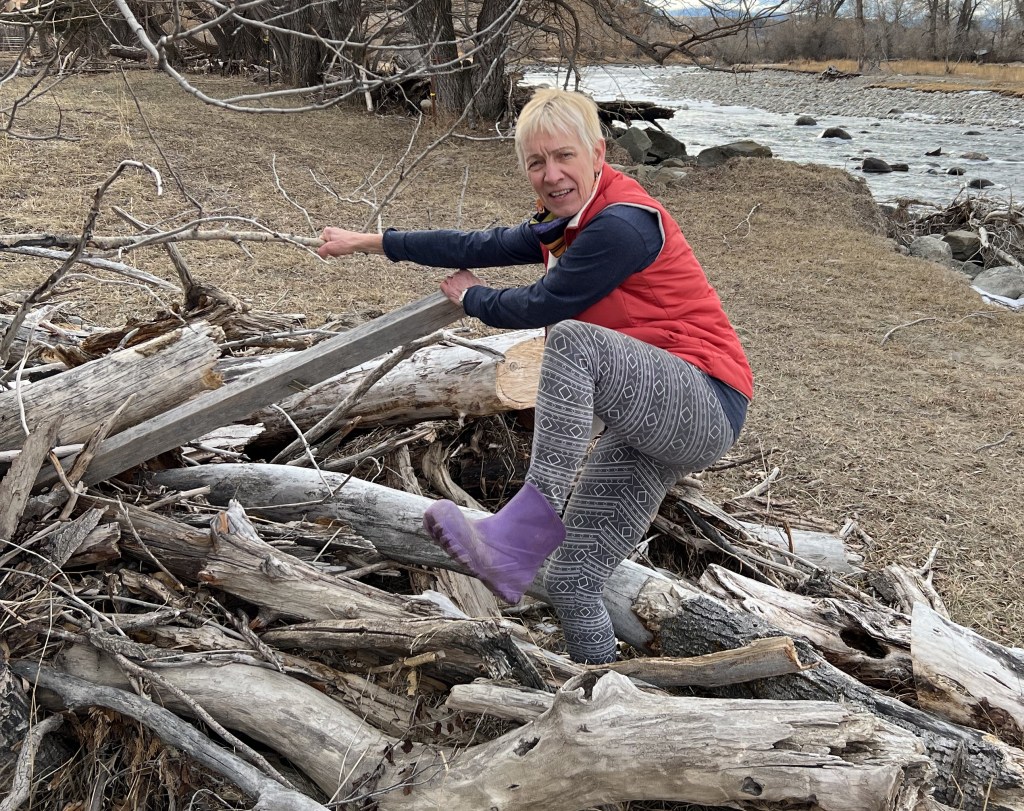
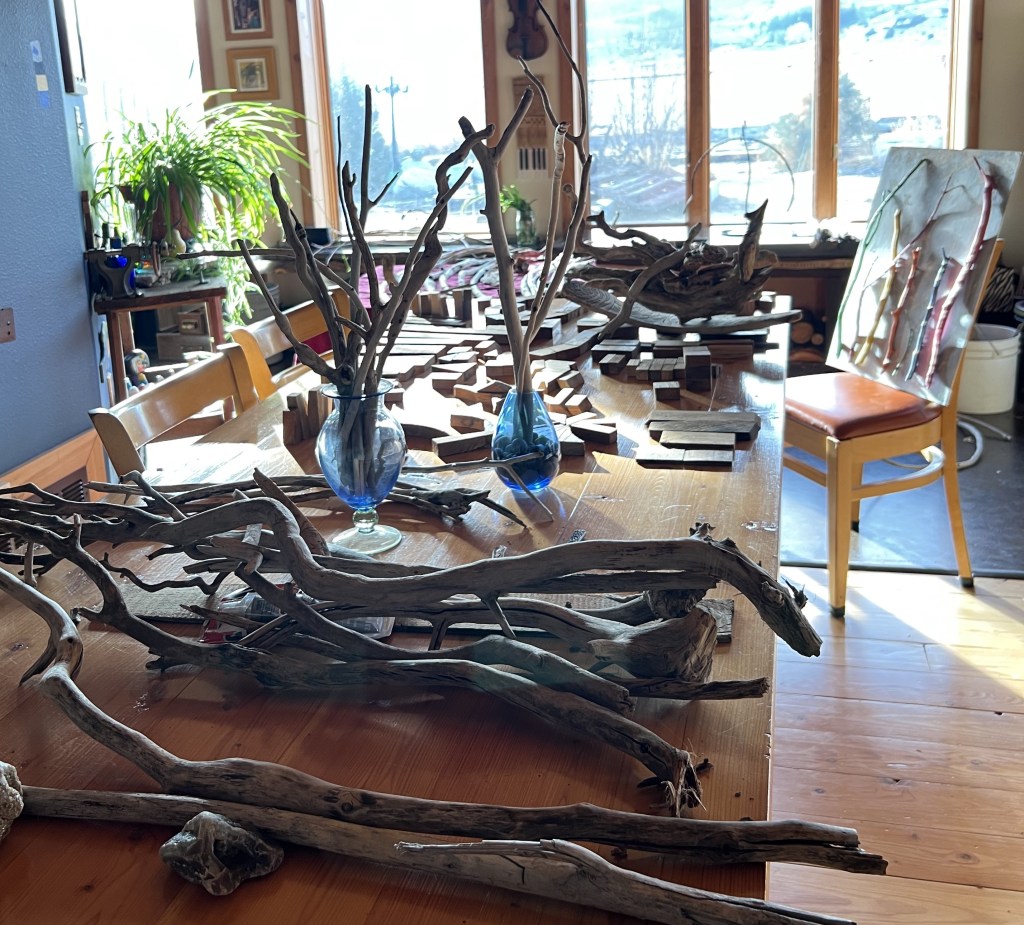
My days are filled with gleaning from piles of flood debris. I yank out planks and bent fence posts, drag burnable wood to the stove, intriguing wood to my gallery, and have a plan to bury the rest.

“Your gallery?” God chuckles. “Um, which surface or shed qualifies for that label? I’d like a tour.”

“Well, it’s a splintery, infested, movable feast, mostly in my head, mostly benign, but occasionally, I use toxic glue or graffiti paint and the fumes are outrageous.”

“I think I can handle it.” God grins.

“Oh, I wouldn’t ask you to,” I say. “Someday, I’ll have it all cleaned up and nicely displayed. I’ll serve muffins and Earl Gray tea.”

“No, you won’t,” God says. “But that’s just fine. Now, let’s take a look, shall we?”

I shrug.

We spend the day considering toxicities and redemptions, the wonders of fungi, the process of fermentation, and the fantastical cottonwood stumps with twisted roots and embedded stones, now tipped skyward. She’s not bothered by the disarray and in fact, she’s intrigued with the idea of making rainbows out of curved sticks. Tonight, we’ll share a glass of rhubarb wine near the flame, and she can help me decide which broken branches are worth burning.

From Whence We Came

Almost every day, God and I sit in a ratty blue recliner angled toward the window and sip beer. God expects me to hold still and listen. I try, but it seems nonsensical—an inefficient and unreasonable request.

Then I remind myself that efficiency isn’t the only road to success and not everything worthwhile is reasonable. The ability to reason is one ingredient in the soup that defines us, but it’s not the entire recipe. There’s sausage, kale, and wonderment. There’s an extravagance in creation that can’t be explained. Abstract thought and scientific inquiry may be the pinnacles of evolution, but pinnacles need foundations. Humans rationalize cruelty as readily as they eat that second donut.

“Working on some interesting similes and metaphors this morning, aren’t we?” God teases, sliding from chair to mirror to window to bird, sashaying to music I can barely hear.

“I’m thinking about foibles and do-overs,” I answer, happy that God seems loose and crazy today. “Could I have the last ten minutes back? I went down the wrong rabbit hole.”

“Nope,” God says. “Why do you even bother to ask? You know better.”

“No, I don’t,” I say, gleeful and untethered. “YOU know better.”

God winks and pulls me out of the chair. We do a four-pig jig creaking around the room in old bodies. We dance straight through the newly purple wall and fall, barriers breaking like bones.

I am blissfully unaware of dinosaurs, dodos, and all the hapless creatures currently facing extinction before they even have a name. They can all be Adam. They can all be Eve. I love them fiercely, but I can’t save them. I can’t even save myself (and truthfully, I don’t want to).

God’s reading glasses fly off while we’re cavorting. They shatter against the edge of a light green piece of granite I keep nearby for thermal mass, and small pieces fly everywhere. But no worries. The dangerous shards gather themselves into a coarse form of collective compassion, willing to return to the fire from whence they came. The fire from whence we all came. The fire to which we will all return.

“Sorry about your glasses,” I say. “I could read to you until they’re fixed if you’d like.”

“I’d like that very much,” God says.

“Do you mind if I start in the middle?” I ask. “I’ve already read the first chapters.”

“Not at all,” God says. “I suspect I know the plot.”

“I’m sure that’s true,” I say, oddly defensive. “But the descriptions are spectacular. And the details matter.”

“Yes, they do,” God agrees. “They really do.”

Believing

Humans are natural believers but the things we choose to believe in vary radically: Exercise, Love, Money, Science, B vitamins, Power, God, Not-God, Red Meat, Medicine, Herbs, Famous People, even Wishes made on Falling Stars. The propensity to believe makes us vulnerable to being duped. And often, instead of being open or skeptical, we act as if loyalty to a belief is a virtue. It’s humiliating and painful to be wrong, so we ferociously defend what we believe in.

“And yet…” The Creative Force woven into all things seen and unseen jigs into view decked out as a troupe of Finnish dancers raising money for the war.

“Hello, God,” I say, waving. I clap to the beat as The Troupe does synchronous high kicks and fancy footwork. At intermission, they link elbows, pass the hat, and fly away. I assumed they were Finnish, but there’s an Irish feel in the remaining air.

What makes something Finnish or Irish or Nigerian? Who’s in? Who’s out? No matter how glittery or damning, all the fine distinctions are temporary. Driven by beliefs, such dichotomous thinking can cause great suffering. It’s deadly to believe rather than inquire. We overlook the still, small path that leads us alongside the unknown and unknowable.

“That path is narrow and dangerous,” God warns in the strained voices of those who’ve fallen away. “Unknowing isn’t safe.”

“It’s safer than pretending,” I say. “Safer than being certain something is true when it might not be.”

“And are you certain of that?” God teases in a thousand laughing voices. I laugh, too. I admire these courageous, vague expressions of the God Who’s Fallen Away. They don’t name themselves God, but I do.

“This may seem obvious,” God says. “But I need neither definition nor defense.”

“I beg to differ,” I argue. “What about the least of you?”

There’s a tall woman in a Russian prison, a short man beaten senseless, a desperate woman forced to be a mother, flood and fire victims, prisons burgeoning, the rich getting richer as the poor sink further into despair.

“Ah, I see what you mean,” God agrees. “But definition? Defenses? These won’t help. Justice. Mercy. Lives laid down, not weapons raised up. Wealth distributed, not hoarded.”

“Much harder,” I say in a sad voice. “Nearly impossible.”

And again, God agrees and without further ado, fades into the nightly news.

Why not admit I know nothing but do something outlandishly braver regardless? I ask myself as I get ready for bed. May as well take a few risks. You’re going to die either way.

This may not be the best way to fall asleep, but it’s an excellent way to wake up.

Existential Angst

The explanation could be as simple as caffeine. Or scoldings by Ms. Manners. Or a niggling Jiminy Cricket on my shoulder whispering reminders of my failings and violations of the common good. I don’t know, but I can’t seem to get rid of the angst and sense of urgency that rob me of the peaceful existence I deserve. Something or someone is out to get me. I share the paranoia of my era. The exaggerated, anxiety-producing avoidance of death.

My father died nine days short of my 20th birthday. He exited life as I was exiting the teens. He was 44. Somehow, my grief-demolished mother hosted a random set of grandparents for a bleak commemoration of the day I was born. She made roast beef, potatoes, and a cake. It was a dark, dark birthday. I don’t know how we managed to swallow.

“But you did,” God says, joining me gently as I sit with memories flooding by on either side. “Your mother was as brave as anyone I’ve known, but I had to attend that party disguised and uninvited. She was done with me, and I don’t blame her.”

“I didn’t even know you were there!” I exclaim. “I brought a different god. He spewed platitudes and mumbled lies about God’s will and imminent resurrections and such. It was awful. Why didn’t you shut him up?”

“All in good time,” God says, her eyes filling with tears. “I’m not apologizing or defending myself, but there are days I just cry my eyes out.”

I put my arms around God while she sobs as if the loss were yesterday. And for God, it was. And is. And ever shall be. I cannot think of what to do. We are all baffled kings composing hallelujahs. Overthrown by instinct and libido, lust and love. Endless birthing. Endless dying.

“I never intend to fool or frighten anyone,” she says, taking deep ragged breaths to calm herself.

“I know, Sweetheart,” I say. I run my fingers through her unruly hair. “But we judge and fool and frighten ourselves. We can’t help it. The contradictions and losses are too much.” God slowly slips out of my embrace. She moves to the outer edges of the known, opens her thousand wings, and disappears. Behind her the path is littered with breadcrumbs, a trail of her broken self. As I follow, all things extraneous fall away, and I am slightly less afraid.

Who’s to Say What Starlight Might Do to the Skin?

Yesterday, I was looking for something in one of our outbuildings but within seconds, I’d forgotten what I was looking for. Our sheds reverberate with such potential that I can’t go in and come back out the same person. Touching the chaos causes a quickening; stacks of windows become greenhouse walls; slightly-damaged doors open to somewhere nice; a child pounds joyously on the drum set; strewn with straw, the stall in the corner protects a menagerie awaiting the ark; futons offer rest (or shelving); saw blades are sharpened; the woodstove is hooked up so I can cook in an emergency; empty frames and canvases are masterpieces hung in a gallery where antiques are tastefully displayed, and the scraps of angular metal have been welded into wings.

Our buildings are all named: Yoga Studio, Bug Barn, Playhouse, Solar Shed, Old Garage, Eva House, Lean-to, River Cabin, and of course, the decrepit and dangerous Contemplation Corner. The names reflect aspirations, not content. The structures are salvage yards and sanctuaries filled with failures awaiting transformation.

“God,” I said. “Proportionally, I bet I have as much broken and discarded stuff as you do.”

“Well, hello there, Junior,” God drawled. He’d materialized beside a flat-tired trailer, chewing a blade of grass with studied nonchalance. His thumbs were hooked on the pockets of dirty overalls. “That’s not exactly what I’d call news.”

“Could you get any more stereotypic?” I asked. God shrugged and faded. I squinted into the neon orange sunset and began walking home.

I am chronically derailed by the allure of what could be, and I blame God for this. It takes resources and patience to repurpose the wrongheaded or rejected. There are days I long for everything to burn to the ground; for fire to devour the bulging collections of oddities and unlikely visions; for extreme heat to purify my remaining days.

“Tidiness does not ensure wisdom,” God said, in the voice of a patient teacher. She was resting in a rainbow-colored hammock hung between two thorny crabapple trees. “I found this hammock under a pile of flat soccer balls,” she added. “I like it.” She was wearing a sundress from the ragbag and had tipped one of my straw hats over her face.

“It’s getting dark,” I said to the spectacle that was God. “You may not need that hat.”

 “Maybe,” she agreed, throwing one unprotected, delicate arm over her head. “But who’s to say what starlight might do to the skin?”  I knew she was making fun of me.

“You’re right,” I said, offering her a sweater. “Who’s to say what starlight might do to the skin?”

Bruised

God and I were sitting in our pajamas near a nice fire, watching the sky, hoping the storm wouldn’t bring the cold temperatures predicted. Hoping the planet would somehow survive the ravages of greed. I was examining an ugly bruise on my forearm. Essentially, bruises occur when capillaries near the surface break and spill blood. Thin skin increases the risk.

Thousands of years ago, a prophet wrote that God wouldn’t take advantage of a bruised reed. There was no mention of bruised arms, egos, or disintegrating hips, but why would this assertion be necessary? What kind of God would go around beating up injured, weakened people, or break an already bruised reed?

“Um, God,” I say, “What’s your point with that whole bruised reed thing?”

God’s full attention swings toward me, a lumbering presence, a set of boots. I pull my sleeve down to cover the purple blotch. A tiny fraction of God’s focus is enough to end life as we know it, but I risk such things because in the end, it doesn’t matter. We’re sitting on a second-hand couch. I don’t care if it gets scorched.

“Why do you ask?” God says, warm breath laced with lavender and the allure of summer.

“Nice move,” I mumble and shift my gaze to the sparrows landing on the icy fence. As most four-year-olds know, Why? has no final answer. Asking why is a way to prolong the conversation, to shift the burden back.

I turn again to the God on my couch. “I ask because…” I am inundated with unwelcome insights. I hate bruised reeds. If I were God, I’d make a bonfire out of those damned reeds. How is it possible to walk alongside the bruising and the bruised? I don’t like wounded healers, and I don’t want to be one.

We sit. The wind is picking up, the chill becoming dangerous.

The ancient gaze of God is kind. “You love what you think is whole and beautiful because your vision is shallow.”

I close my eyes.

The primordial voice of God is gentle. “You love stories with endings because the untold threatens your sense of control.”

I cover my ears.

The wounded hand of God is warm as it hovers over mine. “You love stones because the bruises don’t show.”

I open one eye.

It’s not a single hand but a thousand; mottled, thick veined, and open. I choose one, entwine our fingers, and wait. God willing, the frozen ground will eventually soften toward spring when both planting and burying will be easier.  “Oh, we’re willing,” God says as the sky dumps snow. “But are you?”