Watching a Goldfinch Eat Chokecherries

I’m tired of calling you God, I say, 
as I watch a goldfinch eat chokecherries.
And I’m tired of being called that,
God answers in green, disrobes to fire.

I’m surrounded with absurdity, anger, and absolutes,
but the branch does not break with the weight of the feasting bird.
Sky backdrops vultures circling
but they don’t block the sun.

Layers of harvest are upon me,
a comeuppance of carrots, chard, and beets.
Leering pumpkins, wily cucumbers,
and basil going to seed.

Going to seed.

My hands smell of onion.
My eyes sting from wildfire smoke.
The Collective strums chords
composed for disintegration.

What, then, shall I call you? I ask, settling. Sad.
I’ve always liked Improbable, God says,
then adds but Maybe.
Too much. I shake my head. And not enough.

God smiles a rather evil smile.
Perhaps you could crowdsource the Question.

No way, I say. I wouldn’t like their answers,
and they’d rip me to pieces.
That’s a given, God sighs.
But for now, gather and share.

I don’t want to, I admit.
Improbable but Maybe begins to rain.

If you want to achieve exit velocity, It whispers,
You need to strengthen those wings.

Did I say I wanted to fly? I ask

But that’s exactly what I want.
And I admit, I’ve said it many times.
I do want to fly.

When Your Inner Child’s a Biter

It may take a village to raise a child, but some villages do better than others. And what about the Walt Whitman multitudes within each of us? Who’s in charge of those inner children?

For instance, when things aren’t going her way, or malevolent forces get too close, my own inner child growls and nips like a protective dog. I scold and apply sanctions. Sometimes, she’s contrite. Other times, she clamps her teeth down on my forearm and leaves marks of unrepentance.

God babysits occasionally. My inner child likes to sit on his lap, braiding his beard, poking at his eyes, and pulling on his large, floppy earlobes. The entwined snake tattoo on his temple is one of her favorites, but his various piercings bother her.

Yesterday, she was having a tough time, so she found God and crawled up for a cuddle. He was dozing, a summer novel splayed across his chest. He didn’t rouse himself fast enough to suit her, so she grabbed his limp hand, bit him, and squirmed away. God sat up, put his finger in his mouth, and lumbered after her like the ancient, doting grandfather he is.

“You don’t need to bite, honey,” he said. “That’s not what those pretty teeth are for.”

“How would you know what my teeth are for?” she retorted, pointing at her gleaming incisors. She’s feisty like that.

Gently, God put his hand over her gaping mouth. She kicked him in the shin.

“So that’s how it is,” he said. He winked at me and began dancing around like a boxer. My inner child wore herself out swinging and missing. She finally dropped to the ground, winded and sweaty, her fists still punching at nothing, her ruffly dress torn and dirty.

“I hate you,” she screamed. “You’re a nasty old man. A pervert. Don’t touch me again or I’ll call the police.”

God leaned down and handed her his phone. “Go ahead, sweetheart,” he said.

She slapped the phone from his hand and dissolved, howling and gnashing her teeth. She knew she was bested, but she didn’t seem able to stop the tantrum.

At last, night fell around her, stars came out in forgiving droves, and a holy breeze cooled her miserably enraged body. She and her demons rested in the arms of the river. God stretched himself out on the sandy shore, forearms cushioning his head.

“I love that little hellion,” he said, as if talking to himself. But he knew I could hear him from my mature hiding place in the willows.  

“You can come out now,” he added, his voice tender. “She’s asleep.”

Glue Us In, Baby

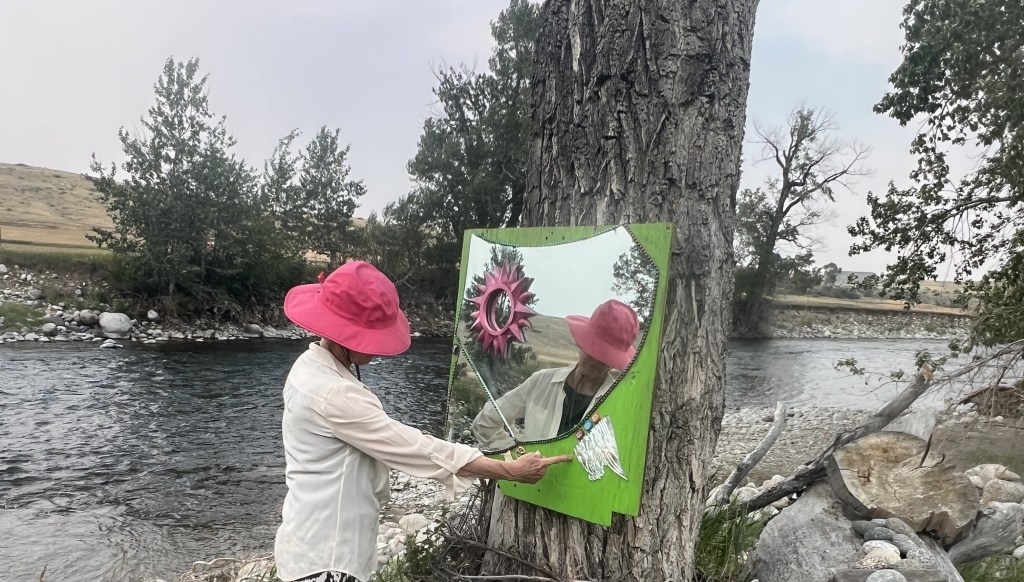
Three years ago, sudden and massive waters dropped a generous array of boulders near the newly cut riverbank. I’ve rolled these stones into a labyrinth and placed a recycled angel named Mary Magdalene at the center. Her arm fell off occasionally, but a fellow angel stopped by and glued it permanently in place.

Rafters appreciate Mary as they drift by, snapping thin lines through the air, hoping to catch and release innocent trout. Darth Vader and the Hulk stand guard, and I’ve added reading glasses.

Lately, besides sticks, stones, and angels, I’ve been drawn to shattered mirrors, discarded jewelry, and certain words–the ones used to deliver sucker punches: Bastard (someone born to an unwed mother); Bitch (a female dog); Fuck (to make love); God (a concept used to elevate oneself and control others).

“Wait!” God exclaims. “Don’t put us on that list.”

 I shrug. “You put yourselves on.”

“Hmmm. Well then, we’re taking ourselves off.”

“Good luck,” I shrug again. “I cross you off. You crop back up.”

“Fascinating,” God says. “What’s that about?”

“Consciousness. We’re at war. URGES. LIES. Still small voices. It’s Jiminy Cricket vs. Pleasure Island. We don’t want to humble ourselves and do the work necessary to be real.”

I step back from my collage and admire how the jagged and the smooth interact. The reconfigured shards reflect my splintered image.

“We love what you’ve done with your imperfections,” God says.

 “I rather like being cracked and shiny,” I admit. “Is that okay with you?”

An explosion of unadulterated laughter threatens to jiggle things loose. The glue isn’t quite dry.

“Mind?” God howls and contorts into a string of Mardi Gras beads, baubles, bones, and tubes of epoxy. “Glue us in, baby,” they chant. “Glue us in and hang us down near Mary.”

“But it’s dangerous down there. Floods. Trespassers. Unrelenting sun,” I warn.

In fact, my angel’s outer layer is peeling from constant UV exposure, and I could lose her to flooding or vandalism.

 “Then hang us high,” they laugh. “We’ve seen a flood or two in our day.” They begin singing an old camp tune. “You put your right arm in. You put your right arm out, you put your right arm in…. Let’s go!”

 I throw my arm over God’s shoulder, and we croon our way to the labyrinth. To Mary. To the river.

We put our whole selves in. We put our whole selves out. We put our whole selves in, and then we shake them all about. We do the hokey pokey, and we turn ourselves around.

And maybe. Just maybe, that’s what it’s all about.

Misperceptions

Birds crash into our southern windows at (literally) breakneck speeds. A few die instantly. Some bounce and fly away, wobbly and mortally wounded. We’ve taken steps to mitigate these errors in bird judgment, but why, oh why does this happen in the first place?

“You can fool all of the people some of the time and some of the people all of the time. But you can’t fool all of the people all of the time,” Creator murmurs to herself, mesmerized by the old neckties fluttering outside our windows.

“Who said that?” I ask. “Abe Lincoln or P.T. Barnum?”

“Does it matter?  Birds get fooled. People get fooled. That’s a sad fact. Manipulating perception can be both profitable and fatal.”

“Profitable?” I asked.

“Duh,” Creator says. “Conspiracy theories sell guns. False claims sell addictive, brain-altering drugs. Naïve people, with inadequate media literacy, donate to malevolent causes or con artists. Birds swoop toward something they want, not realizing that the transparent barrier is a mirage of their desires.”

“I feel for the birds,” I say. “One time, I hit a side window so hard I fell to the floor in front of a restaurant full of people.”

“Did you blame the glass for being there? For being too clean?”

I grin a sheepish grin. “Nah,” I say. “But I wanted to.”

Creator smiles. “Well, well. There may be hope for humanity yet.”

“Oh, no you don’t,” I say, backing away. “Do not pin hope for humanity on me. Nope.”

“People have a tough time admitting their ignorance or misperceptions,” Creator continues, ignoring my disclaimer. “The evidence smacks them in the face, but they drum up far-fetched explanations and take another run. Even when they break their stiff necks, they blame the glass.”

My hand automatically goes to my neck, and I do some yoga stretches to keep it limber. Yes, I occasionally engage in denial and blame, but glass is glass. Doors are doors. Truth is truth. And one clear truth is that humans make mistakes.

“Course-corrections are possible,” Creator adds in a quiet, sad voice. “I realize humility is not a popular virtue, but you don’t have to keep flying into the glass.”

“Do you think the meek will actually inherit the earth?” I ask.

“I think so,” Creator answers. “But the steep cost of repairs will be as unnecessary as all those broken necks.”

Default Settings

 My friend’s computer got hacked so he had to strip down to default settings to cast out the algorithmic demons. Having essentials saved in the cloud turned out to be a very good thing.

God is perched on my new orange ottoman sampling an experimental kefir popsicle I made yesterday. “Could I regress to default settings if I get corrupted?” I ask.

“Too lumpy.” She puts the popsicle on a plate to melt. “And no, you don’t have default settings. You have habits and intentions.”

Some people call God The Cloud of Unknowing. At the moment, this seems like a great name.

“Well then, Cloud,” I say, smiling. “Good thing I upload occasionally, huh?”

The Cloud agrees. “I save all your previous versions, false starts, half-assed plans, and unrealistic tangents.”

“Ugh,” I grimace. Having multiple versions of myself is confusing, and I generate vast numbers of intentions and ideas. I can never decide which ones to delete. “Do you at least have a logical naming system?”

“No,” The Cloud says. “That’s your job, though I do empty the trash once you actually delete and let go.”

“What about things I should have deleted but haven’t bothered?” I ask. “Could you make sure I’m remembered accurately?”

“No,” The Cloud says again. “No one is remembered accurately. But I’ve already remembered you well.”

All my mortal selves leer at me. A wave of vertigo hits, and suddenly, I’m being crushed by a density that makes it difficult to see or move. “Where are we?” I ask.

“Death Valley–282 feet below sea level. The atmospheric pressure is heavier here than anywhere on earth.”

“I don’t like it.”

“Yeah. Generally, I’m a bottom feeder, but it’s not easy here. Cloud formation is limited and whimsical.”

“Let’s go home and upload,” I plead.

“You sure? We’re 65 words short.”

“I’m sure,” I nod. “It’s only going to get worse. We don’t want to upload nonsense, do we?”

“I have some of your early poetry. Want to fill in with that?”

“No way,” I laugh.

I may not have default settings, but The Almighty Programmer faithfully saves my indeterminate multiplicities and understands my intentions.

And regardless of errant deletions or too many versions, there is enormous comfort in this: I am already remembered well.

The Ways We Use the Frontal Lobe

Even the most obvious instructions for being happy, healthy, and wise are routinely ignored, ridiculed, and explained away. Physicians, therapists, pastors, scientists, Jesus, the Dali Lama, Taylor Swift, and a vast array of poets and philosophers past and present shake their heads, mystified, and discouraged.

For instance, though cheap and easy, fossil fuels are finite and poisonous, but who doesn’t like well-paid extractive industry jobs, entertainment, warm houses, and nice vacations?

In the long run, we’d be happier (and less likely to go extinct) if we fed the hungry, welcomed strangers, exercised, turned down the thermostat, stopped bombing, and reduced our fat and sugar intake. Instead, we use our astounding intellect to invent complex rationalizations for less-than-helpful choices.

Me: Admit it, God. Your frontal lobe design has failed. Abstract reasoning is a bust.

God: Yeah. Science and compassion shot to hell by fear and feigned ignorance.

Me: I know. We strive to be avenged, satisfied, pain-free and immortal.

Meanwhile, there’s fire. I let the morning blaze die down because the sun is taking over, beaming radiant energy into the thermal mass I call home. Earthly fires are a triangle: Oxygen, fuel, and heat. Existence is a triangle enabled by fire: Birth, life, and death.

God: And I’m a triangle: Creator, Recycler, and Evolver. I don’t give up.

Me: Well, if I were you, I’d call it quits on earth. Lots of flops and botches.

God: I know you would, and I know you’re afraid, but I’ll never not be around.

The glow of the sun is not fire. It’s nuclear fusion, which involves protons smashing into each other so hard that they stick together and become something new. This transformation produces a tremendous amount of light and heat.

Me: That’s like us, God. When we smash together, good energy is released, right?

God: Cute. But no. You’re a willy nilly smasher. Mostly, you bounce. I help with repairs.

Me: But sometimes, I smash into something vaguely like you. I’m sure of it.

God is chuckling. As usual.

We are all willy nilly smashers. We take a hard run at something, crash, pick ourselves up, dust off our boots, gulp some coffee, tea, whiskey or kombucha, and take another run. Sometimes, fusion occurs, and we’re changed. But mostly, we bounce and remain unchanged.

God: Essentially unchanged, but not unfazed. Shed the defeatist attitude. Keep smashing.

Me: Ah ha! You’re still working on the frontal lobe, aren’t you?

God: Well, I may be deluded, but I believe even total failures have redemptive value.

The sky has clouded up and blocked the sun. I smile at the Eternal Delusion and get my matches. It’s time to start another fire.

Membership

Once in a while, book clubs invite an author to visit. God prefers anonymity, so she always declines. Not me. Often, it’s a nice experience, but on rare occasions, things get awkward. Members who’ve read only the title and back cover take the opportunity to share views tangential or even hostile to the essence of the book. Others fawn over the author, more focused on affiliation than analysis.

And speaking of awkward, I know of a romance writer who finagled an invitation to join her neighborhood book club. Because she published under a pen name, no one realized who she was. When it was her turn to choose a book, she held up her latest bodice-ripper, the slick cover burbling with cleavage and low-slung jeans. Everyone burst into laughter, thinking this was a joke. The author stomped out, never to return. They did not read the book.

“Well, they should have,” God says. “Romance is a billion-dollar industry.”

I roll my eyes. “I prefer murder mysteries. They do less damage.”

God leers at me. “Ah, come on. What’s wrong with a little erotic fantasy? Steamy scenes, orgasmic encounters, soulmates finally licking or sucking just the right spots…”

“Stop!” I interrupt. I don’t enjoy talking about sex with God. “Could we change the subject?”

“Sure,” God says. “But what is the subject?”

I pause and then admit, “I don’t know. And you know I don’t know.”

“Maybe we should talk about who gets invited,” God says.

“To what? Book clubs?”

“No. To anything. You all want to belong, don’t you?”

“Not necessarily. We want to belong to our tribe. People who look and think like we do, believe what we believe, read the same books, and share similar realities.”

“Then don’t invite me!” God snorts. She pulls on her turtleneck sweater. “You’re strangling yourselves. Loosen up, you judgmental little speck.”

“Don’t worry,” I snap. “You are definitely not invited. And don’t call me speck.”

Evening is approaching. The daylight remaining is not straightforward.

“Speck. Dot. Flicker. Flash. You realize that like rain, fire and light do not discriminate, right? So, instead of speck, how about I call you light of the world?”

This is a seductive but perilous proposal. God is the Ultimate Refractive Substance. As light passes through God, it splays and changes directions. That’s why stars twinkle. If I agree, I will be bent and fractured. My membership anywhere will be in question.

“Let me think on that,” I say, hedging.

We curl up on the couch and continue reading our book club’s latest selection, Sun House, by David James Duncan. As usual, I’m a little behind.

Laundry

I sit with my beer and orange juice while a faithful washer groans its way through a modest load of towels and underwear. The cacophony of morning includes two-stroke leaf blowers across the street, Harley riders roaring by, and cheerful but vociferous wild things that do not apologize for their dominance of the airwaves.

Just outside the open window, the Pacific looms large. Sinewy vines have flung themselves over the shoulders of trees and wound themselves around neon blossoms and beautiful fruit.

God is not bothered by the intrusive clamor and overbearing pigmentation. I am. Yesterday, alone on a windy shore, I circled things into simple black and white.

“I don’t like being one of 7 billion,” I tell God. “The entanglement and commotion make me claustrophobic.”

“Sorry to hear that, Chip,” God teases. (She calls me Chip, as in “chip off the old block” just to bug me.) “Would you like your own planet?”        

“Yes, please.” I nod, dipping my toes in salty water.

The Fluidity smiles and flexes, the tide rolls in, and I see that I am already a planet unto myself. Each nucleus spinning my direction is its own planet. The electrons dance, the stars align. I see that I am a singularity made of singularities held together by unspeakable complexities. I am one of One.

I breathe with grudging acceptance and the Fecundity loosens its grip. I relax. The grass withers. The flower fades. But the Gorilla Glue, the Relatable Pacer of the Universe doesn’t let go, doesn’t stop talking, transforming, or replaneting.

A science teacher of mine once declared, “Cell division is a goddamned miracle.” His asides were not often helpful or accurate, but from the perspective of my own DNA, he may have had a point. Cell division can be a very good thing.

God taps me on the shoulder. “Um, I hate to interrupt, but it’s time to hang the clothes.”

“I know,” I say. “Otherwise, they’ll mildew.”

The neighbor’s laughter sounds like a bird. I can’t tell anything apart anymore, and maybe I don’t want to. It’s all a bodacious blur, a heart-wrenching opera, a country-western shindig, a tsunami of sound, a smorgasbord of color.

The God of All that Ripens saunters seductively to the washer, and we begin the ritual of hanging our laundry up to dry, temporarily halting the march of mildew and mayhem. We air our grievances along with our love, holding our shape against the coming formlessness.

A haze of fruit flies rises from the feast of fallen star fruit, and I realize that even in the tumult and dissolution, all is well. All is very well.

The Circle, The Fall, and The Fat-Faced Child

From the perspective of a maggot, a cadaver is not an ending. It’s a feast. But then maggots are a banquet for geckos who are later gobbled up by mice. Laying hens peck mice into bite-sized pieces, and I enjoy chunks of chicken in my stir-fry.

Yeah, yeah. Circle of life and all that.

But are we more than maggot fodder? This has been debated since we invented the language necessary to express the longing and horror the question evokes.

“Of course, you’re more than maggot fodder,” The Ether speaks.

I sigh with relief, but I don’t let my guard down.

“And…?” I ask.

The Ether laughs. “You’ll be gecko excrement as well!”

“And there it is.” I roll my eyes.

“Seriously, honey, you’re not one thing now, and you never will be. The Holy Procession always breaks things down.”

I fight to stay coherent and unbroken in the moment.

The Ether materializes as a fat-faced child. Blond and defiant. I stare at the face. I wonder if it will wrinkle and hollow with age or stay pink and ebullient forever. I wonder if I will get my youthful body back someday.

“You wonder some crazy shit,” God says.

“You would too if you lived here. If you watched the news. If you had an inkling of what it means to deal with a real body.”

“Oh, but I do.”

“No, I live here. I am. And I do. You only pretend.”

The Fat-Faced Child frowns and begins to build a doll house out of Lincoln logs and Legos. “I’m gonna paint this pink and live here,” she says. “You’ll see.”

Her energy could easily swallow me alive. I go to the basement to get paint. Hot pink first. Then lemon yellow, lime green, royal purple, and turquoise. With this pungent, tangible turquoise, we could paint ourselves into the Upper World of the Zuni, and I am filled with joy. I am ready.

“How is this possible?” I ask.

“You have to fall,” she says. “Sometimes hard. Sometimes soft. But you have to let go and fall.”

In front of the doll house, a circle of my dearest friends are singing. Ring around the rosy. Pockets full of posies. Ashes, ashes. We all fall down, and they begin to fall. But The Fat-Faced Child falls first. Even in diminishment and grief, this is something I’ve always known.

  The Fat-Faced Child Falls First

Accusatory cataracts

drop from my eyes

And I realize

The Fat-Faced Child

has always fallen first.

Always suffered most.

Always broken the fall

for the rest of us.

And in the endless ruination,

The Fat-Faced Child

uses all the jagged bones

and tender tissue

to build again.

A Rose by Any Other Name

Sometimes, it’s easier if I don’t call it God. I call it good haircut. I call it washed dishes. Three Macintosh apples on a spindly tree. I call it undisplacement, deep sleep, minty water, solved problem, kind gesture, and silence. I call it insight. Green light. Resolution. Red light. Arthritis. Absolution. Glimmers of compassion, splinters of life, and unwelcome but comforting absolutes. Containment.

The larger sky is impossible to grasp in its entirety, and the names we give the constellations are revealing and projective. The vertigo inducing stomach turning mind exploding body shrinking cosmos intoxicates and decimates.

It’s all so nothing and so everything. Time is a bioluminescent pebble that burns through the palm of my hand, and briefly—oh so briefly–illuminates the steps ahead.

The hollyhocks have outdone themselves this year, and the sunflowers are outrageous. Last year’s seeds, woven into a rowdy celebration of soil, rain, and light. A summer soiree. I slip in surreptitiously. There are earwigs, slugs, wasps, and other unsavory characters among the invited guests.

The sting of consciousness is unmistakably God. The cries of the cranes are God. The rich organic matter is God. The path I use to get away is God. The offer to come back is God. But most days, it’s easier to call it something else.

 “I don’t mind at all,” God assures me. And assures me. And assures me. But I am not assured. Chronic doubt, the evening news, a sudden downpour, unrelenting hunger, fire, suffering, and war—these all complicate what could be simple. Between Alpha and Omega there’s an alphabet with gaping holes and identifiable threats.

And yet.

The day we once called tomorrow has arrived and desperately needs attention. Shall we call it Now? At the subatomic level, there’s an unnamed unity. If we call it love, we might have another chance.

The Ever-presence knows how hard we try to make it fit into our calendars and fears, our agendas and excuses. It flits among the fragments and festivities. It blooms and goes to seed. A circular salvation forms like beads of dew, and without our even asking, it forgives. And forgives. And forgives.

I found a ripe tomato hidden in the weeds, round and red as blood.  

“Help yourself,” God said. And I did.