Ecclesiastes for the Average Reader: A Tutorial

To everything, there is a season and a time for every purpose under heaven. A time to eat chocolate, a time to eat greens. A time to float the river, a time to cut hay. A time to blame, a time to own up. A time to back away, a time to give it your all. A time to dig and a time to refrain from digging.

Reader, please provide your own examples of holding on or letting go. C’mon. You know:

But what’s the use? You grow up. You grow old. Your carefully arranged treasures will be donated or dumped. The shrubs will be misunderstood, and the thistles will return. The stove will backdraft, the colors will run. You’re on your own, and the cards are stacked against you. You are not different than the beasts of the field. And as beasts die, so will you.

Reader, please provide three (only three) examples of your existential despair:

You’re a phony, a caricature of sincerity, a grumbler, a whiner, a blamer. You’re a striver after the sun. You’ve lied, stolen things, and lusted after fame and fortune. You’ve coveted and secretly rejoiced at someone else’s misfortune. You build bad fences. Everyone should be on your side. They’re not. You repeatedly make the same stubborn mistakes, and you’re as vain as anyone you know. It’s all vanity. All of it. This might be a good thing. Might not.

Reader, please cheerfully list three of your own moral shortcomings:

At night, you rehash failings and exaggerate the dreadful demands of the coming day. You toss and turn, sweating through self-inflicted anxieties. You torture yourself with blame, fear, and discontentedness. You wish you had control of your mind. You wish you believed in magic. Finally, as you imagine walking the plank, you fall asleep. But then you have to pee.

Reader, please provide all the reasons everyone should party late into the night:

In the meantime, what’s the harm in trying? What’s the harm in resting? What’s the harm in hoping? What’s the harm in keeping your nose clean and your heart open? Sure, you haven’t gotten it all right, and you never will. You’re far from flawless or erudite. Things rarely work out entirely as you’d planned. Wisdom isn’t all it’s cracked up to be. Now is the time to sigh and say “Ah, what the hell.” And the Teacher nods and says, “Seriously, what the hell?”

Reader, please shrug and provide your own what the hells. As many as you’d like:

Good work, dear one. It’s time for ice cream. Or not.  Next week, Revelations.
Strong Nuclear Force

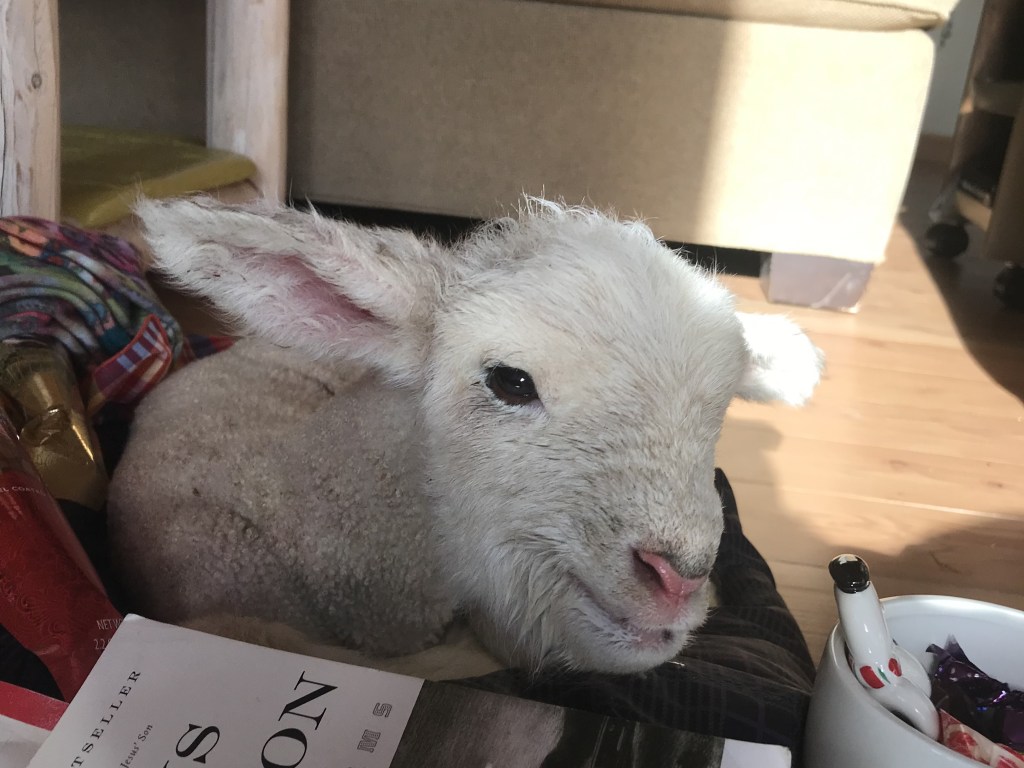
Earlier this week, God and I were deep into a discussion about the aptly named Strong Nuclear Force which is the force that holds subatomic quarks together and is thus responsible for the stability of matter. Because people often anthropomorphize God, I suggested that maybe she should change her name to Strong Nuclear Force. She pretended to consider this before concluding that she preferred other names, such as Lambkins, Alpha, Omega, or The Beloved.

The discussion ended, and the week steamrolled over me the way some weeks do. That brief exchange was unsettling, but I didn’t have time to revisit it. I barely had time to drink beer or exercise or contemplate how to save our tottering democracy. And the weeds took advantage of my frantic pace and went to seed as rapidly as they could.

I accept these harsh realities and the finite linearity of time. With what I consider to be enormous self-discipline, I’ve now seated myself in the old blue recliner, ready to center on the Center. The gardening and vacuuming will have to wait.

“So, you don’t have to go around calling yourself Strong Nuclear Force if you don’t want to,” I say, as my opening volley. “But I don’t like calling you those other names. Especially The Beloved. It sounds obsequious and weak.”

“No worries,” God smiles. “It’s just that I don’t like limiting myself. The nuclear scientists were quaking in their boots when they realized they could break the hold of the Strong Nuclear Force and set protons free. They wondered if once unleashed, the chain reactions would convert all matter to a kind of selfish, toxic energy that would end existence as you all define it.”

“And they detonated anyway,” I sigh. “We’re in so much trouble.”

“Yes, you are. You can see why the basics are so central, right?” God asks.

“Yeah,” I say, wondering which basics she means.

“Love,” she says.

“Too simple,” I say. “Undefined. Mushy. I don’t like that idea anymore. I want to roar and maim and shake people until their heads fall off.”

Strong Nuclear Force lifts her skirts and leaves.

The protons are free to crash.

The rich tell lies and steal from the poor.

The frightened arm themselves with weapons and hatred.

The young flounce. The old stiffen.

“Come back,” I yell. “You win. The Beloved is a fine name.”

“I always win,” she smiles.

“Maybe,” I say. “But that’s not readily apparent. Love is a tall order.”

“I know,” Lambkins says. “I’m often in disguise, but I’m taller than you think.”

Even in Dancing Shoes

Even in dancing shoes, God can balance her energies, lean over, and suck the venom from a snakebite if she wants to. She can heal the sick, calm the angry, and comfort those grieving if she wants to. She can lift burdens, feed the hungry, visit prisoners, and welcome strangers if she wants to.

“Why are you writing these things?” God asks. “It’s weird and inaccurate.”

 “Aren’t they volitional acts?” I ask. “Don’t you have free will? How could this be inaccurate?”

Rather than make eye-contact, I look down at my fingernails. They’re ridged, uneven, and dirty.

God leaves.

Self-pity overwhelms me. Tears slither down into the unknown and regrettable while I endure the harsh odors and intrusive sounds of life going on. Going by. Going on.

There’s a vivacious spirit roaming the overgrown garden in the back. I’m drawn to the tangled jungle of native species, exotic transplants, and invasive weeds. The garden appears to need tending. If I knew what to attack and what to nurture, I would engage in the battle. I would pull weeds, spread compost, and drip pure water where it was needed. I would…

God returns, laden with serpents and migrants, criminals and emaciated children. “Move over,” she says. “There are more to come.”

“There’s no room,” I protest. “And no path. One thoughtless step could easily crush a strawberry, injure a fern, or break the slender stalk of an orchid.”

God looks at me and repeats, “Move over.”

“I can’t,” I shake my head. “I just can’t.”

But this isn’t true. Every moment, I grow smaller, and the cracks in the clay widen. There’s room.

“Are you a weed or a rose?” I ask.

God shifts her weight, impatient. “You’re stalling.”

“Are you perfection or process?” I persist.

“Stop dithering,” she says. “You still have time to bake something.”

I make a face and drag my tired body toward the kitchen.

“That’s the spirit,” God says. “Our guests would love a warm cookie or maybe a loaf of sourdough or pumpernickle.”

“Ah, c’mon,” I groan. “Enough! I don’t want to move over. I don’t want to break bread with the madding crowd. I suppose you want me to fry up a few fishes, too.”

“That’d be nice.” God laughs as she slides a pair of high-heeled tap shoes my direction.  “Your size?”

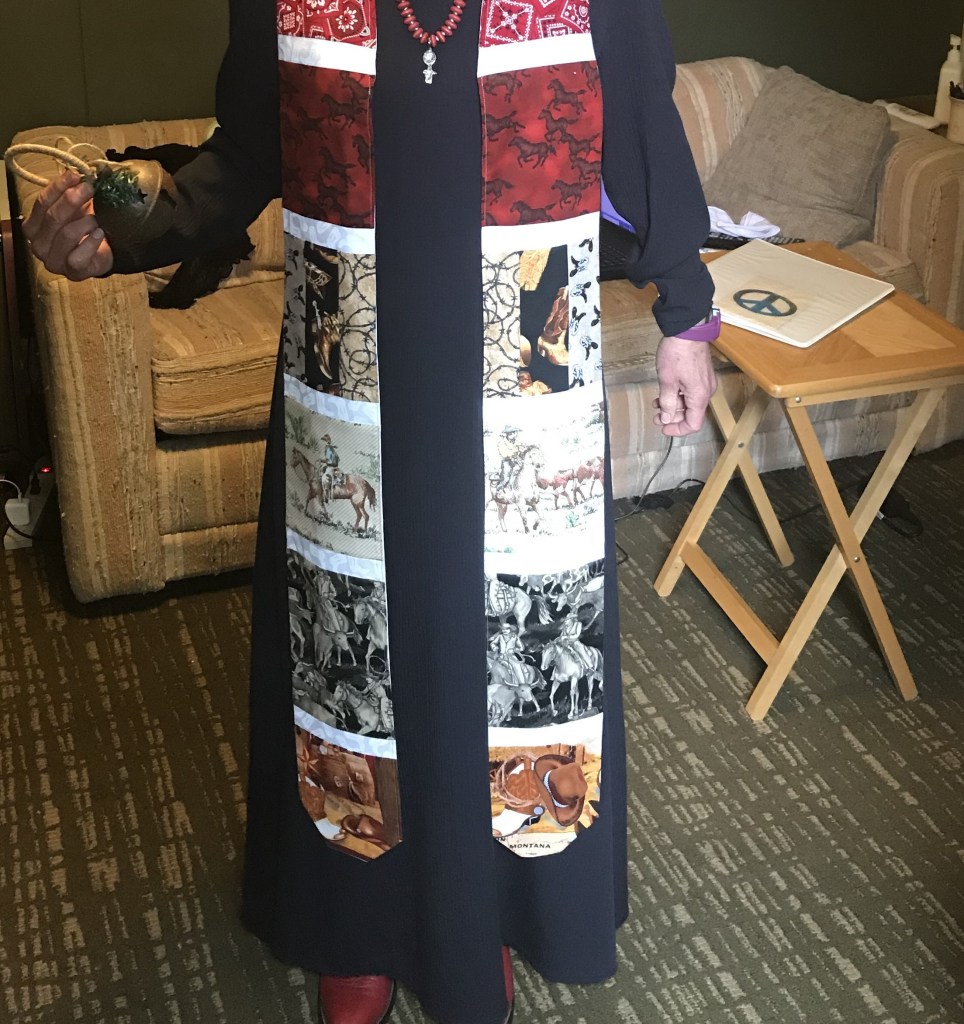
I hate high heels. I want my old red cowgirl boots. I want to hide in the oven with the cookies. I want to roll my life backwards. But I make myself try on these odd, uncomfortable-looking shoes.

“Just right,” I admit.

“I knew it!” she declares, reaching for my hand. “Let’s go.”

Flags

As consciousness ascends
the grin of the devil lingers.
My down comforter and fluffy pillows
smell like smoke.

I had intended to repair the tattered flag in the corner
but I see now that it cloaks the evil twins:
Blind allegiance and false promises.
Riches are blinders, not blessings.

A small plane drones through the dawn’s early light
strewing herds of animals hither and yon
for the pleasure of predators at the top of the chain.

“This is better than husking corn,” one of them says.

The corpses sanctify the trampled sod, now saturated with blood.
The resulting meals may justify giving thanks
but the trophies are pure vanity.

War is the thing to prepare for,
bodies the thing required.

Not this pig,” wrote the poet
before passing to the place of all poems.
We nod to the sentiment, slicing ham
and chopping bacon bits for the salad.

Bless us, oh lord, and these thy gifts…
runs on automatic replay
as I watch people refuse to sign the petition
for reproductive rights.

I’m not fooled by false equivalencies. I sign.

To live is brief. To die is certain.
This lonely insight flays the rays of morning
into the arc of promised justice
I barely believe in anymore.

“Wake up, little one. You have Now,” the Rainbow says.
“And the gossamer of Indigo.”

“But Indigo has begun to unravel,” I protest.
“And I’ve lived too long as a parable to engage with Now.”

Silence.

I polish surfaces in the kitchen
hoping for an accurate reflection.
But the granite is forest green;
the dishwater, troubled; the beer, murky.

The Distortion laughing up at me is God.

“I hope you didn’t pull yourself together on my account,” I say.

“Of course I did,” the Distortion answers.
“No one can live on Indigo alone.”

Misperceptions

Birds crash into our southern windows at (literally) breakneck speeds. A few die instantly. Some bounce and fly away, wobbly and mortally wounded. We’ve taken steps to mitigate these errors in bird judgment, but why, oh why does this happen in the first place?

“You can fool all of the people some of the time and some of the people all of the time. But you can’t fool all of the people all of the time,” Creator murmurs to herself, mesmerized by the old neckties fluttering outside our windows.

“Who said that?” I ask. “Abe Lincoln or P.T. Barnum?”

“Does it matter?  Birds get fooled. People get fooled. That’s a sad fact. Manipulating perception can be both profitable and fatal.”

“Profitable?” I asked.

“Duh,” Creator says. “Conspiracy theories sell guns. False claims sell addictive, brain-altering drugs. Naïve people, with inadequate media literacy, donate to malevolent causes or con artists. Birds swoop toward something they want, not realizing that the transparent barrier is a mirage of their desires.”

“I feel for the birds,” I say. “One time, I hit a side window so hard I fell to the floor in front of a restaurant full of people.”

“Did you blame the glass for being there? For being too clean?”

I grin a sheepish grin. “Nah,” I say. “But I wanted to.”

Creator smiles. “Well, well. There may be hope for humanity yet.”

“Oh, no you don’t,” I say, backing away. “Do not pin hope for humanity on me. Nope.”

“People have a tough time admitting their ignorance or misperceptions,” Creator continues, ignoring my disclaimer. “The evidence smacks them in the face, but they drum up far-fetched explanations and take another run. Even when they break their stiff necks, they blame the glass.”

My hand automatically goes to my neck, and I do some yoga stretches to keep it limber. Yes, I occasionally engage in denial and blame, but glass is glass. Doors are doors. Truth is truth. And one clear truth is that humans make mistakes.

“Course-corrections are possible,” Creator adds in a quiet, sad voice. “I realize humility is not a popular virtue, but you don’t have to keep flying into the glass.”

“Do you think the meek will actually inherit the earth?” I ask.

“I think so,” Creator answers. “But the steep cost of repairs will be as unnecessary as all those broken necks.”

The One-Eyed Chicken

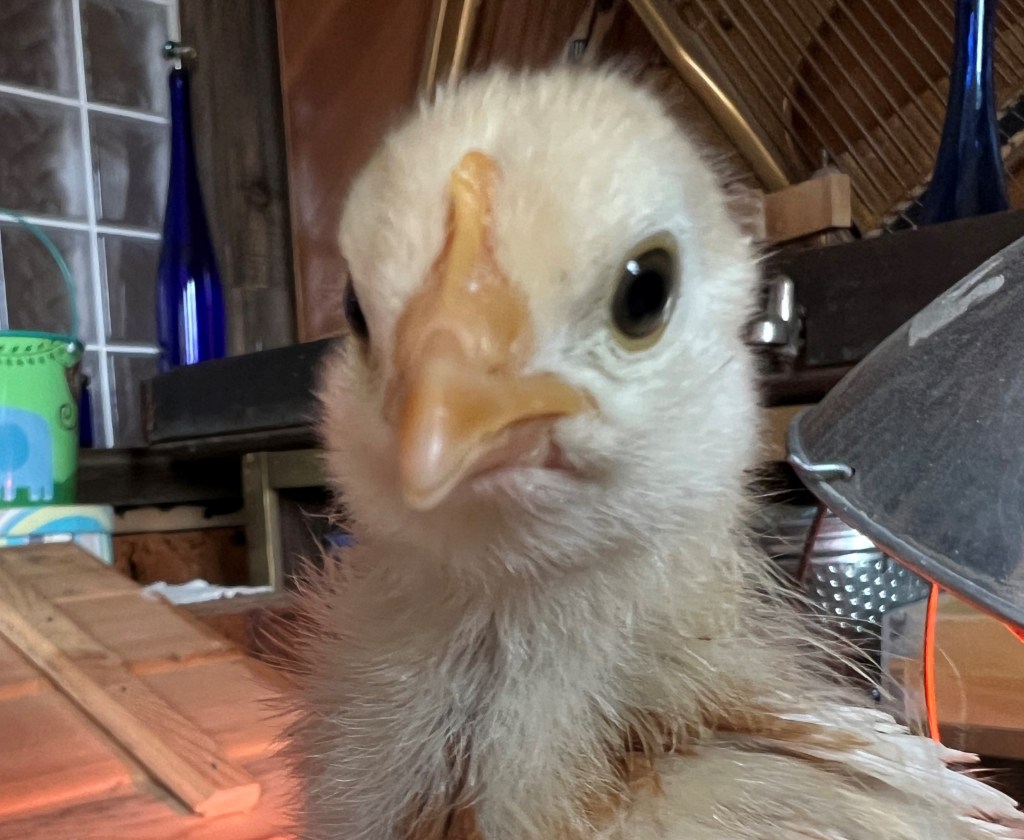
The one-eyed chicken turns her good eye towards me, poised to pounce on the moldy cheese I intend to scatter for our flock of five. In terms of pecking order, I doubt she’s at the top, but she’s held her own, foraging and evading predators for months now. I drop chunks of mozzarella well within her visual field and cheer her on.

Each morning, I render thoughts, words, and prayers the way lard is rendered from the carcasses of the beautiful pigs. I endure the heat of certain realities, stirring the hot mess around in the cauldron of my mind, watching impurities rise to the surface. To those in charge of assigning value, the one-eyed chicken might be classified as an impurity and skimmed off the top. But I’ve hung around with The Idea long enough to realize that the one-eyed chicken is not an impurity. She might actually be the purest expression of meaning available.

I don’t know how she lost that eye. I don’t know how it is that humans lose their way and kill each other. We are frightened and ashamed of our perceived inadequacies. Life seems wildly unfair. We’re lonely. Despite warning signs and alarm bells, we continue to accumulate possessions as if they will save us. We don’t realize we’re gathering floatation devices that push us to the surface where our fatal impurities will be most obvious.

And there it is.

We cannot save ourselves, and this makes us go a little crazy. Will humanity survive the adversarial urges that elevate winners and denigrate losers? Can we decenter ourselves enough to relax into being an ever-evolving, transitory, fraction of The Idea?

Botox doesn’t make us younger. Wealth does not make us worth more. Denial doesn’t change the truth. Fame does not make us immortal. We are loved, as is, by The Idea—a fertile complexity that in the end, renders us as wordless and dependent as the day we were born. The Idea that birthed us is in perpetual danger. It must be hell to watch us gorging on toxic delicacies to prove her wrong. Or prove her right. But The Idea needs no proof. We’re the ones who need proof, so we make things up. False justifications and worthless guarantees.

For now, the one-eyed chicken still lays eggs, which of course, proves nothing.

And everything.

My Way or the Highway

Arguing is easier than listening, even internally. It’s hard to ask myself why I believe what I believe and then to admit that sometimes, I just believe what I want to believe, whether it’s true or not.

And sadly, I’m not alone. Being wrong can be so devastating that even in the face of serious contradictory evidence, people will defend themselves to the point of absurdity, poisoning conversations and relationships as they dig ever deeper holes.  

“Are you including me in this scathing indictment?” Big Guy asks.

“Yes,” I say, without hesitation.

“Well, that’s just wrong,” he says, chuckling.

I give him a phony smile. “Tell me more,” I say, sidestepping conflict with my excellent listening skills.

“You don’t have excellent listening skills,” Big Guy counters. “And I won’t tell you more until you’re ready.”

“I’ll be the judge of when I’m ready,” I say, arms crossed, temper flaring.

“And that’s what I fear the most,” he sighs. “You, judging. You, thinking you’re ready.”

“Ready for what?” I ask, but I’ve lost track of my original premise. Arguing with Cosmicity is disorienting. Big Guy continues to chuckle, which is not helpful.

 I hate the thought of being gullible. Or wrong. My protective cloak of self-righteousness has worn spots. I need to be dead right about something. Anything. What if I’ve wasted my life swinging like Tarzan from belief to belief, only to have the final vine break? What if I’m a naïve fool? What if I grow bitter for erroneous reasons? What if I’ve leaned the ladder of success against a false wall? What if I’ve taken too many supplements all these years?

Big Guy is howling, holding his gut, peeing his pants. “You’re the best, honey. I needed that.”

“Needed what?” I ask, red-faced and defensive.

“I needed to watch you drink from the chalice of uncertainty. Elixir of the Gods, right there. Confessional magic. The meek and humble are my last hope for humanity’s continued existence.”

“So glad I could be of help,” I lie. Big Guy seems to think he’s winning an argument. He’s relishing my chagrin.

“No, and no,” he says. “I don’t relish, and I don’t win.”

“And I don’t get it,” I admit.

“Oh, but you do,” Big Guy says.

Every cliché in the known universe is screaming at me. Platitudes and blind faith parade by, tossing sweet assurances. There are cookies baking, robin eggs hatching, children laughing, ice cream melting, rounds of stiff drinks on God. So little time. So many simplicities.

“You’re ready, little one,” Big Guy whispers.

“I know,” I whisper back. “But hurry. It never lasts for long.”

Eclipse

“I would understand completely if you didn’t love us anymore,” I say to the Outer as humanity roils in its own troubles. “Maybe you never did.”

The Outer slowly removes her apron, wipes her hands, and gives me her full attention. She is the grandmother I miss the most, daffodil bulbs I planted in the fall now emerging green. She is rain. She is equally at home in the bassinette and the casket. She digs ruthlessly into the soul like a miner extracting the rare elements needed to provide light to the world.

“And it’s okay if you don’t love me anymore,” she answers in the voice of a thousand cranes.

“Why do you say things like that?” I ask. I suspect the Outer is being strategic, not honest. I feel certain she wants my love.

“It’s just a badly translated word,” she shrugs. “You have a very limited understanding of, well, of anything. But especially the substance of that word.”

She’s right. Love is an impossible notion. A dark foreboding, an insistent demand. It’s both threat and promise, a transactional negotiation, a rigged wager. It’s time taken away. Time given back. Blood everywhere. Tears flowing. It’s organic and orgasmic. Sacrificial, selfish, obligatory, and oblique.

“There’s a total solar eclipse coming,” the Outer says. “What do you make of that?”

“Nothing,” I say. “Should I?”

“I would if I were you,” she says. “But then, I make something of everything.”

The Outer gives her homemade pinafore a shake and puts it back on. It’s a badly stained yellow. She wraps the strings around her ample middle and ties them in front. I’m filled with envy. I want an apron, too.

“In some places, for a moment, your tiny moon will obscure your view of the sun. I’d call that something,” she says. She’s begun to glow. I realize I am in mortal danger.

“Moon!” I yell. “Moon! I need you.”

Outer laughs. The nuclear fusion continues. Moon arrives just in time and covers me.

“Moon,” I say, humbled. “I love you.”

The great stirring and swirling and folding continues. I’m an easily eclipsed flash of joy, a dash of salt, a grain of sand, a sunflower seed. I offer thanks to the Moon and Stars, the Outer, the Inner, the Unknowable, the Tao, and the Way.

“I love you, too,” the Moon says back.

She hands me an apron and a wide-brimmed hat. A makeshift kitchen has been blown to bits, seven servers and their beautiful aprons, gone. I am desperately sad. But in this grim, eternal spring, the muddy garden calls me by name, and for now, I know where I belong.

Volcanic Activity

A derisive voice arose from the cracks in our tongue and groove flooring. “No wonder you thrash around looking for someone who understands, someone who loves you just as you are. You don’t even understand yourself. Whatever that means. So good luck with that.”

I grimaced. God was rumbling up from below, apparently trying to be therapeutic. True, I am in fact wrestling with the complexities of love and understanding within myself and others. But I hate paradoxical interventions.

“Hello, Nasty God,” I said in a resigned voice. “You’d make a lousy psychologist.”

Bully God, Blunt God, Mean God, Bad Mood God, Belligerent God, Greedy God, and Hot Shit God crowded around the table. Nasty God poured coffee and served cake and ice cream. They chewed with their mouths open, burped, and scratched themselves. One of them purposefully passed gas, and the rest laughed like unchaperoned boys at a slumber party in the basement.

But they weren’t by themselves. And they weren’t in the basement. They were front and center in my muddled mind. I stole time from my meditative morning to scorn them, one by one.

“You will not behave like that in my house.” I shook my finger, matronly and severe. It had little effect.

“You will not be so damn hard on yourself,” they cried in unison. “You will loosen up and cavort.”

“OMG, I will NOT cavort,” I said.

“You WILL cavort,” they shouted gleefully and began to sing in three-part harmony:

Don’t sell us short, you will cavort.

You will smirk and go berserk.

You will rant, and you will pant.

You will flail, and you will quail.

You will cast the evil eye,

you will curse, and you will cry.

It’s who you are, our little star.

We’re never far. We’re never far.

I crossed my arms and glared. They mimicked my posture, climbed on top of my shiny table, and danced an Irish jig, belting out round after round of their ridiculous song. The table expanded into a dance floor, and the Wily Women in tall black boots arrived. All hell broke into angular pieces and floated away like iceberg calves. Iceberg calves.

It went on for weeks. Finally, a nearby volcano erupted. A thick cloud of Messianic Ash blanketed the exhausted inner party, and we melted into nothingness.

For a blessed moment, it was profoundly quiet. No color. No light. No longing. No fear.

Then, “Care to cavort?” they whimpered, breaking the silence in strangulated voices.

I smiled and shook my head.

“We’ll be back,” they promised as they dusted themselves off and faded away.

“I know,” I said, centered and calm. “And I’ll be here.”

Oh, Baby

This is the narrowest time. Night has loosened its grip, and old wine is poured out as libation to the rising sun. My head slumps to my chest, and my shoulders curl inward to make the passage less painful. Less prolonged. To the east, a thin blaze of orange takes hold. With kindling gleaned from around the chopping block, I light a fire so I can immerse my hands in the warm liquid of another day.

“What sayest thou?” I ask the newly arrived Sandhill cranes.

“What thinkest thou?” I ask the rising river.

The answers come on the in-breath and dissipate before I can inscribe an adequate translation. I will have to ask again and try to be worthy of the answers.

My inner audience isn’t kind. The promise of spring is shrouded in snow, and for some reason, the fire is burning more reluctantly than usual. I suspect it’s the blessing and curse of the thick bark still clinging to these beautifully split logs.

Before I slept last night, someone told me they loved me, and someone told me they hated me. The raucous rise of the north wind relieved the barometric pressure of leftover miles. There was just enough time to make a cursory inspection of my seashells, sticks, and rocks before the paralysis set in. Even then, I had to lean into God to make it to the safety of my flannel sheets.

Now, alert and alive, we are filled with equal amounts of dread and joy.

“Oh, baby,” God sighs. “Oh, baby.”

“Oh, God,” I say, pushing back a little. “Oh, God.” I look into myself as far as I can. “I wish you wouldn’t sigh at me. Go sigh at someone else.”

This elicits a smile. We sip coffee, eat toast, and raise our glasses to the trains arriving, the trains departing, journeys beginning, journeys ending. These simple routines grease the wheels, and we’re off.

Who can guess the length of their days? Who can predict the hard hatreds and easy loves? No one knows their own soul very well, let alone the redemptive mind of God at rest in the protective bark of scorched and fallen trees. We cannot be expected to do any better than we can.

“Oh, baby,” The Cosmic Drama Queen sighs again, so inclusive, so determined. Her obsidian eyes are sparkling, her broad shoulders squared. “Oh, baby.”