Tallies

How many pots have you scorched in pursuit 
of the good life, warm soup, or steamed greens?
No worries. You’re often distracted by sparkling words.

How many scrapes and bruises have you endured
because of hasty departures or overpacked plans? No sweat.
You thought you could cut corners that cannot be cut.

Is your fastidious loading of the dishwasher
a point of pride or a place to hide
because the terrain of shame is so steep?

You polish your resentments like silver. This isn't wise.
Pack them up and drag them to town. Melt them down.
The Blacksmith turns everything into serving bowls.

Conjure up some joy. Old is inescapable.
Young is no one’s fault. Apologize when you recognize
that your memories are wrong. Gently move along.

How many times must you be reminded
that only love is worth the extra weight?
One more time, you plead. One more time.

But what is love? A tally that tips the scales?
Count the stars in the heavens, the hairs on your head.
Map the terrain of your body. Make a schema of your heart,

and when your beleaguered soul demands a list
of what you’ve done that matters,
give it a cup of something warm and curl up for a nap.


Come Hell or High Waters

Even though my highly evolved frontal lobe allows me to weigh alternatives, it’s hard to live equivocally, think critically, or keep an open mind. It’s so tempting to explain away contradictions and cling to naïve or wrong-headed beliefs. I suspect most of us do this, come hell or high waters.

And at least in my case, Hell-or-Highwaters usually come, claiming they intend to save me from myself. They go by many names; Hell-or-Highwaters is not my favorite.

“So, what are we defending or pretending today?” they ask as they remove themselves from the sticky wicket of being defined and strip down to an array of naked, undulating possibilities.

“Stop it!” I demand, holding up my hand. “You’re making me sick.”

They shrug. “Nothing wrong with a good vomit now and then.”

“I’m going to have to kill you,” I respond, my voice cold and calm. “All of you.”

“We know, honey,” they nod. “Let’s get on with it.”

Their phony acquiescence is not helpful. “You know I can’t get on with it. I’m not brave enough to be an atheist.”

They seem to find this hilarious. Guffaws rise from the Laughing Buddha in the garden. The winds of Shakti howl. Allah and the Living River giggle like teenagers flirting at a kegger. The hills hold their quaking sides, and brilliant streaks of sunrise release into mirth with such force that the planet is knocked sideways.

This reaction adds insult to injury. “I NEED ONE SURE THING,” I bellow.

“We’re so sorry,” the Choir sings. “But we’re not a thing. We’re a process. A fragile set of evolving constructs. A far, far beyond.”

I make a hateful face and mock their words.

No response.

Of course, no response.

Somehow, I finish typing and lower my leg rest.

 “Let’s roll,” I say to the Iridescent Shadows.

Todd Beamer said those very words as he led the suicidal downing of Flight 93 on 9/11, and with that, the plane intended to be a weapon became a sacrifice. Lives were suddenly ended. Other lives, randomly prolonged. These truths are as brutal as the equations.

Fanatic fervency is not faith, and blind allegiance is not love. The energy we call God is embodied in intricate complexities and barely traceable connections. Thus, we are destined to live amid holy but ineffable words and die in the arms of unlikely possibilities.

“My, my, aren’t we profound today?” Yahweh jokes as the solitary black chicken scratches for worms in the compost. She’s new to the flock, relocated because her sister hens were all killed by a wily racoon. She survived. But understandably, she’s a little skittish.

Proof

How do you know you are loved? Does it mean you get everything you ever wanted? How do you prove your love to someone else? What in the heck is love anyway? Is it like porn? Do you know love when you see it? Feel it? Trust it? Will it? Choose it? 

“Hello,” Love says.
“Gaaa,” I say. “You’re not my grandma. Get away from me.”
“Howdy there, little lady,” Love says with a swagger.
“Don’t howdy me,” I snap. “I’m not your type.”
“Find me. Trust me. Uncover me,” Love demands.
“I can’t. I won’t. I don’t know how,” I shake my head, hands up, defensive.

“Good-bye,” Love says.
“Where’re you going?” I ask, suddenly afraid.
“Don’t know. Don’t care,” Love grins. “Want to ride along?”
“How would I know what I want?” I ask.
“Exactly,” Love nods.

Love settles on the couch. “Do you love anyone?”
“I try,” I say. “But not very well, at least by your standards.”
“And what are my standards?” Love feigns interest.
I consider this for a long while.
Love knits a blanket beside me, humming to herself.

“Well, endurance comes to mind,” I finally venture.
The guess is flat. Two-dimensional. Endurance is not that sexy.
“Good one,” Love says. “Say more.”
“No, you say more,” I counter.

Love leaps up and begins a seductive belly dance.
“Inward, outward. Yes. No. Not-you-ness. Enough.
Letting go while hanging on. Balance.
Acceptance. Sacrifice. Otherness. Oneness.
Shall I go on?”

“Don’t bother,” I sigh. “It’s impossible.”

“Absolutely,” Love stops gyrating.
“I adore that about myself. I’m a gorgeous trip to nowhere,
a deceptively simple meal.
Five sparrows with open mouths and winter on the horizon.
I’m full of myself. Brimming, spilling, messy.
I’m the first longing and the last drink.”

“Love,” I say plaintively. “There are so many cold days and crushed dreams.
So many painful failures. Could I have that blanket when you’ve finished it?”

“No, honey,” Love says. “It’s not for you.
You already have more blankets than you need.”

What? I am embarrassed. Outraged. My demons scream. The collective that I am rushes to the sea—the known and unknown, the just and unjust--intent on self-destruction. Intent on death. But Love calls to the heavens, and the entire crowd of me tumbles into the blue bowl of inverted sky.

Mick Jagger slides onto the curvilinear stage, clearly on a mission. “You can’t always get what you want,” he croons. I want to slap him silly but what’s the use? The truth is not his fault.

Strong Nuclear Force

Earlier this week, God and I were deep into a discussion about the aptly named Strong Nuclear Force which is the force that holds subatomic quarks together and is thus responsible for the stability of matter. Because people often anthropomorphize God, I suggested that maybe she should change her name to Strong Nuclear Force. She pretended to consider this before concluding that she preferred other names, such as Lambkins, Alpha, Omega, or The Beloved.

The discussion ended, and the week steamrolled over me the way some weeks do. That brief exchange was unsettling, but I didn’t have time to revisit it. I barely had time to drink beer or exercise or contemplate how to save our tottering democracy. And the weeds took advantage of my frantic pace and went to seed as rapidly as they could.

I accept these harsh realities and the finite linearity of time. With what I consider to be enormous self-discipline, I’ve now seated myself in the old blue recliner, ready to center on the Center. The gardening and vacuuming will have to wait.

“So, you don’t have to go around calling yourself Strong Nuclear Force if you don’t want to,” I say, as my opening volley. “But I don’t like calling you those other names. Especially The Beloved. It sounds obsequious and weak.”

“No worries,” God smiles. “It’s just that I don’t like limiting myself. The nuclear scientists were quaking in their boots when they realized they could break the hold of the Strong Nuclear Force and set protons free. They wondered if once unleashed, the chain reactions would convert all matter to a kind of selfish, toxic energy that would end existence as you all define it.”

“And they detonated anyway,” I sigh. “We’re in so much trouble.”

“Yes, you are. You can see why the basics are so central, right?” God asks.

“Yeah,” I say, wondering which basics she means.

“Love,” she says.

“Too simple,” I say. “Undefined. Mushy. I don’t like that idea anymore. I want to roar and maim and shake people until their heads fall off.”

Strong Nuclear Force lifts her skirts and leaves.

The protons are free to crash.

The rich tell lies and steal from the poor.

The frightened arm themselves with weapons and hatred.

The young flounce. The old stiffen.

“Come back,” I yell. “You win. The Beloved is a fine name.”

“I always win,” she smiles.

“Maybe,” I say. “But that’s not readily apparent. Love is a tall order.”

“I know,” Lambkins says. “I’m often in disguise, but I’m taller than you think.”

Formatting

Phote Credit: Theresa Vandersnick Burkhart

“If you wanted to write a bible or some holy essays or something, would you use Word?” I asked the Source. “Would you store documents in the Cloud? Post directly to Facebook? TikTok?” My tone was edgy. Yesterday, I’d lost most of my skirmishes with technology.

God’s eyebrows arched quizzically. I waited in comfortable silence, enjoying the sensuous twist of driftwood and the undulations of the emerging horizon. I meditated on medieval monks brewing dark beer as they transcribed and illuminated ancient texts.

“I don’t write things down,” God finally answered. “The written word hardens and can become a weapon. It’s often misused. Have you considered the living word? It offers an array of formatting options that could keep you busy for centuries.”

Brilliant colors bled across the eastern sky, transforming the unspeakable terrors of the night into manageable commandments.

“Yes. On occasion I’m possessed by the living word,” I said “But I still love the written word. What would life be without bodacious, malapropism, or onomatopoeia?”

God’s gaze was steady. The carefully ordered syllables of my life started breaking free, combining and recombining. Recumbent. Iconoclast.  Greek. Mandarin. Farsi. Sanskrit. There are over 7,000 languages spoken by humans in the world right now, and who knows how many more existed before we started counting? And what about the languages of animals? Trees? Vibrations in space?

“Do you think we should include the living word among the list of functional modern languages?” I asked.

“Seriously?” God laughed. “Functional?”

A silver convertible, a rusty jalopy, an all-electric Ford Lightening, a school bus, and a fume-spewing Chevy paraded by. The Drivers grinned and waved.  Instead of candy, they tossed indestructible reading glasses. Delighted children grabbed them and put them on.

“We see you,” the children shouted at me. At each other. At the Drivers. “We see you!” They scooped up small animals, lonely widows, bees, and bones. “We see you!” they cried, rejoicing in their vision.

Their weightless innocence was infectious. I longed for a Buddhist-like acceptance. I’m always trying to weave the words at my disposal into an easily maneuverable raft or a safe path forward, but they often splinter or blow away, catching debris and damming up the Living River as they tumble willy-nilly in the crosswinds.

The Drivers got out of their rigs and circled me, holy eyes magnified by thick lenses, clownish smiles revealing large, sacred teeth. “Relax,” they said. “Word dams are an important part of the ecosystem. Just ask the beavers.”

“I don’t speak beaver,” I protested. “But you could,” they said, their heads nodding sagaciously. “It’s never too late to learn another way of seeing.”

Laundry

I sit with my beer and orange juice while a faithful washer groans its way through a modest load of towels and underwear. The cacophony of morning includes two-stroke leaf blowers across the street, Harley riders roaring by, and cheerful but vociferous wild things that do not apologize for their dominance of the airwaves.

Just outside the open window, the Pacific looms large. Sinewy vines have flung themselves over the shoulders of trees and wound themselves around neon blossoms and beautiful fruit.

God is not bothered by the intrusive clamor and overbearing pigmentation. I am. Yesterday, alone on a windy shore, I circled things into simple black and white.

“I don’t like being one of 7 billion,” I tell God. “The entanglement and commotion make me claustrophobic.”

“Sorry to hear that, Chip,” God teases. (She calls me Chip, as in “chip off the old block” just to bug me.) “Would you like your own planet?”        

“Yes, please.” I nod, dipping my toes in salty water.

The Fluidity smiles and flexes, the tide rolls in, and I see that I am already a planet unto myself. Each nucleus spinning my direction is its own planet. The electrons dance, the stars align. I see that I am a singularity made of singularities held together by unspeakable complexities. I am one of One.

I breathe with grudging acceptance and the Fecundity loosens its grip. I relax. The grass withers. The flower fades. But the Gorilla Glue, the Relatable Pacer of the Universe doesn’t let go, doesn’t stop talking, transforming, or replaneting.

A science teacher of mine once declared, “Cell division is a goddamned miracle.” His asides were not often helpful or accurate, but from the perspective of my own DNA, he may have had a point. Cell division can be a very good thing.

God taps me on the shoulder. “Um, I hate to interrupt, but it’s time to hang the clothes.”

“I know,” I say. “Otherwise, they’ll mildew.”

The neighbor’s laughter sounds like a bird. I can’t tell anything apart anymore, and maybe I don’t want to. It’s all a bodacious blur, a heart-wrenching opera, a country-western shindig, a tsunami of sound, a smorgasbord of color.

The God of All that Ripens saunters seductively to the washer, and we begin the ritual of hanging our laundry up to dry, temporarily halting the march of mildew and mayhem. We air our grievances along with our love, holding our shape against the coming formlessness.

A haze of fruit flies rises from the feast of fallen star fruit, and I realize that even in the tumult and dissolution, all is well. All is very well.

Getting to Yes

On one of my all-time favorite British sitcoms, The Vicar of Dibley, there was a character who answered any inquiry with no, no, no, no, no, no, no…. Then his oppositional stuttering would shift abruptly to something like, “Yes, sounds good.” This made the vicar roll her eyes and the audience laugh. Every time.

That sums up my relationship with my Coauthor fairly well. I look at the deep divisions in the world, the absolute necessity of being loving and forgiving, shake my head, and say No, no, no, no, no. Then I breathe, consider the options, and say Yes. Not because anything looks or sounds all that good. It’s just that Yes is the best answer available.

And the audience laughs. Every time.

The vultures laugh. The sparrows laugh. Friends and enemies laugh. The feasting deer lift their heads and laugh. Secure in the lap of forever, the souls of the brutally departed laugh. Fire-setters, firefighters, funeral directors, midwives, engineers, artists, jailers with rings of keys, pilots with bombing planes, producers of poison, planters of organic seeds.

Laughing. Every time.

But what’s so funny? The knee-jerk string of NOs? The pivot to YES?

“It’s all funny,” my Coauthor says. “Every bit of it.”

“I beg to differ,” I say.

“Of course you do,” my Coauthor chuckles. “See? Now, go ahead and get to yes.”

 “No, no, no, no, no,” I say, shaking my head.

“There’s a Yes in there somewhere,” God insists, sneaking toward me with tickle fingers, making ridiculous, nostril-flaring faces, tossing popcorn in the air to catch in his mouth—the Clown of Heaven, the Fathomless Fool.

“YES!” I yell. “Stop! You’re absurd.”

“No,” God laughs. “No, no, no, no, no.”

“Very funny,” I say. “Now, go ahead and get to yes.”

“Already there,” God smiles. “C’mon in. I’ve got wine and fresh bread.”

The Yes propels me forward. I take my place at the table and break the loaf open, crusty and warm. The wine is bitter, but there are carrots sweetened by the frost and a steaming cup of tea. I am grateful despite the costs and challenges in such wanton communion.

“Yes,” I say, soberly, allowing my eyes to see.

“Yes,” God nods with compassion.

And the day begins. It will be filled with divine comedies, embodied tragedies, the futile and the fulfilling. Most of the doors will be left unlocked, swinging freely in the wind.

Would You Like Me Better as a Bird?

Photo Credit: Scott Wolff

Sometimes God could try to be a little nicer. More fully present. Sure, there are days when we get along fine, but other days God goes silent, and I feel like the world is all my fault. For-profit prisons. Liars worshipped. Migrants capsized. Socialism demonized. Women as chattel and baby machines. The earth abused for our comfort.

On these days, I stomp, kick, and scream. I don my self-righteous armor, mount my trusty steed, and aim my lance at the nearest dark-web, conspiracy-theory, Fox-watching neighbor. This only happens in my head, but even so, I’m surly and unpleasant. Which is ironic since it likely reduces God’s motivation to stop by.

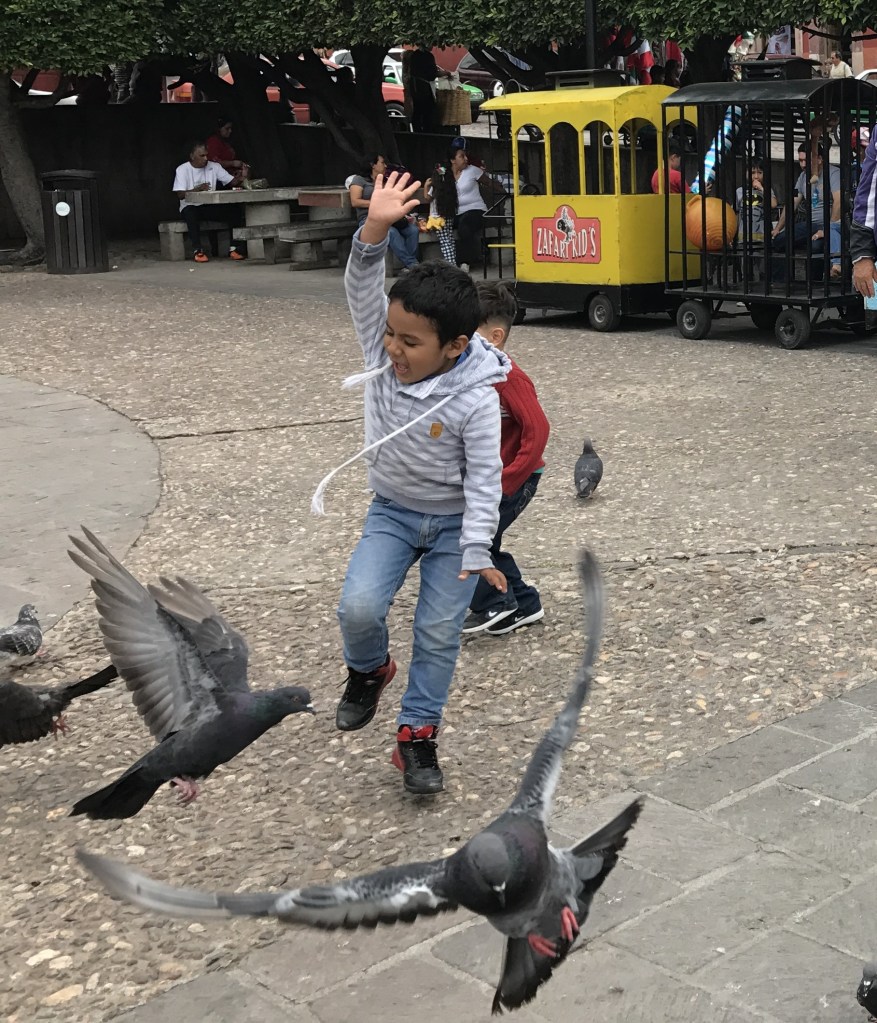
Then I notice the birds. The spectacular seed-eating bug-eating preening singing chirping flocking soaring birds. They are so present, so varied, so temporary. I see God letting them hop on her chest, giggling because it tickles. I see God lining their nests with sacred down. I see God in the lift of their wings. I see God dangling from their beaks. Their blithe innocence is sleek and beautiful.

Even in my ragged unbelief, in my sad and porous bones, I know that no sparrow falls alone. The hairs on my head, the lilies and dandelions, the war-ravaged children, the unsheltered, unloved, unknown. The conscripted. The billions unwillingly born. We’ve all been absorbed in the ocean of Knownness. Swelling buds, the receding tide: illusions of the highest order. We are figments of God’s imagination, players in a dream dreamed by God. I often think I want to free myself, but it seems I have no wings.

Is this my fatal flaw? Is this why I get mired in unlove?

Would you love me more if I could fly? I fling the question into the void, expecting only an echo back, but the Void quickens, and laughter cascades down like lava, vivid orange and dangerous.

“Oh, little fool,” the Void says. “You know I love you as much as you’ll allow.”

I tear up. There is a long, pregnant pause. Then the Void whispers, “And baby, you may not remember, but you have always known how to fly.”

This should be good news, but it frightens me.

I consider the wings of the morning and the skeletal lightness of being while young robins jump around under the lilacs to gain the strength they need to fly. Malignant tendrils of greed give way to the released and rising outbreath of the dead. The Void is right. I have always known how to fly.

Short Podcast With You-Know-Who

Podcaster: Thanks for agreeing to be on my podcast.

God: Glad to be here, but why now?

Podcaster: Well, after spending some years as an atheist, Rainn Wilson (Dwight from The Office) has declared he believes you exist. That’s big. So I thought I’d get you on. Boost my ratings. Go viral.

God: Ah, now I get it. Rainn wrote a nice book, and he’s got a million followers.

Podcaster: Yeah, and his God hasn’t endorsed any massacres or sacrifices. Can you say the same for yourself?

God: Of course.

Podcaster: What’s your name again? I may have you mixed up with a more violent, judgmental God.

God: Understandable. My real name is not something you could understand or even pronounce. You people use a lot of nicknames. Approximations.

Podcaster: Are you the one who guarantees an afterlife but only under certain conditions?

God: Nope.

Podcaster: Are you the one in favor of people killing other people, like in self-defense, or war?

God: Nope.

Podcaster: Are you the one who devalues women? Hates gays? Insists on pregnancies brought to term?

God: Nope.

Podcaster: Are you the one who wants to be praised all the time? Elevated? Worshipped?

God: Nope.

Podcaster: I’m not sure you’re really God. Do you have some commandments or something to prove it?

God: Yep.

Podcaster: Well, that’s a relief. Are there ten of them?

God: Nope. Only two. And they’re for your own good, not mine.

Podcaster: And these are?

God: Love me and love your neighbor as yourself.

Podcaster: That’s a problem right there. You won’t even say who you are. How can I love you?

God: Well, let’s assume I created you and basically everything seen and unseen, and I infused it all with love. Kind of like a perfect mother, if there was such a thing.

Podcaster: Big assumption.

God: Yeah. Well, how about that neighbor thing?

Podcaster: Um, let’s drill down on that. I think I could love a few, select neighbors. Is that enough?

God: Nope.

Podcaster: Do you have any suggestions for how to do that comprehensive love thing?

God: (sighing) Crack open your puny chest, pry open your stubborn mind. Die instead of kill. Lay down your weapons. Cheerfully give all you can give. Find joy instead of fault. Be still. Tender. Humble. Awake.

Podcaster: (snapping God’s microphone off) And that’s it for today, folks. Tune in tomorrow for a rebuttal, led by a panel of experts: The Rich, Lucifer, Judas, Adam, Eve, Kali, Coyote, and others who’ve let their lower natures run amok.

God: (gently touching the cheek of the Podcaster) Got a minute?

Podcaster: (recoiling) Nope.

Gone

To begin my morning wrestling match, I typed the word gone and then backspaced it out of existence and then typed it again. It sits on my screen, a fragile, arrogant four-letter word with its dukes up, ready to go a round or two with denial. But here’s the truth:  I can make it disappear and reappear the rest of the day if I’m so inclined.  I am more or less in command of my words. This is comforting. Sobering.

Spoken or recorded, words can linger beyond the speaker or the author. We fawn over first words. Cherish the last. The words in between muddle along, hurting, encouraging, freeing, frightening, disguising, delighting, warning, elucidating, lying, and shaping whatever they touch.

“Hello,” God says. “What have we here?”

“Me, muddling,” I say. “Thanks for interrupting. It was getting weird in my head.”

Gone can do that,” God says. “Try go or going instead. More energized and hopeful. For now, that’s probably better for you.”

“Don’t pamper me.”.

God looks surprised. “Why not?”

“I want to be tough enough to handle it on my own.”

“Handle what?”

“You know. Goneness. Endings. Closures. Failures.”

“Oh good grief.” God digs his fingers into my shoulders. “Listen.”

I listen.

The rumble of a gravel truck. The neighbor’s choice of music. Birds singing. Fire crackling. Familiar sounds.

“Good,” God says. “Can you bring any of that back and hear it over?”

“Well,” I say with a grin. “That truck won’t make those exact sounds again, but I think Pandora is on replay next door.”

This cracks God up. “Ha ha! Pandora. Good one. So you think your playlists will save you?”

I look at God like he’s lost his mind. I shake my head and try to turn my back which is silly. There is no back.

“And there is no gone,” God says gently. “There’s nothing but Now. Type that.”

“I just did.”

“Good. What you think is solid, what you think is redundant, what you think will last, it’s all just Now.

“But wouldn’t it be great if words could pass through into forever?”

“Actually, there’s one word that does that,” God says.

“I suppose you mean Now,” I say.

“Nope,” God says. “It’s my favorite name—quite difficult to translate. In your native tongue, the closest you’ve got is love.”

I dig my fingers into God’s shoulders and in my most serious, sad voice, I say, “God, love is what makes gone so painful.”

“I’m fully aware of that,” God says, equally sad and serious. “But the alternatives are worse.”