Runoff


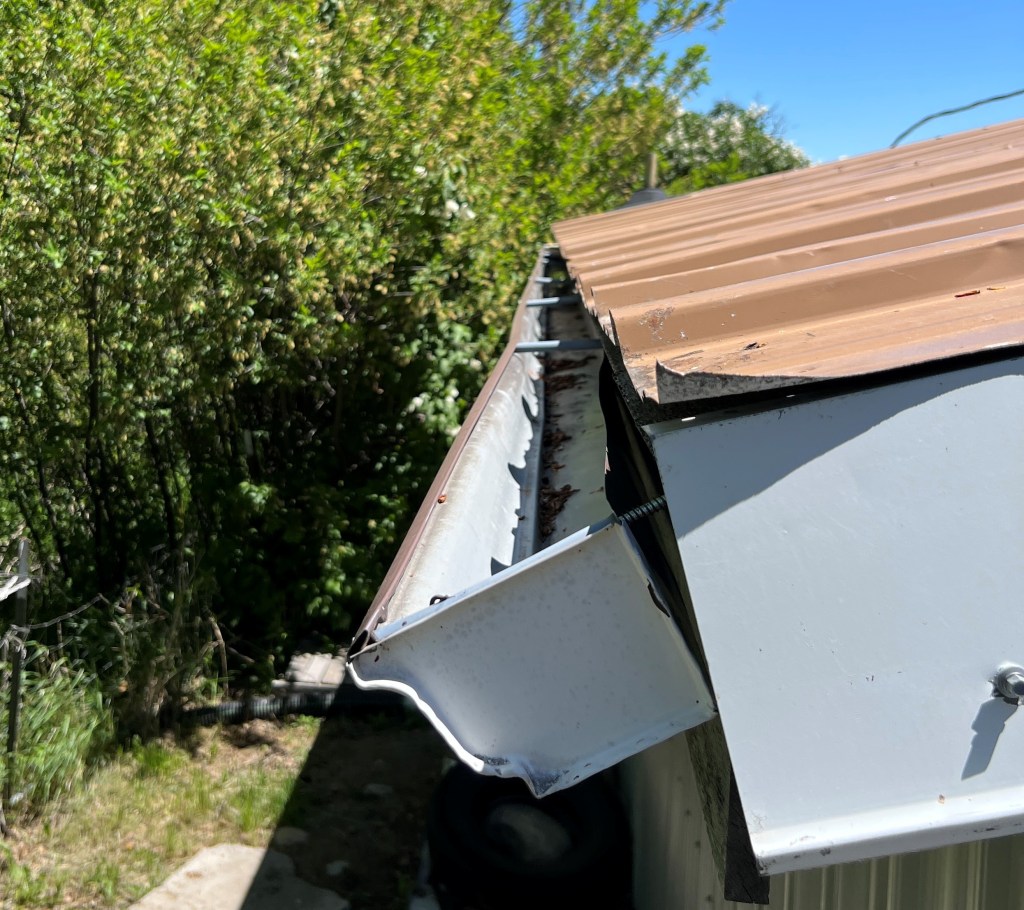
Lately, I’ve been fixated on guttering. We have a lot of unguttered or badly guttered buildings. When rain falls on impervious surfaces and is not guttered or sloped away, it pools up and erodes old foundations.

Water may seem innocuous. Innocent. But it is the (almost) universal solvent. According to the Khan Academy, “Water is key to the vast majority of cellular chemical reactions essential to life. Water molecules are polar, with partial positive charges on the hydrogens, a partial negative charge on the oxygen, and a bent overall structure.”

A bent structure may sound unattractive or dangerous, but in fact, it’s the magic that allows the embodiment of both the negative and the positive to coexist and dissolve nearly anything.

But even with the threat of dissolution, rain is not the essential problem. Too many impenetrable surfaces are.

Thus: guttering. The precious rainwater is renamed runoff and routed to centralized locations such as sewers or storage tanks. This creates the potential for stagnation or downstream flooding.

As humans, we long for shelter from the storm. Impenetrability is tempting. It’s hard to be vulnerable, receptive, and thankful; harder still to lovingly accept rejection and scorn.

But we live in a world where the Coauthors and the Dancers cause the rain to fall on the just and unjust. The sun shines on the kindly folk as well as the cruel, selfish fools.

Many of us feel quite indignant about this. We seek justice but often end up plotting revenge. This storyline has no happy ending. In fact, it has no ending at all. Revenge is self-perpetuating.

Bullies, tyrants, and other impervious souls have developed gutters that shunt kindness and forgiveness off as if they were wastewater. The resulting pools putrefy due to the contaminants they’ve picked up, testifying to the toxicity of fear.

Watching sacrifices go down the drain or get routed to a holding tank where good intentions become sludge is painful.

Even so, the stubbornly resilient make plans (that will no doubt go awry) and dig deep into linty pockets to offer the widow’s mite.

The Holy Role-Models of Resilience are chaotic, redundant, and flighty. They live in the gutters and fix broken toys. And while wildfires rage, they shelter frightened families under scorched wings.

It sometimes seems that Creation has grown weary of us, and the exhausted Dancers have lost the beat. I honestly don’t know.

But in this briefest of moments, some of us have the great good fortune of being lilies of the field, hoping no one sprays us with a broad leaf herbicide as we turn our open faces to the cleansing rain and rejoice when sunlight breaks through.

The Soul is a Hand Dug Well

This day begins thirsty, with snippy inner voices arguing
while I await the arrival of Some Words.

I am grateful for water.

We’re alive, but mostly liquid,
with skin so thin and porous, we’re always parched.

Clean water is rare and costly.

Some quench their thirst by lapping up the toxic surface run-off,
gamboling about as if impervious to poison.

Others sip from the bitter sponge, lifted to their lips
while they hang on self-inflicted crosses, arguing.

God arrives and sighs.

Listen, all you secret selves, all you conflicted creatures
fearfully hiding on easy street.

The soul is a hand dug well.

The way forward is always down, rocky and hot.
And at times, it will seem lonely. But you’re never digging alone.

Remember that. You’re never digging alone.

Water

The river has risen to magnificence, inflicting random agonies. I play the pain on my old guitar and the pain plays me like water. We are an unlikely duet. I yield the melody to the flooding river because my ragged vocal cords cannot handle the range this song demands. There are high notes best expressed with compassion and exquisitely controlled vibrato, and bass notes so low they trouble the souls of those with ears to hear.

God dances on the surface of the swirling eddies, a child performing in her first recital, insects reveling in abundance. Entire homes float by. “What can we take apart?” God asks, rubbing millions of wet hands in anticipation. “And how shall we put things back together?”

I know I should volunteer but I have no idea where to start or what to do. “God,” I say, speaking against the thunder of boulders rolling by. “How can I help?”

“Good question,” God replies. I’m surprised. Usually, it’s God asking the good questions.

“Climb as high as you can, look across the valley, and find the place where earth meets sky. Then hold your thumb to the horizon and notice how your perception shifts.”

This is a trick I’ve done many times to shrink the size of an imposing moon, but always with ambivalence. I usually prefer an imposing moon and my own hazy beliefs about gravity and the relative size of things.

“I don’t want to do that,” I say to God. “Any other suggestions?”

“Sure,” God shrugs. “Do what you need to do. Take the moon home for all I care. I’ve made a million moons and there are more to come. They will always agitate the water until it turns into wine.”

Uprooted trees float by, lodge, and bend the current. I wade into icy shallows, kick debris off the fence, and watch the current take it away. God shows up in bib waders. I wonder if the old guy is foolish enough to try and fish. He has worms and sinkers. I shake my head. He grins a sloppy, open-mouthed grin.

God’s first suggestion comes back to mind, and I realize elevation is not a bad thing. I pack the guitar and prepare to begin this last ascent. I’ll not lift my thumb to the horizon, though, because perception doesn’t change the order of things. Instead, I will harken to Mother Mary’s wisdom and let it be.