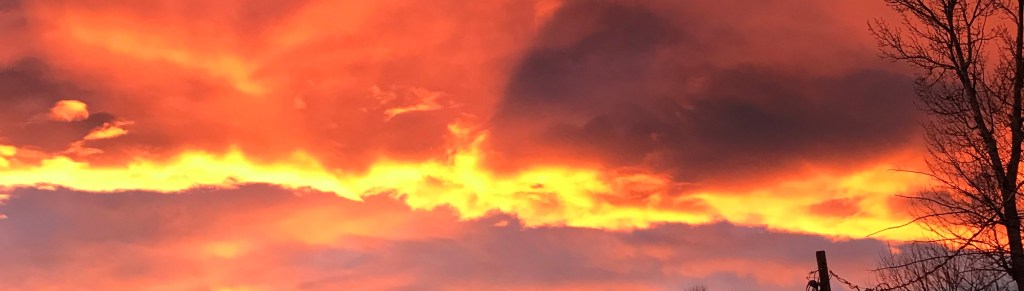
Advice from the Artist


As you continue to diminish, 
finish your work with glossy varnish
to protect against the ravages of too much sun.
Safeguard the subtle shadings
and hoard the necessary joys of passing on.

The river gives you walking sticks and songs.
The land has offered sustenance and stones.
But reality lands hard on brittle bones.

It’s all too beautiful,
the sunsets and train wrecks,
the intentional offspring, the adopted ducks,
the bad ideas, the sheep and goats,
the bombs and tender mercies,
the labyrinths and weeds.
It’s all too beautiful to leave behind.

And Yet.

Graceful decreasing
makes room for increasing.
The Baptist knew
you can only wash a few
before your hands grow too cold
to be trusted. Step down, aside, and forward.
The Greater Whole is waiting by the fire.

Come warm yourself.
The guests are gathering to honor
all the good you’ve tried to do.

Offer your acceptance speech in lavender
while the evening light plays havoc
with defiant greens and blues.
In scenes yet to be enacted,
you may not recall your lines
so pin them here and there in red
behind the sofa or underneath the lamp.

Hearts on Fire

When your heart is on fire smoke gets in your eyes

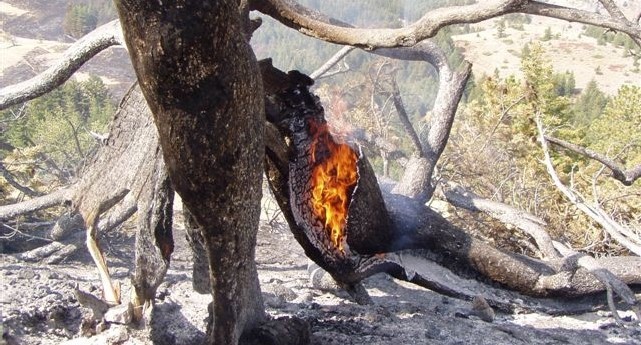
Death rolls in, a thousand acres, flaming,
thick smoke drifting south.
We are blinded by the slow burn of a million lies.
Nothing trickles down.

The poor belong among us.

And we are among ourselves on a finite planet
on an infinite journey with a wee small chance
of getting it right.
Love is right. Violence is not.

The greater good is an apple tree the voles left alone
because we pulled the mulch away from the trunk.
Sometimes, winter should not be diminished.

What comes to everyone over time
are thirteen birds, four horsemen,
and an appetite for sweets and salt.
The indulgences and the seven deadly sins
are always calling. Try not to answer.

Stare down, instead
and watch where you place each foot.
Wish each other well.
We are stardust and ashes,
and we neither live nor die
without fire.

Oh, Baby

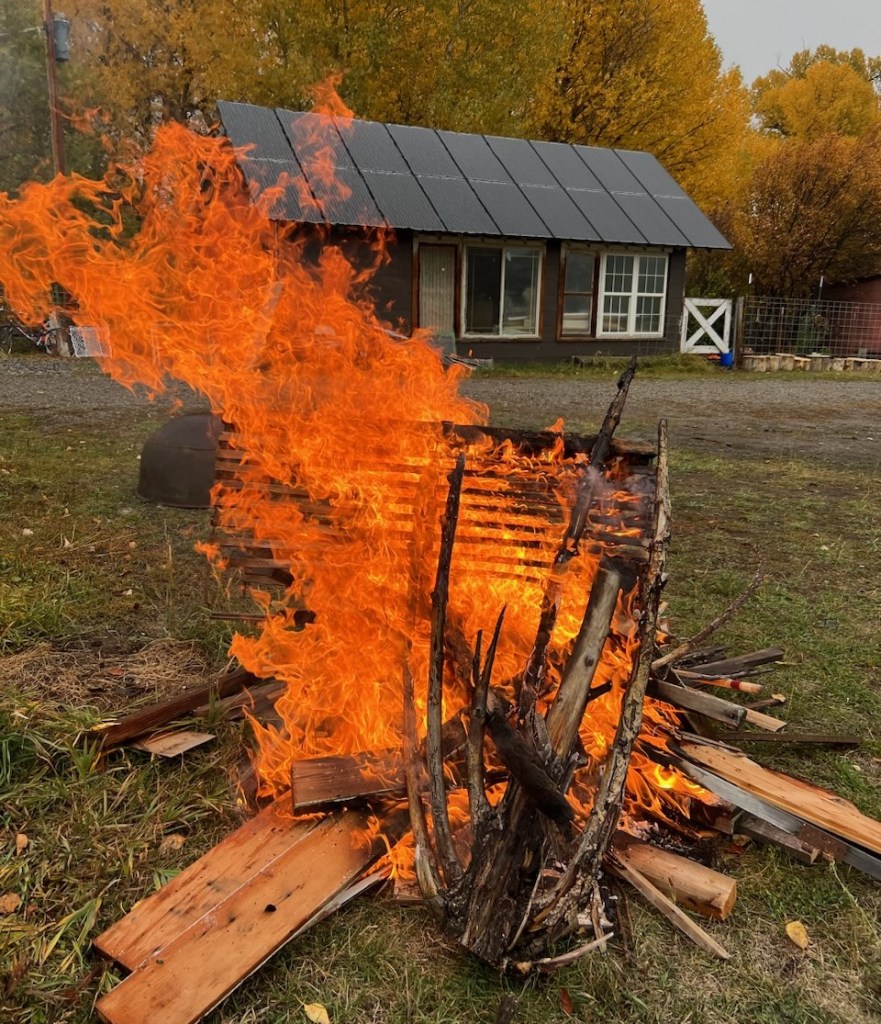
This is the narrowest time. Night has loosened its grip, and old wine is poured out as libation to the rising sun. My head slumps to my chest, and my shoulders curl inward to make the passage less painful. Less prolonged. To the east, a thin blaze of orange takes hold. With kindling gleaned from around the chopping block, I light a fire so I can immerse my hands in the warm liquid of another day.

“What sayest thou?” I ask the newly arrived Sandhill cranes.

“What thinkest thou?” I ask the rising river.

The answers come on the in-breath and dissipate before I can inscribe an adequate translation. I will have to ask again and try to be worthy of the answers.

My inner audience isn’t kind. The promise of spring is shrouded in snow, and for some reason, the fire is burning more reluctantly than usual. I suspect it’s the blessing and curse of the thick bark still clinging to these beautifully split logs.

Before I slept last night, someone told me they loved me, and someone told me they hated me. The raucous rise of the north wind relieved the barometric pressure of leftover miles. There was just enough time to make a cursory inspection of my seashells, sticks, and rocks before the paralysis set in. Even then, I had to lean into God to make it to the safety of my flannel sheets.

Now, alert and alive, we are filled with equal amounts of dread and joy.

“Oh, baby,” God sighs. “Oh, baby.”

“Oh, God,” I say, pushing back a little. “Oh, God.” I look into myself as far as I can. “I wish you wouldn’t sigh at me. Go sigh at someone else.”

This elicits a smile. We sip coffee, eat toast, and raise our glasses to the trains arriving, the trains departing, journeys beginning, journeys ending. These simple routines grease the wheels, and we’re off.

Who can guess the length of their days? Who can predict the hard hatreds and easy loves? No one knows their own soul very well, let alone the redemptive mind of God at rest in the protective bark of scorched and fallen trees. We cannot be expected to do any better than we can.

“Oh, baby,” The Cosmic Drama Queen sighs again, so inclusive, so determined. Her obsidian eyes are sparkling, her broad shoulders squared. “Oh, baby.”

The Ways We Use the Frontal Lobe

Even the most obvious instructions for being happy, healthy, and wise are routinely ignored, ridiculed, and explained away. Physicians, therapists, pastors, scientists, Jesus, the Dali Lama, Taylor Swift, and a vast array of poets and philosophers past and present shake their heads, mystified, and discouraged.

For instance, though cheap and easy, fossil fuels are finite and poisonous, but who doesn’t like well-paid extractive industry jobs, entertainment, warm houses, and nice vacations?

In the long run, we’d be happier (and less likely to go extinct) if we fed the hungry, welcomed strangers, exercised, turned down the thermostat, stopped bombing, and reduced our fat and sugar intake. Instead, we use our astounding intellect to invent complex rationalizations for less-than-helpful choices.

Me: Admit it, God. Your frontal lobe design has failed. Abstract reasoning is a bust.

God: Yeah. Science and compassion shot to hell by fear and feigned ignorance.

Me: I know. We strive to be avenged, satisfied, pain-free and immortal.

Meanwhile, there’s fire. I let the morning blaze die down because the sun is taking over, beaming radiant energy into the thermal mass I call home. Earthly fires are a triangle: Oxygen, fuel, and heat. Existence is a triangle enabled by fire: Birth, life, and death.

God: And I’m a triangle: Creator, Recycler, and Evolver. I don’t give up.

Me: Well, if I were you, I’d call it quits on earth. Lots of flops and botches.

God: I know you would, and I know you’re afraid, but I’ll never not be around.

The glow of the sun is not fire. It’s nuclear fusion, which involves protons smashing into each other so hard that they stick together and become something new. This transformation produces a tremendous amount of light and heat.

Me: That’s like us, God. When we smash together, good energy is released, right?

God: Cute. But no. You’re a willy nilly smasher. Mostly, you bounce. I help with repairs.

Me: But sometimes, I smash into something vaguely like you. I’m sure of it.

God is chuckling. As usual.

We are all willy nilly smashers. We take a hard run at something, crash, pick ourselves up, dust off our boots, gulp some coffee, tea, whiskey or kombucha, and take another run. Sometimes, fusion occurs, and we’re changed. But mostly, we bounce and remain unchanged.

God: Essentially unchanged, but not unfazed. Shed the defeatist attitude. Keep smashing.

Me: Ah ha! You’re still working on the frontal lobe, aren’t you?

God: Well, I may be deluded, but I believe even total failures have redemptive value.

The sky has clouded up and blocked the sun. I smile at the Eternal Delusion and get my matches. It’s time to start another fire.
Between Firmaments

And God made the firmament and divided the waters which were under the firmament from the waters which were above the firmament…And God called the firmament Heaven. And the evening and the morning were the second day.

Post hoc weather report: For two days in a row the wind didn’t blow. When this happens and there’s sun, I tend to forget about adversity. There’s nothing to lean into or ward off or hide from. I lose focus and get dangerously, gloriously expansive. I know this about myself so on the first windless day, I remained mindful, took a walk and hung up laundry.

But the second day was too much. I dragged everything out at once and balanced it between brilliant sky and deep waters, the firmaments of heaven and hell. I sang along with Bob Marley, beat on the blue barrels, and danced from possibility to possibility, arm in arm with an adolescent God. It’s often God’s fault when I get ecstatic and reckless like that.

We opened cans of paint, glued odd-shaped scraps of wood together, and redid the driftwood bouquet, adding antique marbles and sparkly broken glass I’d swept up after the wind slammed the garage door a couple years ago. The door had been double-paned, but on impact, the inner pane shattered into light aqua beads. I knew they’d be perfect for something. And the door still works. In fact, the remaining pane mirrored God slinking by, a black dog with a stick. Eternally hopeful.

I threw the stick a few times but then asked God to help me take some selfies near the old typewriter that sits among my outdoor sculptures on a massive stump that looks dead but isn’t. Every spring, I remove the hopeful shoots. I don’t want a tree there.

We did the selfies and examined our hands. So many angles, so many ways to see what could be. We briefly reviewed the reasons for self-restraint and then shelved them near my collection of dull saw blades and dented mailboxes. We were giddy from the fumes of liquid nails and high gloss varnish.

The elasticity of our joy stretched into the evening and when it was time to call it a day, we did. We called it the second day and rested.

But the earth wobbled in the night, and the vicious wind is back. I have awakened to stinging dust. Swirling ash. Things old and broken have lost the sheen of potential. I’m tempted to start a fire to rid myself of these burdens, but I can’t. With this much wind, it could burn the whole world down.

From Whence We Came

Almost every day, God and I sit in a ratty blue recliner angled toward the window and sip beer. God expects me to hold still and listen. I try, but it seems nonsensical—an inefficient and unreasonable request.

Then I remind myself that efficiency isn’t the only road to success and not everything worthwhile is reasonable. The ability to reason is one ingredient in the soup that defines us, but it’s not the entire recipe. There’s sausage, kale, and wonderment. There’s an extravagance in creation that can’t be explained. Abstract thought and scientific inquiry may be the pinnacles of evolution, but pinnacles need foundations. Humans rationalize cruelty as readily as they eat that second donut.

“Working on some interesting similes and metaphors this morning, aren’t we?” God teases, sliding from chair to mirror to window to bird, sashaying to music I can barely hear.

“I’m thinking about foibles and do-overs,” I answer, happy that God seems loose and crazy today. “Could I have the last ten minutes back? I went down the wrong rabbit hole.”

“Nope,” God says. “Why do you even bother to ask? You know better.”

“No, I don’t,” I say, gleeful and untethered. “YOU know better.”

God winks and pulls me out of the chair. We do a four-pig jig creaking around the room in old bodies. We dance straight through the newly purple wall and fall, barriers breaking like bones.

I am blissfully unaware of dinosaurs, dodos, and all the hapless creatures currently facing extinction before they even have a name. They can all be Adam. They can all be Eve. I love them fiercely, but I can’t save them. I can’t even save myself (and truthfully, I don’t want to).

God’s reading glasses fly off while we’re cavorting. They shatter against the edge of a light green piece of granite I keep nearby for thermal mass, and small pieces fly everywhere. But no worries. The dangerous shards gather themselves into a coarse form of collective compassion, willing to return to the fire from whence they came. The fire from whence we all came. The fire to which we will all return.

“Sorry about your glasses,” I say. “I could read to you until they’re fixed if you’d like.”

“I’d like that very much,” God says.

“Do you mind if I start in the middle?” I ask. “I’ve already read the first chapters.”

“Not at all,” God says. “I suspect I know the plot.”

“I’m sure that’s true,” I say, oddly defensive. “But the descriptions are spectacular. And the details matter.”

“Yes, they do,” God agrees. “They really do.”

Who’s to Say What Starlight Might Do to the Skin?

Yesterday, I was looking for something in one of our outbuildings but within seconds, I’d forgotten what I was looking for. Our sheds reverberate with such potential that I can’t go in and come back out the same person. Touching the chaos causes a quickening; stacks of windows become greenhouse walls; slightly-damaged doors open to somewhere nice; a child pounds joyously on the drum set; strewn with straw, the stall in the corner protects a menagerie awaiting the ark; futons offer rest (or shelving); saw blades are sharpened; the woodstove is hooked up so I can cook in an emergency; empty frames and canvases are masterpieces hung in a gallery where antiques are tastefully displayed, and the scraps of angular metal have been welded into wings.

Our buildings are all named: Yoga Studio, Bug Barn, Playhouse, Solar Shed, Old Garage, Eva House, Lean-to, River Cabin, and of course, the decrepit and dangerous Contemplation Corner. The names reflect aspirations, not content. The structures are salvage yards and sanctuaries filled with failures awaiting transformation.

“God,” I said. “Proportionally, I bet I have as much broken and discarded stuff as you do.”

“Well, hello there, Junior,” God drawled. He’d materialized beside a flat-tired trailer, chewing a blade of grass with studied nonchalance. His thumbs were hooked on the pockets of dirty overalls. “That’s not exactly what I’d call news.”

“Could you get any more stereotypic?” I asked. God shrugged and faded. I squinted into the neon orange sunset and began walking home.

I am chronically derailed by the allure of what could be, and I blame God for this. It takes resources and patience to repurpose the wrongheaded or rejected. There are days I long for everything to burn to the ground; for fire to devour the bulging collections of oddities and unlikely visions; for extreme heat to purify my remaining days.

“Tidiness does not ensure wisdom,” God said, in the voice of a patient teacher. She was resting in a rainbow-colored hammock hung between two thorny crabapple trees. “I found this hammock under a pile of flat soccer balls,” she added. “I like it.” She was wearing a sundress from the ragbag and had tipped one of my straw hats over her face.

“It’s getting dark,” I said to the spectacle that was God. “You may not need that hat.”

 “Maybe,” she agreed, throwing one unprotected, delicate arm over her head. “But who’s to say what starlight might do to the skin?”  I knew she was making fun of me.

“You’re right,” I said, offering her a sweater. “Who’s to say what starlight might do to the skin?”

Wildfires

We evacuated a few days ago. God refused to help sort what to take but rode along in the tiny spaces available in the car and winked at me as the fire officials at the station explained that the wind had shifted. The fight was going another direction. If we took the back roads, we could go home. As we turned around, God disappeared and I was glad to see him go, even though his absence is as much of an illusion as his presence. At least with him ostensibly gone, I could avoid thorny conversations for a while.

Who wants to talk with the God of fire during an evacuation? The God of suffering, loss, and apparently random events? It never goes well. The book of Job for example; an elongated poem, a chorus of voices and views, Yahweh and Satan in a cosmic pissing match, Yahweh’s praise of evolution, and a lesson in pointlessness. Sure, there’s the veneer of a happy ending, but not if you realize it will all end again. Who wants to lose everything twice? Thrice? Forever?

“Do you think the key is to have nothing to lose?” God asked as I sat by the window, breathing smoky air, waiting for another evacuation notice. I didn’t mind that God had swung back around. He was better than the meager offerings on Roku.

“I don’t know about that,” I said, scanning my accumulations; books, art, a sheepskin rug, my yoga mats, special rocks, blue glass, a cedar jewelry box filled with trinkets, a stack of incomplete gardening journals (we start a new one every spring). Of what consequence would their loss be? Little to none. Of what consequence has my life been? Or anyone’s?

God nodded, noncommittal. Listening. I grieved and tried to be brave about it all. I wanted to imagine I was of great consequence; something other than one of the trillion dominoes God has gleefully lined up, waiting and watching to see what might set off the next run, gently drumming his fingers, offering substantial odds to anyone willing to bet against him. I wondered if I could step out of line. Redirect the future of my particular genetic strain, remain standing, and win.

“Of course,” God said. “Be my guest. I like winners.”

“But I thought you liked losers,” I said. Conversations like this give me vertigo of the soul. Winning isn’t definable, and I don’t actually know what kind of consequence I want to be. It’s risky business to have God along in an evacuation because no matter what you take along, God knows what you’ve left behind and will circle back. God always circles back. This may be a good thing, but I’d rather have the promise of perpetuity or at least a direct way home.

Plagues, Pestilence, Fire, and Greed

Image credit: Aljazeera

It is terribly tempting to detach from the news. But I can’t. Protests, fires, floods, torture, gun accumulations, fascists, pandemics, stupidity, war, rape, riots, starvation—these are where the weakest live and die, where misery is chronic, where God makes her home—on the precipice of annihilation.

“I have to let them suffer,” God says as she darkens the room. “There is no other way to show you your failings. No other way to challenge you forward. But I die with them. Every single mangled body. Every single last breath. Each rotten, contorted act of injustice. I’m right there.”

“Yeah?” I say, feeling nauseated and furious. “Yeah? And are you there with the bomber? The shooter? The choke-holder? The fire-starter? The pompous politicians? The filthy rich?”

“Honey, you know I am,” God says in an imploring voice. “I know you’re angry, but you know I am.” And God’s right. I do know. That’s why I pray and swear my way through the sickening news. But it makes me crazy.

If God fully materialized, I’d punch her lights out. I’d go down swinging. If her ears were visible, I’d give her an earful. I’d look her straight in the eye and tell her she’s a failure. I might even reach for her heart, intending to pull it out and examine it with my angular fingers and ever-diminishing vision. But luckily for both of us, she’s staying safely out of reach.

“Honey, I’ve forgiven you,” she says. “And the polite thing to do would be to forgive me back.”

Forgive God for this lousy short existence? For the nightly exposure to the sufferings she could end? Forgive God for what’s happened to people enslaved, burned alive? Women abused? Children starved or beaten to death? Forgive God for the explosive human ego and the fanatical fears that are wiping us out?

“Forgiveness is an act of faith,” God says.

“Stop it,” I say to God. “You’re God. You can do whatever you damn well want.”

“I know that,” God says. “I’m fire and water. I’m beauty, compassion, blood, and guts. I’m beyond and under, alongside and within. And you need to try a little harder. You have to forgive yourself. And me. And carry on. You need to believe against the odds it will come out okay.”

“I can’t,” I say. “It won’t.

“You can,” God says. “It will.”

“I won’t,” I say.

“You will,” God says. “Like I said, forgiveness is an act of faith. And I believe in you.”

Insult to Injury

I often make lists of the many sins committed against me. Acts of omission or malice, blows landed, insults slung. It’s like anticomfort food. And to add to my misery, ailments regularly drape and infest my body. Some days, I hope for a temporary ceasefire between invading forces. Other days, all is lost.

“Despair is nothing new to the human condition,” God says. “But then, neither is joy.”

“Oh, you are so subtle, God.” I said with a snarl, thinking God was trying to cheer me up.

“I’m hungry,” God said. “Will you give me a scrap of food?” This was not what I’d expected, and I’d already put the breakfast things away. I ignored the request.

“I’m frightened,” God said. “I’m lonely. I’m in prison.” God looked misshapen. I backed away. He seemed deranged and dangerous.

“My village flooded. I have nothing left,” God said. I checked the locks on my doors and the passwords on my accounts.

“I’m so tired,” God said. “I walked all night.” I shook my head. God was filthy, and I’d just changed the sheets.

“My legs have been broken,” God said. “I can’t walk.” He tried to drag himself toward me, arm over arm. I turned my back and ran until I fell exhausted on rocky ground. God coalesced in the stratosphere, floated down like a feather, and circled his body around mine. My face burned with shame. “I can’t,” I said through clenched teeth and tried to kick him away. “I can’t fix you. Can’t fix all the broken places. Can’t stop coming apart. What do you want from me?”

“Oh baby,” God murmured as he rocked my resistant body. “I want joy…and maybe a bit of compassion now and then. The kind that gratitude generates. But mostly, joy.”

This seemed reasonable, but I couldn’t fend off the fog of helplessness thickening around me. It was blinding and cold. I thought this nicer, softer God would obliterate it for me, but instead, he looked worried. “Throw it off!” he said, with some urgency. “Throw it off now. Think. Where’d you hide that last bit of joy?”

“In the paint brushes,” I said, sitting up. “And that incredibly twisted driftwood. And the words. And that kiss.”

“Go,” God said. “Paint, wander, write, kiss. And be sure to light the fire. I’ve dried the kindling for you.” He pulled small sticks from under his robe.

Suddenly, more than anything, I needed to paint something purple. And gold. And forest green. But the world had grown too dark to see very well. I remembered a line from Frederick Douglass’s famous speech (What to the Slave is the Fourth of July?) It’s not light that we need, but fire. Artificial illumination would not do. I could only paint a true and joyous thing by enduring the flickering glow of fire. I took the kindling gratefully and kissed the Pathetic Old Thing on his wrinkled cheek as we turned ourselves toward the gathering storm.