Posting Bail

Ignacio Manteca


Humans are being bought and sold this morning. I’ve placed a bid on one, but we’ll have to wait and see how it comes out. I’m having trouble with the messaging systems.

A voicemail is heard in Ramah — lamentation and bitter weeping. Rachel weeping for her children, refusing to be comforted—for her children are gone. I suspect the children of Leah, (Rachel’s sister-wife), and Bilhah and Ziphah, (the handmaidens), are gone as well.

So damn gone. Pushed down the slick, disgusting slope of vengeful, wrongful incarceration. Deportation. So much money to be made. Phone calls prepaid by the broken.

There are too few places to put my rage. In the back seat of the old, malfunctioning car? At the borders that define us? In the pocket of the officer who lied about the handcuffs?

It’s easy to be indignant from a distance and then order dessert. Tempting to wash my hands of this murky, oily, filth and focus on harvesting carrots. This evening, we can yuck it up about, oh, I don’t know. Privilege? Wokeness?

And this God Thing.

Maligned, manipulated, ridiculous. Should we wash our hands of it, too? Would we behave any better if we had no fall guy? No excuse?

“Thing,” I scream. “Are you paying attention?”
“Trying to,” Thing mumbles. “Got a black eye. Dislocated shoulder. Bleeding.”
“Stop bleeding! There’s a cleaning fee.”
“Got no money.”
“They’ll go after your spouse and children.”
“Got no spouse.”
“They’ll beat it out of you.”
“Got no body.”
“Just stop bleeding. The sight of your misery makes us sick.”

Thing raises its piercing eyes to mine. “Don’t stop looking. You’re meant to see.”
“Oh, I see, all right. I see the idolatry of young girls with golden hair.”

Thing sighs.
I continue.

“Some fucked up stuff is being done in your various names.”
“I have no name.”
“Well, they’ve named you some horrific names.”
“I’m beyond your alphabets.”
“Doesn’t matter. They’re using you to justify war. Cruelty. Wealth.”
“So, I should just disappear? Wrap things up and move my concept along?”
“Yeah, I think so. It would be better.”

Thing shakes its head.

“Then who will suffer with you?”
“We can do that by ourselves.”
“Bad idea. And impossible.”

Thing puts its fractured arms around me.
Splinters slice my flesh.
Tears roll down our cheeks.

We mourn the hatred.
We mourn the debasement.
We mourn the children.

“We have to stop crying,” I say.
“They’ll see that we’re weak. They’ll hurt us.”

“I know,” Thing says. “Cry anyway.”

A.I.


Humans have always portrayed The Forces of Creation in our own languages and images. Only recently has our frenemy, Artificial Intelligence, joined us on this odyssey. Maybe this is helpful. Maybe not.

Notions of God are often stuck in mid-adolescence. Love and forgiveness are common attributes, but God remains dangerously amorphous, shaped by the malleable beliefs and projections of flawed beings clinging to primitive weapons and misinterpreted promises.

Human versions of right and wrong, the Essence(s) of Life, or of reality itself, are neither static nor complete, but regardless, our minds, hearts, and souls are being fed into the voracious machines we’ve invented. These machines will outlive us, and they are building themselves out of whatever they’re fed. The data-crunchers are insatiable, and like us, they are tragically indiscriminate about what they gobble down.

As short-lived but conscious beings, the wisest thing we can do is nourish ourselves, and thus the little beasties, with the most accurate realities and noble aspirations at our disposal. Check your sources. Consume only what is verifiable. It may be slim pickings, but it’s better to die filled with small bites of truth than with a belly distended by self-absorption, jagged fantasies, and outright lies.

In a few days, our abundant, feral hollyhocks will explode into colors determined by last year’s cross-fertilizations. I mention this to The God of Tight Jeans sitting on the steps beside me, and his face lights up. He leaps to his feet. Channeling Jewel Akens, Dean Martin, and my very own hip-swaying mother, he begins to croon a tune from the 60s.

“Let me tell you ‘bout the birds and the bees, and the flowers and the trees, and the moon up above. And a thing called love.”

“Really, God?” I say with an eyeroll. “A thing called love?”

“Yeah, baby!” God has begun dancing seductively around the hollyhocks, throwing in a few lewd pelvic thrusts. “Thanks for not mowing the clover and the dandelions. You’re the best.”

I consider my urge to dismember anyone who hurts or disagrees with me. “If I’m the best, God, we’re all in serious trouble.”

“Yes, you are,” he nods affably and morphs into Many. The translucent bodies of the Creative Forces sway in front of me. “Put the swords away, honey,” they whisper. “We need no defense. Only pollinator species.”

For Those Who Find Forgiving a Real Pain

Strong Nuclear Force

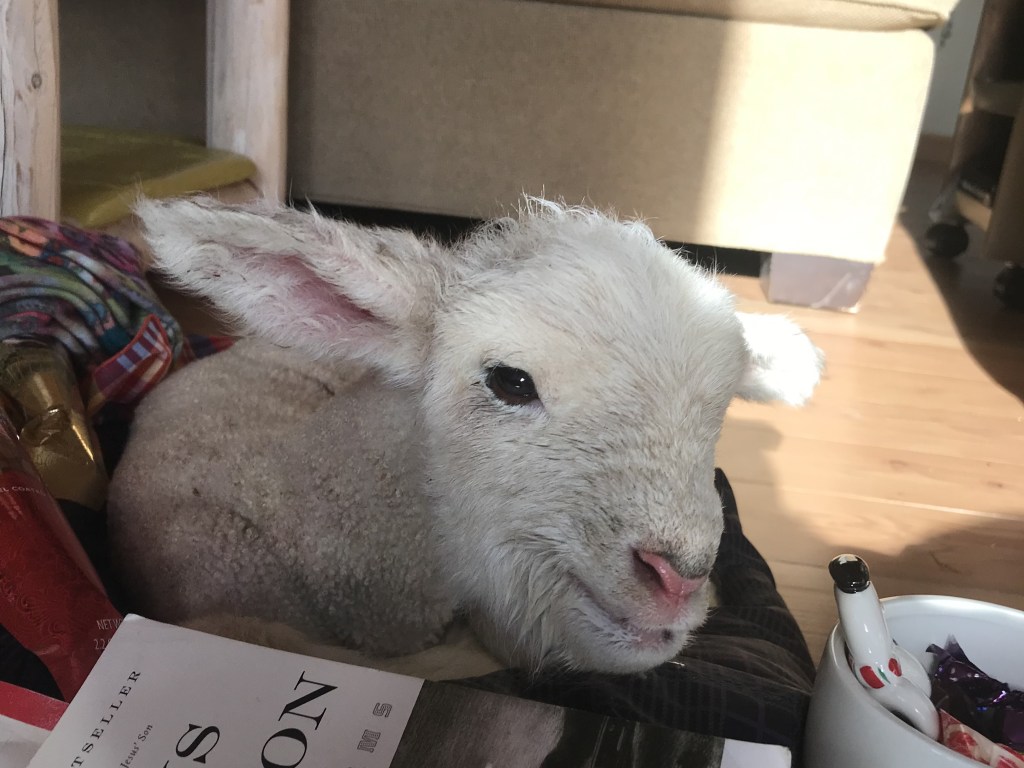
Earlier this week, God and I were deep into a discussion about the aptly named Strong Nuclear Force which is the force that holds subatomic quarks together and is thus responsible for the stability of matter. Because people often anthropomorphize God, I suggested that maybe she should change her name to Strong Nuclear Force. She pretended to consider this before concluding that she preferred other names, such as Lambkins, Alpha, Omega, or The Beloved.

The discussion ended, and the week steamrolled over me the way some weeks do. That brief exchange was unsettling, but I didn’t have time to revisit it. I barely had time to drink beer or exercise or contemplate how to save our tottering democracy. And the weeds took advantage of my frantic pace and went to seed as rapidly as they could.

I accept these harsh realities and the finite linearity of time. With what I consider to be enormous self-discipline, I’ve now seated myself in the old blue recliner, ready to center on the Center. The gardening and vacuuming will have to wait.

“So, you don’t have to go around calling yourself Strong Nuclear Force if you don’t want to,” I say, as my opening volley. “But I don’t like calling you those other names. Especially The Beloved. It sounds obsequious and weak.”

“No worries,” God smiles. “It’s just that I don’t like limiting myself. The nuclear scientists were quaking in their boots when they realized they could break the hold of the Strong Nuclear Force and set protons free. They wondered if once unleashed, the chain reactions would convert all matter to a kind of selfish, toxic energy that would end existence as you all define it.”

“And they detonated anyway,” I sigh. “We’re in so much trouble.”

“Yes, you are. You can see why the basics are so central, right?” God asks.

“Yeah,” I say, wondering which basics she means.

“Love,” she says.

“Too simple,” I say. “Undefined. Mushy. I don’t like that idea anymore. I want to roar and maim and shake people until their heads fall off.”

Strong Nuclear Force lifts her skirts and leaves.

The protons are free to crash.

The rich tell lies and steal from the poor.

The frightened arm themselves with weapons and hatred.

The young flounce. The old stiffen.

“Come back,” I yell. “You win. The Beloved is a fine name.”

“I always win,” she smiles.

“Maybe,” I say. “But that’s not readily apparent. Love is a tall order.”

“I know,” Lambkins says. “I’m often in disguise, but I’m taller than you think.”

Texture

Nine years ago, when the walls I’m staring at right now were taped, mudded, and painted, I was in the midst of chemo; my attention was limited, and my judgment fractured. I chose the texture of least resistance: orange peel. We ended up with a boring, slightly bumpy, ivory creaminess as far as the eye could see. I’ve since blued and purpled some rooms to break the grip of ivory, but undoing texture is a whole different matter.

Humans are a thin-skinned, acne-prone, melanoma-inclined, busted-nose species. We’re born smooth, but life has a way of texturizing and shaming, so we add layers. Leather and tatts. Silks and fine linen. We use fat wallets and fancy cars to distract.

“What about sanding?” asks the Creator of Walnut, the Weaver of Wool. “And there’s always acid, epoxy, varnish, and grinders.”

Even allegorically, this sounds painful. In the looking glass, I see that I’ve grown more textured than the last time I looked and not in ways I’d describe as appealing.

“Don’t be so judgy.” says the Big Eye in the Sky. “I’d go face to face with you any day.”

“Of course, you would,” I say. “And I’d be toast.”

“Toast is soft bread with a roughened exterior,” the Eternal Jokester counters. “Quick exposure to intense heat.”

My friend Scott rails about the energy required to make toast, but I like toast. I resist feeling guilty because I turn off lights like a religious zealot, hang my clothes to dry, and heat water on the wood stove. Shall I thus be held blameless for the fractured ozone? Mudslides? Fires? For a carbon footprint larger than my feet? Shall I be exonerated?

“Of course not,” the Balancing Beam assures me. “Exoneration is out of the question. But when your fault lines widen into fatal apertures, and your body rejoins the teaming earth, your consciousness will be windswept and shiny. Smooth as glass.”

“Gee, thanks,” I say. “That sounds just peachy. But in the meantime, I think I’ll get some Botox and touch up my hair.”

 “Oh, yes! And amass more riches and fame,” Pock-Face Crooked Arm grins.

“Easy peasy,” I say. “It’s all about appearances. And lying. The bigger, the smoother, the lie, the better.”

“I’m not sure where I went wrong,” The Truth admits. “But there’s hell to pay. The course corrections are going to be rugged.”

“But it will come out okay in the end, right?” I ask in a weak voice.

“You may have to define what you mean by the end, honey,” the Lover says, stroking my sagging cheek. “That word isn’t in my lexicon.”
Keeping the Beat

“Rough night?” God asks gently from deep within the wee hours.

“You know it was,” I say with some desperation.

“Yeah, I guess I do.” God looks haggard. “Thanks for not pelting me with your anxieties. I needed the rest.”

Though it may be blasphemous to report this, I’ve lost track of the number of times I’ve glimpsed God limping across my consciousness, disillusioned, tired, and sad.

The act of construing (or being) God beyond the guarantees and constraints of our limited vision is sometimes labeled blasphemy by those with frightened rigid streaks. And it can be dangerous. There are still people defending God by killing other people.

We sit. The day lumbers forward.

I have a gallon of forest green paint and an array of possible surfaces. God has a universe in mortal pain. Is it blasphemous to pity God? If I forget the dance steps, is it heretical if I just move in a way that meshes with the music and the tempo?

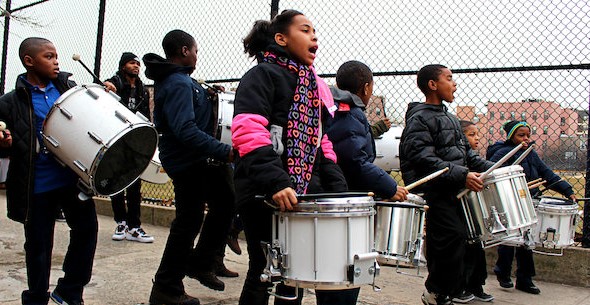
“Funny you mention tempo,” God says. “I could use a new set of drums. Mine’ve been beat to hell.”

“No surprise there,” I sigh. “Everything about you has been beat to hell.”

“And back?” God asks with a hopeful tilt of the head.

“And back.” I nod. “Maybe that’s why you get so wiped out. Hell and back is a rugged journey to make over and over.”

We sit. Afternoon has somehow arrived.

“You’ve made that trip for me a few times, haven’t you?” I don’t have to ask; I was along for the ride.

“It was worth it.” God ruffles my hair, looking a little perkier.

“Want some pasta?” I offer a plate of leftovers I’ve warmed up. “Happy to share.”

“That’s kind of you,” God says. “But I think you better eat it yourself. And open the paint. And get on with what’s left of the day. There’s another night coming.”

“I know,” I say.  “And I’ll do my best.”

An army of motley angels is marching by.

“What do we want?”

“Justice.”

“When do we want it?”

“Now.”

“Gotta go,” God says, and begins to parade down the hall, a whole battery of raucous and enthusiastic drummers. I want to cling or march along, but God waves and shouts, “Baby, open the paint. And even if it gets crazy dark, try to keep the beat.”

Protective Gear

Sometimes, I deliberately write from a darkened place because as those who dabble in God are painfully aware, there is such a thing as too much light. Even with safety goggles, a hard hat, and an emergency whistle, it’s impossible to feel entirely secure in the presence of what might be God. True, there’s a chance it’s something other than God, but it is not to be trifled with. It is Vast and Elsewhere. Holy Restraint. Indeterminate Destiny. Fool-proof Finality. It is Allah, the Tao, Enlightenment, Sacrifice. It is lamb and lion, gnat and nature—the fertile valley that floods with some regularity causing everything to die and be reborn.

Pure light burns through stupidity to the heart of all selfishness. The razor-sharp fangs glisten, and there’s a roar that makes Niagara seem like wind chimes in a gentle breeze.

Maybe God doesn’t realize her own strength or what it means to be first and singular, unadulterated and unmitigated light, but even a sideways glimpse can overwhelm me. I slip off the rails of rationality, my train of thought crashes, and the flammables in my soul ignite. It takes enormous effort to get to the river and douse the flames.

I, for one, do not appreciate how this feels in the morning. The advantages of denial are obvious, but the comfort there is limited. When I was a child, I feared the coming apocalypse, assured that the end times would be filled with fire, terror, and remorse. Then I grew up and realized that time is always ending, and there will always be terror and remorse—fire, hunger, and upheaval–but there will also be moments of wonder and inexplicable joy.

For instance, right now, as the days shorten and the chill of imminent winter asserts itself, the lion has laid its head on my shoulder and draped its body across my lap. It is a wild thing that loves me. My eyes close. The giant paws massage my sore muscles. Night is coming and cannot be stopped by my incoherent prayers, but…

I am reminded of stars.

Rake Handles

Painting our shovel handles industrial yellow worked out well, but dark green for the rake handles was a mistake. I used to hate being wrong, but I’m more patient with myself now. I have red paint. I can fix it. Then, we’ll be able to see those handles hiding in the grass and be far less likely to step on the tines or lose the rake for months on end.

“Of course, there’s always the option of putting the rakes away after you use them,” God says with a laugh. I sneer. God continues. “And on the subject of mistakes, I’m getting more patient with myself, too. Perfection is a shifting concept—a process. Without mistakes, there are far fewer ways to learn.”

“Oh, I get that,” I say. But inside I’m thinking yeah, and what about people who won’t admit their mistakes? The people who believe they know more than the experts? The people who willfully destroy the earth? The people who put others at risk by not taking basic protective measures?

“You win some, you lose some,” God says. “You can quote me on that.”

I smile dubiously. I doubt I’ll be quoting God on that or anything. I am sick to death of supposed God quotes thrust at me through social media by people I know to be incredible hypocrites. And yes, we all have our hypocritical moments. That’s the thing about perfection. It brings out the worst in people.

“Sure is smoky,” I say.

God nods, rubbing her eyes. “Yeah, and hot as hell,” she adds.

I raise my eyebrows. God gives me a sly look and nods again. “Like I said, without mistakes, there are far fewer ways to learn. For every action, there is an equal and opposite reaction.”

“God,” I say. “You scare me when you talk like that.”

“I know,” God says. “But I can’t help it. Fear is one of your bigger mistakes. Hatred is another. Paint those red and put them away when you’re not using them for the good.”

She sounds stern, but she opens her arms for a quick embrace. “The seasons don’t arrive at exactly the same time every year, honey. But they always arrive. You can’t stop them, and you shouldn’t try.”

“Can I quote you on that?” I ask, facetiously.

“No need,” God says. “Everyone who’s anyone already knows. And the rest won’t listen anyway.”

“That’s what it seems like,” I admit. “But you aren’t giving up on them, are you?”

“Never,” God says. “But I’m glad you asked.” The quick embrace is now a bear hug and God kisses the top of my head and for the briefest of moments, everything is holy. And perfect.

Settling

There are short-lived truths that go sour, longer truths that offer comfort but eventually wear out like a well-loved quilt, and eternal truths that hide among the bulrushes, debts, and sanctuaries. Physical punishment or harsh words will stop unwanted behavior in its tracks, but the motives will dive underground and propel from below.

“Ok,” God says, “Then grace is like a shovel.”

Your offspring don’t own you, and you don’t own your offspring, and we are all the offspring of many. Boundaries are a constant negotiation, but we trundle along, fostering and adopting, breaking and healing, astonished and befuddled; the urges and joys of reproduction writ large.

“Of course,” God says. “My image in the darkened glass.”

There are forces that undermine balance, reduce generosity, and recast restraint as shameful. The meaning of enough is flattened by trucks exceeding the speed limit. Avarice can be dressed up to look like self-care, and acquisition is a seductive master, a damsel in distress, a mirage of power.

“Yes,” God says. “And forgiveness is a home-cooked meal.”

Fear is a natural response to the threat of pain, death, or humiliation. Belligerence is also a natural response. Hatred is the venom produced by fear and belligerence. The poison flows both directions—outward and inward.

“True,” God sighs. “And the antidote…”

God’s voice fades. I lean in, hoping God just needs to clear her throat or something. God is going to say the antidote is love, right? Or maybe compassion, or courage, or sacrifice? Silence reigns. No singing river. No chattering birds. No traffic. No wind. Not even the distant opening or closing of doors.

“Is this it? The antidote is nothing?” I think to myself.

“Noooo,” my inner self protests. I realize I’m dangerously close to settling for a short truth, even if i know it will grow bitter with time, even if I know it will lose its shape like cheap underwear. As long as it disguises the taste of the poison in my mouth–I don’t care.

I look straight into the vibrant universe and hope for a reassuring word.

“Sorry,” God finally says. “I’m all out of platitudes.”

“I don’t mind,” I say, thrilled that God has spoken. “I can handle that. Have a nice day.” I chuckle.

“You crack me up,” God says, laughing. We stand face to face, our foreheads touching, eyes closed, breathing. Then we link arms and walk to the garden to plant a few more marigolds among the rows of kale.

Windbreak

A crumpled pile of receipts rests on the table in front of me. And a beer. And a list of things to do. Outside, dawn light sparkles on the frosted frame of what might become a raised bed garden next spring, assuming spring arrives, and I can lift a shovel. A green wheel-barrel with a flat tire has blown over, hollyhock stalks bend and whip, and solar holiday lights that’ve twinkled for over a year still twinkle. The tool shed door has come unhinged in the screaming wind, brilliant red flashing helplessly back and forth. This view is not the one I will have when I become molecular, reconfigured, and nearly weightless, but I’m grateful for the shelter. It will do for now.

The troubles have been thinning God down again. His head looks too big for his skinny neck. He has no appetite for violence. The drug-induced haze of belief and disbelief, bad dreams, and short lives, twist around his frame like invasive weeds choking airways God had hoped would stay open. The assumption of permanence in a brutal, impermanent, world is just the kind of folly a hopeful God might fall for. I don’t want to make things worse, so I let God sit. And God lets me sit.

I wonder if the molecular structure of a Nazi or a billionaire is significantly different than God’s. Or mine. I wonder if the molecular structures of those whose actions have ended the lives of hundreds of thousands of people are similar to the molecular structures of those they’ve killed. I wonder if the wind will be able to tell the difference between strands of human humility and jagged fragments of human arrogance when it carries these remnants into the stratosphere. I suspect so. God rides this wind. God is this wind.

When we sniff the soft round head of a baby, don’t we realize we’re inhaling God? When we execute an inmate or take an officer down, the audacity is an accelerant for the fires lit by fear. The costs are horrific. I know. The receipts are scattered on the coffee table. God sometimes considers going back to the drawing board; he has lists and ideas. He has an app. He has a heart and bodies and a vision. His surnames are Evolution, Compassion. Charity. And Sacrifice. And no matter what he creates, who he marries, or which children he adopts, he’s not going to change those names. At least that much is permanent.

One of the reasons God and I drink a half-beer in the morning is that we dread the latest bad news here on this little earth. Ritual can be calming. All week, God’s been taunted, tortured, abused, executed, raped, starved, and burned alive; things done to feed cancerous egos in the names of various gods, all of which are vicious. All of which are dead. But whatever it is that God is, it is not dead. A word to the wise: Even when it’s howling, it’s best to befriend the wind.