Forewords

Some books have forewords by famous or knowledgeable persons who offer praise and guidance about the author and the content of the book. You can often alleviate confusion if you read the foreword before diving into the story.

Wouldn’t it be great if we were all born with forewords? Most of us would welcome a little prophetic commentary about our potential coherence and skillsets, and of course, hints about who’s who, what to expect, the plot, subplots, and dead ends.

God clears her throat, leans one elbow on the counter for balance, and kicks off her crocs to rub the soles of her malodorous feet. I startle and stare at the unshapely, overweight, gray-haired specter in my kitchen.

“I’m beat,” she groans. “Cashiered all night. We were so slammed I hardly had time to pee.”

“Nice costume!” I sneer. “You look great in polyester and frump. Makes me want to fall down and worship you right now.”

“Go ahead, Ms. Sarcasm. But you might confuse people. It’s not in your storyline.”

“Maybe. But remember the grieving summer when we danced naked in that abandoned house? Or the night I laid flat in the hayfield, digging my fingers into October dirt, dedicating every ounce of my being to whatever good we could do?”

God lifts a skeptical eyebrow, limps to the living room, plops down on the reclining couch, and raises the footrest.

“Ah, that’s better,” she says. “How’s your supply of Budweiser?”

Somehow, I knew this would be the next request. Does God have a predictable plotline? My own narrative favors dark beer, but I have leftovers from recent guests.

“How about a dusty IPA?”

She shrugs. “Fine. And maybe a bite to eat?”.

I rustle up what I’ve got. She chugs the beer, gobbles a few cheesy crackers, and falls asleep, mouth slack, crumbs on her chin.

The snoring of the exhausted poor permeates the dawn. I stare at the fallen arches and callouses of every worker, every waitstaff, at faces twisted into smiles, hoping for generous tips. Hoping for a raise.

The rich are gathered in the dining room, eating from the hands of domesticated children. They help themselves to precious metals, surcharge fuel, food, and basic necessities, and savor the best of the milk and honey.

My humble guest rouses herself and pats the cushion beside her. I collapse into our shared weariness and contemplate my chances (or anyone’s chances) of writing a happy ending.

“It seems like the last chapters almost write themselves,” I mumble, my heart heavy.

“True. Though judicious editors can make a world of difference.”

“Yeah,” I say. “But most people hate being edited.”  

“That’s true,” she sighs. “So true.”

Hair

Human hair is fascinating. We’re not nearly as furry as our ancestors and cousins, but we still sprout the stuff. Left alone, it signals everything from how old you are to how well you slept last night. But of course, we don’t leave it alone. We cover it, color it, play with it, yank it out, let it sluff off, implant, extend, shave, curl, straighten; We cut it, dreadlock it, donate it, and occasionally douse it to kill off the lice.

We’re sometimes born bald. We sometimes die bald. I was yanked from the womb early with forceps that left my head badly misshapen. Fine tufts gradually grew in, and my hair was unremarkable for decades. But then God let cancer have a go at me, and the chemo stripped it all back off.

“What???” God says, emphatically.

“Yes, all of it. Legs, arms, eyebrows, privates…”

“I know what you mean, but ‘God let cancer have a go?’ C’mon. Is that really how you see it?”

“What other way is there?” Me, arms crossed. God, preening in the mirror.

I don’t want platitudes for an answer. In my limited view, if God is God, then that’s that. Good and evil might seem definable in the moment, but as time in our mortal bodies passes, clarity fades and boundaries blur. Any kind of loss, torture, crucifixion, or disease takes a terrible toll. But endings, unsettlings, baldings, and pain often provide the energy necessary for rebirth, joy, peace, and health.

“True,” God says. “But even that isn’t the whole story.”

“So, then what’s the whole story?” I ask. But I have a pretty good idea what God is going to say.

“There is no such thing as a whole story,” God says, with a grin larger than necessary. “The wholeness of the story is in the process. There are no tragic or happy endings, because there are no endings.”

“I knew you were going to say something impossible like that,” I say. “And you know they feel like endings, right?” I tip my head to the side and add, “At least you didn’t blame anyone.”

God touches my face, kisses my head, and nods. “Nice chatting, but I need to go now. I’ve got a hair appointment. Just a trim, but I’m thinking of adding strands of purple here and there.”

God is beautifully grey, but purple will be a nice addition. And as for me, my hair’s been more or less back for five years now. I’m into bleach and occasional blue, but I have tubes of red, green, pink, and turquoise at the ready. I like having choices, but–here’s a small confession—if I don’t like the outcomes, it’s nice to have God around to help me reconfigure.

Goodwill

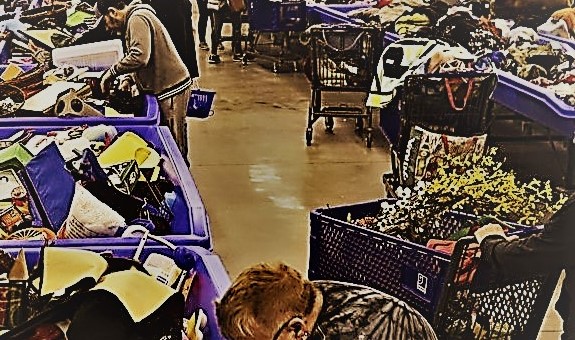
Today, I am wearing polka dot pants and a striped shirt. My hair is bedheaded in an unattractive way and my black and green socks feature a famous golfer. Yes, I’ve been to the church of Goodwill again, and as usual, God was present in abundance. I had to leave, but it was clear that God planned to stay until closing. While I was there, he managed to load five carts full of treasures as he chatted up the Russians and a shy woman who looked Asian. He commiserated with the disabled man and paid for three people’s purchases.

I don’t know what he did when the store closed for the night, but I came back to this borrowed house in this borrowed town and did laundry. We’re here because my friend Max is clinging, perhaps unwillingly, to the last strands of a well-lived life. At present, I’ve hidden myself upstairs to write and think. I hope God doesn’t come by. I’m preoccupied and sad, and it would be tedious to review all his finds.

“Tedious?” God says, incredulous. “You might be the slowest learner ever. How long have we been acquainted?”

“Depends,” I sigh. “At least half-a-century. But if we go with Psalms 139, then longer.”

For some reason, God thinks this is funny. Maybe I do too. Or maybe not. Who wants to count up every second they’ve breathed the rarefied air of this good earth? Music from downstairs drifts up. “I love it when you sing to me,” croons David Gabriel, singing Steven Merritt’s song, The Book of Love. It’s part of the Zoom pub quiz process that ends this semester’s happiness class. My job is to stay offline and out of sight. I’m fairly good at both, but I’m worried about God. He’s in a mood.

“Should I sneak down and wink at everyone on the screen?” God asks. “Or just check my Facebook page and download megabytes of things?”

“No,” I say firmly. “You’d bump him offline, and if you show up, you’ll cause trouble.”

“Exactly,” God says. “I’d like that.”

“What makes you happy, God?” I ask, hoping to distract him.

“Money,” God says. I roll my eyes. “Doing whatever I feel like doing. Driving a fast car. Taking more than my share. Getting drunk and stoned and all messed up. Keeping my wife pregnant.”

“Stop it,” I say, plugging my ears. This is not the time for irony.

God shrugs. “You asked,” he says. “Want to see some of my stuff? I found three navy blue shirts, this hat, and…” He glances at my face and stops mid sentence. His voice cracks. “There’s nothing more either of us can do,” he says. “Death will come when it comes.”

“But you’re hanging out there, right?” I manage to say.

“I can’t believe you’re even asking,” God says. But he says it in a soft, kind voice. It’s then that I notice the logo on the shirts and the baseball hat. Mariners. Max’s favorite team.