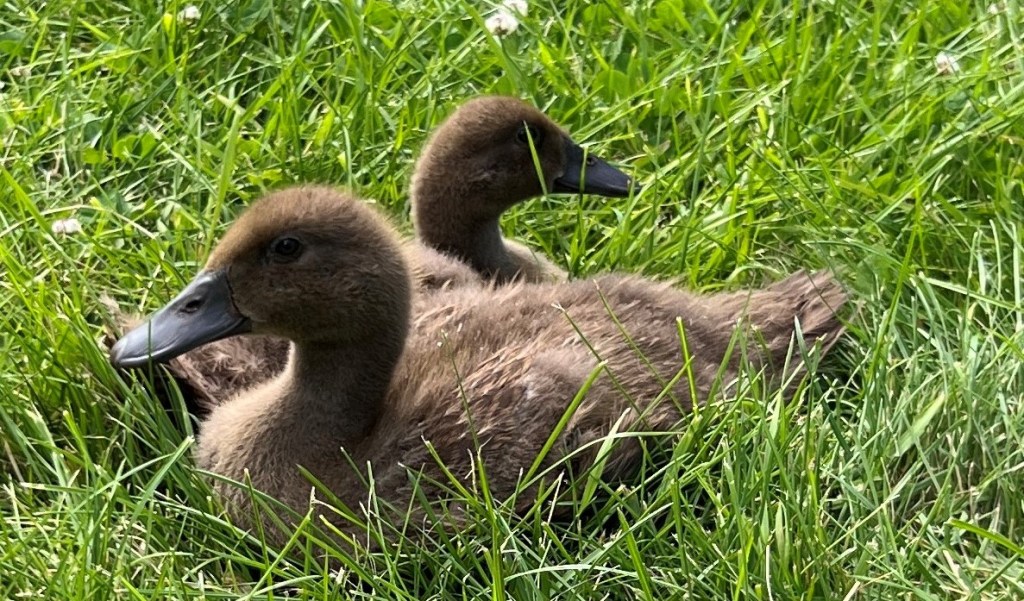
The Ducks

The ducklings escaped. We were gone and it was raining. Most likely, they waddled to the river and floated downstream. They may not have taken their size into account. They were too small to buck the current and make their way back to their shelter and the humans who dug them tasty worms. With their underdeveloped wings, flying home would not be an option. They launched into the wild unknown, and they will not be returning.

Hermann Hesse wrote, “The bird fights its way out of the egg. The egg is the world. Who would be born must first destroy a world. The bird flies to God.” Hesse went on to name God Abraxas. God is always named or unnamed according to our needs and agendas. For my purposes today, I’ll call them Water.

Here’s why: Without water, we would not exist. But I don’t worship water. It neither wants nor appreciates worship. When you’re that powerful, you can afford to be humble. Perhaps you don’t even mind being polluted. Hidden. Transformed. Evaporated.  To you, the flow of suffering is all in a day’s work.

If you are God, you just are.

Death has meaning only for mortals. We cling to our shells and boundaries even as they thin and weaken. It’s unlikely that anyone enjoys being pushed out of the womb, and when the time comes, the work of breaking the shell from within appears to be exhausting and perilous. But inevitable.

So, sure. Run to the river, you traitorous ducks. Your easy food will go to the chickens. I’ll siphon the poopy water out of your plastic pool, and your nice straw bedding will become mulch. I don’t mind transitions. Or aging. Or abandonment. Not at all. Run, ducks, run.

God is chuckling from the corner. “Yes, indeed! Denial is always an option. Consciousness is as hard to handle as birthing.”

“I have no idea what you’re talking about,” I say, even as I move closer to the banks of the river. The current is swift. Water bursts into vapor as it hits stone, and the ancestors shimmer in the misty veil.

My mind is a whirlpool of images. Ice cracks across the lakes of winter, and steam rises from the center of the fractures in Yellowstone Park. Earthquakes are an ever-present danger. The risk of liquefaction looms on the crest of the clay-footed hills. Our bodies are more than half water, and the rain has begun to fall again. I am too weak to swim upstream.

“Just get in the boat.” God cuts the engine and pats the cushioned seat nearby. “You make us very tired some days.”

That Lonesome Valley

One of the harder things about human consciousness is the realization that we are mortal. No one knows exactly how to handle this, but as the generations ahead of us decline and pass, we bear witness, one way or another. Some claim that the last task entrusted to sentient beings is to die well.

My own mom was a fighter. Even though beset by serious medical limitations, she renewed her realtor license in her eightieth year. My dad died when Mom was thirty-nine. She was utterly shattered. She arranged for immediate family to be seated in the back pew at the funeral, and afterwards, she never set foot in the church again. She was done with that version of God, and who can blame her?

“Not me!!” God interjects. “No blame here.”

Even though she unchurched herself, Mom held a steadfast belief that when she died, she would meet my dad in heaven and give him a full account of how she held on to the ranch and finished raising the kids.

I glance at God, sad, proud, and a little embarrassed at the childlike simplicity of her assumptions.

“No worries,” God says gently. “Even if that’s not exactly how things work, I appreciate the ways humans create myths and rituals to find strength and resolve. Your mom’s resilience was epic.”

“Yeah. But remember how she felt about mirrors and getting old? She hated the reflection of her aging face. Really hated it. And it was tough for me, too. I could see what was coming, not only for her, but eventually for me.”

“Oh, I remember,” God nods. “But I’ve noticed you don’t hide from mirrors. In fact, you seem drawn to them.”

“Maybe,” I laugh. “Morbid curiosity.” I lean into my antique trifold mirror, pull my skin back toward my ears, make a goofy face, and add, “Mirrors prove that I’m still here.”

My grin fades as I continue to stare. “But God, I see the etching of the years, I see what my children see, and it breaks my heart. I wish I could protect them.”

“I know. But you can’t. Love isn’t always about protection or denial. Love tells the truth and then offers to help,” God says, as the room floods with mirrors. Every wall is now reflective.

“Like what you’re doing right now?” I ask. “Is this love?”  

I fight the urge to close my eyes and cover my face. Instead, I square my shoulders and press my palm against the cold glass. From deep within, the ancient eyes of God twinkle, and God’s palm meets mine. The glass warms.

The Eyes of Your Eyes

On the First Day, God said “I am a three-headed monster, a four-toed sloth, five stars, seven heavens, and fifty ways to leave your lover. I am without guile in my slinky nighty and seductive poses. There’s little doubt what I want. And no question I will get it.”

And as soon as I could, I responded.

 “Wow! Is there anything I can do for you?” I may have seemed a little obsequious and I was afraid it was too late.

“Relax,” God said. “You don’t have to sign up—the long arm of evolution conscripted you before time. You’re conscious of being conscious, but you’re distracted by abstractions of yourself. Let me ask you this: Will the eyes of your eyes stay open even as it appears there is nothing left to see?”

Will the eyes of my eyes stay open?

“Probably not,” I confessed. “I don’t even know if they’re open now.” I felt pathetic admitting this, but with God, it’s better to be honest than make promises you can’t keep.

“Do you know what I’ll say on the Last Day?” God asked.

I shook my head.

“Hello, gorgeous,” God said. “I’ll say hello gorgeous. I’ll say hello elements. Hello reformation. Hello darkness. Hello light. I’ll tell myself who I AM again. For your sake. And for mine.”

“And when, exactly, will that be?” I asked, thinking it would be nice to be ready.

God looked at me with sympathy. “Well, for me, it’s Now. And always. First and last are the same to me. But for you, it’s indeterminate. You can decide or it will be decided.”

“But couldn’t you give me a hint?” I begged. “I want to look my best.”

“That’s the spirit!” God exclaimed, beaming. “Look your best.”

The Burden of Autonomy

IMG_4256 (2)

God and I are organizing my mom’s memorial. God keeps writing rhyming poems and trite drivel. This surprises me. One might think God would be a more free verse sort of entity.

“Why are you doing that?” I ask. Rude, perhaps, but this kind of writing seems so constricted and sentimental.

“What’s an uplifting word that rhymes with death?” God asks, chewing on a pencil, ignoring my question.

The word comes out unbidden. “Breath,” I say with a frown.

And then I cry. For three days and three nights, her body breathed on. Brain stem at work, they said. So we waited, and read to her, and sat by her, and combed her hair, and rolled her body gently to and fro. We talked, watched football, played music, and sat. Sat with life as it fought to hold on, sat with death as it waited with us.

She would not have wanted to die that way, but then, she didn’t want to die at all. She wasn’t one to give up. Ever. Her favorite saying was, “When the going gets tough, the tough get going.” Obviously, she wasn’t Buddhist.

“God,” I say. “Why did you keep her alive those last days?”

“I didn’t,” God says, surprised. “She did. You did.”

I shake my head but I know it’s true. God looks on while we ignore basic quality of life issues, and invent ever more life-prolonging machines, medicines, and treatments, and provide them selectively to those with resources. God looks on while we starve and murder, deny help, and blame the poor for their conditions. God looks on while some people rake in millions of dollars as providers of interventions, medications, or insurances, and others go bankrupt trying to save a loved one.

If God fell from scaffolding and broke up his body, would Worker’s Comp fight to minimize the costs of his rehabilitation? Would we deny him Medicaid? If God slipped on the marble floor she was mopping…if God got cancer as a child…if God…

God interrupts. “I did not invent dialysis, chemo, or the electric chair. You did. I don’t set bones, prescribe blood pressure medications, or do CPR. You do. I don’t distribute food, goods, or services—nor do I withhold them. That’s all you.”

“But what about “thy will be done” and all that?” I ask. “Aren’t the fortunate fortunate because of you? Aren’t the rich rich because you blessed them? And the healthy? Isn’t it your will for people to live as long as they possibly can?”

God’s eyes roll and she makes a gagging sound. “No,” she says, steely-eyed. “Absolutely not. I’m sick of being used as an excuse. My will is, frankly, for you all to get a clue. You’re so self-absorbed and short-sighted, I have to repeat myself endlessly. Mercy. Justice. Compassion. Self-sacrifice. Translate those, would you? Your finite lives are your own. You have autonomy. You have choices. Stop blaming me.”

The weight of human prerogative pushes the air from my lungs. I have no reply.

“Breathe,” God says. “Breathe.”