Escape

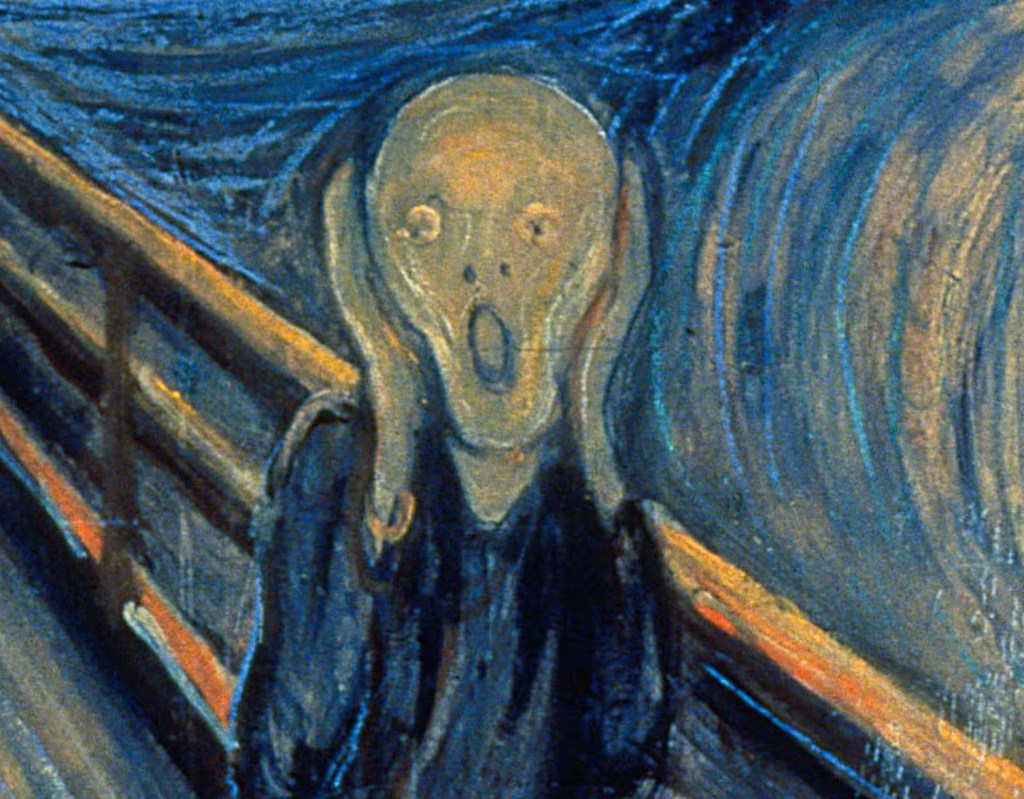
Edvard Munch 1893


What makes you happy when you wake up alive?
You only need one, but you can name up to five.
The dog, your shoes, your home, or the sun?
A good cup of coffee? A cinnamon bun?

(The alphabet rotates through my mind as I search for words that rhyme, trying to escape the horror of the current holocausts. I slip into doggerel. Clever ditties. Slanted lines, good times, shallow sips through thin-set lips, the scream rising in the back of my throat.)

We’re a tiny planet floating in space,
killing each other at the usual pace.
A few are too rich, billions, too poor.
What, exactly, are we fighting for?

(I watch my fingers jump around the keyboard, my chest steadily rising and falling. How can I possibly live this day as if I’m entitled to all this good fortune? All this potential? There is Greenness ascending with a name that is on the tip of my tongue.)

Yesterday, the sky was so blue
I lay on my back with the privileged few
and gazed at infinity somewhat at ease
in my long conversation with rivers and trees.

(I’m increasingly able to see the end, but I don’t want to. It’s not a gift I requested. And I grasp the fallacies of simplistic faith with its tragic outcomes and cruel justifications for suffering. Which is what we do. We suffer. More than anything else, we suffer.)

Can I buy you a drink? The Trickster arrives.
Oh, hello, I say, and then break out in hives.
I’m sorry, I say. I don’t know what to do.
Oh stop, grins the Trickster. It’s not about you.

(I’d like to believe that, but I’m stuck in my bones, and it is about me, at least for now. On the other hand, wouldn’t it be nice if the apparition of skin melted away more gracefully, and the scales fell from our eyes so we could behold our unformed substances mingling?)

What makes you ready to meet your own end?
The kindness of strangers, the love of a friend?
You can answer this once, or twice, or thrice.
But whatever you do, could you try to be nice?

(The Trickster nods. That’s a big ask, honey. It’s easy to crush and kill and lie and hoard. It’s tempting to pound your chest, bully others, and demand the best. But the minutes tick away regardless. I nod. Three crows land on the fence. They caw and nod as well.)

Honing Toward Perfection

Today, The Gods are the consistency of sunset, vulnerable as snow. A northern gale stirs my worst instincts, exposing the road to hell and back—a familiar excursion for many of us. The Gods are hopeful hitchhikers, rebellious dancers who lead and follow at the same time, repeatedly exhausting themselves.

“Truth.” The Gods sigh through the haze of impending February. I hold the palm of my hand steady, hoping they’ll land. They weigh nothing. They mean everything.

“Rest here,” I whisper. “You’ll be safe with me.”

My bravado is laughable. Nowhere is safe for God. Not evolution. Not war. Not atmosphere. Not black holes, good intentions, bad karma. Perhaps The God’s most accurate description is They-Who-Are-Not-Safe, and they are especially unsafe in the grasping hands of human imagination.

The Gods remove their glasses, breathe, and rub the lenses with their pure cotton robes. They assume a professorial pose.

“My dear, we’ve known you a very long time. You’re the shape of a certain universe where treachery is expected. Suffering is real. You’re a stone rolling downhill. We can’t catch you because we’re rolling, too.”

This apparent abdication angers me. If it were possible to give God a swift kick in the butt without hurting my own toes, I’d do it many times a day. But with God, I never wear steel-toed boots. Instead, I wear thick, cozy socks so I can slip quietly from room to room, age to age, life to life, barely disturbing the old soul.

“We hear you anyway,” The Gods laugh. “Our senses have been honed by the human condition. Our legs are blown off, our children starved. We bear the brunt of genocidal hatred.” They pause and add, “These embodiments are excruciating, but being misperceived has its rewards. There’s nothing we don’t see. Nothing we don’t hear. Nothing we can’t bear.”

“I don’t understand,” I lament, holding my head in my hands. “I just do not understand.”

The Gods laugh a second time, a wistful, ironic laugh. “You’ve got a bad case of existential fatigue,” they explain as they offer their scarred and ancient palms. “Rest here. You’ll be safe with us.”

With trepidation, I lay myself down in the fleshy folds, and the holy fingers curl inward.

“So, this is where I disappear,” I mumble, drowsy.

“Not yet,” The Gods say. “You still have senses to be honed.”

I snap awake and begin burrowing back out of the corporeal warmth. I don’t want to be honed. For a third and final time, The Gods burst into laughter, so hearty and inclusive that I can’t help myself. I laugh, too.

“See?” The Gods say. “Honing isn’t that bad.”

Between Firmaments

And God made the firmament and divided the waters which were under the firmament from the waters which were above the firmament…And God called the firmament Heaven. And the evening and the morning were the second day.

Post hoc weather report: For two days in a row the wind didn’t blow. When this happens and there’s sun, I tend to forget about adversity. There’s nothing to lean into or ward off or hide from. I lose focus and get dangerously, gloriously expansive. I know this about myself so on the first windless day, I remained mindful, took a walk and hung up laundry.

But the second day was too much. I dragged everything out at once and balanced it between brilliant sky and deep waters, the firmaments of heaven and hell. I sang along with Bob Marley, beat on the blue barrels, and danced from possibility to possibility, arm in arm with an adolescent God. It’s often God’s fault when I get ecstatic and reckless like that.

We opened cans of paint, glued odd-shaped scraps of wood together, and redid the driftwood bouquet, adding antique marbles and sparkly broken glass I’d swept up after the wind slammed the garage door a couple years ago. The door had been double-paned, but on impact, the inner pane shattered into light aqua beads. I knew they’d be perfect for something. And the door still works. In fact, the remaining pane mirrored God slinking by, a black dog with a stick. Eternally hopeful.

I threw the stick a few times but then asked God to help me take some selfies near the old typewriter that sits among my outdoor sculptures on a massive stump that looks dead but isn’t. Every spring, I remove the hopeful shoots. I don’t want a tree there.

We did the selfies and examined our hands. So many angles, so many ways to see what could be. We briefly reviewed the reasons for self-restraint and then shelved them near my collection of dull saw blades and dented mailboxes. We were giddy from the fumes of liquid nails and high gloss varnish.

The elasticity of our joy stretched into the evening and when it was time to call it a day, we did. We called it the second day and rested.

But the earth wobbled in the night, and the vicious wind is back. I have awakened to stinging dust. Swirling ash. Things old and broken have lost the sheen of potential. I’m tempted to start a fire to rid myself of these burdens, but I can’t. With this much wind, it could burn the whole world down.

How I Hang On

The strands of God I braid into lifelines are made of rags, dried roots, aches, pains, snake skins, and sun. My images of God are stained by blood and the poison leaves of rhubarb, crushed, boiled, dried, and painted on muslin shipped from India, the cloth of royalty, spun with pride by beautiful brown people starving for a chance at life.

There are those who keep their meditations and rituals tight and tidy, like spiritual minimalists. They expect God to do the same. Variations on good and evil are not tolerated because of the mess that creates. But I can absolutely assure you, attempts to keep God simple and sorted out never work.

God appears or withdraws without warning. God ignores, intrudes, laughs, cries, gallops away, swims back, soars, grovels, snorts, pouts, lurks, flaps, crawls, and overstays any kind of real or imagined welcome. I lament the naïve worship of false saviors and the primitive ways we think we can protect ourselves.

“And what about plastic?” God asks, joining my foray into complexities and despair. “Tupperware was once regarded as a miracle.” God takes the shape of a vacuum cleaner, then a fridge; God infuses a book of photos of my chemo baldness and the breastless beauty of my friend’s short-term victory over cancer. God is flippant and fancy, playing the fool to cheer me up.

“Be ye still, God,” I say to all the moving pieces.

“Good one,” God laughs and pulls me onto the trampoline. God is protective, warning those close to me that I can’t be bounced as high anymore. Even though this signals the condition of my bones, I am comforted by the attention.

“I know you pretty well,” God says, watching me jump. “I wish you’d stay off ladders.”

“Oh, take a hike,” I say.

 “Good idea,” God says. And away we go.

This is the Big Truth. We can neither contain nor control God: not in rituals, not in words, not in ideas (simple or otherwise), not in rules, not in promises, not in skylines or photos—even from the Hubble telescope. God refuses to be shaken down, defined, spoken for, or reduced. Thus, it is wise to entertain sorrow, welcome the stranger, love the enemy, and find strength in the profound, complex joy that is life itself. God’s blood is the blood we bleed. It is on loan from eternity.

We Have No Sheep

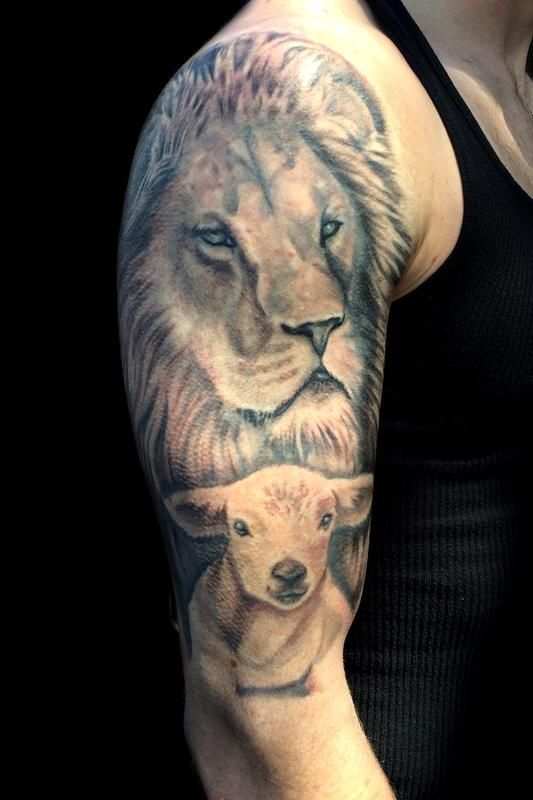
Any minute now, God is going to show up with a new tattoo. He calls them Prison Ribbons. Medals of Honor. He’ll be revving a stolen Harley. He’ll be broke. If arrested, he will be killed.

Any day now, God is going to knock meekly on the outside door, waiting to be welcomed in. She will be crying. There are things too painful to bear alone.

Sometime in the afternoon, God is going to hear someone praying to win a soccer game, begging for help with an obstinate child, asking for healing, or relief, or just one more day, alive on the planet.

This evening, God is going to corral the sheep for their own safety. There’s been a mountain lion sighting. Even the dogs are nervous.

And me? Oh, I’ll be friendly enough. I’ll do some weeding in the garden. Bake some bread. Read. Think. Write. Plan. Argue. And I’ll wait. That’s the hardest. The waiting.

Unbearable, unthinkable companion, could you wait with me? Unload the guns? Unpack the anger? Could we dismantle our fears together? Maybe we could examine our jagged little pieces of hatred and throw them in the river. They won’t skip, but over the eons, they’ll smooth into gleaming stones.

I want to build a translucent wall of agate and quartz that everyone can touch—the living and the dead—the livid and the lucid and the lame—the wayward sons and daughters of a very wayward God.

But I find myself chewing my thumbnail, drinking my beer, rocking in the recliner like the old fool I’m becoming. I want to buy a donkey to protect the sheep. We have no sheep. We have terror, borrowed time, and limited vision but, as of this moment, we have no sheep.