A devoted Buddhist once told me that he practices dying every night. Due to his oddly belligerent demeanor I didn’t ask for details. But it gave me ideas.
To die well requires less practice and more conscious forethought. A laissez-faire attitude toward mortality is common. But “dealing with things” long before your time comes is a kindness to the planet and your beloveds.
For instance, embalming fluids hold your placid smile in place for viewing, but they eventually leak out, and they’re poison. Sadly, though less toxic and land-consuming, cremation adds around 550 pounds of carbon dioxide to your carbon footprint.
So my newest idea involves compost (I hear my loved ones sighing, “Of course, it does.”) But they’ll thank me someday. I have a plan, and it’s simple.
My favorite quilter will help me create a colorful body wrap with handles and bright yellow ties to ease the burden of moving me to my chosen resting place.
There’s a boggy spot just behind the open-faced calving shed on the family ranch. It has a magical circle of aspen. As a child, I recognized this was a thin place between worlds. With any luck, I’ll die while the ground is warm and active, so a small backhoe can dig a shallow hole.
When I first began my own “dealing with things,” I had my friend built a coffin of rough-cut lumber, but now I realize that coffins are unnecessary. Cotton cloth is enough. I want the fewest barriers possible between me and the rich, good earth.
I want nothing to impede the dissolution or the dream.
My brooding seems to trigger the Not-God. “What about a headstone, you fool?” she shrieks. “How will your offspring find you in times to come?”
My Coauthor and I surround her with understanding arms, and the purple bruising of fear fades to ivory. We hold each other safe in the center of the Holy Dialectic. “My offspring have already found me,” I tell the Not-God. “And I them.”
In her clear contralto, my Coauthor begins to sing, “Row, row, row your boat, gently down the stream.” The Not-God covers her ears and shouts, “What will you do with that coffin, then? And all those stones you’ve gathered?”
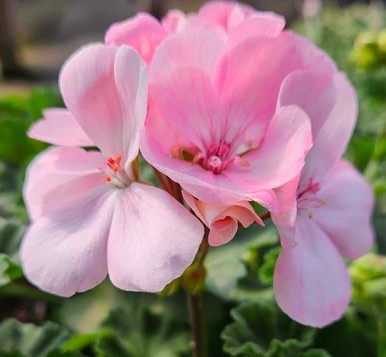
I turn toward into the Shadow that she inhabits. “I’ve been lining the Path with smooth stones for years. And my former coffin will make a beautiful planter. Someone gave me some geraniums, and I feel certain they will be easy to propagate.
“What colors?” the Not-God whimpers.
“All of the colors,” I smile. “Do you have a favorite?”
“Pink,” she brightens and grins like a child. “Hot, hot pink.”
—
For more uplifting, cheery poems and conversations just like this one, you can order our book from the YOU KNOW WHO and for a mere 13.99, you can laugh and cry your way through this missives every day!!

 Short visits with an honest God