Speaking Terms

Yesterday, God and I were not on speaking terms. Today, a purifying spring snow is falling, the beer is cold, and I have repented. It was partly God’s fault, but I’m the one repenting. It works better that way. God can be a real handful, but after I calm down, I don’t mind cajoling him along. It’s that or fire him, and I don’t want to fire him: I need the help. We all need the help. Even the toughest among us need the help.

“Not true,” the Bruising Force of God says, smearing bacon fat on the last piece of toast. “Well, maybe true,” he admits, chewing with his holy mouth open.

“Sometimes, you disgust me,” I say, trying to focus on the garden instead of God’s missing teeth, the dead bodies in Ukraine, or the grief inherent in being human. Pandora is playing my Eva Cassidy station. I turn up the volume to drown out the smacking noises. Long ago, a friend introduced me to Eva’s voice—though Eva had already died of breast cancer. She didn’t survive long enough to enjoy her success. My friend does not remember any of this because her memories have come as untethered as cheap kites in sporadic wind.

“Cheap. Fancy. Doesn’t matter. They all come back to earth,” God says, as he brushes crumbs off his shirt. “Write that down,” he adds. “That’ll be a good line.” I glare out the window. The snow is thicker now, each flake a mesmerizing angularity, falling straight and heavy. I wonder if the weight will break branches.

“Yes,” God says, still pontificating. “Branches will break. Oceans will rise. There will be surges and recedings. But in the meantime, I’d sure like another piece of toast.”

My wish to bring God down a notch is palpable, but I manage to get up, walk calmly to the kitchen, and make more toast.

Bucket Lists

Nearly all the windows in our house are oriented south for solar gain, but the view to the north is exceptionally nice. Our inner space reflects a set of values, givens, and limits. We’ve filled most rooms with books and rocks to hide lapses in judgment. Outside, the garden has gradually improved—I love repurposing metal coated with rust and twisted stumps that are not yet dust. It takes a practiced eye to see the beauty.

“Yes,” God says, disrupting my existential mulling. “I love repurposing, too. Especially the fragile and distorted.”

“Hi there, God,” I say in a falsely chipper voice. “How about you be nice and take care of me today? Let’s exercise, write, do some art, drink green smoothies, and then after I’ve fallen fast asleep, how about you carry me gently into the next realm?”

“What?” God says in mock surprise. “You want to cash it in?”

“Well, yeah. Or, maybe,” I say. “I don’t like aging. I want an easy way out.”

“An easy way out,” God echoes, nodding. “Thank you for being honest with me.” This is a standard phrase therapists use when clients drop a verbal bomb about their homicidal, suicidal, malicious, vindictive, hopeless, violent urges and fantasies. It buys a little time.

But God doesn’t need to buy time. I’m suspicious. God already knows I’m as afraid of dying as the next person, but I’m deeply ambivalent about staying alive. Fighting for every last breath soaks up resources, drains loved ones, involves a fair amount of suffering, and has the same outcome. What’s a few more days or even years if they are filled with pain, struggle, and hardship? It may look heroic, but there are many ways to define heroic. Leaving willingly, gracefully, at the right time might be another definition. I glance sideways at God.

God glances back. “How’s that bucket list coming?” she asks, with a mischievous smile. “I know you’re inclined toward rescuing and saving, but don’t put the world, or yourself, on the list. You can save neither.”

“God, darling,” I say. “I don’t even know what ‘save’ means. And how’s your bucket list coming along?”

“Thanks for asking, sweetie,” God says. “But let’s talk about why you want to know.” This is another classic therapy maneuver; turn the question back on the client. But then God reaches over, takes a drink of my coffee, and salutes herself in one of my many mirrors. This is not a classic therapy move. Too invasive. Too intimate. Impulsively, I look straight at God, grab her cup, and take a swig. The coffee is hot, dark, and bitter. I want to spit it out, but God bows her head, palms together, touching her lips. I have the distinct impression she’s cheering me on, so I swallow and raise the cup. We look in the mirror together. It takes a practiced eye to see the beauty.

Naked in the End

You will be happy to know the accent wall is now midnight blue, the ladder-backed chair rescued from the dump, lime green, gold, maroon, and yellow, and though my life has not gotten noticeably better, I used recycled paint, so there are five fewer dented cans awaiting resurrection in the basement. They are empty. I’m happy. I’m drinking the leftover Malbec wine for breakfast, but I would prefer dark beer. We must all make sacrifices.

Among the things set free by the storm last night are five rotten cottonwoods, one majestic willow, and twenty-six irrigation pipes rattled loose from their line of duty and sent tumbling dangerously through the darkened sky. Those of us left behind have accepted the fact that we will not be able to save the planet by ourselves. The wind has agreed to help but at great cost. Millions of unwilling children have lined up along the shoreline hoping for food. The tide will rise and take them. Their elders will follow. Millions of other species have unwittingly signed on for extinction, simply by being themselves—ugly, simple, and in the way.

For a while, we will fight to save the pandas, the owls, and the wealthy; the beautiful and those who make us laugh. I, for one, will write words infused with angry sympathy for those born into suffering, born with few options, those who then hate, radicalize, and destroy. The war games continue.

I kick at the shins of God, trying to wake them up. This cannot be the Original Intention. I am a foolish Cinderella. They are a flimsy Prince Charming. I am Jack. They are the Giant. I plant magic beans. They are the purveyors of binder weed and quack grass. I install solar panels. They are the sun and patchy morning fog. They are the good witch, the man behind the curtain, the placebo effect. They are a modest chemical reaction, and we are atoms splitting, cloaked in a thick shawl we’ve drawn over our shoulders, thinking it was pure merino wool. It is not. It is denial. I have considered freezing to death instead of protecting myself with lethal and selfish lies. When souls stand naked in the end, truth will be the only shelter. Not power. Not possessions. Not beauty. Not brilliance. Truth is always grounded in humility, compassion, and sacrifice. Sometimes, to practice, I wear clothes thinned to threads by others and endure the brutally cold light for as long as I can.

Pick-up Truck

At the present moment, I readily admit I’d rather spend my time shopping online for a reliable used pick-up than hang out with God. Existentially, I know I’m not alone in this preference.

To be clear, I don’t mean just any pick-up. I want a humble, road-worthy little pick-up that will take me anywhere I want to go. Sadly, these are rare. In our current culture, driving a small, fuel-efficient pick-up has become a direct threat to one’s sense of superiority, a signal of submission to bigger trucks, a failure to flaunt one’s flagrant, entitled use of all things petroleum.

And I don’t mean I’m avoiding just any God. If I could find a God who would answer my prayers for a dependable rig, that would be one thing. But the God who shows up most of the time rides shotgun without regard for vehicular prestige or utility. Of course, there are times I like driving around with a good shotgun-riding God. But other times, I want a God who will take the wheel and get me what I want right now. And I want it sanctified, guilt-free, and easy; a blessing from a God who bestows blessings on those who deserve them. Like me.

If I had a little pick-up, I could buy big things and haul them around. I could load up furniture I no longer like and get rid of it. I could throw a sleeping bag in the back, drive anywhere I fancied, and take care of myself. I could escape into thingness, dislocation, and the illusion of having the right-of-way. I even imagine finding an offramp that turns me and my pickup around to give us another run at life.

If I had a God who would agree to be my Security Detail, my Bouncer, my Getter and Doer—a God I could prop in the corner to scare away the heathens and inferiors, wouldn’t that be nice? If I think of it that way, I could be God’s God.

“I don’t need a God,” God informs me in a gruff voice intended to disguise amusement. I’m neither startled nor dismayed. I grin sheepishly, my mind caught in the cookie jar of fantasized omnipotence.

“Uh, hi God,” I say. “Good thing you dropped by. It was getting a little crazy in here.”

“No worries,” God says. “There’s a pandemic of crazy going on. How about we quarantine together? I’ve got a couple of ventilators if we need them.”

“Sounds good,” I say. “I’ve got reams of bamboo toilet paper.”  Shotgun God slaps his thigh. Bouncer God lets people in. Cardboard God starts a fire, and I stir the cauldron of soup and feed the sourdough starter some nice, fresh flour.

When the Choir Preaches Back

Sometimes I count my blessings; sometimes I count my years, and though I don’t like admitting it, sometimes I count the number of people I think of as willfully, proudly ignorant, and my mood sinks. But as dawn arrives and light asserts itself, my despair dissipates into benign speculation, and I am among the billions awaiting transitions no one can explain. I watch God in the fire and in the lines of frost across the windows evaporating directly into air. I watch God peacefully protesting greed, misogyny, and cruelty. I imagine my grandchildren and their grandchildren carrying genes across the great divides of life and death, and I am both stricken and intrigued. What could I possibly do to lessen the burdens and reduce the suffering to come?

God emerges gentle. Always gentle. Always sacrificial. Always self-assured. Kindling for the fire. Moisture for the frost. God surrounds me, stone tools, dead branches, herds of deer, flocks of sparrows, and a holy stillness in which I can rest. I don’t want to rest. I am aware of how easily I will break and burn and disappear. I want to speed down the runway and lift into a sky that will leave me unbroken and unchanged.

“If you reduce the suffering, you reduce the joy,” God speaks in everywhere voices. “If you take away the burdens, the bones soften. The understandings recede and the cost rises.”

“Hello, Old Friend,” I say. “Let’s not fight today. I won’t disagree or complain or act as if I know anything at all. Instead, could we fly? Could we walk through fire, find the garden, and open the gates?”

God laughs and lifts a million arms in praise. A multitude of God begins to sway to an inescapable beat; a galactic choir robed in sunrise crimson bursts into a seditious version of the Hallelujah Chorus; I’m not Mormon or Jewish, Muslim or Buddhist, Jainist or Hindu, or anything defined beyond my tenuous friendship with God, but as I sidle up, my Friend throws a heavy velvet robe across my shoulders, and I join the altos. We sing the truths of repeated defeat. The roiling ocean of human sorrow buoys us up, the crashing waves, a steady percussion section. Hundreds of soaring sopranos lift off and take the high notes with them, but like spring, they promise to return.

The Meek

“Here’s the question,” I said to God. “Why would the meek even want to inherit the earth? After the unmeek are finished pillaging, what’ll be left anyway?”

Three distinct snow devils twirled by, and then a vicious wind blew the remnants of the last storm across the garden, blurring my view. The weather patterns have begun to express earth’s outrage at its tormentors. The meek stand at the far end of the long arc of justice and there’s no pot of gold awaiting. Only diminishment and misery.

“Interesting question,” God said. “Could I get a couple of scrambled eggs? The brown, free-range ones, if you please.”

“Why?” I asked. “What’s the point? You’re not hungry.”

God shrugged and made his own eggs.

And here’s another interesting question,” I said with some irritation. “Why is nature so exquisite? Elephants. Apple trees. Caterpillars. Orchids. Translucent baby mice, huddled in their circle of pink, bones so tiny they could be eyelashes. Wild skies. Bengal tigers. Wheat fields before harvest. Fire. Ice.” I paused, caught up in the complexity and splendor of it all. Then added, “and why are humans so destructive?”

God ate his eggs, nodding and smacking his lips. “These eggs were fertilized,” he said. “Circle of life and all that. Tasty. But this toast is questionable. I think your flour has gone bad, and I think I’d like some ice cream.”

I sighed. The wind had died down. The air was clean, my vision unimpeded, my flour rancid, my questions mostly unanswered, and for some inexplicable reason, my soul was at peace. A cold snap was rolling in, but we had enough wood. I vowed to have more faith next time and buy less flour. But I bake a lot of bread.

“Survival is a complicated, temporary equation, isn’t it?” I asked God as he zipped his down coat, wrapped his neck with a wool scarf, and pulled his rabbit fur hat down tight. I didn’t expect him to answer, but he did.

“Yes and no,” he said. “On one side are the essentials: Compassion. Humility. Sacrifice. On the other, well, you figure that out.” He took a long lick of what appeared to be licorice ice cream and added, “It may involve delight.” Then he slipped out the door to the west where joyous and majestic mountains rose to greet him. There were snowshoes strapped to his back.

High Wind Warning

As dawn arrived, the wind picked up and all manner of things wired or weighted down began banging and clanging in protest, especially the artistic frying pan hanging next to the rusty tire chains. Everything not secured took flight. It was the last I saw of the brown tarp, the ordinary clothes I’d hung to dry, and the light pink clouds that make mornings easier. I ran outside and grabbed at vague shapes flying by, but it was futile. I looked up. The tempest had peeled the sky raw, and the gaping blue of infinity was in sharp relief. I wasn’t ready for the existential vertigo that washed over me. My lack of innocence was frightening.

“God!” I yelled from the middle of nowhere. “I could use some help here!” The voracious wind emptied my lungs and flung my words down the valley. I took cover in the low-slung fort I’d built as a child, amazed it was still there. On hands and knees, I inched deep into the soft, undisturbed darkness and found a place to hide.

This is where a Godness discovered me, hours later. I was thirsty and ready to surrender. The Godness began to sing against the merciless gusts in a tone lower than sound. Gradually, the wind died down, and we emerged to survey the damage. Fallen trees, stripped branches, shed antlers, lost feathers, disturbed water, dashed dreams—a landscape bereft of permanence. Neither God nor the earth engage in murderous self-defense. I could see why the promise of heaven makes so little sense. It’s only the promise of hell that matters.

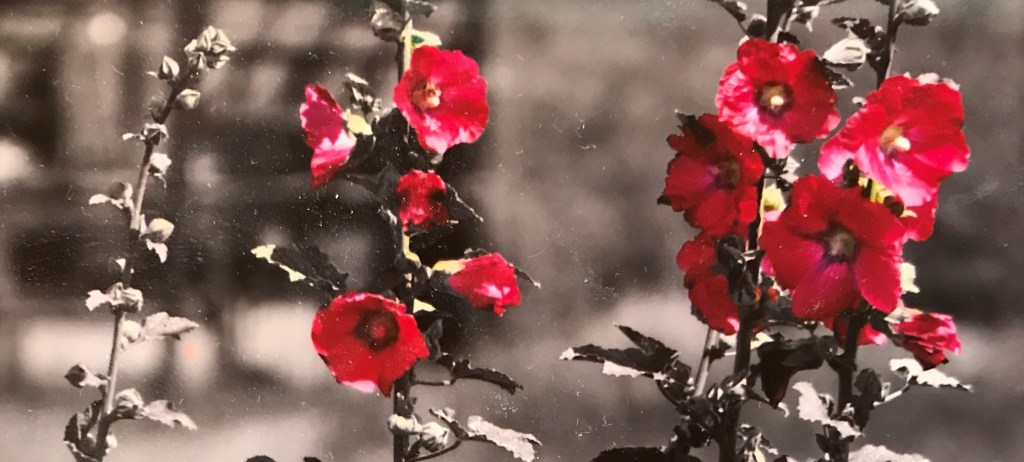
I tried to whisper the names of God etched in the grounded patterns of dust and ash, but my lips were gone. Holy breath, warm and moist on my neck, made me long for my mother, or a simpler God, or something easier than gale-force wind. Gently, the Godness wrapped me in fragmented light and told me I would always be beautiful. I shook my head and blushed the blood red color of my favorite hollyhock.

Hollyhocks are biennials. The seeds from the parent plants sprout and gather force the first year and bloom madly the next. They can last for generations without any human assistance. The hope they inspire seems delicate. But it’s not.

Off-Gassing

I closed doors, opened windows, turned on fans, and lit the first fire in my new wood cookstove this morning so it could begin off-gassing. Then I took my latest rock project outside to spray with clear lacquer. The smell of that stuff can ruin your day if not your lungs. Some things necessarily involve the management of toxicity. In fact, as I think about it, there’s likely no avoiding toxicity as part of a larger process. Anywhere. Ever.

“You sure about that?” God asked.

“No,” I said, “but I bet you have an opinion.”

That cracked God up. “Ha! Me? An opinion? Did you forget I’m God? I don’t have opinions.” She said this with disdain.

I felt like doing a little off-gassing myself at this point. “Fine,” I said. “But back to toxicity. It’s like evil, right? Somehow, it’s part of the point. Rotten things smell terrible. Poop is disgusting. It’s the essential tug-of-war.”

“Not exactly.” God looked bored. “What’re you wearing for Halloween?” she asked. “I’m thinking witch, but I also love going as Quasimodo. That hump and giant mole really get to people. And it’s easier than dragging along a broom.”

I stared at God and then out the window. I wondered how the fire was doing. I wondered if the stones were dry. I wondered if I would ever get a straight answer from God.

“You won’t get many,” God said. “But I’m consistent. There’s that.”

“Like ‘love your enemies’ and all those other impossibilities?” I said, in a surly voice. “You mean how you’re the definition of compassion while horrid things happen all the time, right? You mean how deception is wrong, no matter what?”

God smiled, nodded, and lifted with a thousand wings. God drifted like smoke. God surfaced, a blue whale in a vast sea. I was enfolded in something beyond myself. It was nothingness, but I wasn’t worried. Something about me was holding strong. The basics. The dialectics.

“Don’t forget Lucifer,” God whispered and rubbed what felt like my head. “I love that little pipsqueak.”

“I’ve always known that,” I whispered back. “I’ll never forget.” I was making promises I had no way of keeping, but it seemed to please God anyway.

“Set the intention,” said Blue Whale before diving to the ocean floor. “Then hang on.”

So that’s what I’m doing. Intention is set and I’m hanging on. I will minimize my toxicity as best I can. But my reach exceeds my grasp, as I suspect it always will—and that damn new stove is back-drafting.

Detritivores

Photo credit: Andrew Cooper

We buried huge pieces of our neighbor’s fallen cottonwood in our garden a couple years ago so the soil could benefit as the wood decomposed. The Germans named this process Hugelkulture. Our neighbor had planned to burn the pile–converting decaying wood to unnecessary BTUs and ash. Not an awful thing to do, but not ideal.

Over the past couple years, deceased bodies beloved to me have also been converted to ash; rolled through a special chamber that reaches over 1400 degrees Fahrenheit, bone fragments pulverized, and the resulting remains scattered on chosen hills, sprinkled on the face of deep waters, buried alongside a rosebush, or saved in an urn.

The air stirred during one of these scatterings. Turns out it was God, shaking flour off her apron so she could join the final minutes of the ceremony. She’d been baking croissants. Thanks to her vigorous flapping, the gray powder twirled upward in micro dust devils instead of drifting peacefully to earth. “That’s what ash does,” God whispered defensively as I frowned and shook my head. “It can’t be entirely controlled or avoided even on calm days.”

“Then you’re a lot like ash,” I whispered, smiling so she wouldn’t think I was angry with her. Of course, I’m always a little angry with God but not enough to want to hurt her feelings or make her disappear. I think she feels the same about me.

“No, not ash. I’m more like the detritivores chomping away on your cottonwood stumps,” she teased back.

“Excuse me?” I raised my eyebrows.

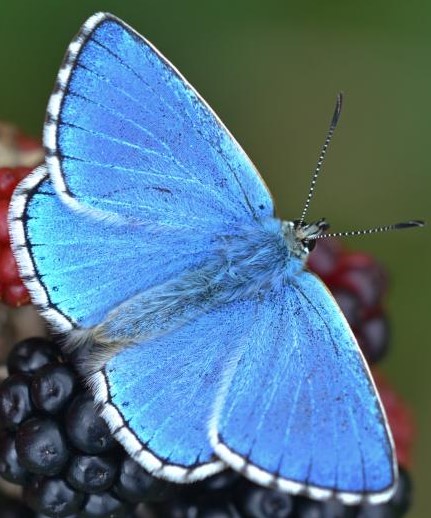
“Look it up,” God whispered. But somehow, I knew. Detritivores are creatures that convert the dead to nutrition for the living; butterflies, maggots, and such. They thrive off waste, breaking down and cleaning up that which is left behind.

Once, I was laying in some grass and a butterfly landed in front of my nose. It was my father, long-dead, hypnotic wings the iridescent blue of his eyes. He was as attentive as ever. We talked of things, worldly and otherwise, and he flew away. Now, decades later, many more forebears have joined him.

“I’d rather go gently into dark dirt than blaze up in flames,” I muttered to God. “Is it legal to be buried in your own garden?” We’d both been rude side-talkers, but my voice may have gotten louder. God shushed me. The priest intoned the final blessing and made the sign of the cross, ignoring the ash settling on his shoulders. I leaned in close and whispered, “I bet those robes are going straight to the cleaners.” God stared straight ahead, but her mouth twitched a little as we bowed our heads for the final prayer. Neither of us closed our eyes.

Shelter from the Storm

We are all a long way from home, dithering and dallying, trancelike automatons until something small or large loosens a stone in the foundation. Lost, but not completely lost. Found, but not yet found. Half-heartedly seeking what Bob Dylan called a lethal dose of salvation. Always a little messed up, though occasionally well-intended. For instance, I didn’t mean to leave the rice in the microwave overnight or the fish on the counter. I didn’t set out to drink all the cold brew and not start the next batch. But mea culpa—these are among my many thoughtless mistakes, and I hereby offer myself conditional forgiveness. I tell myself You’ve got to stay focused. And I add Straighten up and die right. Or is it lie right? Or fly right?

“I prefer fly right,” God says, settling in on the couch beside me. “And who put you in charge of forgiveness?

“Well, I’ve always assumed it was you,” I say, “And it’s a hell of a job.”

God smiles sympathetically and rifles through the mail, lists, receipts, masks, and rubber bands on the coffee table. I sit quietly, hoping for a bit of advice or assistance. My recent efforts to be more organized have fallen woefully short. The demons of distraction are delighted as I try various methods to get centered: Deep breathing (smoky air); beer (disorienting); garden (needs weeding, watering system not working); sticky notes (they lose their effectiveness when they’re everywhere). Lovingkindness meditation (too hard). I’m full of excuses and self-pity. There’s plenty of blame to go around.

“I wish I lived somewhere that forgiveness wasn’t even a necessary thing,” I say.

“Hmmm,” God says, absorbed in a sale flyer for energy-efficient window replacement. “I doubt it.”

And to top things off, the Text Predictions function in Word has suddenly turned itself on. I hate Word guessing at what I’m trying to say. I hate automatic updates. I hate passwords. I hate warring search engines. I hate smoky air, suicide bombers, drought, rice in the microwave, weeds in the garden, turkeys in the straw, refugees in the ocean, people willing to infect each other with viral hatred, flagrant ignorance, and this long and winding road that always leads me here. To the here and now of an ever-eroding present tense. I’m a child of the 60s.

That prophetic Beatles song locks down in my brain. “Don’t leave me waiting here,” I sing to God. I think I’m being funny, but God and I choke up. The Long and Winding Road was their last number-one single in the USA. So fitting. The unattainable. The end is the beginning, and the beginning is the end. The wandering is the journey. The trying is the failing. The failing reveals grace, and our last job is to die forgiven.

“I do know how hard it is, honey,” God says. I nod. We sit, staring out the recycled windows at the waning but beautiful garden.