The Coming of the Winter


Chopping hollyhock skeletons in the wind guarantees a shower of fertilize seeds scattering every which way. Far too many will attempt to germinate no matter where they’ve landed.

Hollyhocks are cross-breeders. Mutators. They mix it up. It’s impossible to predict which colors they’ll sport if they successfully root and grow. Lavender, salmon, yellow, white, pink, red, and magenta. In moderation, they are spectacular, but like the unwanted and displaced everywhere, their attempts to flourish indiscriminately must be attenuated. This, I do not enjoy.

There is weariness in managing opportunists, weeds, and predators,
in seeking balance against exuberant or shameful excess.
There is tedium in finding words, choosing words, creating words.
Like hollyhock seeds, there are too many fertile words
jostling for position in our limited thoughts.
Especially in the fall, when everything is browning
and dropping and preparing for winter
as if another spring is guaranteed. As if lying is acceptable.

“Preheat the oven,” my Coauthor says. “We need to hurry.”
I glance at the clock and shake my head. “Too late. We’ll have to go without the bread.”

Disappointed and crabby, my Coauthor helps load the car. We put the sweet batter in the fridge for later baking and our resentments on hold for later resolution. Not every day can roll out smoothly. The smell of cinnamon cannot infuse every moment. No one lives forever.

That doesn’t stop us from blaming each other.

“God,” I say sternly. “You could’ve heated up the oven on your own.”

God glares out the window. We drive the muddy roads a little too fast, but we make it in time to be of help.

There is weariness in brushing the remaining strands of hair,
in mumbling hollow phrases of comfort.
There is tedium in searching for ways to say I love you,
fare thee well, and goodbye.
The first skiff of snow on the mountains
is the last gasp of the summer that promised never to end.
As the light wanes, the transformation of pleasant evenings
into the inevitable pitch-black night is softened
by a moon that is no longer out of reach.

Pilgrimage

Our final pilgrimage to my favorite Goodwill was a resounding success, but it was twinged with the usual autumn sadness. My father died in the fall when I was nineteen. For whatever reasons, I began shopping at thrift stores shortly after. Maybe I needed to prove I could take care of myself. Or maybe I wanted to give discarded items one last chance at usefulness. A selective resurrection.

Whatever the origins, it’s a spiritual practice now.

Time ceases to exist as Original Source and I sort through bins of castoffs and misfits, keeping in mind the needs and tastes of everyone we love. The possibilities are endless. Our cups and our carts runneth over.

Unpacking is less rewarding. Original Source abdicates as I face the flood of questions:

How did this get in my cart? What, dry-clean only? Why didn’t I check this zipper? Where’s the other boot? Will this really fit her? Oh, dear, are scarves out of style? Aren’t they still worn by Germans and movie stars?

Then, the recriminations:

You have too much stuff. Red is not your color. You’re a hoarder, a second-hand capitalist. You idiot, here’s the other boot, and they’re both for the left foot. Five aprons will not make you a better cook. There’s no room for more coats. And this candle stinks!

Next, the defenses:

You can’t have too much hand sanitizer, and red looks better with a little blue. That stain might come out. It’s hard to find a gold lamé shawl when you need one or Halloween pajamas, for that matter. Single boots make quirky, boho vases, and if the electricity goes out at night, you can locate that candle by smell alone.

Finally, action:

It’s all sorted. Little futures line the halls like wallflowers. I sidle up, dressed for any occasion, hoping Someone will ask me to dance. My imagination has a touch of arthritis, but I can still feign elegance and squeeze my feet into glass slippers.

Here’s the truth: Glass slippers offer no support whatsoever and shatter easily.

The sound of breaking glass attracts Cinderella’s attention. She glares from her repurposed throne, fanning herself.

“No worries,” I tell her. “I’ll glue the shards into a collage and call it Happily Ever After.”

Prince Charming and I bring in the last load of laundry.

“Warm for this time of year,” he says, mopping his brow with a silk bandana.

Cinderella sashays over in a chiffon gown, and Prince Charming tenderly takes her hand. Original Source takes mine, and the orchestra begins playing my grandmother’s favorite waltz. I have no idea how close we are to midnight, but I don’t care.

I Can Move the Iris

IMG_6550 (2)

A lot of people like autumn. I don’t. Sure, autumn lovers have their reasons, and I have mine. Not worth a debate, except maybe internally, as yet again, I find myself inspecting my belly button. “Why do you not like autumn, Rita?” I ask myself. “Too much death. Too many endings. Too much work. Things to put to bed. The threats. The oncoming winter,” I answer. But I’ve now distracted myself. The mention of belly button has flipped me out of my autumn reveries to my memories of my actual belly button. With both pregnancies, it popped out of its usual spiral, protruding like a small boy’s misplaced penis. No smooth, picturesque baby bump for me.

People conscious of appearances tried to shame me into wearing looser tunics or thicker tops. They suggested bandaids or an inner body wrap to push that thing back in. I resisted, trying to be comfortable with all aspects of the cataclysmic set of bodily accommodations entailed in pregnancy. Fake it ‘til you make it, right? Or as Popeye asserts, “I yam what I yam.” I didn’t pop my belly button out on purpose. It was just part of the process. But I remember the shame. Waves of shame for both my lack of perfection and my refusal to disguise that disappointing imperfection.

God and I frequently tangle around these issues. Pregnancy and childbirth; these are not walks in the park. Of course, neither are knee replacements, starvation, braces, kidney stones, or war. Some suffering is voluntary. Some suffering has a purpose, a desired outcome. But some suffering seems pointless and avoidable. And the little ones, the powerless ones, the poor—these always suffer first and most. These are God’s peeps. If God has gone missing, this is where you’ll find her, suffering alongside. I don’t like this. I like this far less than autumn. I could endure endless autumn if God would just step up and end the vast and unjust suffering of innocent, powerless people.

And of course, I just lied.

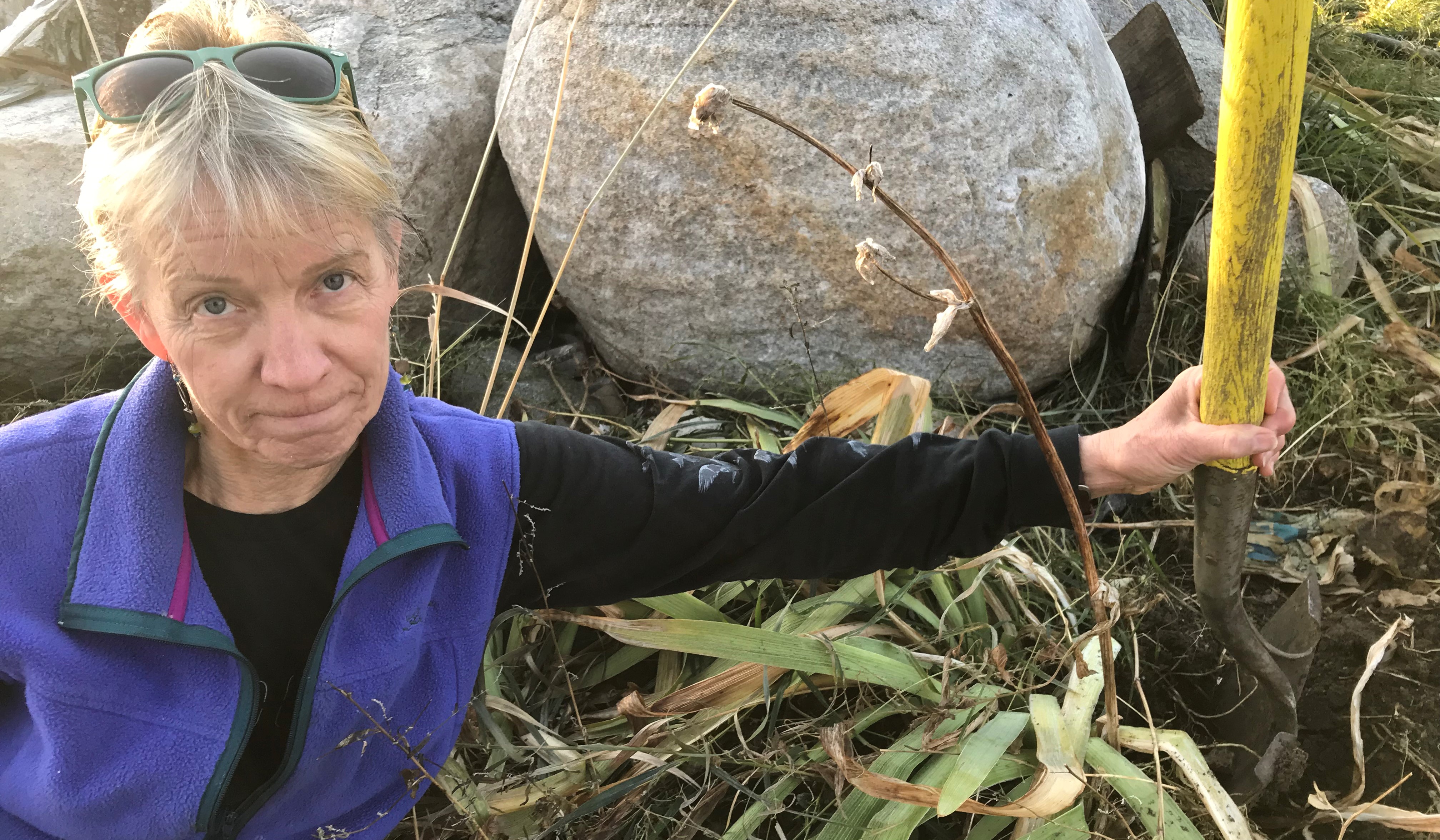
Two years ago, I planted the iris bulbs in an unfortunate location. The weeds and native grasses have completely overtaken them, giving me a daily view of negligence and defeat. I wasn’t thoughtful. I wasn’t perfect. I acted expediently instead of wisely. Oh God, I need to save one hungry child, one mangled family, one small patch of soil. I’ve got to get something right before I die. Please. I’m begging here. Please.

The arms of God are crossed. The eyes of God are piercing. The heart of God is coursing the blood of God through the arteries of my over-exposed existence. “You can move the iris bulbs,” she says. “This would be the time.”

As I mentioned, I don’t like autumn. It’s nearly too much for me.