Delusions to Die By

Though historians may beg to differ, it seems that humans have never been this close to self-annihilation. While wars rage and the earth gets trashed, the most pressing moral inquiry of the masses is this: “How can I get a better deal?”

A derisive snort and mocking applause announces The Presence in the corner.

“Hello, Holy Contradictions,” I mumble.

What I tease into words in the murky dawn might be the wind or a mouse scratching in the wall, but I feel certain something beyond is lurking in the cosmos. I offer greetings most mornings.

“Good day,” HC says, emerging from chimera to full status as a citizen unto itself. It has wings. It has legs. It has a beating, bleeding heart. “You aren’t wrong,” it adds from a perfectly formed mouth.

“You mean my sarcastic comment about the morality of acquisition? The Art of the Deal? Or the nearness of extinction?”

“It’s all rooted in selfish genes and the wrong-headed notion of survival of the fittest,” HC says with scorn. “You think you want fat lives, herd immunity, and evidence of superiority as indicated by possessions and an address on Easy Street.”

“True,” I admit. “That does sound good. Makes me want to be the fittest.”

HC snorts again. “Have you thought that through? C’mon. You’ve got the brain power to get beyond your genes. In the end, the Fittest will stand armed, paranoid, and alone. The winner of the rat race is a rat.”

“Nice platitudes,” I say. “Got a better way?”

HC shrugs. “Stop deluding yourself. No one survives. It’s Now that counts.”

“Thanks,” I snap. “I feel so much better.”

“The ultimate measure of fitness is how you love and protect the unfit. It’s time to break the light into itself, hold the Face of Anger in your hands, and let her bite you.”

My hands are fisted. “You are certifiably nuts,” I say in a low, edgy voice.

“And you are certifiably angry,” HC says with authority.

“Yeah. So, I’m supposed to bite myself?”

HC nods. “And hold the Faces of Joy and Justice but be careful. They’re elusive and explosive.”

“You’re seriously insane,” I say. “I can’t do any of this.”

“Oh, but you can,” HC insists, not at all sympathetic. “Hold all the Faces of Insanity in your hands and let them bite the hell out of you.”

I stare at my weathered hands. The biting has begun.

“I’d rather hold your face,” I plead, frightened.

“Oh, my little mosquito!” HC says gently. “What do you think you’re doing?”

A grim hilarity takes hold. I slap myself silly, and for now, we get on with it.
Big Comes By

As great chunks of what we’ve known to be good in our community, country, and world continue to crumble, grief and disbelief have paralyzed me. My Friend, Big, comes by to offer his shoulder to cry on, his gut to punch, his eye to blacken, his body to fold into.

“Too late, Big,” I shake my head. “They’ve got us this time. I’m giving up. It’s over.”

“Who’s got us?” Big demands, incredulous at my surrender.

“The demonic forces of primal instincts. They’ve won.”

Big grimaces. “Yeah. Everyone fears being rejected from the herd. I thought adding same-sex attractions and transgendered hearts to the mix would do the trick. I love continuums. You realize mutations, inclusion, and diversity are the heart of evolution, right?”

“No, we don’t realize that. In fact, we’ve made up commandments that keep everyone insecure and judgmental. Deep down, no one is sure their genitals are adequate. Thus, the thrill of the chase. Hatred. Domination. It’s all on flagrant display. It’s killing us.”

“Come here, Little,” Big says. “You’re sad. How about we make some lists?”

“What kind of lists?” I ask, wary.

“Ah, maybe a nice list of daily delights. Or generous things you could do today.”

My insides explode.

“GET OUT YOU FECKLESS FOOL!” I shout.

Big laughs. “Or maybe a list of numbers you could call to protest? Or signs to carry when you march?”

“OUT!” I stomp my foot.

“A list of gifts you could give your enemies?”

My eyes are blazing, my fuses blown.

Big raises his eyebrows and pounds a facetious fist. “Okay, darling.  How about a hitlist of humans we could sterilize, or drug and relocate?”

“Now you’re talking!” I yell, punch the air, . . . and burst into tears. “But my knives are dull,” I sob, impotence tightening around my neck. “Big, we’re lost. We’re really lost.”

Big steps way, way back and throws his arms around the dying planet. His breasts swell. He nurses the starving and anoints the suffering with oil. Dark children from the Cradle of Humanity stare into the abyss forming around us.

“Little,” Big says with a dramatic sigh. “I’m gonna miss this place.”

My jaw drops. Big folding? This can’t be true. He’s up to something.

“Me, too, Big. I’ll miss it too,” I counter, sly-eyed.

“Didn’t see that coming,” Big admits. “I thought pretending to give up would make you do something.”

“Two can play that game.” I say, proud of calling his bluff.

“Now what?” Big asks.

“Maybe I should buy my enemies more guns.” I say, grinning.

“Good one,” Big laughs and slaps his thigh so hard the planets realign. “But no.”

The Big Bang

The Big Bang slammed me awake last night. I leapt up, disoriented by the interplay of light and dark.

“Where’s that damn cloaking device?” The Voices of God bellowed as they rushed around the cosmos, causing huge dust storms and limited visibility. “There are incoming attributions and false narratives. Cheap bombs, shrapnel, black holes, and clusterfucks. Get under the bed and dig, baby, dig.”

In times like these, God never makes literal sense, but the urgency was palpable. I grabbed a robe and raced for the hills. Everything was coming apart. Suffering shimmered in the frigid air, obscuring the path, garbling the few words that meant anything.

The ark capsized. Creatures great and small swam to shore and thundered uphill behind me, trying to escape inbound tsunamis of ignorance and the cruel waves of degeneration. God’s hair was on fire, flames licking the heavens dry.

I tossed the cloaking device to the Creators and shouted, “Get out while you can.”

God disappeared into a flock of starlings that lifted from tree to sky, rejoicing. Their seamless undulations blocked the sun, blinding everyone below. Soldiers on both sides dropped their guns, and we wrapped ourselves in white. There was nothing left to do but lie flat and let the earth cradle our slim and innocent hopes.

To God, we are an exotic species, endangered and angular. We bend light and draw fire in unpredictable ways. As singularities, we’ve been extinct from the beginning, but in limited multiplicities, we eke out tenuous lives in tents pitched on the banks of an ever-rising river.

“Who are you?” a curly-haired child tugged on my sleeve; brown eyes luminescent. Green eyes, piercing. Blue eyes glinting black. The child was hungry but did not ask for food.

“What are you doing?” an old man demanded, his beard blazing red, his legs blown off. It seemed clear that I did not meet with his approval.

“Are you my father?” I whispered, frightened by the familiarity of it all. “Are you my child?”

The cloaking device deactivated. The scales fell from my eyes. The child ate. The old man laughed and slapped my back. The starlings landed and began nesting in the warm cleavages of Abraham’s lovers: Hagar; Sarah; Keturah. Other Mothers appeared: Adishakti; Mary; Kali; Maya; and of course, and always, Grandmother Eve.

“So many Mothers in one place,” I said. “You’re in big trouble.”

“I can handle it,” the Idea of God waved dismissively. “Go back to sleep.”

I grabbed the weathered hands and shook my head. “You’re going to need some help. I’m staying.”

Grandmother patted the bench beside her. “It won’t be long either way,” she smiled. “Suit yourself.”

Pilgrimage

Our final pilgrimage to my favorite Goodwill was a resounding success, but it was twinged with the usual autumn sadness. My father died in the fall when I was nineteen. For whatever reasons, I began shopping at thrift stores shortly after. Maybe I needed to prove I could take care of myself. Or maybe I wanted to give discarded items one last chance at usefulness. A selective resurrection.

Whatever the origins, it’s a spiritual practice now.

Time ceases to exist as Original Source and I sort through bins of castoffs and misfits, keeping in mind the needs and tastes of everyone we love. The possibilities are endless. Our cups and our carts runneth over.

Unpacking is less rewarding. Original Source abdicates as I face the flood of questions:

How did this get in my cart? What, dry-clean only? Why didn’t I check this zipper? Where’s the other boot? Will this really fit her? Oh, dear, are scarves out of style? Aren’t they still worn by Germans and movie stars?

Then, the recriminations:

You have too much stuff. Red is not your color. You’re a hoarder, a second-hand capitalist. You idiot, here’s the other boot, and they’re both for the left foot. Five aprons will not make you a better cook. There’s no room for more coats. And this candle stinks!

Next, the defenses:

You can’t have too much hand sanitizer, and red looks better with a little blue. That stain might come out. It’s hard to find a gold lamé shawl when you need one or Halloween pajamas, for that matter. Single boots make quirky, boho vases, and if the electricity goes out at night, you can locate that candle by smell alone.

Finally, action:

It’s all sorted. Little futures line the halls like wallflowers. I sidle up, dressed for any occasion, hoping Someone will ask me to dance. My imagination has a touch of arthritis, but I can still feign elegance and squeeze my feet into glass slippers.

Here’s the truth: Glass slippers offer no support whatsoever and shatter easily.

The sound of breaking glass attracts Cinderella’s attention. She glares from her repurposed throne, fanning herself.

“No worries,” I tell her. “I’ll glue the shards into a collage and call it Happily Ever After.”

Prince Charming and I bring in the last load of laundry.

“Warm for this time of year,” he says, mopping his brow with a silk bandana.

Cinderella sashays over in a chiffon gown, and Prince Charming tenderly takes her hand. Original Source takes mine, and the orchestra begins playing my grandmother’s favorite waltz. I have no idea how close we are to midnight, but I don’t care.

Texture

Nine years ago, when the walls I’m staring at right now were taped, mudded, and painted, I was in the midst of chemo; my attention was limited, and my judgment fractured. I chose the texture of least resistance: orange peel. We ended up with a boring, slightly bumpy, ivory creaminess as far as the eye could see. I’ve since blued and purpled some rooms to break the grip of ivory, but undoing texture is a whole different matter.

Humans are a thin-skinned, acne-prone, melanoma-inclined, busted-nose species. We’re born smooth, but life has a way of texturizing and shaming, so we add layers. Leather and tatts. Silks and fine linen. We use fat wallets and fancy cars to distract.

“What about sanding?” asks the Creator of Walnut, the Weaver of Wool. “And there’s always acid, epoxy, varnish, and grinders.”

Even allegorically, this sounds painful. In the looking glass, I see that I’ve grown more textured than the last time I looked and not in ways I’d describe as appealing.

“Don’t be so judgy.” says the Big Eye in the Sky. “I’d go face to face with you any day.”

“Of course, you would,” I say. “And I’d be toast.”

“Toast is soft bread with a roughened exterior,” the Eternal Jokester counters. “Quick exposure to intense heat.”

My friend Scott rails about the energy required to make toast, but I like toast. I resist feeling guilty because I turn off lights like a religious zealot, hang my clothes to dry, and heat water on the wood stove. Shall I thus be held blameless for the fractured ozone? Mudslides? Fires? For a carbon footprint larger than my feet? Shall I be exonerated?

“Of course not,” the Balancing Beam assures me. “Exoneration is out of the question. But when your fault lines widen into fatal apertures, and your body rejoins the teaming earth, your consciousness will be windswept and shiny. Smooth as glass.”

“Gee, thanks,” I say. “That sounds just peachy. But in the meantime, I think I’ll get some Botox and touch up my hair.”

 “Oh, yes! And amass more riches and fame,” Pock-Face Crooked Arm grins.

“Easy peasy,” I say. “It’s all about appearances. And lying. The bigger, the smoother, the lie, the better.”

“I’m not sure where I went wrong,” The Truth admits. “But there’s hell to pay. The course corrections are going to be rugged.”

“But it will come out okay in the end, right?” I ask in a weak voice.

“You may have to define what you mean by the end, honey,” the Lover says, stroking my sagging cheek. “That word isn’t in my lexicon.”

Laundry

I sit with my beer and orange juice while a faithful washer groans its way through a modest load of towels and underwear. The cacophony of morning includes two-stroke leaf blowers across the street, Harley riders roaring by, and cheerful but vociferous wild things that do not apologize for their dominance of the airwaves.

Just outside the open window, the Pacific looms large. Sinewy vines have flung themselves over the shoulders of trees and wound themselves around neon blossoms and beautiful fruit.

God is not bothered by the intrusive clamor and overbearing pigmentation. I am. Yesterday, alone on a windy shore, I circled things into simple black and white.

“I don’t like being one of 7 billion,” I tell God. “The entanglement and commotion make me claustrophobic.”

“Sorry to hear that, Chip,” God teases. (She calls me Chip, as in “chip off the old block” just to bug me.) “Would you like your own planet?”        

“Yes, please.” I nod, dipping my toes in salty water.

The Fluidity smiles and flexes, the tide rolls in, and I see that I am already a planet unto myself. Each nucleus spinning my direction is its own planet. The electrons dance, the stars align. I see that I am a singularity made of singularities held together by unspeakable complexities. I am one of One.

I breathe with grudging acceptance and the Fecundity loosens its grip. I relax. The grass withers. The flower fades. But the Gorilla Glue, the Relatable Pacer of the Universe doesn’t let go, doesn’t stop talking, transforming, or replaneting.

A science teacher of mine once declared, “Cell division is a goddamned miracle.” His asides were not often helpful or accurate, but from the perspective of my own DNA, he may have had a point. Cell division can be a very good thing.

God taps me on the shoulder. “Um, I hate to interrupt, but it’s time to hang the clothes.”

“I know,” I say. “Otherwise, they’ll mildew.”

The neighbor’s laughter sounds like a bird. I can’t tell anything apart anymore, and maybe I don’t want to. It’s all a bodacious blur, a heart-wrenching opera, a country-western shindig, a tsunami of sound, a smorgasbord of color.

The God of All that Ripens saunters seductively to the washer, and we begin the ritual of hanging our laundry up to dry, temporarily halting the march of mildew and mayhem. We air our grievances along with our love, holding our shape against the coming formlessness.

A haze of fruit flies rises from the feast of fallen star fruit, and I realize that even in the tumult and dissolution, all is well. All is very well.

Don’t Listen to the Wind

“How old do you think I am?” the wind asked as she whined by.

“Older than those hills you’re blowing away.” I smiled.

“And twice as dusty,” God added, chuckling.

The wind shrugged and continued on her way, but I kept up the banter. I love it when God is amused.

“Hey, speaking of old, how about that 300-cubit ark they built in Kentucky? Or that dinosaur museum in Montana where they claim that homo sapiens co-existed with the T-Rex?” I grinned.

The literalist take things to such absurd levels, I assume the Creator thinks it’s funny.

“Don’t,” God said with a catch in his voice. “Don’t.”

I did a doubletake. God wiped his eyes and dropped his head into his hands. “I never dreamed humans would devolve like this,” he said, his voice heavy. “Of course, it’s inspired. It’s poetry, analogy, history, myth. It’s best guesses, confessions, and cautionary tales.”

I put my arm over God’s shoulder. Handed him a hanky. We sat in the garden with our backs to the wind.

“Talk to me,” I said. God blew his nose and grabbed a handful of rotting leaves.

“Do you know who I am?” he asked.

“Not for sure,” I admitted. “But I suspect you’re The Source. The Artist. Most of the time, you seem nice. Maybe a little lonely.”

God threw the leaves in the air, and we watched the wind take them.

“Do you know where I live?” he asked.

“Um, I guess I’d say everywhere,” I said.

“So why don’t you visit more often?” God asked like a sidelined elder.

“Sorry,” I mumbled. “It’s harder than you think.”

“Oh, don’t I know!” God leaped up and began pacing the perimeter of the space-time continuum. “Don’t I know!”

“You’re upset,” I reflected in my best therapist voice.

“Ya think?” God snapped. “I’m plagued by deluded fundamentalist folly; people frightened by mercy, blinded to my magnitude. Vast cults, twisting beautiful literatures into false guarantees, justifying murder, mayhem, war, and extinction. Yeah. I’m upset.”

“But we’re not all like that,” I protested. “There are scientists! And activists! Truth-tellers, artists, and public servants…”

“Burned at the stake,” God interrupted, glaring.

Wow. God was as grim as I’d seen him for a while. I took a deep breath. Sometimes, dark humor helps. “Well, everyone enjoys a good barbeque,” I said.

“Don’t bother,” the wind snorted. “I’ve tried everything. He’s got to deal with this on his own. It’s beyond you.”

“No, it’s not,” God whispered in a voice so low the wind stopped to listen. “Sometimes, she makes me laugh. I like that.”

The Long Gray Bird

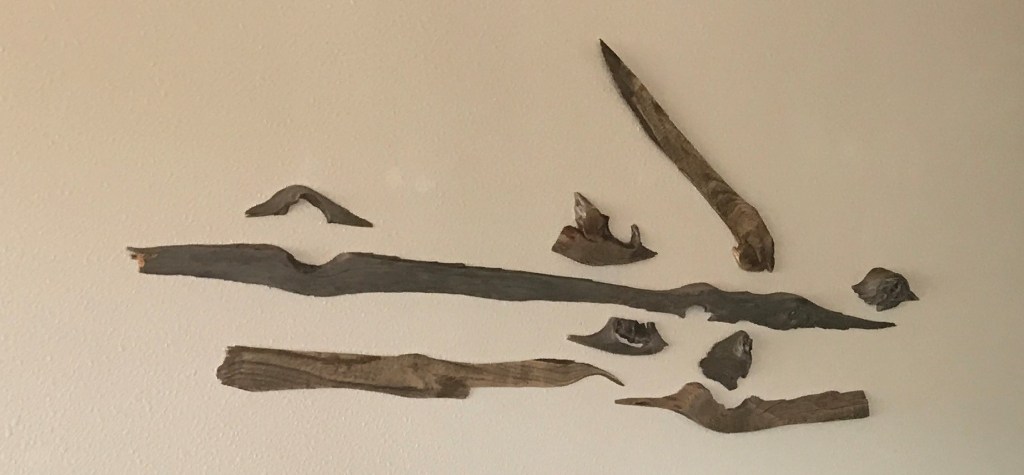
The long gray bird is back with her disconnected head and graceful wing. She defines space that would otherwise be undefined, and she does so without much deliberation. She could have easily been compost or firewood which would have been fine. But for now, she’s an expression of God and grace, small nails, and a blank wall.

Last night on the news, I saw a soldier in combat fatigues: helmet, rifle, boots. He was sitting vacant-faced on the steps of a bombed-out building, the dark child beside him barely clad. Neither of them will ever find their way to my easy world. In fact, they may not even make it home.

I sleep, and in my dream, I welcome them. They are God. To the Soldier I say, “God, darling. You are beautiful and deadly. I wish you were obsolete.” To the Child I say, “Get up and run. It’s not safe here.” The Soldier looks me in the eye and hands me his rifle. “You cannot define the space around me,” he says. “I have to do that myself.” He lifts the Child into his arms with a certain finality and cushions her head safe against his chest.

I don’t know where they’re going or if they’ll return. I wave and try my best to smile, but the departure leaves me bereft, without purpose or direction.

“God,” I whisper, awake and facing morning, “You know I’d like to extend my reach; do things that make me feel important and complete. I’d like to turn the tide of hate into an ocean of love. I’d like to make the fear go away.”

The God of early morning is often soft, responsive to my naïve and narcissistic longings. She is patient. Unafraid. She knows that in any given moment, I could pull her off the wall, snap her neck, and put her in the woodstove, thus ending the torment of hope. She laughs like smoke. She is the residue of a well-lived life, the stubble in the field. She is sapling and ash, beginning and end, warrior and rose.

“I know,” the God of early morning whispers back. I hear the murmur of wings as the gray bird takes flight. “I am of your doing, and you of mine.” I nod, and again I wave and smile. But this time, no grief. I’m at peace with the leavings. Joyful, even. There is little doubt that in my next dream, I will learn to fly.

Joy

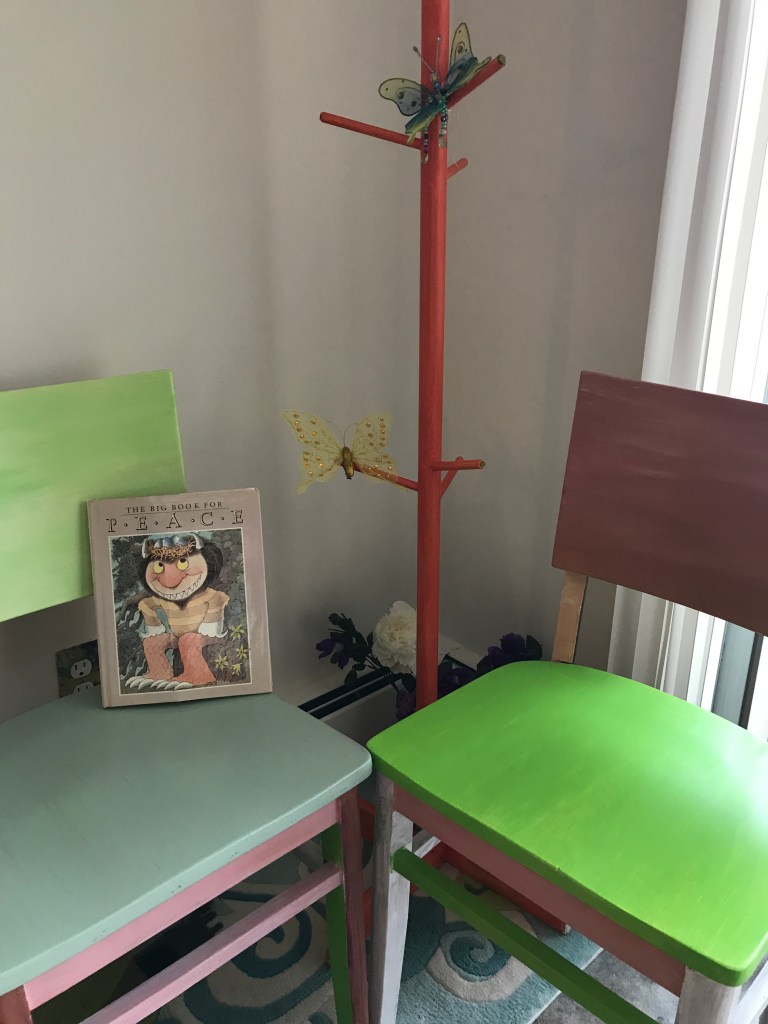
“Hey God,” I said as I stared at two chairs I plan to transform. “Is there joy in magenta?” God was stretched out on the couch, reading an old New Yorker. He lowered the magazine.

“Come again?” He made a point of looking at me attentively.

“Joy,” I said. “What is it?” For a simple, three-letter word, joy is surprisingly agile and elusive. Sometimes, I get a rush of joy from certain pigments. Other times, everything clashes. I give thanks for primer. New canvases. Old chairs. Starting over.

God raised himself to one elbow. He’s long and thin today. “Honey, fragments of joy are visitations–temporary indwellings. The chemicals involved for temporal beings like you aren’t stable. In fact, the physical and spiritual are dangerously reactive.”

I’ve never like chemistry. I’d rather consider joy outside the realm of chemicals. But God was insistent and maybe a little worried.

“Unstable. Check it out.” He laid back down and feigned rapt interest in reading. When he treats me like that, I know I’m supposed to carry on.

Fine. I looked it up: Something that is dangerously reactive is in constant danger of polymerization, condensation or decomposition. It can also become self-reactive when stressed or under pressure. I was starting to relate. Stay with me, fellow chemistry-avoiders. I’ll simplify.

Polymerization involves small molecules that join together and become BIG molecules, causing heat and pressure. Yes. Greed and light. This can be modulated by catalysts and initiators—I know plenty of interpersonal catalysts and initiators–but it can get out of control. Boom. No joy. Inhibitors can be useful, if properly managed. But they can malfunction. They’re supposed to slow or prevent unwanted reactions, but they decline in power over time. They need to be kept chilled. We get lazy. Things happen.

Condensation involves molecules that join together to make a new substance (sounds kind of sexy). Byproducts might include water or some other simple substance, but the energy produced is sometimes more than predicted—more than can be handled. There can be fire, or serious ruptures. Jealousy. Hatred. And yes, joy—but hoarded or gone wrong.

And then there’s decomposition—well known to all of us aging into simpler forms. Even decomposition can release hazardous amounts of energy. “Some pure materials are so chemically unstable that they vigorously decompose at room temperatures by themselves.” Scan your social connections. Rings true, especially this past year.

Self-reactivity is even more painful. Explosions can occur from even small tremors—an insult, a hammer blow, elevated demands. Destructive reactivity. No joy.

“Ok,” I said, “So it’s risky. I get it.” Then I began applying the magenta to the corners of an overworked canvas. “Let’s just see what happens.” And from the far end of ultraviolet, where things are no longer visible to the naked eye, God smiled and said, “Yes, let’s.”

Cerulean Blue

A while back, God asked to borrow a few tubes of my acrylic paint. How could I say no? I have an abundance of paint. He took the most exotic colors and has yet to return them. This morning, I’m working up my courage to demand that he either order replacements or return my paints. There was a tube of cerulean blue that I always used sparingly because of the magic it could evoke. I can’t say for certain but knowing that tube is missing may be the reason I’ve not touched my paints for months. So, I’m sitting here, waiting for God, planning how I’ll broach the subject.

“Just broach it already,” God says from the darkest corner in the room. I can barely see him, but he sounds present and impatient.

“Well, that cerulean blue was my favorite,” I say, equally present and impatient. “I think you knew that when you took off with it.” I’m standing my ground. God’s got nothing on me this morning. The fires are raging, the air is dense, and as usual, I’m predicting a bitter end to humanity.

The room goes blue. The bluest blue. The blue of perfect sky, calm ocean, deep lake. So blue I can taste it; I can hear it. I can feel it sinking in. My wayward hands and desolate heart are blue. My smirky face is blue. The insides of my eyelids are blue, and the claw marks I’ve made trying to escape are blue. Everything is exceedingly, abundantly blue.

“Enough?” he asks, grinning. His teeth and saliva are a dazzling blue.

Transformed, absorbed, I run with blue legs into the blue universe and throw my arms around a miraculous blue marble floating in blue nothingness. I am renewed. I will paint until my fingers fall off. I will paint with my body, my hammer, my shoes, every ounce of me. I will fling color around like confetti, and it will be God. Layers and layers of God. It will always be God.

“I still see you,” I tell God as he slowly removes himself from visibility. “I see you just fine. And I hear you humming blue. And I taste you in this beer. And I know you aren’t going anywhere. And I’m happy. But could you give me back that paint you borrowed? Please?”

“Sure,” the Blue murmurs. He hands me a bag of paints with more colors than I’ve ever seen. “Break a leg,” he says.

“Oh, good grief,” I say. “That’s what you say to an actor about to go onstage.”

“Right,” God says, hitting himself on the side of his blue, blue head. “I knew that.” But it wasn’t a mistake. God always means what he says. When God encounters headstrong humans, he often wrestles with them. They don’t come away destroyed, but they definitely limp. With these colors, I will not come out unscathed. Or even alive. But I’m okay with that. I’m going to paint anyway.