Hearts on Fire

When your heart is on fire smoke gets in your eyes

Death rolls in, a thousand acres, flaming,
thick smoke drifting south.
We are blinded by the slow burn of a million lies.
Nothing trickles down.

The poor belong among us.

And we are among ourselves on a finite planet
on an infinite journey with a wee small chance
of getting it right.
Love is right. Violence is not.

The greater good is an apple tree the voles left alone
because we pulled the mulch away from the trunk.
Sometimes, winter should not be diminished.

What comes to everyone over time
are thirteen birds, four horsemen,
and an appetite for sweets and salt.
The indulgences and the seven deadly sins
are always calling. Try not to answer.

Stare down, instead
and watch where you place each foot.
Wish each other well.
We are stardust and ashes,
and we neither live nor die
without fire.

Friendly Fire

Each moment is a drink of water,
a green ball bouncing down
the gravel road, a quandary as simple

as kindness, the idea of more stars.
There’s nothing to fear
but the snapping of branches in the wind.

To live as a split infinitive is a sign of courage,
a matter of style. Nothing is absolute.
To live now, half-formed,

circling like a sharp-eyed hawk
is to accept an unnamed infinity
and a sense of chronic dislocation.

We are pages in a book of promises,
lies that come true, wishes that don’t,
dawns that arrive, nights that fall.

Give me your time. I’ll give you mine.
After the danger of frost has passed
we’ll plant tomatoes and roses and basil

and go through the motions of poetry.
As the meaning soaks in we will succumb
to the vast and friendly fires of the sun.

Tallies

How many pots have you scorched in pursuit 
of the good life, warm soup, or steamed greens?
No worries. You’re often distracted by sparkling words.

How many scrapes and bruises have you endured
because of hasty departures or overpacked plans? No sweat.
You thought you could cut corners that cannot be cut.

Is your fastidious loading of the dishwasher
a point of pride or a place to hide
because the terrain of shame is so steep?

You polish your resentments like silver. This isn't wise.
Pack them up and drag them to town. Melt them down.
The Blacksmith turns everything into serving bowls.

Conjure up some joy. Old is inescapable.
Young is no one’s fault. Apologize when you recognize
that your memories are wrong. Gently move along.

How many times must you be reminded
that only love is worth the extra weight?
One more time, you plead. One more time.

But what is love? A tally that tips the scales?
Count the stars in the heavens, the hairs on your head.
Map the terrain of your body. Make a schema of your heart,

and when your beleaguered soul demands a list
of what you’ve done that matters,
give it a cup of something warm and curl up for a nap.


The Sugar’s at the Bottom

Sometimes, you have to grit your mental teeth and force the images to land so you can pull them apart. The world is a damaged ship, listing dangerously starboard. Your longing to prove or fix something scratches like a cat on the screen that protects your soul, and your selfish nature hides in the weeds, rusting and jagged–a trip hazard and destroyer of lawnmower blades.

“Morning,” your Coauthor mumbles in a sleepy voice.

“Coffee?” you offer, calm on the surface, agitated inside.

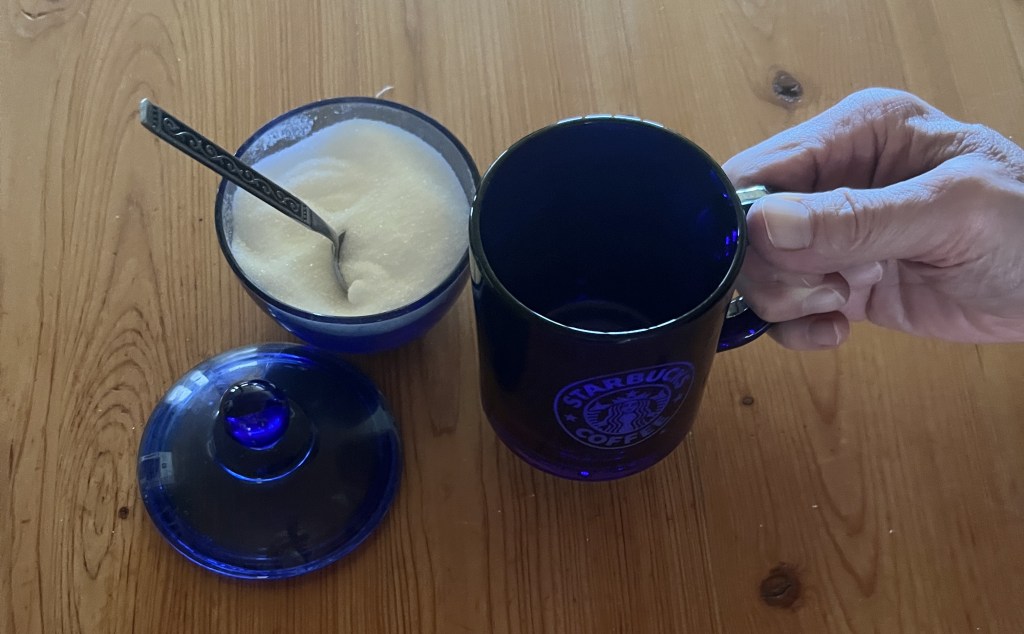
Coauthor nods, reaching for the sugar.

“What do you have in mind for today?” you ask.

“The usual,” Coauthor shrugs.

“But I don’t feel like being generous,” you say. “Or patient. Or kind.”

“How’s the joint pain?” Coauthor asks.

“Tolerable,” you frown. “How’s yours?”

“I’m always inflamed,” Coauthor admits. “And for that, I’m grateful.”

Usually, your Coauthor is clear-eyed about ailments, victories, ice cream, and the dying coral reefs. There are costs for doing business with fickle microbes and solar storms. That which can be altered is miniscule, and even if done well, evolution will occasionally circle back and bite you in the butt. That’s why most Coauthors look so chewed up most of the time. Chewed up, surly, and weary. Okay, maybe not surly. That’s more you. But weary and wounded. That’s for sure.

Your Chewed-up Chum checks the weather. Rain. Flood warnings. Wind. But later, things will clear, and there will be a deep peace that passes all understanding–which is a good thing because your current understanding is so slow that a tired donkey pulling an overfilled cart could easily pass it by. There’s nothing poetic about bombed-out homes, repeated migrations, or starvation. Nothing. Maybe you could approach the devastation symbolically, but that might make it harder. You simply don’t know.

“Understanding is essential and impossible,” Coauthor says. “The you that you think of as you can grasp only fractions of the puzzle. The complexity is beyond your fleeting singularity. Just find a corner piece and hang on.”

“What does a corner piece look like?” you ask, feigning innocence.

“Oh, you know. It’s rounded on the edges. The nobs point inward,” Coauthor grins enigmatically.

You rub your rounded belly and consider the risks of real, expansive connections. In the past, you’ve tried to force puzzle pieces to fit. Bad idea. You limp away, limp back, limp away. Each time your view expands, your energy diminishes.

“The capacity for compassion depends on being broken. Sometimes, more than once,” your Coauthor says in a matter-of-fact tone.

“Stir your coffee,” you sigh. “The sugar’s sunk to the bottom.”

“Thanks,” Coauthor says. “But I like it that way.”

Oh, Baby

This is the narrowest time. Night has loosened its grip, and old wine is poured out as libation to the rising sun. My head slumps to my chest, and my shoulders curl inward to make the passage less painful. Less prolonged. To the east, a thin blaze of orange takes hold. With kindling gleaned from around the chopping block, I light a fire so I can immerse my hands in the warm liquid of another day.

“What sayest thou?” I ask the newly arrived Sandhill cranes.

“What thinkest thou?” I ask the rising river.

The answers come on the in-breath and dissipate before I can inscribe an adequate translation. I will have to ask again and try to be worthy of the answers.

My inner audience isn’t kind. The promise of spring is shrouded in snow, and for some reason, the fire is burning more reluctantly than usual. I suspect it’s the blessing and curse of the thick bark still clinging to these beautifully split logs.

Before I slept last night, someone told me they loved me, and someone told me they hated me. The raucous rise of the north wind relieved the barometric pressure of leftover miles. There was just enough time to make a cursory inspection of my seashells, sticks, and rocks before the paralysis set in. Even then, I had to lean into God to make it to the safety of my flannel sheets.

Now, alert and alive, we are filled with equal amounts of dread and joy.

“Oh, baby,” God sighs. “Oh, baby.”

“Oh, God,” I say, pushing back a little. “Oh, God.” I look into myself as far as I can. “I wish you wouldn’t sigh at me. Go sigh at someone else.”

This elicits a smile. We sip coffee, eat toast, and raise our glasses to the trains arriving, the trains departing, journeys beginning, journeys ending. These simple routines grease the wheels, and we’re off.

Who can guess the length of their days? Who can predict the hard hatreds and easy loves? No one knows their own soul very well, let alone the redemptive mind of God at rest in the protective bark of scorched and fallen trees. We cannot be expected to do any better than we can.

“Oh, baby,” The Cosmic Drama Queen sighs again, so inclusive, so determined. Her obsidian eyes are sparkling, her broad shoulders squared. “Oh, baby.”

Planned Obsolescence

Did you know that if you push a straight edge up the outside of your apparently empty tube of toothpaste, at least a week’s worth will squish to the top? And if you cut the tube open and flay it, you’ll find even more of the goo clinging to the inside.

Labeling and packaging practices are fraught with waste, lack of imagination, and greed, often making it difficult to use up the entire contents of whatever it is you’ve purchased. And don’t get me started on single-use plastics, false recycling guarantees, and planned obsolescence.

Even well-intended containment is tricky. For instance, my own packaging has become increasingly prone to leaking, bruising, and breaking. My container has been taped up, repainted, and artificially preserved for a while now. Clearly, it’s not going to last until everything I have to offer is entirely used up.

As I struggle with this unpleasant reality, a primal protest grips me.

“Hey, Universe!” I yell. “When we age out, do our unused talents and potentialities end up in the Great Landfill of the Afterlife? Do you reabsorb our unwritten masterpieces? Our unsung songs? Hard-earned but unheeded advice? Unturned stones and dormant acts of kindness? How about the promises we meant to keep? Do you even have a plan for this obsolescence?”

God’s enormous head lifts from its heavenly repose in the sky beyond sky, and the Gaze comes to rest on the tiny speck that is our planet, that is my naked eye, that is a bioluminescent Whisper in the amniotic fluids covering the earth.

“You are not the sum of your talents, failures, passions, or fears,” the Whisper murmurs as the tide rolls in. “You’re the question, not the answer. You’re the journey, not the miles. You’re evolution’s hitchhiker, the plot of my favorite fantasy, and a transitory fraction in the equation you call eternity.”

This ethereal, evasive answer infuriates me. I want my untapped potential to guarantee longevity if not immortality. Like the spiritual toddler that I am, I throw my temporary container to the ground and beat my knobby fists against the pain of consciousness, empathy, imperfection, erosion, imagined glories, and old dogs.

The earth receives my rage and offers joy. Its undulating tenderness envelops me.

I roll onto my back and stare at the sky gathering itself into another night. The massive head of God explodes into trillions of stars, galaxies expanding, defying entropy and all attempts to limit or restrain.

Every boundary eventually gives way. Every horizon is a curvature forward. And we are all, together and forever, the trajectory of a certain hope and the substance of things not seen.

Missive from the Beautiful, Horrible Moment

Every morning I sit in the warm, chunky soup of God, my attention split between robins in the garden, clouds on the move, and my fingers poised above the keyboard. God appreciates the opportunity to clown around, but sometimes they take it too far, and I feel left out.

I want God to notice me. I eat dandelions. I pull clumps of quack grass, pretending there’s a chance to eradicate this long-rooted invader. Quack grass is also known as twitch, quick grass, quitch grass, scutch, dog grass and witchgrass. My own pet name for it is Satan. On more generous mornings, I allow for the possibility that it has redemptive features. Not today.

“How about we all float on our backs?” God suggests, flailing happily in the womblike liquid of themselves, ignoring boundaries such as time and space.

I shake my head. The steady pressure of God is eroding my body. The Ever-Presence is a weighted blanket, a hazmat suit, an open invitation to find peace in what is true. I am not a maker of stars, but I am my own tornado. While I’m still able, I will continue spinning through the garden, yanking quack grass to kingdom come.

All the faces of God smile. “Look!” they say. The arms of God bend, fingers pointing every possible direction. I have no idea where to look.

“You’re too inclusive. Too amped. Could we bring it down a notch?” I ask petulantly.

The many fists of God punch the air, and their faces melt like candles into a singular pool where I see my singular reflection and consider my singular fate. The robins appear to be flirting, ready to mate. The aroma of God is intoxicating, but even so, my stiff hands won’t curl around the quack grass anymore.

My friends and family are floating on nearby rivers, hiking their own circuitous trails, and I wish them well. I wish myself well. I wish God well—the Unitary, the Complex, the Galactic–all of them.

“Thank you,” they say harmonically.

“You’re welcome,” I say automatically.

“That’s unlikely,” they laugh. “Our welcome is usually, um, shall we say overstated?”

I nod. “Well, you’re more welcome than quack grass.”

They grin, poking each other in the side. “Score! We’re more welcome than quack grass.”

I realize God is making fun of me, so I issue a slight retraction. “Actually, that’s not entirely true. Depends on the day.”

The Perfect Couch

I’ve searched for the perfect couch for a large portion of my adult life. I maintain a steady presence on the internet marketplaces and frequent the thrift shops scattered across the three states we travel the most. My couch karma is pathetic. Once, I broke my vow to only buy used items and bought a new one. That didn’t work out either.

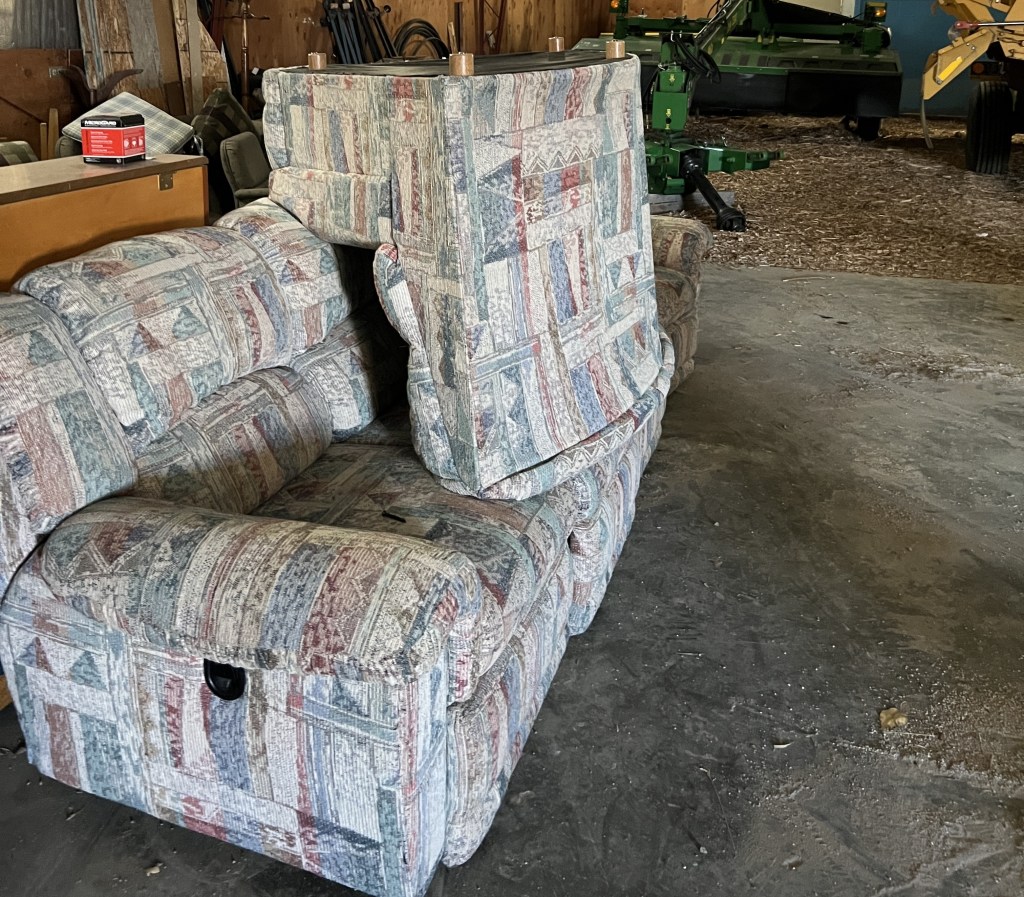
Over the years, God has cheerfully sat on each of them except for the small sectional coated with multiple layers of nearly invisible cat hair. That one didn’t even make it into the living room. Too bad. It would have matched the nostalgic recliner I’m usually sitting in this time of day. If any cat people are interested, the sectional is piled in the barn. Blue geometric design. Can’t miss it.

“You’re funny,” God says, lowering himself into the sagging cushions of my most recent attempt.

“I know,” I reply, proud but sad. My mom would have turned eighty-nine today. I didn’t engage in any “Happy Birthday in Heaven” posts, but I’ve sent my regards to wherever the essence of mothers goes.

Generally, my mom did not like secondhand furniture, but she loved this little recliner that last year because she could put the footrest up and down on her own. Limits and needs humiliated her. She would have starved rather than ask someone to cut up her meat. I can relate.

It is one of life’s ironies that if we live long enough, we come to understand the disappointments, fears, and irritating quirks of our elders from the inside out.

“No, no. That’s not irony,” God says. “That’s mercy.”

“I don’t think so,” I say. “It feels vindictive. It makes me wish I’d been nicer and tried harder to understand.”

“No amount of niceness takes mortality away. You were nice enough.”

“I’m not so sure.”

“Trust me,” God says, “You were nice enough.” Then he adds, “Say, I didn’t sleep well last night. Mind if I take a little rest?”

He yawns, snaps the wobbly footrest up, settles back, and is soon snoring peacefully. I watch his chest rise and fall while George Winston plays melancholy piano in the background. Such short lives. Such very short lives.

I guess maybe it is mercy, I think. Better to understand later than never. A rush of adoration washes over me. I lower my own footrest quietly to tuck a turquoise blanket around the vast arthritic feet of my friend, the patient creator, the weary one, snoozing on my latest bad couch.

What Condition My Condition Is In

A moment or two ago, I was hunkered down in an old Chevy van with two women I admired but didn’t know well. We were finessing undercover maneuvers to abolish some unfair hiring practices. And in the fragile and fractional ways of justice, we succeeded. I didn’t know it at the time, but they were God.

Faith was the slender, quiet one. A shaman. With the help of heavenly beings, she planned her own starvation and left for higher ground. Grace was outspoken. Irrepressible. She had a breast removed as a token of her love. “Statistically, I’m stepping up so seven other women don’t have to do this,” she joked, framing it as a willing sacrifice rather than a curse. These are the ways of the cross as I understand it.

But there is so little I understand.

The drivers of the machines of destruction let their engines idle when they’re not full throttle. I despise this ignorant, highly polluting practice. They are overweight and complacent; their masters are neither. Humans now move more carbon each year than Nature, even when earthquakes and floods are factored in.

Game on, humans. I think to myself as if I were God. You won’t win this one.

“Excuse me.” God emerges from the paralyzing fog of nostalgia and dismay, eyebrows knit downward. “I’d like a word with you, young lady.” Looks like he’s going to grab my arm and drag me somewhere out of sight for a scolding.

“Well, I’d like a word with you, too,” I answer, knitting my eyebrows to match his.

“Word,” he says.

“Word,” I answer.

We laugh.

Fed by riotous tributaries of living words, the clear lake of infinity pools up at my feet. I strip off armor, shelter, clothing, and body; I shed ideas, hopes, fears, longings, and memories. I dip everything in the sacred water, hang it all up to dry, and jump in.

 But I’m cold and uncertain. I have no idea if I should try to swim in my condition.

“And what condition might that be?” God asks, floating by on his back. For some reason, this makes me think of Kenny Rogers and the First Edition.

“Decrepit,” I say. I had been filled with self-pity, but something about that song makes me smile. God shakes his head and points at the shoreline where there are rows and rows of old Chevy vans. And so many smiling people.