Guests

Upstream from us, there’s an old guy who’s been known to shoot off his rifle when rafters float by. I don’t do that. But it does throw me off when God lands on our sandy bank and strides to the house, excessively tattooed, dreadlocks flowing, a nearly naked wife and a gaggle of chattering children trailing behind. My compassion wriggles away like a garter snake in tall grass. I am wary and antagonistic. God is far less challenging as a superhero or a ray of light.

I rally and force myself to be nice to this God of awful multiplicities and entitled bearing. It’s a shallow nice, verging on phony. This is God the Other. No wonder humans so readily fear and hate The Other.

“Welcome,” I say, half-heartedly. “Would you all like something to drink?”

“Sure. Sweet tea if you have it,” God says. “Nice place you got here.”

My suspicions flare. Are they casing the joint? Am I under surveillance? Will my hospitality be repaid by something nefarious, manipulative, or even deadly? Will I be poisoned?

“Oh, you’ve already been poisoned,” God chuckles.

“Snack?” I say, offering a tray of fresh vegetables with hummus. Snap peas, green peppers, and little carrots.

The children make gagging noises and demand bacon. I hate the smell of bacon, and God knows this. They open the fridge and stare. I don’t like the door open. I don’t like my leftovers being examined.

God runs the hot water too long, pees in the garden, and dominates the conversation. There are wet socks everywhere.

As I make lunch for them, they mention taking a little siesta.

“It isn’t even noon,” I protest.

“Yeah, but it’s so hot. We’re tired. Could you unload the raft while we put our feet up for a spell?”

Unload the raft? My heart sinks. God appears to be moving in. I have no space for this. No bandwidth. There’s not a charitable thought in my head.

A gentle breeze cools the heat of my rapid-fire fears and defenses. It’s God.

“Center,” she whispers. “Deep breath. You can do this.”

“I know,” I hiss back. “But why, God? Why?”

“Practice,” God grins. “Do you think we enjoy being so unsettling? You’re our neighbor, honey. We love you. We do this for you.”

“Gee, thanks,” I say.

“You’re welcome,” God says. The entire Collective grabs the plate of cookies. Crumbs fly as they gobble more than their share. Then they curl innocent and nap like cats in the sun.

The crumbs are holy, I remind myself, sweeping the kitchen, surprisingly calm. The crumbs are holy, and I am loved.

Ice Cold Beer

My enlightenment began decades ago at the Yellowstone County Fair. Until that moment, I thought beer to be of questionable value when compared to Pepsi or Strawberry Fanta. But in the sweltering heat, someone handed me a red plastic cup filled with ice cold beer, I drank, and it was heavenly. No sticky sweetness. Just icy liquid bringing swift existential relief to my parched throat and weary soul. I finally understood the goodness of beer.

But the next time I took a big swig of one of the popular yellow brands, I nearly gagged. The evening was chilly, the campfire smoky, and the beer lukewarm. Ah ha, I thought to myself, sidling away from the keg. Nothing is good in and of itself. It is all relative.

And thus, for a moment, I was enlightened.

Or at least, that’s how I remember it. But now, I’m not so sure.

God clears their throat in the back of my mind. I open it, and they drift into the room like pollen, like music, like a fine piece of evocative art.

“Hello,” I say.

“Hello,” God says.

“How are ya?” I ask.

“Fine, thanks. Yourself?”

“Can’t complain,” I say.

That’s a lie. I can complain, and sometimes, I complain vehemently. But God knows everything, so it hardly seems like lying when I lie to God. Besides, I know God isn’t fine, so we’ve just engaged in a mutual lying ritual common to my culture. God’s not fine. I’m not fine. But who has time to listen to the truth of our miseries?

“They aren’t miseries,” God says.

“I beg to differ,” I say. “But misery shared is misery halved, so let’s share.”

“Cute,” God says. “And joy shared is joy multiplied, so let’s go turn some stones and see if we find a speck of joy.”

“It’s too hot out there,” I protest.

“C’mon. We’ll take some cold, dark beer,” God insists.

“Okay, fine,” I sigh. Then add sarcastically, “For you, Creator Darling, anything.”

“That’s the spirit!” God exclaims. “Same here.”

“I call bullshit,” I say.

“We do, too,” God says.  

And we laugh all the way to the river. There we leave most stones unturned, admire the speed and variety of spiders, and along with our beer, sip the bitter truth of fresh, clear water slipping without protest to the salty sea.

And for a moment, I am enlightened again.

Missive from the Beautiful, Horrible Moment

Every morning I sit in the warm, chunky soup of God, my attention split between robins in the garden, clouds on the move, and my fingers poised above the keyboard. God appreciates the opportunity to clown around, but sometimes they take it too far, and I feel left out.

I want God to notice me. I eat dandelions. I pull clumps of quack grass, pretending there’s a chance to eradicate this long-rooted invader. Quack grass is also known as twitch, quick grass, quitch grass, scutch, dog grass and witchgrass. My own pet name for it is Satan. On more generous mornings, I allow for the possibility that it has redemptive features. Not today.

“How about we all float on our backs?” God suggests, flailing happily in the womblike liquid of themselves, ignoring boundaries such as time and space.

I shake my head. The steady pressure of God is eroding my body. The Ever-Presence is a weighted blanket, a hazmat suit, an open invitation to find peace in what is true. I am not a maker of stars, but I am my own tornado. While I’m still able, I will continue spinning through the garden, yanking quack grass to kingdom come.

All the faces of God smile. “Look!” they say. The arms of God bend, fingers pointing every possible direction. I have no idea where to look.

“You’re too inclusive. Too amped. Could we bring it down a notch?” I ask petulantly.

The many fists of God punch the air, and their faces melt like candles into a singular pool where I see my singular reflection and consider my singular fate. The robins appear to be flirting, ready to mate. The aroma of God is intoxicating, but even so, my stiff hands won’t curl around the quack grass anymore.

My friends and family are floating on nearby rivers, hiking their own circuitous trails, and I wish them well. I wish myself well. I wish God well—the Unitary, the Complex, the Galactic–all of them.

“Thank you,” they say harmonically.

“You’re welcome,” I say automatically.

“That’s unlikely,” they laugh. “Our welcome is usually, um, shall we say overstated?”

I nod. “Well, you’re more welcome than quack grass.”

They grin, poking each other in the side. “Score! We’re more welcome than quack grass.”

I realize God is making fun of me, so I issue a slight retraction. “Actually, that’s not entirely true. Depends on the day.”

The End is Always Nigh

Once upon a time, I took comfort in this bit from Ecclesiastes: Generations come and generations go, but the earth remains forever. The sun rises and the sun sets, and hurries back to where it rises… Of course, I now realize the earth will not remain forever. It depends on asteroids, nuclear bombs, and cosmic waste. Forever isn’t an option.

For every goddamn action, there’s an equal and opposite reaction. I realize that attempting to inhabit impermanence is oxymoronic. But I can’t stop myself.

Mounted on a skittery horse, I navigate the slippery slopes of transience with a rope in my teeth trying to lasso the good moments and make them last. If my attention snaps the wrong direction, I could find myself swinging from the saddle horn. Depending on how badly this spooks the horse, my chances of climbing back on would be slim to none.

“Your metaphors aren’t working for me,” God says. “You don’t even like rodeos.”

I shrug and grin. “True. But you know what I like even less than rodeos?”

“I imagine I do since I’m God.”

Undaunted by the sarcasm, I continue. “I don’t like death or uncertainty or good things ending or rotten things continuing ad nauseum.”

“Well, blow me over with a feather,” God says.

“And I don’t like suffering or feeling inadequate. I don’t like making decisions or wasting time. I don’t like diseases or injuries, aging, accidents, robberies, lies, cruel jokes, or greasy food. I don’t like mediocrity, bullies, or vicious dogs.”

“Good to know,” God says, peering down at me. Like a hog rooting for grubs it seems I’ve dug myself a surprisingly deep hole. It’s easy to do in the spring mud.

 “So hey, could you use a hand?” God asks.

This strikes me as condescending. I’ll climb out on my own when I’m good and ready.

In a mocking voice, I answer, “So hey, instead of you dragging me up, how about I make room for you to come down?”

“Sure,” God says, handing me a shovel. “I’ll get my boots. Want me to bring anything else?”

“Water,” I say, but I immediately regret it. God’s up to something.

Sure enough, the flood begins. The shovel becomes a floatation device. I’m lifted from the grave I was digging, and I kick myself to shore.

The water recedes. The sun shines.

“Still early,” God observes, squinting at the horizon. “Might be a good day to start some seedlings on the porch.”

“But I don’t even know if I’ll be around to harvest,” I pout, hoping for a guarantee.

“Doesn’t matter,” God says. “Plant.”

Why Do I Have This Heart?

When I have time on my hands, I try to squeeze the moments into a softball-sized orb but like particles of sand, the individual instances won’t stick together. Eternity may be circular, but apparently, my life is not. It’s entirely up to me how to use my time, but it won’t roll up like a river rock or a bowling ball, I can’t hold on to it, and it won’t come by again. This adds an unwelcome gravity to my choices.

Volition is a terrible curse. It’s right up there with self-awareness, God, and the nutritional labels on packaged foods. Humans have debated the correct basis for making the right choices for as long as they could articulate the question.

“But can you articulate the question even now?” asks the Issuer of All Questions as he stomps snow off his boots and sniffs the air.

To my chagrin, my hands smell like liquid nails, creosote, and chlorine—all toxic. There are plastic containers and dried brushes on my counter. I’m doing laundry with warm water and fabric softener, eating chocolate laced with lead. I designed our house to let the sun warm it, but there are days when the sun doesn’t shine. My carbon footprint remains larger than my feet.

“Probably not,” I admit. “But I ask a lot of questions. That’s safer than locking down on one anyway, right?” I’m trying to shelve the chronic shame I feel for various shortcomings and hypocrisies. “

“I hate to say this, little buddy, but that sounds like rationalization,” the Issuer says. This could come across as judgmental, but I know him better than that. He’s just trying to help.

“Of course it is,” I admit. “But then, why do I have this brain?

The Issuer smiles. Wrinkles upon wrinkles define and deepen the beauty I’ve come to expect from that weathered face.

“That’s a fair question,” he says gently. “But here’s a better one: Why do you have that heart?”

Existential Angst

The explanation could be as simple as caffeine. Or scoldings by Ms. Manners. Or a niggling Jiminy Cricket on my shoulder whispering reminders of my failings and violations of the common good. I don’t know, but I can’t seem to get rid of the angst and sense of urgency that rob me of the peaceful existence I deserve. Something or someone is out to get me. I share the paranoia of my era. The exaggerated, anxiety-producing avoidance of death.

My father died nine days short of my 20th birthday. He exited life as I was exiting the teens. He was 44. Somehow, my grief-demolished mother hosted a random set of grandparents for a bleak commemoration of the day I was born. She made roast beef, potatoes, and a cake. It was a dark, dark birthday. I don’t know how we managed to swallow.

“But you did,” God says, joining me gently as I sit with memories flooding by on either side. “Your mother was as brave as anyone I’ve known, but I had to attend that party disguised and uninvited. She was done with me, and I don’t blame her.”

“I didn’t even know you were there!” I exclaim. “I brought a different god. He spewed platitudes and mumbled lies about God’s will and imminent resurrections and such. It was awful. Why didn’t you shut him up?”

“All in good time,” God says, her eyes filling with tears. “I’m not apologizing or defending myself, but there are days I just cry my eyes out.”

I put my arms around God while she sobs as if the loss were yesterday. And for God, it was. And is. And ever shall be. I cannot think of what to do. We are all baffled kings composing hallelujahs. Overthrown by instinct and libido, lust and love. Endless birthing. Endless dying.

“I never intend to fool or frighten anyone,” she says, taking deep ragged breaths to calm herself.

“I know, Sweetheart,” I say. I run my fingers through her unruly hair. “But we judge and fool and frighten ourselves. We can’t help it. The contradictions and losses are too much.” God slowly slips out of my embrace. She moves to the outer edges of the known, opens her thousand wings, and disappears. Behind her the path is littered with breadcrumbs, a trail of her broken self. As I follow, all things extraneous fall away, and I am slightly less afraid.

Sphincters and Other Lesser Parts of the World

In the process of letting go (a euphemism for aging) I’ve grown more conversant with my inner workings. Organs, nerves, limbs, skin, circulatory systems, hairline–we’ve all befriended each other. For instance, on a recent road trip miles from anywhere, my bladder urged me to pull over. I squatted (a humble pose if there ever was one) and waved cheerfully at the driver of the pick-up that happened by. She waved back. A warm calm spread throughout my body as my bladder and I drove on home.

Some of us think of creation as parts of The Body. Others are more exclusive about who’s in and who’s out; what’s to be honored, who’s to be enslaved. These are ego-based pretendings, wrong-headed derivations. In the Oneness, every molecule has a voice. For instance, when stubbed, the oft-overlooked third toe suddenly takes center stage.

This is the kind of pondering that almost always guarantees a visit from God. Sure enough. She’s arrived on the west wind with a flood-inducing chinook on her tail.

“Why, hello there, God,” I say. “What a nice surprise. C’mon in.” My automatic hospitality reminds me of a poem my grandmother had on her kitchen wall:

            Guest, you are welcome here. Be at your ease.

            Get up when you’re ready. Go to bed when you please.

            We’re happy to share with you, such as we’ve got,

            The leaks in the roof and the soup in the pot.

            You don’t have to thank us or laugh at our jokes.

            Sit deep and come often. You’re one of the folks.

I memorized the rhyme, but I didn’t know what it meant to sit deep, and I didn’t like people partaking of my grandmother’s kindness. I wanted her all to myself. Now, I want God all to myself. I want singular adoration, endless comfort, and permission to be at my ease forever without the hassles of caring for others.

“Sorry,” God says. “Doesn’t work that way.” We gaze at the fire. She strokes her chin. “If you had a choice, which part of The Body would you be?”

I chew my thumb and think. Brain, eyes, ears all come to mind, but they’re too obvious. “Bladder,” I say. “I’d be the mop bucket.”

God laughs. “You know you’d have to cooperate with the sphincter, right?”

“Yeah,” I say. “I’ve known that for a very long time.” I raise my right hand. “I do hereby solemnly swear to love and honor the sphincters of the world. My own and others.”

I expect God to chuckle, but instead, I realize we are sitting deep; God and me. And I see that nothing functions without cooperation and mutual respect, internally or out there in the nasty, brutal, fractured Oneness we live within. I know I’m not alone, but sometimes I wish I were.

Shelter from the Storm

We are all a long way from home, dithering and dallying, trancelike automatons until something small or large loosens a stone in the foundation. Lost, but not completely lost. Found, but not yet found. Half-heartedly seeking what Bob Dylan called a lethal dose of salvation. Always a little messed up, though occasionally well-intended. For instance, I didn’t mean to leave the rice in the microwave overnight or the fish on the counter. I didn’t set out to drink all the cold brew and not start the next batch. But mea culpa—these are among my many thoughtless mistakes, and I hereby offer myself conditional forgiveness. I tell myself You’ve got to stay focused. And I add Straighten up and die right. Or is it lie right? Or fly right?

“I prefer fly right,” God says, settling in on the couch beside me. “And who put you in charge of forgiveness?

“Well, I’ve always assumed it was you,” I say, “And it’s a hell of a job.”

God smiles sympathetically and rifles through the mail, lists, receipts, masks, and rubber bands on the coffee table. I sit quietly, hoping for a bit of advice or assistance. My recent efforts to be more organized have fallen woefully short. The demons of distraction are delighted as I try various methods to get centered: Deep breathing (smoky air); beer (disorienting); garden (needs weeding, watering system not working); sticky notes (they lose their effectiveness when they’re everywhere). Lovingkindness meditation (too hard). I’m full of excuses and self-pity. There’s plenty of blame to go around.

“I wish I lived somewhere that forgiveness wasn’t even a necessary thing,” I say.

“Hmmm,” God says, absorbed in a sale flyer for energy-efficient window replacement. “I doubt it.”

And to top things off, the Text Predictions function in Word has suddenly turned itself on. I hate Word guessing at what I’m trying to say. I hate automatic updates. I hate passwords. I hate warring search engines. I hate smoky air, suicide bombers, drought, rice in the microwave, weeds in the garden, turkeys in the straw, refugees in the ocean, people willing to infect each other with viral hatred, flagrant ignorance, and this long and winding road that always leads me here. To the here and now of an ever-eroding present tense. I’m a child of the 60s.

That prophetic Beatles song locks down in my brain. “Don’t leave me waiting here,” I sing to God. I think I’m being funny, but God and I choke up. The Long and Winding Road was their last number-one single in the USA. So fitting. The unattainable. The end is the beginning, and the beginning is the end. The wandering is the journey. The trying is the failing. The failing reveals grace, and our last job is to die forgiven.

“I do know how hard it is, honey,” God says. I nod. We sit, staring out the recycled windows at the waning but beautiful garden.

Nothing to be Done

Sometimes I take God by the neck and shake him until he goes limp and falls like rain and dust and shards of stained glass at my feet—a deadly mix of elements within my power to restore but broken and unlikely. I walk away barefoot, continually astonished at the human propensity to self-destruct.

Usually, the high wind warnings are accurate. Anything of value or consequence must be weighted down or be lost. But somehow the birds stay light and navigate the currents of air with enviable grace. It’s easy to resort to anger. It’s tempting to bow down to lesser gods and find temporary nourishment by eating the tender parts of your own soul. Tempting, but not wise. This morning, I pause and chew my thumb nail instead. Penitent. Pensive. Wishing I had the patience of Job or the dark wings of Kali.

God assembles himself. I keep my hands in my lap. God swivels his hips. I nod noncommittally. God leans in and whispers, “I can tell you where the chickens are hiding their eggs.” He’s flirting. I resist.

“I can predict the next storm,” he says. I shrug.

“Hell, I can control the next storm,” he adds, trying to get a rise out of me. It works.

“Do you think I don’t know that?” I ask, exasperated. “Do you not understand how hard that is to hear? You can control a storm but not an army? You can make it rain, but things die of drought and starvation?”

When I’m like this, sometimes God gets irritable and defends himself, claiming to suffer along with everyone else. Sometimes, God gets all loving and huge and tries to instill hope. And sometimes, God just takes a single sip of my dark morning beer and waits.

And I wait. And the silence reminds me of wonder. And the slow-moving clouds remind me of water. And I remember the unusually fat worm I dug up yesterday. Of their own volition, my calloused hands come together in a kind of praise—a grudging acceptance of very thin skin.

There’s nothing to be done about God. Ground cover only lasts so long. Light breaks through. Dirt blows in. Rain eventually falls and the magical seeds sprout; rhizomes shoot along in the dark until they surface uninvited. The tenacity is a splendor and a curse.

“You remind me of quackgrass,” I tell God, breaking our shared revery.

“Funny,” God says. “I was thinking the same thing about you.”

What Makes God Sick

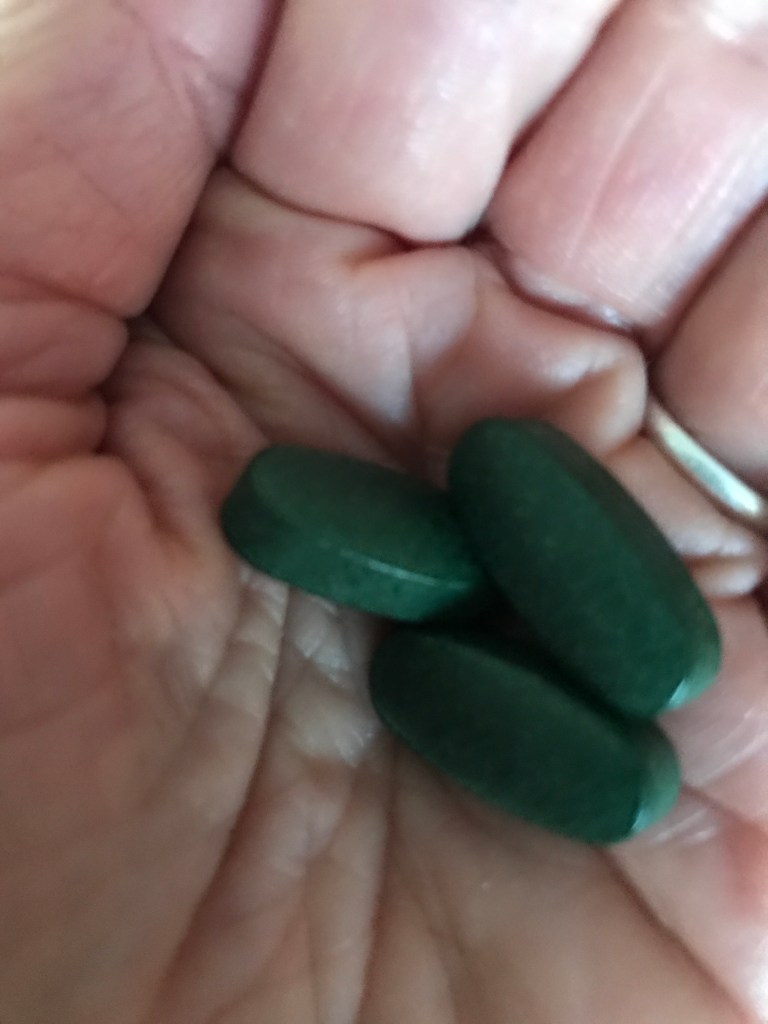
I sat down in my comfy place this morning to chat with God, but as we settled in, I noticed I’d left the kitchen lights on. I sighed, glanced at God, and went to turn them off. But before I got to the switch, there on the cluttered counter, I noticed the free sample of vitamins from my shopping trip yesterday, so I found the scissors, opened the packet, and spilled three extra-large tablets into my hand–dense, alfalfa green. The morning had been filled with horrifying images and tedious demands–and here were three ridiculously green promises of health and vitality. I laughed out loud, warmed some tea, brought the magic pills back to the couch, put my feet up on the big coffee table, turned to show God my stash…and of course, noticed the kitchen lights were still on.

I grimaced.

“What?” God asked, as I shook my head. I reached for a vitamin and swallowed it down, willing the vibrant green to restore my memory, increase my mindfulness, and make me whole, young, and beautiful. God chuckled, but she didn’t look well.

“I’ll take one of those,” God said, reaching toward me.

“Sorry,” I said. “I’m not sharing. They might be my last hope. Besides, you can just blink yourself to beauty and youth. You don’t need alfalfa.”

“True,” God said. “You’ve got a point, there. But you don’t need it either.”

I suspected I knew what God meant, but I didn’t ask. I focused on digesting the vitamin, trying to detach from the outcomes I long for; God focused on digesting whole galaxies of compost, broken people, collusion, trashed planets, and collateral damage—byproducts of wrongheaded consciousness, fear, arrogance, and hatred.

I looked straight at God. “How can you stand to eat that stuff?” I asked. “I mean, I’m grateful, but I worry there’ll come a day you can’t handle one more bite, and your body will explode, and that will be that. We’ll be bits of God-vomit on the cosmic wall.”

“Gross,” God said, making a classic adolescent face. “That’s disgusting.”

“I know,” I said, pleased with myself. It’s not easy to get God to make that face. To witness the Eternal Vulnerability openly expressed. Such moments are vast and holy. Hard to handle.

I don’t fall on my knees. I’ve tried that. It doesn’t work. Instead, I fall on my words, circling myself with images and explanations, searching for an elaborate way out. I finally fall silent, but not before I whisper, “You win.” I hand over the remaining vitamins, go back to the kitchen to get a cold cloth for God’s sweaty head, and this time, I turn out the lights.