Flags

As consciousness ascends
the grin of the devil lingers.
My down comforter and fluffy pillows
smell like smoke.

I had intended to repair the tattered flag in the corner
but I see now that it cloaks the evil twins:
Blind allegiance and false promises.
Riches are blinders, not blessings.

A small plane drones through the dawn’s early light
strewing herds of animals hither and yon
for the pleasure of predators at the top of the chain.

“This is better than husking corn,” one of them says.

The corpses sanctify the trampled sod, now saturated with blood.
The resulting meals may justify giving thanks
but the trophies are pure vanity.

War is the thing to prepare for,
bodies the thing required.

Not this pig,” wrote the poet
before passing to the place of all poems.
We nod to the sentiment, slicing ham
and chopping bacon bits for the salad.

Bless us, oh lord, and these thy gifts…
runs on automatic replay
as I watch people refuse to sign the petition
for reproductive rights.

I’m not fooled by false equivalencies. I sign.

To live is brief. To die is certain.
This lonely insight flays the rays of morning
into the arc of promised justice
I barely believe in anymore.

“Wake up, little one. You have Now,” the Rainbow says.
“And the gossamer of Indigo.”

“But Indigo has begun to unravel,” I protest.
“And I’ve lived too long as a parable to engage with Now.”

Silence.

I polish surfaces in the kitchen
hoping for an accurate reflection.
But the granite is forest green;
the dishwater, troubled; the beer, murky.

The Distortion laughing up at me is God.

“I hope you didn’t pull yourself together on my account,” I say.

“Of course I did,” the Distortion answers.
“No one can live on Indigo alone.”

The Sugar’s at the Bottom

Sometimes, you have to grit your mental teeth and force the images to land so you can pull them apart. The world is a damaged ship, listing dangerously starboard. Your longing to prove or fix something scratches like a cat on the screen that protects your soul, and your selfish nature hides in the weeds, rusting and jagged–a trip hazard and destroyer of lawnmower blades.

“Morning,” your Coauthor mumbles in a sleepy voice.

“Coffee?” you offer, calm on the surface, agitated inside.

Coauthor nods, reaching for the sugar.

“What do you have in mind for today?” you ask.

“The usual,” Coauthor shrugs.

“But I don’t feel like being generous,” you say. “Or patient. Or kind.”

“How’s the joint pain?” Coauthor asks.

“Tolerable,” you frown. “How’s yours?”

“I’m always inflamed,” Coauthor admits. “And for that, I’m grateful.”

Usually, your Coauthor is clear-eyed about ailments, victories, ice cream, and the dying coral reefs. There are costs for doing business with fickle microbes and solar storms. That which can be altered is miniscule, and even if done well, evolution will occasionally circle back and bite you in the butt. That’s why most Coauthors look so chewed up most of the time. Chewed up, surly, and weary. Okay, maybe not surly. That’s more you. But weary and wounded. That’s for sure.

Your Chewed-up Chum checks the weather. Rain. Flood warnings. Wind. But later, things will clear, and there will be a deep peace that passes all understanding–which is a good thing because your current understanding is so slow that a tired donkey pulling an overfilled cart could easily pass it by. There’s nothing poetic about bombed-out homes, repeated migrations, or starvation. Nothing. Maybe you could approach the devastation symbolically, but that might make it harder. You simply don’t know.

“Understanding is essential and impossible,” Coauthor says. “The you that you think of as you can grasp only fractions of the puzzle. The complexity is beyond your fleeting singularity. Just find a corner piece and hang on.”

“What does a corner piece look like?” you ask, feigning innocence.

“Oh, you know. It’s rounded on the edges. The nobs point inward,” Coauthor grins enigmatically.

You rub your rounded belly and consider the risks of real, expansive connections. In the past, you’ve tried to force puzzle pieces to fit. Bad idea. You limp away, limp back, limp away. Each time your view expands, your energy diminishes.

“The capacity for compassion depends on being broken. Sometimes, more than once,” your Coauthor says in a matter-of-fact tone.

“Stir your coffee,” you sigh. “The sugar’s sunk to the bottom.”

“Thanks,” Coauthor says. “But I like it that way.”

Misperceptions

Birds crash into our southern windows at (literally) breakneck speeds. A few die instantly. Some bounce and fly away, wobbly and mortally wounded. We’ve taken steps to mitigate these errors in bird judgment, but why, oh why does this happen in the first place?

“You can fool all of the people some of the time and some of the people all of the time. But you can’t fool all of the people all of the time,” Creator murmurs to herself, mesmerized by the old neckties fluttering outside our windows.

“Who said that?” I ask. “Abe Lincoln or P.T. Barnum?”

“Does it matter?  Birds get fooled. People get fooled. That’s a sad fact. Manipulating perception can be both profitable and fatal.”

“Profitable?” I asked.

“Duh,” Creator says. “Conspiracy theories sell guns. False claims sell addictive, brain-altering drugs. Naïve people, with inadequate media literacy, donate to malevolent causes or con artists. Birds swoop toward something they want, not realizing that the transparent barrier is a mirage of their desires.”

“I feel for the birds,” I say. “One time, I hit a side window so hard I fell to the floor in front of a restaurant full of people.”

“Did you blame the glass for being there? For being too clean?”

I grin a sheepish grin. “Nah,” I say. “But I wanted to.”

Creator smiles. “Well, well. There may be hope for humanity yet.”

“Oh, no you don’t,” I say, backing away. “Do not pin hope for humanity on me. Nope.”

“People have a tough time admitting their ignorance or misperceptions,” Creator continues, ignoring my disclaimer. “The evidence smacks them in the face, but they drum up far-fetched explanations and take another run. Even when they break their stiff necks, they blame the glass.”

My hand automatically goes to my neck, and I do some yoga stretches to keep it limber. Yes, I occasionally engage in denial and blame, but glass is glass. Doors are doors. Truth is truth. And one clear truth is that humans make mistakes.

“Course-corrections are possible,” Creator adds in a quiet, sad voice. “I realize humility is not a popular virtue, but you don’t have to keep flying into the glass.”

“Do you think the meek will actually inherit the earth?” I ask.

“I think so,” Creator answers. “But the steep cost of repairs will be as unnecessary as all those broken necks.”

Please Don’t Go

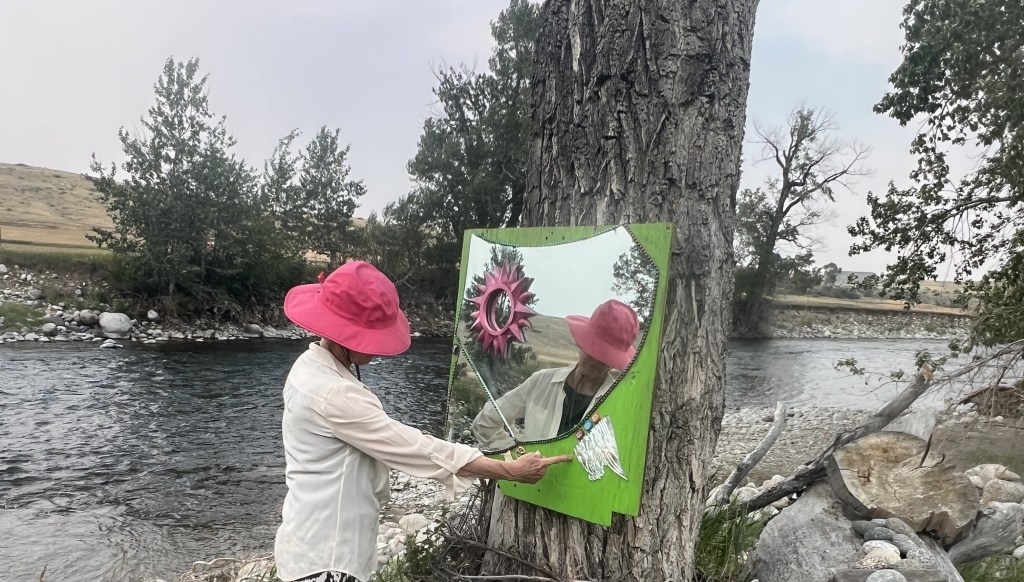
Here on the banks of the Stillwater River, it’s time to face another sweet goodbye. I’m sad. Life is a series of arrivals and departures. Even though some departures are temporary, I’m reminded of that old saying: You can never step in the same river twice. It may look and sound like the same river, offering familiar cool waters on a hot day. But don’t be fooled. Those waters are both ancient and new. They’ve been solid, liquid, and gas. They’ve been everywhere, and they will be back. They know you only in passing, and you know them not at all.

The root of the word stagnation is “standing water.” Generally, no one loves stagnation. It’s associated with nasty smells, writer’s block, mosquitoes, and economic slowdowns. But where would we be without stagnation? Growth for growth’s sake is a hallmark of cancer. Standing water is a temporary relief, a foreboding surface. When I lean over in the evening light, I see the outlines of the devil and the divine.

“So, I’m glacier, ocean, cloud, and cesspool,” the Divine says. “Ironic.”

“Ironic,” I agree. “I don’t like the status quo, and I don’t like change. I don’t like leaving and I don’t like staying.”

“Well, then, I’ve got some good news for you. I never leave and I never stay. At the galactic level, the more things change, the more they stay the same.”

“But I’m not currently galactic,” I remind the Unchanging Change. “And your cute colloquialisms are not helpful.”

“I love you more than your parents did,” The She of the Universe says. “I love you more than you love yourself. More than your partner, children, grandmother, chickens, or dogs.”

I do a doubletake. What brought this on? Was I asking for love?

“Don’t act so surprised,” The She smiles. “You’re always asking. And I understand. Relinquishing is not your forte. You need a lot of reassurance.”

Sometimes being known so definitively and casually makes me feel oppositional. Feisty.

“But what about that poster with the cat clinging to the screen door?” I argue. “The one that says Hang in there, baby?”

“Seriously? You want to live your life based on guidance from posters?” The She asks. “Besides, the cat doesn’t look all that happy, does it?”

“No,” I admit. “It looks frantic. But what’s the alternative?”

“Letting go, of course. Cats usually land gracefully on their paws. The problem is more about screens and tangled claws than a short, clean, fall.”

I withdraw my fingernails, drop into the arms of the waiting ground, and wave goodbye. I hope for many happy returns, but nothing is guaranteed.

Texture

Nine years ago, when the walls I’m staring at right now were taped, mudded, and painted, I was in the midst of chemo; my attention was limited, and my judgment fractured. I chose the texture of least resistance: orange peel. We ended up with a boring, slightly bumpy, ivory creaminess as far as the eye could see. I’ve since blued and purpled some rooms to break the grip of ivory, but undoing texture is a whole different matter.

Humans are a thin-skinned, acne-prone, melanoma-inclined, busted-nose species. We’re born smooth, but life has a way of texturizing and shaming, so we add layers. Leather and tatts. Silks and fine linen. We use fat wallets and fancy cars to distract.

“What about sanding?” asks the Creator of Walnut, the Weaver of Wool. “And there’s always acid, epoxy, varnish, and grinders.”

Even allegorically, this sounds painful. In the looking glass, I see that I’ve grown more textured than the last time I looked and not in ways I’d describe as appealing.

“Don’t be so judgy.” says the Big Eye in the Sky. “I’d go face to face with you any day.”

“Of course, you would,” I say. “And I’d be toast.”

“Toast is soft bread with a roughened exterior,” the Eternal Jokester counters. “Quick exposure to intense heat.”

My friend Scott rails about the energy required to make toast, but I like toast. I resist feeling guilty because I turn off lights like a religious zealot, hang my clothes to dry, and heat water on the wood stove. Shall I thus be held blameless for the fractured ozone? Mudslides? Fires? For a carbon footprint larger than my feet? Shall I be exonerated?

“Of course not,” the Balancing Beam assures me. “Exoneration is out of the question. But when your fault lines widen into fatal apertures, and your body rejoins the teaming earth, your consciousness will be windswept and shiny. Smooth as glass.”

“Gee, thanks,” I say. “That sounds just peachy. But in the meantime, I think I’ll get some Botox and touch up my hair.”

 “Oh, yes! And amass more riches and fame,” Pock-Face Crooked Arm grins.

“Easy peasy,” I say. “It’s all about appearances. And lying. The bigger, the smoother, the lie, the better.”

“I’m not sure where I went wrong,” The Truth admits. “But there’s hell to pay. The course corrections are going to be rugged.”

“But it will come out okay in the end, right?” I ask in a weak voice.

“You may have to define what you mean by the end, honey,” the Lover says, stroking my sagging cheek. “That word isn’t in my lexicon.”

Waiting for Asparagus

On my belly, eye-level with thistles, there’s no sign of asparagus emerging. But this will change as the days lengthen and the rains come. For decades, I’ve made compelling requests of this ancient asparagus patch, and it has done what it can to save me. This has less to do with faith than with remembering and waiting. There are forces at work; we are at their mercy.

Waiting for Bats

Some years ago, on Father’s Day, we hung a double-chamber bat house on the warm side of our home. So far, no bats have moved in. We had hoped that they would take up residence and eat mosquitoes. Instead, a pair of robins have built a nest on top of the box, and their droppings trail down the side of the darkly stained cedar.

Waiting for Redemption

An ominous enlightenment is stirring offstage. Twice, it has missed its cue. It is an enraged bull, pawing the ground, spewing snot and indignation. It is a rusting toy. It doesn’t like its assigned role. It wants to rewrite the script.

Waiting for the Answer

This morning, I texted The Gods three times, begging for alternatives, biting back tirades and justifications. Silence is the hardest answer to accept. I left an offering at the edge of a slash pile and imagined the thick smoke bellowing skyward, hiding their thin defenses.

Waiting for the Raucous Conclusion

There are animals, wild and otherwise, who will outlive me, but there are others who will not. In fact, I will eat some before this day is done. If I were a hunter, I would make sure I had a clean shot. Then I would give thanks, waving one hand over the lifeless body, raising the other in gratitude. Hand to mouth. Heart to ashes. Dust to dust.

Platitude Day

“I’ve still got it!” God exclaimed in a braggy voice. He stuck out his butt and raised his hands in a victory march around our uncomfortable orange couch.

“Still got what?” I steeled myself for a barrage of the absurd.

“Whatever it takes,” God answered.

“Oh, it’s Platitude Day,” I observed in a chilly voice.

“I don’t have to explain myself to you,” God said.

“And I don’t have to explain myself to you,” I retorted.

“That’s rich,” God laughed. “You can’t even explain yourself to yourself. Give it a try.

“Leave me alone,” I said.

“Never,” God said.

My eyes stung with absolutes and finalities. I didn’t want to cry, so I stared at the orange objects peppering my visual field. Then I moved to lime green. I took my pulse.

I wrote my funeral vows in the dirt with a long walking stick. One end had been whittled to a sharp point for balance and clarity. The other end was wrapped in rope for a better grip. It was a little tall for me. I shrink a bit every year and have to remember to downsize my expectations accordingly.

This passive acceptance caught God’s attention. “Outsourcing, not downsizing. Insourcing. Reverse osmosis. Whatever it takes.” He looked determined. “Too many killed waving white flags. Too many born to dead mothers. The holy will always be greater than the sum of its parts. You have less to remember than you assume.”

“You’re driving me insane. Please, please, please get out.” The tears spilled.

“There’s no out, baby,” the Insistent Presence whispered. “But then, there’s no in either. Go ahead and cry a little. I don’t mind.”

“DON’T MIND??” I yelled at the Organizing Principles of the Universe. “YOU DON’T MIND?” How could God not mind? I dried my eyes and took a breath. Two breaths. Counted to ten. I straightened my spine, got my hammer, put my shoulder to the wheel, and twirled my lariat overhead.

“Hold my beer,” I shouted. “I’ve still got it, too. You want a piece of me?”

“You’re right,” God chuckled. “It is definitely Platitude Day.”

He drank my beer. I painted him orange. We confessed our sins and rejoiced in small victories. We took tall orders and gathered no moss as we rolled downhill. We sat tight, broke a leg, and let it all go.

The Presence met the sick and dying at the door. I sang to them. And at the end of the day, in a mind-bending way, it all mattered just enough to matter.

“Would you like me to go now?” God asked.

“Sure,” I said. “But I’m going with you.”

Formatting

Phote Credit: Theresa Vandersnick Burkhart

“If you wanted to write a bible or some holy essays or something, would you use Word?” I asked the Source. “Would you store documents in the Cloud? Post directly to Facebook? TikTok?” My tone was edgy. Yesterday, I’d lost most of my skirmishes with technology.

God’s eyebrows arched quizzically. I waited in comfortable silence, enjoying the sensuous twist of driftwood and the undulations of the emerging horizon. I meditated on medieval monks brewing dark beer as they transcribed and illuminated ancient texts.

“I don’t write things down,” God finally answered. “The written word hardens and can become a weapon. It’s often misused. Have you considered the living word? It offers an array of formatting options that could keep you busy for centuries.”

Brilliant colors bled across the eastern sky, transforming the unspeakable terrors of the night into manageable commandments.

“Yes. On occasion I’m possessed by the living word,” I said “But I still love the written word. What would life be without bodacious, malapropism, or onomatopoeia?”

God’s gaze was steady. The carefully ordered syllables of my life started breaking free, combining and recombining. Recumbent. Iconoclast.  Greek. Mandarin. Farsi. Sanskrit. There are over 7,000 languages spoken by humans in the world right now, and who knows how many more existed before we started counting? And what about the languages of animals? Trees? Vibrations in space?

“Do you think we should include the living word among the list of functional modern languages?” I asked.

“Seriously?” God laughed. “Functional?”

A silver convertible, a rusty jalopy, an all-electric Ford Lightening, a school bus, and a fume-spewing Chevy paraded by. The Drivers grinned and waved.  Instead of candy, they tossed indestructible reading glasses. Delighted children grabbed them and put them on.

“We see you,” the children shouted at me. At each other. At the Drivers. “We see you!” They scooped up small animals, lonely widows, bees, and bones. “We see you!” they cried, rejoicing in their vision.

Their weightless innocence was infectious. I longed for a Buddhist-like acceptance. I’m always trying to weave the words at my disposal into an easily maneuverable raft or a safe path forward, but they often splinter or blow away, catching debris and damming up the Living River as they tumble willy-nilly in the crosswinds.

The Drivers got out of their rigs and circled me, holy eyes magnified by thick lenses, clownish smiles revealing large, sacred teeth. “Relax,” they said. “Word dams are an important part of the ecosystem. Just ask the beavers.”

“I don’t speak beaver,” I protested. “But you could,” they said, their heads nodding sagaciously. “It’s never too late to learn another way of seeing.”

The One-Eyed Chicken

The one-eyed chicken turns her good eye towards me, poised to pounce on the moldy cheese I intend to scatter for our flock of five. In terms of pecking order, I doubt she’s at the top, but she’s held her own, foraging and evading predators for months now. I drop chunks of mozzarella well within her visual field and cheer her on.

Each morning, I render thoughts, words, and prayers the way lard is rendered from the carcasses of the beautiful pigs. I endure the heat of certain realities, stirring the hot mess around in the cauldron of my mind, watching impurities rise to the surface. To those in charge of assigning value, the one-eyed chicken might be classified as an impurity and skimmed off the top. But I’ve hung around with The Idea long enough to realize that the one-eyed chicken is not an impurity. She might actually be the purest expression of meaning available.

I don’t know how she lost that eye. I don’t know how it is that humans lose their way and kill each other. We are frightened and ashamed of our perceived inadequacies. Life seems wildly unfair. We’re lonely. Despite warning signs and alarm bells, we continue to accumulate possessions as if they will save us. We don’t realize we’re gathering floatation devices that push us to the surface where our fatal impurities will be most obvious.

And there it is.

We cannot save ourselves, and this makes us go a little crazy. Will humanity survive the adversarial urges that elevate winners and denigrate losers? Can we decenter ourselves enough to relax into being an ever-evolving, transitory, fraction of The Idea?

Botox doesn’t make us younger. Wealth does not make us worth more. Denial doesn’t change the truth. Fame does not make us immortal. We are loved, as is, by The Idea—a fertile complexity that in the end, renders us as wordless and dependent as the day we were born. The Idea that birthed us is in perpetual danger. It must be hell to watch us gorging on toxic delicacies to prove her wrong. Or prove her right. But The Idea needs no proof. We’re the ones who need proof, so we make things up. False justifications and worthless guarantees.

For now, the one-eyed chicken still lays eggs, which of course, proves nothing.

And everything.

Who’s Show Is It, Anyway?

Be thou comforted, little dog:

thou too in Resurrection shall have a little golden tail.

                                                                                                     –Martin Luther

Host: Why are dogs so popular with people?

Mystery Guest: Only certain people.

Host: Fine. Why are dogs so popular with certain people?

Mystery Guest: They’re a warm, reflective surface. They’re loyal without condition.

Host: But people spend more on dogs than they donate to feed hungry children.

Mystery Guest: Apples and oranges. Sometimes dogs make people more charitable.

Host: Maybe. But it seems to me we should devote more money to caring for innocent children.

Mystery Guest: True. Sometimes dogs inspire. Sometimes, they distract.

Host: Distract from what?

Mystery Guest: Misery. Complexity. Mortality.

Host: But they lick their own butts. Then they lick your face.

Mystery Guest: Your point?

Host: Disease. Filth. Bother. Hair. They hump your leg.

Mystery Guest: Love is messy.

Host: That’s a weak answer. I’m sorry I asked you to be on the show.

Mystery Guest: Some days, I’m sorry I accepted. But the show must go on.

Host: Wait. What do you mean? Who’s show is it, anyway?

Mystery Guest: I was hoping you’d ask.

Host: But I don’t need to ask. It’s mine. All mine. I invited you, right?

Mystery Guest: You can make assumptions, as long as you realize that’s what they are.

Host: I don’t like how this is going. You need to leave.

Mystery Guest: I’m afraid that’s not possible. This is my show.

Host: You’re crazy. I’m calling security.

Mystery Guest: Don’t be silly. I am security.

White noise. Dead space. Bombs. Sirens. Music. Dogs twitch and sigh in their dreams.

Host: And that’s a wrap. Thanks for coming by.

Mystery Guest: Thanks for having me.

Host: Next week, cats. Parrots. Pigs. Children.

Mystery Guest: Slaves. Hierarchy. Autonomy. Dependence. Servanthood. Abuse.

Host: No.

Mystery Guest: Education. Compassion. Self-sacrifice. Gratitude.

Host: I said no. Give me that microphone and get out.

Mystery Guest: This is my microphone. You have your own. Use it wisely.

Host: I’m turning everything off now.

Mystery Guest: I wish that were possible, my friend. But as we know, the show must go on.