Laundry

I sit with my beer and orange juice while a faithful washer groans its way through a modest load of towels and underwear. The cacophony of morning includes two-stroke leaf blowers across the street, Harley riders roaring by, and cheerful but vociferous wild things that do not apologize for their dominance of the airwaves.

Just outside the open window, the Pacific looms large. Sinewy vines have flung themselves over the shoulders of trees and wound themselves around neon blossoms and beautiful fruit.

God is not bothered by the intrusive clamor and overbearing pigmentation. I am. Yesterday, alone on a windy shore, I circled things into simple black and white.

“I don’t like being one of 7 billion,” I tell God. “The entanglement and commotion make me claustrophobic.”

“Sorry to hear that, Chip,” God teases. (She calls me Chip, as in “chip off the old block” just to bug me.) “Would you like your own planet?”        

“Yes, please.” I nod, dipping my toes in salty water.

The Fluidity smiles and flexes, the tide rolls in, and I see that I am already a planet unto myself. Each nucleus spinning my direction is its own planet. The electrons dance, the stars align. I see that I am a singularity made of singularities held together by unspeakable complexities. I am one of One.

I breathe with grudging acceptance and the Fecundity loosens its grip. I relax. The grass withers. The flower fades. But the Gorilla Glue, the Relatable Pacer of the Universe doesn’t let go, doesn’t stop talking, transforming, or replaneting.

A science teacher of mine once declared, “Cell division is a goddamned miracle.” His asides were not often helpful or accurate, but from the perspective of my own DNA, he may have had a point. Cell division can be a very good thing.

God taps me on the shoulder. “Um, I hate to interrupt, but it’s time to hang the clothes.”

“I know,” I say. “Otherwise, they’ll mildew.”

The neighbor’s laughter sounds like a bird. I can’t tell anything apart anymore, and maybe I don’t want to. It’s all a bodacious blur, a heart-wrenching opera, a country-western shindig, a tsunami of sound, a smorgasbord of color.

The God of All that Ripens saunters seductively to the washer, and we begin the ritual of hanging our laundry up to dry, temporarily halting the march of mildew and mayhem. We air our grievances along with our love, holding our shape against the coming formlessness.

A haze of fruit flies rises from the feast of fallen star fruit, and I realize that even in the tumult and dissolution, all is well. All is very well.

The Circle, The Fall, and The Fat-Faced Child

From the perspective of a maggot, a cadaver is not an ending. It’s a feast. But then maggots are a banquet for geckos who are later gobbled up by mice. Laying hens peck mice into bite-sized pieces, and I enjoy chunks of chicken in my stir-fry.

Yeah, yeah. Circle of life and all that.

But are we more than maggot fodder? This has been debated since we invented the language necessary to express the longing and horror the question evokes.

“Of course, you’re more than maggot fodder,” The Ether speaks.

I sigh with relief, but I don’t let my guard down.

“And…?” I ask.

The Ether laughs. “You’ll be gecko excrement as well!”

“And there it is.” I roll my eyes.

“Seriously, honey, you’re not one thing now, and you never will be. The Holy Procession always breaks things down.”

I fight to stay coherent and unbroken in the moment.

The Ether materializes as a fat-faced child. Blond and defiant. I stare at the face. I wonder if it will wrinkle and hollow with age or stay pink and ebullient forever. I wonder if I will get my youthful body back someday.

“You wonder some crazy shit,” God says.

“You would too if you lived here. If you watched the news. If you had an inkling of what it means to deal with a real body.”

“Oh, but I do.”

“No, I live here. I am. And I do. You only pretend.”

The Fat-Faced Child frowns and begins to build a doll house out of Lincoln logs and Legos. “I’m gonna paint this pink and live here,” she says. “You’ll see.”

Her energy could easily swallow me alive. I go to the basement to get paint. Hot pink first. Then lemon yellow, lime green, royal purple, and turquoise. With this pungent, tangible turquoise, we could paint ourselves into the Upper World of the Zuni, and I am filled with joy. I am ready.

“How is this possible?” I ask.

“You have to fall,” she says. “Sometimes hard. Sometimes soft. But you have to let go and fall.”

In front of the doll house, a circle of my dearest friends are singing. Ring around the rosy. Pockets full of posies. Ashes, ashes. We all fall down, and they begin to fall. But The Fat-Faced Child falls first. Even in diminishment and grief, this is something I’ve always known.

  The Fat-Faced Child Falls First

Accusatory cataracts

drop from my eyes

And I realize

The Fat-Faced Child

has always fallen first.

Always suffered most.

Always broken the fall

for the rest of us.

And in the endless ruination,

The Fat-Faced Child

uses all the jagged bones

and tender tissue

to build again.

Don’t Listen to the Wind

“How old do you think I am?” the wind asked as she whined by.

“Older than those hills you’re blowing away.” I smiled.

“And twice as dusty,” God added, chuckling.

The wind shrugged and continued on her way, but I kept up the banter. I love it when God is amused.

“Hey, speaking of old, how about that 300-cubit ark they built in Kentucky? Or that dinosaur museum in Montana where they claim that homo sapiens co-existed with the T-Rex?” I grinned.

The literalist take things to such absurd levels, I assume the Creator thinks it’s funny.

“Don’t,” God said with a catch in his voice. “Don’t.”

I did a doubletake. God wiped his eyes and dropped his head into his hands. “I never dreamed humans would devolve like this,” he said, his voice heavy. “Of course, it’s inspired. It’s poetry, analogy, history, myth. It’s best guesses, confessions, and cautionary tales.”

I put my arm over God’s shoulder. Handed him a hanky. We sat in the garden with our backs to the wind.

“Talk to me,” I said. God blew his nose and grabbed a handful of rotting leaves.

“Do you know who I am?” he asked.

“Not for sure,” I admitted. “But I suspect you’re The Source. The Artist. Most of the time, you seem nice. Maybe a little lonely.”

God threw the leaves in the air, and we watched the wind take them.

“Do you know where I live?” he asked.

“Um, I guess I’d say everywhere,” I said.

“So why don’t you visit more often?” God asked like a sidelined elder.

“Sorry,” I mumbled. “It’s harder than you think.”

“Oh, don’t I know!” God leaped up and began pacing the perimeter of the space-time continuum. “Don’t I know!”

“You’re upset,” I reflected in my best therapist voice.

“Ya think?” God snapped. “I’m plagued by deluded fundamentalist folly; people frightened by mercy, blinded to my magnitude. Vast cults, twisting beautiful literatures into false guarantees, justifying murder, mayhem, war, and extinction. Yeah. I’m upset.”

“But we’re not all like that,” I protested. “There are scientists! And activists! Truth-tellers, artists, and public servants…”

“Burned at the stake,” God interrupted, glaring.

Wow. God was as grim as I’d seen him for a while. I took a deep breath. Sometimes, dark humor helps. “Well, everyone enjoys a good barbeque,” I said.

“Don’t bother,” the wind snorted. “I’ve tried everything. He’s got to deal with this on his own. It’s beyond you.”

“No, it’s not,” God whispered in a voice so low the wind stopped to listen. “Sometimes, she makes me laugh. I like that.”

Monday Monday

Most Mondays (the start-over day) I grope my way to coffee and toast, check the weather, listen to the news, and pause to consider the wonderment and demands of another day. Then I prowl around considering which room to declare sacred for the next couple of hours, which chair will be most inspirational, and which accoutrements might help me face the blank screen and a recalcitrant Coauthor. We have a deal. On Mondays, we will string together a set of words that speak to the human condition.

Usually, I settle into one of our old recliners, expand into everything, fold into nothing, and die a couple of times while my Coauthor courses through my circulatory systems, both physical and psychic. She glints off the shiny surfaces of my remaining life and prances naked desires across my ever-changing visual field.

I shield my eyes.

Plug my ears.

Duck my head.

Doesn’t matter.

It’s an Internal, Infernal Presence.

There’s no escape.

“Wouldn’t it be nice if everyone had a comfy recliner like you?” my Coauthor asks as she peeks from an array of books on the bookshelf and strums seven painted driftwood sticks glued to a canvas as if they were strings on a cello. As if she has become Yoyo Ma. As if this complex web of existence is intentional. As if I am among the intentions.

“Sure. Go for it,” I snap. “Whip up 7.9 billion recliners. Make them compostable and fireproof. Make sure they can serve as flotation devices and bomb shelters and can be eaten during famine. Make them vibrate with joy and catch mice and roll across all the floors of the world without leaving marks.”

“Brilliant!” she declares, clapping her many hands. “I’ll put a solar panel on the back of each one, and they’ll pivot to follow the sun.”

She gives me a meaningful glance.

“No,” I say. “I will not pivot to follow the sun.”

“Oh, my silly little minion,” she laughs. “You’ve always pivoted to follow the sun. And you always will.”

I could protest this ludicrous claim, but with the Internal, Infernal Presence, there’s no winning, no losing, and definitely, no escape.

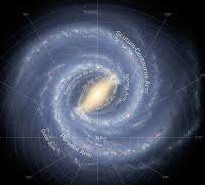
The sun is one of billions of stars orbiting the center of the Milky Way. Every 230 million years, an orbit is completed. In our heart of hearts, all silly minions know this. The Mondays will come and go until they don’t. Nothing is static. Nothing is certain. Tomorrow may rain, but in the end, we’ll follow the sun.

If You Pray, Be Honest

Me: Excuse me, Outer Intuition, Inner Nagger, Origins of Love, and Source of Galactic Central Heating, I need a check-in. I suspect you’re aware that there are a lot of people who’ve decided the best way to deal with the Idea of You is to emulate Nancy Reagan: Just say no way.

Ineffable: Oh yes, that’s fine with me. Entirely understandable. Gotta love those atheists.

Me: And of course, there are other people who say the Idea of You emerges from their experience of mountains or stargazing or babies.

Ineffable: That’s nice. I like that.

Me: And some say that if by chance there is something like you, it is unknowable.

Ineffable: Well, that’s wise. In times like these, bet-hedging is the way to go.

Me: But the ones that worry me are the vast hordes of True Believers. Do you know about them?

Ineffable: Of course. That impulse emerged with human consciousness. It’s a cult-like, primitive narcissism fed by fear, avarice, and a quest for power and immortality. Long on delusion. Short on reasoning. It’s intriguing.

Me: Intriguing, my ass. It’s killing us.

Ineffable: I can see why you’d feel that way. But it’s not me. No version of me is killing you.

Me: Yeah, sure. Guns don’t kill people. People kill people. But what’s the point? Why do humans lock down on these falsely-comforting, narrow, ignorant narratives of the Idea of You that dangle formulaic salvations? Or endorse sadistic sacrifices? They don’t know the real you.

Ineffable: WHAT? THE REAL ME? Now you’re scaring me. Did you really just say that?

Me: Gotcha. Hahahahaha.

Ineffable: Very funny. Is there a real you?

Me: Ah, maybe. I don’t know. Don’t change the subject.

Ineffable: We’re more alike than you realize.

Me: Now you’re scaring ME!”

Ineffable: Why? Because there’s a lot of suffering and death inflicted in the name of the “real me”?

Me: No. I know that’s not like any version of you.

Ineffable: The real versions of me are more like the ones being killed. Especially the powerless ones.

Me: And that’s what I’m afraid of.

Ineffable: I’m a little afraid myself, honey. But mostly sad.

Me: Yeah. Mostly sad.

Getting to Yes

On one of my all-time favorite British sitcoms, The Vicar of Dibley, there was a character who answered any inquiry with no, no, no, no, no, no, no…. Then his oppositional stuttering would shift abruptly to something like, “Yes, sounds good.” This made the vicar roll her eyes and the audience laugh. Every time.

That sums up my relationship with my Coauthor fairly well. I look at the deep divisions in the world, the absolute necessity of being loving and forgiving, shake my head, and say No, no, no, no, no. Then I breathe, consider the options, and say Yes. Not because anything looks or sounds all that good. It’s just that Yes is the best answer available.

And the audience laughs. Every time.

The vultures laugh. The sparrows laugh. Friends and enemies laugh. The feasting deer lift their heads and laugh. Secure in the lap of forever, the souls of the brutally departed laugh. Fire-setters, firefighters, funeral directors, midwives, engineers, artists, jailers with rings of keys, pilots with bombing planes, producers of poison, planters of organic seeds.

Laughing. Every time.

But what’s so funny? The knee-jerk string of NOs? The pivot to YES?

“It’s all funny,” my Coauthor says. “Every bit of it.”

“I beg to differ,” I say.

“Of course you do,” my Coauthor chuckles. “See? Now, go ahead and get to yes.”

 “No, no, no, no, no,” I say, shaking my head.

“There’s a Yes in there somewhere,” God insists, sneaking toward me with tickle fingers, making ridiculous, nostril-flaring faces, tossing popcorn in the air to catch in his mouth—the Clown of Heaven, the Fathomless Fool.

“YES!” I yell. “Stop! You’re absurd.”

“No,” God laughs. “No, no, no, no, no.”

“Very funny,” I say. “Now, go ahead and get to yes.”

“Already there,” God smiles. “C’mon in. I’ve got wine and fresh bread.”

The Yes propels me forward. I take my place at the table and break the loaf open, crusty and warm. The wine is bitter, but there are carrots sweetened by the frost and a steaming cup of tea. I am grateful despite the costs and challenges in such wanton communion.

“Yes,” I say, soberly, allowing my eyes to see.

“Yes,” God nods with compassion.

And the day begins. It will be filled with divine comedies, embodied tragedies, the futile and the fulfilling. Most of the doors will be left unlocked, swinging freely in the wind.

Planned Obsolescence

Did you know that if you push a straight edge up the outside of your apparently empty tube of toothpaste, at least a week’s worth will squish to the top? And if you cut the tube open and flay it, you’ll find even more of the goo clinging to the inside.

Labeling and packaging practices are fraught with waste, lack of imagination, and greed, often making it difficult to use up the entire contents of whatever it is you’ve purchased. And don’t get me started on single-use plastics, false recycling guarantees, and planned obsolescence.

Even well-intended containment is tricky. For instance, my own packaging has become increasingly prone to leaking, bruising, and breaking. My container has been taped up, repainted, and artificially preserved for a while now. Clearly, it’s not going to last until everything I have to offer is entirely used up.

As I struggle with this unpleasant reality, a primal protest grips me.

“Hey, Universe!” I yell. “When we age out, do our unused talents and potentialities end up in the Great Landfill of the Afterlife? Do you reabsorb our unwritten masterpieces? Our unsung songs? Hard-earned but unheeded advice? Unturned stones and dormant acts of kindness? How about the promises we meant to keep? Do you even have a plan for this obsolescence?”

God’s enormous head lifts from its heavenly repose in the sky beyond sky, and the Gaze comes to rest on the tiny speck that is our planet, that is my naked eye, that is a bioluminescent Whisper in the amniotic fluids covering the earth.

“You are not the sum of your talents, failures, passions, or fears,” the Whisper murmurs as the tide rolls in. “You’re the question, not the answer. You’re the journey, not the miles. You’re evolution’s hitchhiker, the plot of my favorite fantasy, and a transitory fraction in the equation you call eternity.”

This ethereal, evasive answer infuriates me. I want my untapped potential to guarantee longevity if not immortality. Like the spiritual toddler that I am, I throw my temporary container to the ground and beat my knobby fists against the pain of consciousness, empathy, imperfection, erosion, imagined glories, and old dogs.

The earth receives my rage and offers joy. Its undulating tenderness envelops me.

I roll onto my back and stare at the sky gathering itself into another night. The massive head of God explodes into trillions of stars, galaxies expanding, defying entropy and all attempts to limit or restrain.

Every boundary eventually gives way. Every horizon is a curvature forward. And we are all, together and forever, the trajectory of a certain hope and the substance of things not seen.

Little Planet Big Lies

Photo Credit: Scott Wolff

Earlier today I told myself some little white lies and then moved on as one does in order to survive. The falsehoods involved a forced smile, the use of an herbicide, the denial of grief, and the last bite of ice cream. My chronic inclusion of God could itself be a lie, but if so, it’s neither white nor little.

This is because God yanks the universal down to the particular. For instance, she mimicked my smile, bathed in the herbicide, paraded around clad in old photographs, sang Paul Simon, drank the old wine, and hid the chocolate syrup. I threatened to go back to bed and restart the day, but she raced ahead, pulled off the blankets, and pretended to be the ghost of Octobers past.

I gave up, overwhelmed by the insistent Presence, the insanity of the seasons, and the weight of knowing what’s coming. The future is an out-of-control Mack truck, and we’re all bugs destined for the windshield.

But for now, God and I sit calmly, me contemplating how much phlegm a body can produce when fighting a viral invasion, God knitting socks for soldiers and other unsheltered souls.

“Whose side are you on?” I ask, thinking about revenge and innocence, viruses and hosts.

“My own,” God says.

“Figures.” I get up to make a smoothie. “Where’d you hide the chocolate?”

“Deep in the recesses of your ontological brain,” God chuckles.

“Of course.” I sigh, wave the fruit flies away, and peel two bananas from Guatemala. I drop them into the blender made in China, add blueberries from New England, and pour in kefir I made myself—but the milk I used? It’s from cows, possibly nearby. Possibly not. I toss in Swiss chard from our garden, squeeze in chocolate from Cameroon, and push the button.

“Would you like some?” I ask.

“Not now, thanks,” she says. “But I’m glad you found your way to the kitchen.”

I lift my glass to a delicate world, but the complexities and hypocrisies rob me of delight. I look at God, desperate to save what’s left of the day.

“Enjoy the damn smoothie,” she says. Her smile is genuine. “I’ll be back.”

 “Where are you going?” I ask.

“Gotta deliver these stockings. The alpaca fleece is from Columbia, the needles are bamboo. From Japan. Winter’s coming in Ukraine, and there are the barest feet you’ve ever seen in Gaza.”

I steel myself and sip the toxic nectar of this splendid, blended earth. Then sadly, I bid farewell to October and pull on a pair of socks she left for me. It’s chilly out there, but I need to harvest the last of the carrots and beets. Root crops, like certain hardy people, do well in Montana.

Being the Cozy One

There’s much to be said for a Cozy God. Not just passive cozy. No. I mean assertive, smother-hugger, cheek-pincher, aren’t-you-just-adorable, big-lapped cozy.

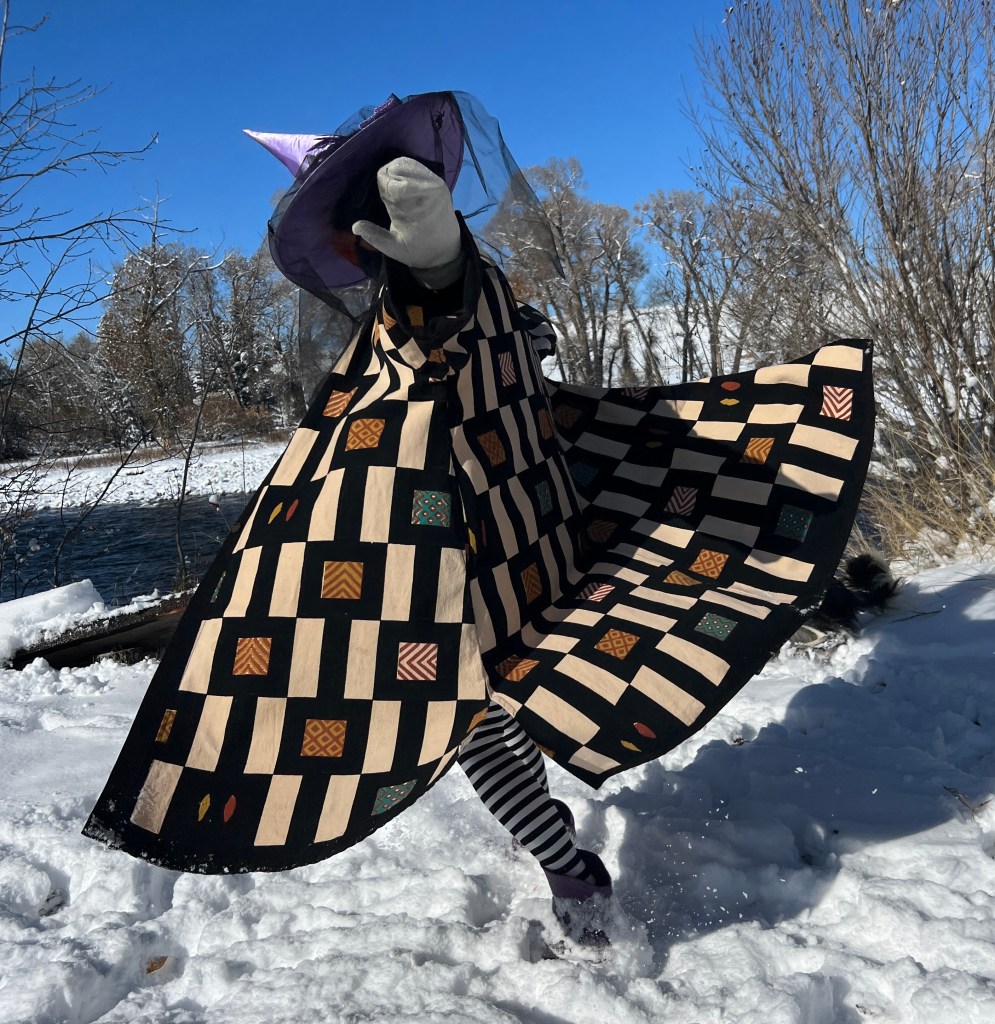
But today’s version is sharp-tongued and angular. Her purple hat is cockeyed and her cloak of many colors drenched from flying through the freezing rain. She’s shivering and disoriented. Thus, I’m forced to be the cozy one.

“Here. Drink this.” I offer a cup of hot chocolate laced with peppermint schnapps and replace her cloak with a down comforter. She lifts the mug to her bluish lips, sips, sighs, and settles near the fire.

I let her warm up in silence. Mostly I’m happy when any version of God drops by, but as she curls her tired body and nods off, I realize some visitations are less pleasant than others. I consider hiding the refreshments and putting out the fire.

Where’s Cozy God? I complain to myself.

Witchy God yawns, stretches her thin arms above her head and says, “She’s busy. I’m subbing for her today.”

“What’s she up to?” I ask, interested despite my disappointment. If I’m hosting Witchy God, then maybe somewhere, someone is being cuddled and fed by a cozy, affectionate God.

“Doesn’t work that way,” Witchy God says. “The manifestations are interactive. You get what you give. You get what you need. But luckily, you never get what you deserve.”

 “Why not?” I ask, peevish and disappointed. “I try to be thoughtful. I share my stuff…” My voice trails off. “Well. Most of it. Some of it. Sometimes.”

I’m suddenly uncomfortable claiming I deserve a visit from Cozy God. The equations are slippery, comparisons fraught with subjectivity, tinged with envy.

“So what’s your cozy quotient, my pretty?” Witchy God asks in her witchy voice.

“You mean how much cozy do I need?” I ask, ever hopeful.

“No. How much cozy are you putting out there?”

And there it is. The eternal question. Witchy God begins whirling like a dervish, and the remaining October leaves let go.  Every limb is bare. Winter has arrived. The wars rage on. Witchy God is preparing to do whatever it is she does. Her cloak has dried, and her thermos is filled with my cocoa and schnapps.

“I’ll ride shotgun for as long as I can,” I say reluctanly. I swing my leg over the broom, but her take-off velocity leaves me flat on my back in front of my toasty fire.

“Not every battle is yours,” Warm Room whispers. “With that bad hip, you could be a bit more cautious.”

“No way,” I say.

Warm Room gives me a knowing smile and hands me a broom of my own.

Impact

Who doesn’t (secretly or overtly) want to be a social influencer? Maybe a few humble souls are at peace with having little influence in the world, but I doubt they’re in the majority. Humans want proof that they matter—as measured by clicks, votes, money, fame, prestige, or power.

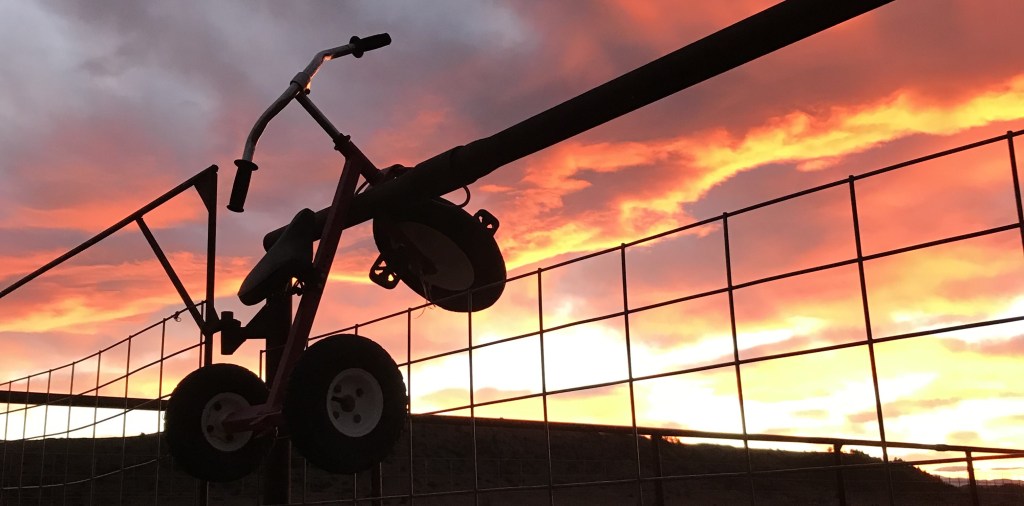
Years ago, I began learning a lesson I’m still working on. As a newly minted rehabilitation counselor, I was assigned to teach a young man with a serious brain injury how to ride his three-wheeler to the sheltered workshop where he glued pieces of wood together every day. This is harder than it might sound.

He flashed me a drooly grin as he turned a block early for the third time. I calmly redirected him, but inside, my ego was screaming. I wanted to be actualized and recognized. I wanted to be somebody. But here I was, with my master’s degree, on a back street in nowhere USA trying to help a badly damaged human being learn to navigate a three-block commute.

He gritted his teeth and pushed hard on the pedals. I pictured him before the crash, a reckless teenager, stomping on the gas in his souped-up car. He’d lost control and rolled three times. Hours later, the jaws of life had freed him to face a partial recovery followed by this new, confusing existence.

We made it to the employee entrance on his fourth try. I feigned approval, but I was resentful and exasperated. I had functional legs, strong arms, and an eager mind. I had a ten-speed bike, running shoes, three published poems, and a family that did not wish me dead.

“Can’t you give me something important to do?” I whined to the Universe. “Something that’ll make a difference?”

The day froze into a singular moment.

“Allow me to introduce you,” the Universe replied in a clear, penetrating voice. “This is my son, Clayton, with whom I am well-pleased. He needs a little help. I chose you, but if you’re unavailable, I have others.”

And as if that wasn’t enough, the Universe continued. “Clayton, dear, this is your servant, Rita. Be patient with her. She’s still figuring things out.”

So much life has flowed under so many bridges since that day, and so many Claytons have come and gone. In this waning light, Wisdom occasionally lifts her skirts to show me her ankles. But even now, instead of sitting in gratitude, I sometimes long for more. I want accolades and adoration. Assurances that I matter. Most days, I push down hard on the pedals, but I’m uncertain of which way to turn.

Obviously, I’m still figuring things out.