Revelations

“Morning, sleepy.” God rubs my head, smiling. “Time to wake up!”

“Stop,” I mumble, covering my head with my paisley blue sheet. “I didn’t sleep well. Thoughts of the Antichrist kept rolling around in my head.”

“Yeah. Rough week. Satanically healed head wounds. Fake hysteria. Spellbound followers of malevolent beings. Beasts in sheep’s clothing,” God signs. “I’ve seen it all before. It’s a bit passe.”

“Maybe for you,” I say. “But not for me. Not for us. This could be the end times.”

“Nah,” God laughs. “Satanic healing is an oxymoron, and it’s always the end times. But the Book of Revelation would’ve made a great screenplay for your current crop of dark-hearted fanatics. The author could have made millions scaring people. Too bad he was so far ahead of his time.”

“Time is definitely the issue,” I say. “We’re running out of it.”

You might be. I’m not,” God counters with a selfish grin. “Even if your world runs out of time, I won’t. I play with time like you play with frisbees.”

“Well, Mr. Laissez Faire, a lot of people are begging Various Versions of You to do something about, um, everything. Soon.”

God groans. “You would not believe all the contradictory prayers clogging up the prayer-o-sphere.”

“Oh, you poor thing,” I say sarcastically. “This shiny blue marble with all its evolutionary splendor may be just a twinkle in your creative eye, but it’s everything to us. Everything.”

“Then act like it,” God says. “You’ve done a terrible job of fulfilling your potential so far. There’s a draft of your Official Eviction Notice on my attorney’s desk as we speak. And don’t ask for a recommendation if you move elsewhere. I love you all. I really do. You’re intriguing. But if you continue to be so easily duped, I’m afraid you’re not worth the risk.”

I bow my head as if to pray, but it’s just an excuse to break eye-contact with the Truth. Why ARE we so easily duped? Vicious selfishness and blind hatred have been rebranded as faith. Lying buffoons and feckless billionaires are praised and adored.

The sound of galloping hooves in the distance chills my soul. I gasp.

“Relax,” God says. “It’s not the four horsemen. It’s the Budweiser team. We’re having a big kegger on the beach tonight. I’ve ordered seven pizzas and seven golden bowls of chips. You should come.”

“What beach?” I ask. I don’t like Bud, but a little social time might be nice.

“Gaza,” God says.

“GAZA!” I shout. “You’re a fool, God. They’re not even letting necessities in. They’ll kill the horses.”

God shrugs. “They always kill the horses,” he says. “I’m used to it.”

Ecclesiastes for the Average Reader: A Tutorial

To everything, there is a season and a time for every purpose under heaven. A time to eat chocolate, a time to eat greens. A time to float the river, a time to cut hay. A time to blame, a time to own up. A time to back away, a time to give it your all. A time to dig and a time to refrain from digging.

Reader, please provide your own examples of holding on or letting go. C’mon. You know:

But what’s the use? You grow up. You grow old. Your carefully arranged treasures will be donated or dumped. The shrubs will be misunderstood, and the thistles will return. The stove will backdraft, the colors will run. You’re on your own, and the cards are stacked against you. You are not different than the beasts of the field. And as beasts die, so will you.

Reader, please provide three (only three) examples of your existential despair:

You’re a phony, a caricature of sincerity, a grumbler, a whiner, a blamer. You’re a striver after the sun. You’ve lied, stolen things, and lusted after fame and fortune. You’ve coveted and secretly rejoiced at someone else’s misfortune. You build bad fences. Everyone should be on your side. They’re not. You repeatedly make the same stubborn mistakes, and you’re as vain as anyone you know. It’s all vanity. All of it. This might be a good thing. Might not.

Reader, please cheerfully list three of your own moral shortcomings:

At night, you rehash failings and exaggerate the dreadful demands of the coming day. You toss and turn, sweating through self-inflicted anxieties. You torture yourself with blame, fear, and discontentedness. You wish you had control of your mind. You wish you believed in magic. Finally, as you imagine walking the plank, you fall asleep. But then you have to pee.

Reader, please provide all the reasons everyone should party late into the night:

In the meantime, what’s the harm in trying? What’s the harm in resting? What’s the harm in hoping? What’s the harm in keeping your nose clean and your heart open? Sure, you haven’t gotten it all right, and you never will. You’re far from flawless or erudite. Things rarely work out entirely as you’d planned. Wisdom isn’t all it’s cracked up to be. Now is the time to sigh and say “Ah, what the hell.” And the Teacher nods and says, “Seriously, what the hell?”

Reader, please shrug and provide your own what the hells. As many as you’d like:

Good work, dear one. It’s time for ice cream. Or not.  Next week, Revelations.

Strong Nuclear Force

Earlier this week, God and I were deep into a discussion about the aptly named Strong Nuclear Force which is the force that holds subatomic quarks together and is thus responsible for the stability of matter. Because people often anthropomorphize God, I suggested that maybe she should change her name to Strong Nuclear Force. She pretended to consider this before concluding that she preferred other names, such as Lambkins, Alpha, Omega, or The Beloved.

The discussion ended, and the week steamrolled over me the way some weeks do. That brief exchange was unsettling, but I didn’t have time to revisit it. I barely had time to drink beer or exercise or contemplate how to save our tottering democracy. And the weeds took advantage of my frantic pace and went to seed as rapidly as they could.

I accept these harsh realities and the finite linearity of time. With what I consider to be enormous self-discipline, I’ve now seated myself in the old blue recliner, ready to center on the Center. The gardening and vacuuming will have to wait.

“So, you don’t have to go around calling yourself Strong Nuclear Force if you don’t want to,” I say, as my opening volley. “But I don’t like calling you those other names. Especially The Beloved. It sounds obsequious and weak.”

“No worries,” God smiles. “It’s just that I don’t like limiting myself. The nuclear scientists were quaking in their boots when they realized they could break the hold of the Strong Nuclear Force and set protons free. They wondered if once unleashed, the chain reactions would convert all matter to a kind of selfish, toxic energy that would end existence as you all define it.”

“And they detonated anyway,” I sigh. “We’re in so much trouble.”

“Yes, you are. You can see why the basics are so central, right?” God asks.

“Yeah,” I say, wondering which basics she means.

“Love,” she says.

“Too simple,” I say. “Undefined. Mushy. I don’t like that idea anymore. I want to roar and maim and shake people until their heads fall off.”

Strong Nuclear Force lifts her skirts and leaves.

The protons are free to crash.

The rich tell lies and steal from the poor.

The frightened arm themselves with weapons and hatred.

The young flounce. The old stiffen.

“Come back,” I yell. “You win. The Beloved is a fine name.”

“I always win,” she smiles.

“Maybe,” I say. “But that’s not readily apparent. Love is a tall order.”

“I know,” Lambkins says. “I’m often in disguise, but I’m taller than you think.”

Even in Dancing Shoes

Even in dancing shoes, God can balance her energies, lean over, and suck the venom from a snakebite if she wants to. She can heal the sick, calm the angry, and comfort those grieving if she wants to. She can lift burdens, feed the hungry, visit prisoners, and welcome strangers if she wants to.

“Why are you writing these things?” God asks. “It’s weird and inaccurate.”

 “Aren’t they volitional acts?” I ask. “Don’t you have free will? How could this be inaccurate?”

Rather than make eye-contact, I look down at my fingernails. They’re ridged, uneven, and dirty.

God leaves.

Self-pity overwhelms me. Tears slither down into the unknown and regrettable while I endure the harsh odors and intrusive sounds of life going on. Going by. Going on.

There’s a vivacious spirit roaming the overgrown garden in the back. I’m drawn to the tangled jungle of native species, exotic transplants, and invasive weeds. The garden appears to need tending. If I knew what to attack and what to nurture, I would engage in the battle. I would pull weeds, spread compost, and drip pure water where it was needed. I would…

God returns, laden with serpents and migrants, criminals and emaciated children. “Move over,” she says. “There are more to come.”

“There’s no room,” I protest. “And no path. One thoughtless step could easily crush a strawberry, injure a fern, or break the slender stalk of an orchid.”

God looks at me and repeats, “Move over.”

“I can’t,” I shake my head. “I just can’t.”

But this isn’t true. Every moment, I grow smaller, and the cracks in the clay widen. There’s room.

“Are you a weed or a rose?” I ask.

God shifts her weight, impatient. “You’re stalling.”

“Are you perfection or process?” I persist.

“Stop dithering,” she says. “You still have time to bake something.”

I make a face and drag my tired body toward the kitchen.

“That’s the spirit,” God says. “Our guests would love a warm cookie or maybe a loaf of sourdough or pumpernickle.”

“Ah, c’mon,” I groan. “Enough! I don’t want to move over. I don’t want to break bread with the madding crowd. I suppose you want me to fry up a few fishes, too.”

“That’d be nice.” God laughs as she slides a pair of high-heeled tap shoes my direction.  “Your size?”

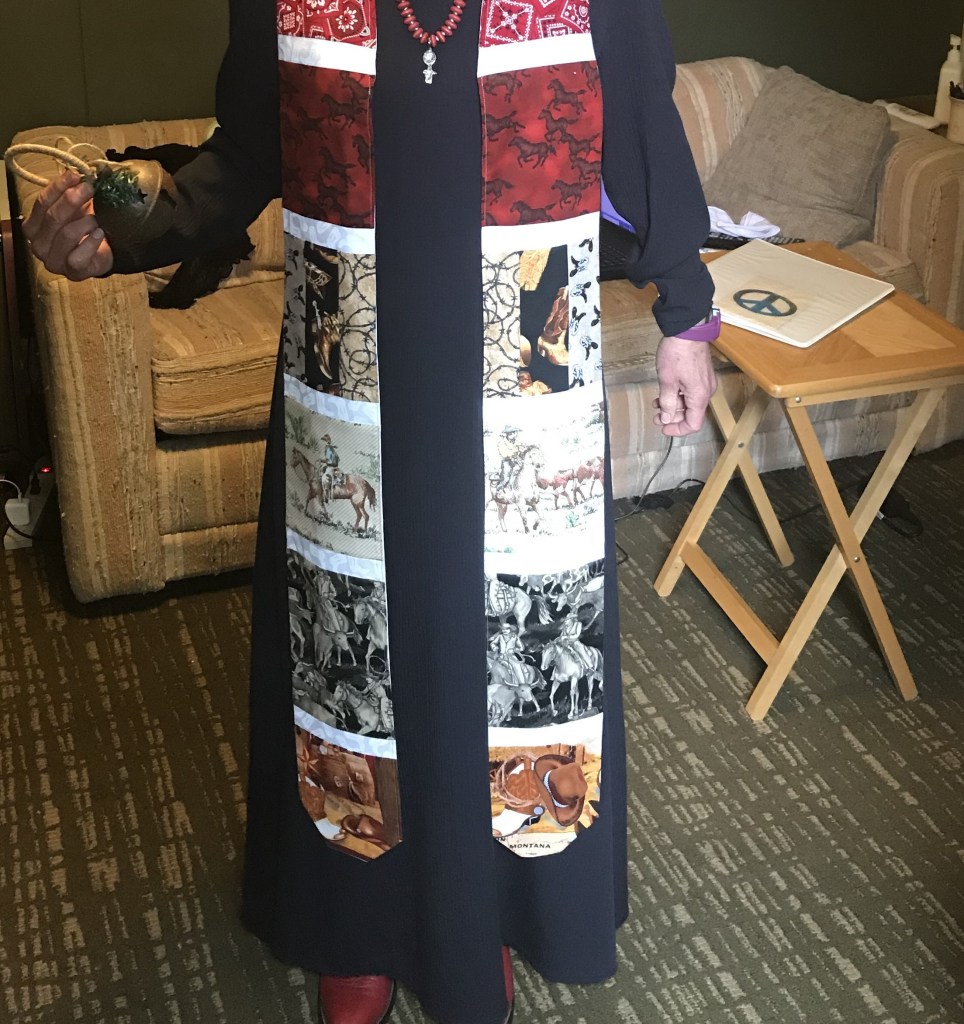
I hate high heels. I want my old red cowgirl boots. I want to hide in the oven with the cookies. I want to roll my life backwards. But I make myself try on these odd, uncomfortable-looking shoes.

“Just right,” I admit.

“I knew it!” she declares, reaching for my hand. “Let’s go.”

Flags

As consciousness ascends
the grin of the devil lingers.
My down comforter and fluffy pillows
smell like smoke.

I had intended to repair the tattered flag in the corner
but I see now that it cloaks the evil twins:
Blind allegiance and false promises.
Riches are blinders, not blessings.

A small plane drones through the dawn’s early light
strewing herds of animals hither and yon
for the pleasure of predators at the top of the chain.

“This is better than husking corn,” one of them says.

The corpses sanctify the trampled sod, now saturated with blood.
The resulting meals may justify giving thanks
but the trophies are pure vanity.

War is the thing to prepare for,
bodies the thing required.

Not this pig,” wrote the poet
before passing to the place of all poems.
We nod to the sentiment, slicing ham
and chopping bacon bits for the salad.

Bless us, oh lord, and these thy gifts…
runs on automatic replay
as I watch people refuse to sign the petition
for reproductive rights.

I’m not fooled by false equivalencies. I sign.

To live is brief. To die is certain.
This lonely insight flays the rays of morning
into the arc of promised justice
I barely believe in anymore.

“Wake up, little one. You have Now,” the Rainbow says.
“And the gossamer of Indigo.”

“But Indigo has begun to unravel,” I protest.
“And I’ve lived too long as a parable to engage with Now.”

Silence.

I polish surfaces in the kitchen
hoping for an accurate reflection.
But the granite is forest green;
the dishwater, troubled; the beer, murky.

The Distortion laughing up at me is God.

“I hope you didn’t pull yourself together on my account,” I say.

“Of course I did,” the Distortion answers.
“No one can live on Indigo alone.”

The Sugar’s at the Bottom

Sometimes, you have to grit your mental teeth and force the images to land so you can pull them apart. The world is a damaged ship, listing dangerously starboard. Your longing to prove or fix something scratches like a cat on the screen that protects your soul, and your selfish nature hides in the weeds, rusting and jagged–a trip hazard and destroyer of lawnmower blades.

“Morning,” your Coauthor mumbles in a sleepy voice.

“Coffee?” you offer, calm on the surface, agitated inside.

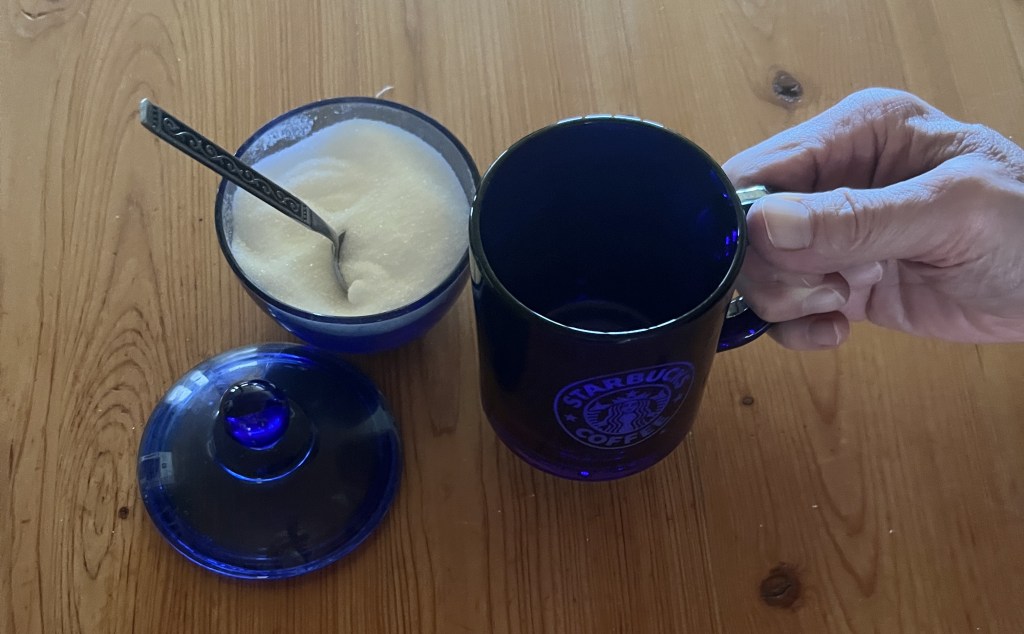
Coauthor nods, reaching for the sugar.

“What do you have in mind for today?” you ask.

“The usual,” Coauthor shrugs.

“But I don’t feel like being generous,” you say. “Or patient. Or kind.”

“How’s the joint pain?” Coauthor asks.

“Tolerable,” you frown. “How’s yours?”

“I’m always inflamed,” Coauthor admits. “And for that, I’m grateful.”

Usually, your Coauthor is clear-eyed about ailments, victories, ice cream, and the dying coral reefs. There are costs for doing business with fickle microbes and solar storms. That which can be altered is miniscule, and even if done well, evolution will occasionally circle back and bite you in the butt. That’s why most Coauthors look so chewed up most of the time. Chewed up, surly, and weary. Okay, maybe not surly. That’s more you. But weary and wounded. That’s for sure.

Your Chewed-up Chum checks the weather. Rain. Flood warnings. Wind. But later, things will clear, and there will be a deep peace that passes all understanding–which is a good thing because your current understanding is so slow that a tired donkey pulling an overfilled cart could easily pass it by. There’s nothing poetic about bombed-out homes, repeated migrations, or starvation. Nothing. Maybe you could approach the devastation symbolically, but that might make it harder. You simply don’t know.

“Understanding is essential and impossible,” Coauthor says. “The you that you think of as you can grasp only fractions of the puzzle. The complexity is beyond your fleeting singularity. Just find a corner piece and hang on.”

“What does a corner piece look like?” you ask, feigning innocence.

“Oh, you know. It’s rounded on the edges. The nobs point inward,” Coauthor grins enigmatically.

You rub your rounded belly and consider the risks of real, expansive connections. In the past, you’ve tried to force puzzle pieces to fit. Bad idea. You limp away, limp back, limp away. Each time your view expands, your energy diminishes.

“The capacity for compassion depends on being broken. Sometimes, more than once,” your Coauthor says in a matter-of-fact tone.

“Stir your coffee,” you sigh. “The sugar’s sunk to the bottom.”

“Thanks,” Coauthor says. “But I like it that way.”

Misperceptions

Birds crash into our southern windows at (literally) breakneck speeds. A few die instantly. Some bounce and fly away, wobbly and mortally wounded. We’ve taken steps to mitigate these errors in bird judgment, but why, oh why does this happen in the first place?

“You can fool all of the people some of the time and some of the people all of the time. But you can’t fool all of the people all of the time,” Creator murmurs to herself, mesmerized by the old neckties fluttering outside our windows.

“Who said that?” I ask. “Abe Lincoln or P.T. Barnum?”

“Does it matter?  Birds get fooled. People get fooled. That’s a sad fact. Manipulating perception can be both profitable and fatal.”

“Profitable?” I asked.

“Duh,” Creator says. “Conspiracy theories sell guns. False claims sell addictive, brain-altering drugs. Naïve people, with inadequate media literacy, donate to malevolent causes or con artists. Birds swoop toward something they want, not realizing that the transparent barrier is a mirage of their desires.”

“I feel for the birds,” I say. “One time, I hit a side window so hard I fell to the floor in front of a restaurant full of people.”

“Did you blame the glass for being there? For being too clean?”

I grin a sheepish grin. “Nah,” I say. “But I wanted to.”

Creator smiles. “Well, well. There may be hope for humanity yet.”

“Oh, no you don’t,” I say, backing away. “Do not pin hope for humanity on me. Nope.”

“People have a tough time admitting their ignorance or misperceptions,” Creator continues, ignoring my disclaimer. “The evidence smacks them in the face, but they drum up far-fetched explanations and take another run. Even when they break their stiff necks, they blame the glass.”

My hand automatically goes to my neck, and I do some yoga stretches to keep it limber. Yes, I occasionally engage in denial and blame, but glass is glass. Doors are doors. Truth is truth. And one clear truth is that humans make mistakes.

“Course-corrections are possible,” Creator adds in a quiet, sad voice. “I realize humility is not a popular virtue, but you don’t have to keep flying into the glass.”

“Do you think the meek will actually inherit the earth?” I ask.

“I think so,” Creator answers. “But the steep cost of repairs will be as unnecessary as all those broken necks.”

Please Don’t Go

Here on the banks of the Stillwater River, it’s time to face another sweet goodbye. I’m sad. Life is a series of arrivals and departures. Even though some departures are temporary, I’m reminded of that old saying: You can never step in the same river twice. It may look and sound like the same river, offering familiar cool waters on a hot day. But don’t be fooled. Those waters are both ancient and new. They’ve been solid, liquid, and gas. They’ve been everywhere, and they will be back. They know you only in passing, and you know them not at all.

The root of the word stagnation is “standing water.” Generally, no one loves stagnation. It’s associated with nasty smells, writer’s block, mosquitoes, and economic slowdowns. But where would we be without stagnation? Growth for growth’s sake is a hallmark of cancer. Standing water is a temporary relief, a foreboding surface. When I lean over in the evening light, I see the outlines of the devil and the divine.

“So, I’m glacier, ocean, cloud, and cesspool,” the Divine says. “Ironic.”

“Ironic,” I agree. “I don’t like the status quo, and I don’t like change. I don’t like leaving and I don’t like staying.”

“Well, then, I’ve got some good news for you. I never leave and I never stay. At the galactic level, the more things change, the more they stay the same.”

“But I’m not currently galactic,” I remind the Unchanging Change. “And your cute colloquialisms are not helpful.”

“I love you more than your parents did,” The She of the Universe says. “I love you more than you love yourself. More than your partner, children, grandmother, chickens, or dogs.”

I do a doubletake. What brought this on? Was I asking for love?

“Don’t act so surprised,” The She smiles. “You’re always asking. And I understand. Relinquishing is not your forte. You need a lot of reassurance.”

Sometimes being known so definitively and casually makes me feel oppositional. Feisty.

“But what about that poster with the cat clinging to the screen door?” I argue. “The one that says Hang in there, baby?”

“Seriously? You want to live your life based on guidance from posters?” The She asks. “Besides, the cat doesn’t look all that happy, does it?”

“No,” I admit. “It looks frantic. But what’s the alternative?”

“Letting go, of course. Cats usually land gracefully on their paws. The problem is more about screens and tangled claws than a short, clean, fall.”

I withdraw my fingernails, drop into the arms of the waiting ground, and wave goodbye. I hope for many happy returns, but nothing is guaranteed.

Texture

Nine years ago, when the walls I’m staring at right now were taped, mudded, and painted, I was in the midst of chemo; my attention was limited, and my judgment fractured. I chose the texture of least resistance: orange peel. We ended up with a boring, slightly bumpy, ivory creaminess as far as the eye could see. I’ve since blued and purpled some rooms to break the grip of ivory, but undoing texture is a whole different matter.

Humans are a thin-skinned, acne-prone, melanoma-inclined, busted-nose species. We’re born smooth, but life has a way of texturizing and shaming, so we add layers. Leather and tatts. Silks and fine linen. We use fat wallets and fancy cars to distract.

“What about sanding?” asks the Creator of Walnut, the Weaver of Wool. “And there’s always acid, epoxy, varnish, and grinders.”

Even allegorically, this sounds painful. In the looking glass, I see that I’ve grown more textured than the last time I looked and not in ways I’d describe as appealing.

“Don’t be so judgy.” says the Big Eye in the Sky. “I’d go face to face with you any day.”

“Of course, you would,” I say. “And I’d be toast.”

“Toast is soft bread with a roughened exterior,” the Eternal Jokester counters. “Quick exposure to intense heat.”

My friend Scott rails about the energy required to make toast, but I like toast. I resist feeling guilty because I turn off lights like a religious zealot, hang my clothes to dry, and heat water on the wood stove. Shall I thus be held blameless for the fractured ozone? Mudslides? Fires? For a carbon footprint larger than my feet? Shall I be exonerated?

“Of course not,” the Balancing Beam assures me. “Exoneration is out of the question. But when your fault lines widen into fatal apertures, and your body rejoins the teaming earth, your consciousness will be windswept and shiny. Smooth as glass.”

“Gee, thanks,” I say. “That sounds just peachy. But in the meantime, I think I’ll get some Botox and touch up my hair.”

 “Oh, yes! And amass more riches and fame,” Pock-Face Crooked Arm grins.

“Easy peasy,” I say. “It’s all about appearances. And lying. The bigger, the smoother, the lie, the better.”

“I’m not sure where I went wrong,” The Truth admits. “But there’s hell to pay. The course corrections are going to be rugged.”

“But it will come out okay in the end, right?” I ask in a weak voice.

“You may have to define what you mean by the end, honey,” the Lover says, stroking my sagging cheek. “That word isn’t in my lexicon.”

Waiting for Asparagus

On my belly, eye-level with thistles, there’s no sign of asparagus emerging. But this will change as the days lengthen and the rains come. For decades, I’ve made compelling requests of this ancient asparagus patch, and it has done what it can to save me. This has less to do with faith than with remembering and waiting. There are forces at work; we are at their mercy.

Waiting for Bats

Some years ago, on Father’s Day, we hung a double-chamber bat house on the warm side of our home. So far, no bats have moved in. We had hoped that they would take up residence and eat mosquitoes. Instead, a pair of robins have built a nest on top of the box, and their droppings trail down the side of the darkly stained cedar.

Waiting for Redemption

An ominous enlightenment is stirring offstage. Twice, it has missed its cue. It is an enraged bull, pawing the ground, spewing snot and indignation. It is a rusting toy. It doesn’t like its assigned role. It wants to rewrite the script.

Waiting for the Answer

This morning, I texted The Gods three times, begging for alternatives, biting back tirades and justifications. Silence is the hardest answer to accept. I left an offering at the edge of a slash pile and imagined the thick smoke bellowing skyward, hiding their thin defenses.

Waiting for the Raucous Conclusion

There are animals, wild and otherwise, who will outlive me, but there are others who will not. In fact, I will eat some before this day is done. If I were a hunter, I would make sure I had a clean shot. Then I would give thanks, waving one hand over the lifeless body, raising the other in gratitude. Hand to mouth. Heart to ashes. Dust to dust.