Even in Dancing Shoes

Even in dancing shoes, God can balance her energies, lean over, and suck the venom from a snakebite if she wants to. She can heal the sick, calm the angry, and comfort those grieving if she wants to. She can lift burdens, feed the hungry, visit prisoners, and welcome strangers if she wants to.

“Why are you writing these things?” God asks. “It’s weird and inaccurate.”

 “Aren’t they volitional acts?” I ask. “Don’t you have free will? How could this be inaccurate?”

Rather than make eye-contact, I look down at my fingernails. They’re ridged, uneven, and dirty.

God leaves.

Self-pity overwhelms me. Tears slither down into the unknown and regrettable while I endure the harsh odors and intrusive sounds of life going on. Going by. Going on.

There’s a vivacious spirit roaming the overgrown garden in the back. I’m drawn to the tangled jungle of native species, exotic transplants, and invasive weeds. The garden appears to need tending. If I knew what to attack and what to nurture, I would engage in the battle. I would pull weeds, spread compost, and drip pure water where it was needed. I would…

God returns, laden with serpents and migrants, criminals and emaciated children. “Move over,” she says. “There are more to come.”

“There’s no room,” I protest. “And no path. One thoughtless step could easily crush a strawberry, injure a fern, or break the slender stalk of an orchid.”

God looks at me and repeats, “Move over.”

“I can’t,” I shake my head. “I just can’t.”

But this isn’t true. Every moment, I grow smaller, and the cracks in the clay widen. There’s room.

“Are you a weed or a rose?” I ask.

God shifts her weight, impatient. “You’re stalling.”

“Are you perfection or process?” I persist.

“Stop dithering,” she says. “You still have time to bake something.”

I make a face and drag my tired body toward the kitchen.

“That’s the spirit,” God says. “Our guests would love a warm cookie or maybe a loaf of sourdough or pumpernickle.”

“Ah, c’mon,” I groan. “Enough! I don’t want to move over. I don’t want to break bread with the madding crowd. I suppose you want me to fry up a few fishes, too.”

“That’d be nice.” God laughs as she slides a pair of high-heeled tap shoes my direction.  “Your size?”

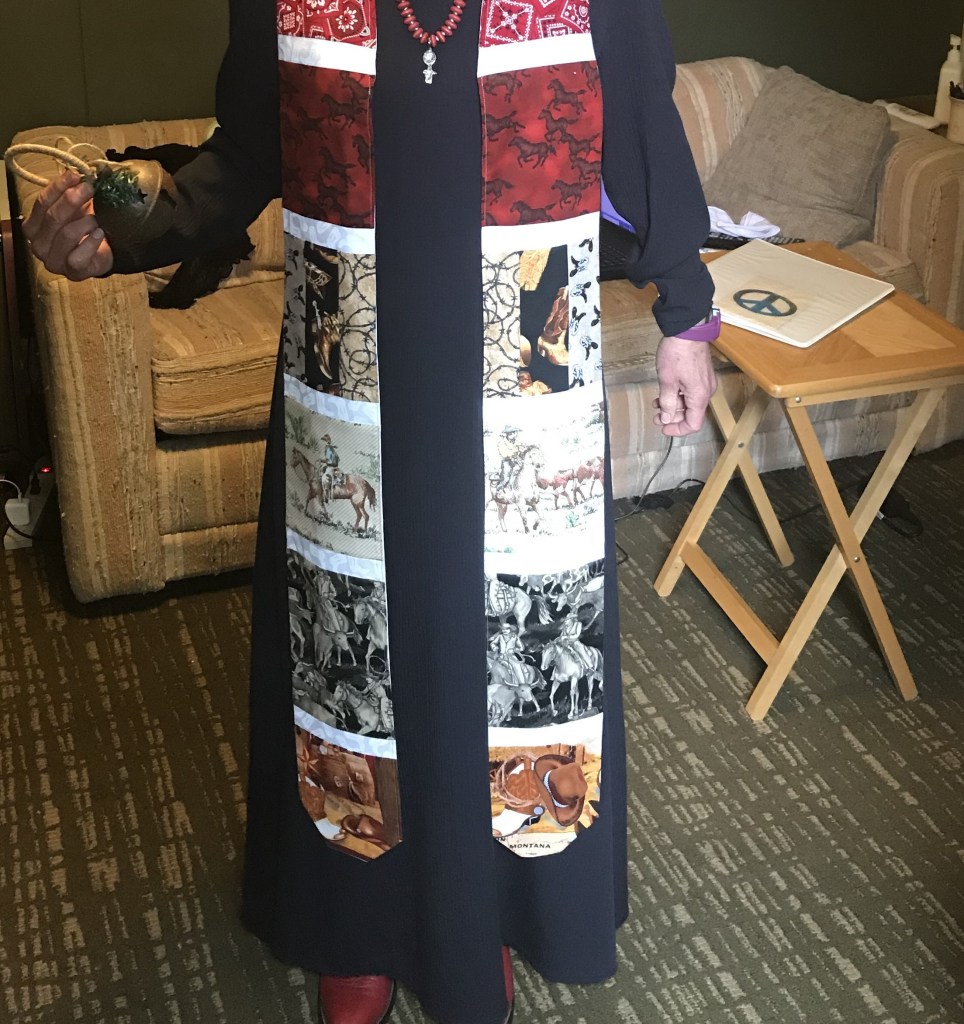
I hate high heels. I want my old red cowgirl boots. I want to hide in the oven with the cookies. I want to roll my life backwards. But I make myself try on these odd, uncomfortable-looking shoes.

“Just right,” I admit.

“I knew it!” she declares, reaching for my hand. “Let’s go.”

Flags

As consciousness ascends
the grin of the devil lingers.
My down comforter and fluffy pillows
smell like smoke.

I had intended to repair the tattered flag in the corner
but I see now that it cloaks the evil twins:
Blind allegiance and false promises.
Riches are blinders, not blessings.

A small plane drones through the dawn’s early light
strewing herds of animals hither and yon
for the pleasure of predators at the top of the chain.

“This is better than husking corn,” one of them says.

The corpses sanctify the trampled sod, now saturated with blood.
The resulting meals may justify giving thanks
but the trophies are pure vanity.

War is the thing to prepare for,
bodies the thing required.

Not this pig,” wrote the poet
before passing to the place of all poems.
We nod to the sentiment, slicing ham
and chopping bacon bits for the salad.

Bless us, oh lord, and these thy gifts…
runs on automatic replay
as I watch people refuse to sign the petition
for reproductive rights.

I’m not fooled by false equivalencies. I sign.

To live is brief. To die is certain.
This lonely insight flays the rays of morning
into the arc of promised justice
I barely believe in anymore.

“Wake up, little one. You have Now,” the Rainbow says.
“And the gossamer of Indigo.”

“But Indigo has begun to unravel,” I protest.
“And I’ve lived too long as a parable to engage with Now.”

Silence.

I polish surfaces in the kitchen
hoping for an accurate reflection.
But the granite is forest green;
the dishwater, troubled; the beer, murky.

The Distortion laughing up at me is God.

“I hope you didn’t pull yourself together on my account,” I say.

“Of course I did,” the Distortion answers.
“No one can live on Indigo alone.”

The Sugar’s at the Bottom

Sometimes, you have to grit your mental teeth and force the images to land so you can pull them apart. The world is a damaged ship, listing dangerously starboard. Your longing to prove or fix something scratches like a cat on the screen that protects your soul, and your selfish nature hides in the weeds, rusting and jagged–a trip hazard and destroyer of lawnmower blades.

“Morning,” your Coauthor mumbles in a sleepy voice.

“Coffee?” you offer, calm on the surface, agitated inside.

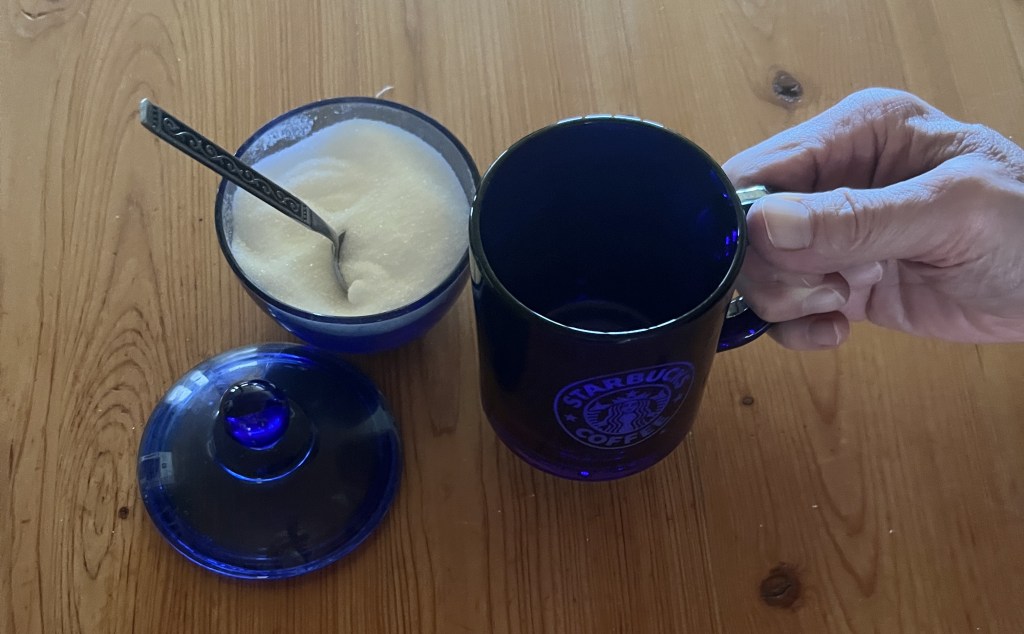
Coauthor nods, reaching for the sugar.

“What do you have in mind for today?” you ask.

“The usual,” Coauthor shrugs.

“But I don’t feel like being generous,” you say. “Or patient. Or kind.”

“How’s the joint pain?” Coauthor asks.

“Tolerable,” you frown. “How’s yours?”

“I’m always inflamed,” Coauthor admits. “And for that, I’m grateful.”

Usually, your Coauthor is clear-eyed about ailments, victories, ice cream, and the dying coral reefs. There are costs for doing business with fickle microbes and solar storms. That which can be altered is miniscule, and even if done well, evolution will occasionally circle back and bite you in the butt. That’s why most Coauthors look so chewed up most of the time. Chewed up, surly, and weary. Okay, maybe not surly. That’s more you. But weary and wounded. That’s for sure.

Your Chewed-up Chum checks the weather. Rain. Flood warnings. Wind. But later, things will clear, and there will be a deep peace that passes all understanding–which is a good thing because your current understanding is so slow that a tired donkey pulling an overfilled cart could easily pass it by. There’s nothing poetic about bombed-out homes, repeated migrations, or starvation. Nothing. Maybe you could approach the devastation symbolically, but that might make it harder. You simply don’t know.

“Understanding is essential and impossible,” Coauthor says. “The you that you think of as you can grasp only fractions of the puzzle. The complexity is beyond your fleeting singularity. Just find a corner piece and hang on.”

“What does a corner piece look like?” you ask, feigning innocence.

“Oh, you know. It’s rounded on the edges. The nobs point inward,” Coauthor grins enigmatically.

You rub your rounded belly and consider the risks of real, expansive connections. In the past, you’ve tried to force puzzle pieces to fit. Bad idea. You limp away, limp back, limp away. Each time your view expands, your energy diminishes.

“The capacity for compassion depends on being broken. Sometimes, more than once,” your Coauthor says in a matter-of-fact tone.

“Stir your coffee,” you sigh. “The sugar’s sunk to the bottom.”

“Thanks,” Coauthor says. “But I like it that way.”

Misperceptions

Birds crash into our southern windows at (literally) breakneck speeds. A few die instantly. Some bounce and fly away, wobbly and mortally wounded. We’ve taken steps to mitigate these errors in bird judgment, but why, oh why does this happen in the first place?

“You can fool all of the people some of the time and some of the people all of the time. But you can’t fool all of the people all of the time,” Creator murmurs to herself, mesmerized by the old neckties fluttering outside our windows.

“Who said that?” I ask. “Abe Lincoln or P.T. Barnum?”

“Does it matter?  Birds get fooled. People get fooled. That’s a sad fact. Manipulating perception can be both profitable and fatal.”

“Profitable?” I asked.

“Duh,” Creator says. “Conspiracy theories sell guns. False claims sell addictive, brain-altering drugs. Naïve people, with inadequate media literacy, donate to malevolent causes or con artists. Birds swoop toward something they want, not realizing that the transparent barrier is a mirage of their desires.”

“I feel for the birds,” I say. “One time, I hit a side window so hard I fell to the floor in front of a restaurant full of people.”

“Did you blame the glass for being there? For being too clean?”

I grin a sheepish grin. “Nah,” I say. “But I wanted to.”

Creator smiles. “Well, well. There may be hope for humanity yet.”

“Oh, no you don’t,” I say, backing away. “Do not pin hope for humanity on me. Nope.”

“People have a tough time admitting their ignorance or misperceptions,” Creator continues, ignoring my disclaimer. “The evidence smacks them in the face, but they drum up far-fetched explanations and take another run. Even when they break their stiff necks, they blame the glass.”

My hand automatically goes to my neck, and I do some yoga stretches to keep it limber. Yes, I occasionally engage in denial and blame, but glass is glass. Doors are doors. Truth is truth. And one clear truth is that humans make mistakes.

“Course-corrections are possible,” Creator adds in a quiet, sad voice. “I realize humility is not a popular virtue, but you don’t have to keep flying into the glass.”

“Do you think the meek will actually inherit the earth?” I ask.

“I think so,” Creator answers. “But the steep cost of repairs will be as unnecessary as all those broken necks.”

Please Don’t Go

Here on the banks of the Stillwater River, it’s time to face another sweet goodbye. I’m sad. Life is a series of arrivals and departures. Even though some departures are temporary, I’m reminded of that old saying: You can never step in the same river twice. It may look and sound like the same river, offering familiar cool waters on a hot day. But don’t be fooled. Those waters are both ancient and new. They’ve been solid, liquid, and gas. They’ve been everywhere, and they will be back. They know you only in passing, and you know them not at all.

The root of the word stagnation is “standing water.” Generally, no one loves stagnation. It’s associated with nasty smells, writer’s block, mosquitoes, and economic slowdowns. But where would we be without stagnation? Growth for growth’s sake is a hallmark of cancer. Standing water is a temporary relief, a foreboding surface. When I lean over in the evening light, I see the outlines of the devil and the divine.

“So, I’m glacier, ocean, cloud, and cesspool,” the Divine says. “Ironic.”

“Ironic,” I agree. “I don’t like the status quo, and I don’t like change. I don’t like leaving and I don’t like staying.”

“Well, then, I’ve got some good news for you. I never leave and I never stay. At the galactic level, the more things change, the more they stay the same.”

“But I’m not currently galactic,” I remind the Unchanging Change. “And your cute colloquialisms are not helpful.”

“I love you more than your parents did,” The She of the Universe says. “I love you more than you love yourself. More than your partner, children, grandmother, chickens, or dogs.”

I do a doubletake. What brought this on? Was I asking for love?

“Don’t act so surprised,” The She smiles. “You’re always asking. And I understand. Relinquishing is not your forte. You need a lot of reassurance.”

Sometimes being known so definitively and casually makes me feel oppositional. Feisty.

“But what about that poster with the cat clinging to the screen door?” I argue. “The one that says Hang in there, baby?”

“Seriously? You want to live your life based on guidance from posters?” The She asks. “Besides, the cat doesn’t look all that happy, does it?”

“No,” I admit. “It looks frantic. But what’s the alternative?”

“Letting go, of course. Cats usually land gracefully on their paws. The problem is more about screens and tangled claws than a short, clean, fall.”

I withdraw my fingernails, drop into the arms of the waiting ground, and wave goodbye. I hope for many happy returns, but nothing is guaranteed.