Certainties

“The mythical versions of you are far more palatable than the possibility of you,” I told God who was lurking in the predawn shadows. My mind was slightly disheveled, body and soul stiff and creaky. A mouse scrabbling in the closet had yanked me awake. Troubling uncertainties leaked from the murky remnants of deep sleep.

“No they’re not,” God answered, flitting like a sparrow from idea to idea. “Mythical versions are made by humans. They’re fear-based and jagged.”

“Some are,” I agreed. “But some portray you as all light. Soft, loving, pliable, and boundless.”

“Really?” God asked. “I guess I’m not familiar with all my renditions.”

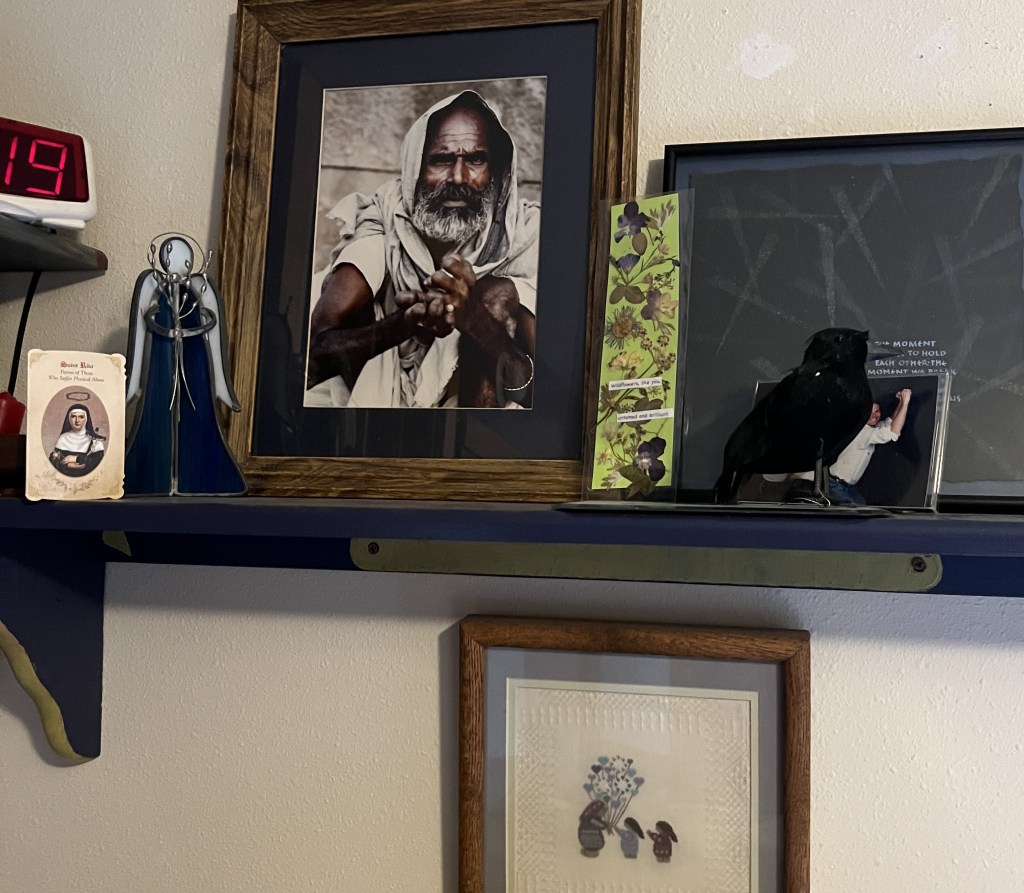
“This is an absurd conversation,” I said to the deep-eyed leper who has stared at me through the same nonglare glass for 40 years. “It is impossible to know God,” I said to the pewter angel from my mother-in-law’s collection. “I did not ask to be born,” I told the yellowing leaves. “And you’ve made a terrible mistake,” I said to the mouse.

None of my declarations stopped the digital clock from flashing up new numbers. My small victories mattered little to the wind. The earth is still quaking, and there are those awaiting the death of God with a certain eagerness. They rub their hands in anticipation, planning ways to distribute what’s left behind. Sometimes, I am among them.

“All ye in need of rest, I have a hammock,” God declared. “All ye without a cause, I have some little gods for sale.”

“Are you certain that’s how you want to start this day?” I asked.

“Certainty is over-rated,” God said, sharp teeth gleaming through the fleeting crimson sunrise.

I fought my way out of bed, fended off the vertigo, baited the mousetrap, and opened the fridge gingerly, as if I were lifting the seventh seal—the final seal—the ultimate pandora’s box—the well-earned wrath of a frustrated deity. In truth, all I wanted was my dark beer, but it’s better to be ready for anything.

“It’s always the end times and the beginning,” God said.

“I know,” I sighed. “But that’s hard for linear creatures like us.”

“You’re tougher than you look!” God said.

“So are you,” I said, wary but alive. We exchanged respectful nods and made our way into the rapidly forming substance of another day.

“Hey, could you give me a hand?” God yelled from the trunk of the ancient crabapple tree.

I nodded. Last night’s storm had twisted the hammock into knots. It took us forever to straighten it out.

The Blame Game

Having someone or something to blame for my mistakes, disappointments, and entropy in general is such a blessing. If no one, if nothing, steps up to take the fall, then what? The empty abyss of nothingness, the voracious black hole of randomness, the uncontrollable, irreparable, directionlessness of life suck me undertow, and I’m paralyzed. Blame is a very good thing.

“But everyone is trying as hard as they can, right?” God says sarcastically. “So how can you blame anyone?”

“Oh, I’m a skilled, irrational blamer,” I say with pride. And it’s true. Except when I focus my lens on myself, there is solace in blaming and excuse-making. I harbor resentments, nurse grudges, and scan my environment for everything that’s wrong with anything. When I have a chance, I point out these shortfalls in a judgy voice as if the failings I unearth are both shameful and deliberate.

“I’ve noticed that occasionally you include yourself among the damned,” God observes in a kind voice. Almost offensively kind. I’m not in the mood.

“Leave me alone,” I say. “I don’t want to be understood or placated. I want things to go my way. I want things to be shiny, warm, buttery, pretty, predictable, and trouble-free. I want everything to be right with the world.”

“Don’t we all?” God sighed.

“See? This is my problem, God.  If you’re even a thing, then why aren’t you a preventer of tragedy or at least a fixer? Seems definitional of anything called God.”

“There’s a chance you’ve got the wrong dictionary, honey,” God said.

I scowl. God stares steadily into my squinty eyes. Her love is seeping into the room, and I don’t like it. Yeah, sure, being loved should make me happy, but there are strings attached. Equanimity, acceptance, and holy detachment come at a cost.

I don’t want to face hard times or try to do better. I want my address to be Easy Street, where everyone is pain free, youthful, fat, and sassy.

I don’t want to be loved despite my imperfections. I want to be perfect. I don’t want to be loved as I decline and die. I want to be immortal.

“Ding, ding, ding,” God says, pretending she’s got a bell in her hand. “We have a winner, folks. She makes it to the bottom in record time.”

I flip God off with my knobby middle finger. She blows me kisses. I grab them out of the air and make them into a string of luminescent beads. Elegant jewelry? Noose? It appears to be my choice. But I’m never sure.

Seven

Here’s a fun fact: forgiving others is highly advisable for our own well-being. There are various sayings addressing this basic truth. My favorite is: Let that shit go, man. It’s killing you.

Over the centuries philosophers and theologians have written about the topic. In one source familiar to many, the Greek is a tad unclear. How many times are we supposed to forgive the same stupid insults, injuries, or mistakes? Seventy times seven (490)? Or just seventy plus seven (a mere 77)? It’s translated both ways, but honestly, I can’t see why it matters since it’s unlikely many of us make it past two.

Unforgiveness, grudges, and plans for revenge are personal treasures that clatter along behind us like tin cans tied on the back of the “Just Married” car.

“That racket makes me crazy,” God says. “For the life of me, I don’t see why you do this to yourselves.”

“Ah, but remember, we’re not like you. We have our self-esteem to protect. We get all tangled up in righteous indignation and strategic self-defense whereas you can just la-la-la along embodying benevolence and good cheer. We’re fragmented, weaker,” I pause and then add with a sly grin, “and more complex.”

God starts laughing. Side-splitting gale force laughter spreads over the space-time continuum. I can’t help but join in. The leaves turn and fall. The garden harvests itself. The cows come home. Imagined or real offenses blow away, and my sword and shield melt like candle wax. God howls.

“Stop it, God,” I beg between gasps. “I’m going to wet my pants.”

It doesn’t stop. My life flashes before my eyes, and it’s perversely hilarious. I see all the forgivenesses I could have requested or granted. I see all the burdens I could have offloaded and all the joys I could have experienced. It seems like this should make me sad, but it doesn’t. God and I just keep laughing.

Finally the seventh day arrives, and we rest from our laughter. I make a soft, downy bed of my many sins and shortfalls, intending to sleep the sleep of the grateful dead. The Incarnation of Forgiveness snuggles in beside me, pulls the quilt up to our chins, and whispers, “Love bears all things, believes all things, hopes all things, and endures all things. Love never ends.”

“That’s nice,” I murmur. “And I forgive you.”

God snorts, and the laughter threatens to start again. But I gently put my finger on God’s lips. “Shhhh,” I whisper. “Relax, buddy. We gotta get some sleep.”

This Little Light of Mine

Instead of turning on the lights, I often choose to find my way along in the natural darkness that gathers at the end of the day. I put my arms out in front of me and wiggle my fingers so if I misjudge the passageway and hit the wall, my loose, flexible fingers will save me from full-body impact, and I can gracefully adjust my course.

If I happen to be outside, in addition to putting my arms out, I access the maps and nerve endings stored in my feet, remembering fences, gates, high spots, low spots, and the long history of undulations in the dirt. It’s a rare night that falls dark enough to require more than that.

 I imagine this practice will be helpful when my eyes fail or the grid goes down, and I like the challenge of malleable mindfulness.

I practice kindness the same way. When the dim gloom of malevolence, morons, or mean people descends on my psyche, I put my arms out and wiggle my fingers to reduce the chances of causing harm.

Once in a while my fingers run into God. Or at least I think it’s God because the encounter leaves me tingling and confused. From a logical distance, I know it’s not the whole God. I’m a blindfolded child touching the elephant’s leg thinking I now know the truth about elephants.

“I’m more like a cold snap than an elephant,” the Voice of God chimes in. “You can get frostbite playing that game.”

“Yeah, I know,” I say. “But there are always dishes to wash, and the water’s warm. I usually recover nicely.”

“Why don’t you just turn on the lights and be done with it?” God asks.

I turn instinctively toward the Voice but see only an obscure reflection that could be anyone—even myself. “Isn’t that your job?” I ask the Haziness.

“No,” the Haziness says adamantly.

“Okay. My mistake.” I shrug, then add with what I hope is a healthy mix of dignity and contrition, “But I kind of like the dark sometimes. It softens the harsher realities.”

“True,” the Haziness says. “But you’ll be fine in the light. Let me know when you’re ready. I’ve got plenty of sunscreen and a massive umbrella.”

“I don’t need your sunscreen or umbrellas,” I scoff.

“Okay. My mistake,” the Haziness says. “What is it you need?”

Last night’s pots and pans are soaking in the sink. The question hangs in the air, unanswered. I suspect it will always hang in the air. But the soapy water is steamy and comforting.